Your actions speak louder than words—what if AI were listening? When AI understands behavior, not just language, entirely new possibilities emerge.
Source: Youtube
Your actions speak louder than words—what if AI were listening? When AI understands behavior, not just language, entirely new possibilities emerge.
Source: Youtube

A student guide for AI in college writing.
Source: Youtube
IBL News | New York
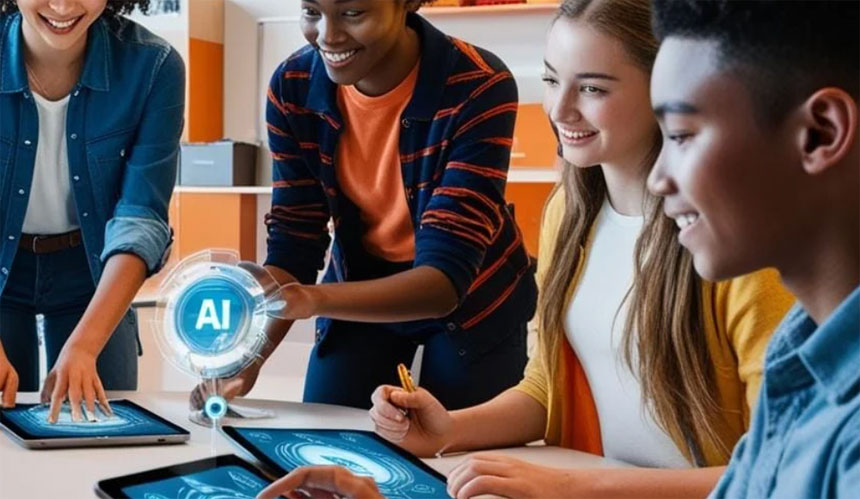
Learners are increasingly becoming instructional designers, identifying gaps in the learning experience and utilizing AI to address these gaps in pedagogical practices.
These instructional design gaps can be inadequate or inaccessible content, poor practice opportunities, deficient scaffolding, and missing emotional support, among others.
For example, one student said, “I use ChatGPT as a study guide to explain stuff that the course glosses over, which I then add to my notes. This helps me reinforce what I’m learning, and it’s been hella useful so far.”
Additionally, learners asking AI to “act as my professor and grade this draft” or “create a practice quiz, asking me each question one by one” reveal that instructional assessment and practice systems are failing to support learning.
Therefore, experts suggest that instructional designers should closely study how learners interact with AI and adapt their role accordingly, evolving from content creators to learning ecosystem architects.
OpenAI’s “Top 20 Chats for Finals” data reveal how learners worldwide actually engage with learning content.
In a May 2025 post, OpenAI disclosed how many learners are using AI to enhance their learning process.
These are some prompts:
Dr. Philippa Hadman, an expert and researcher on education, wrote,
“The most successful instructional designers of 2025 and beyond won’t be those who resist AI or those who blindly embrace it. The winners will be those who study what learner AI behaviour teaches us about effective learning design and who use those insights to create more responsive, human-centered learning ecosystems.”
“The future of instructional design is about learning from what learners create when they have access to responsive, personalized, and emotionally intelligent learning support.”
St. Joseph Public Schools are developing their own AI project called “AI Integration.”
Source: Youtube

Winning the AI race will depend on which country adopts AI software the fastest, says Business Software Alliance CEO Victoria Espinel.
Fuente: Youtube
This talk explores how our minds run on invisible algorithms patterns of thought and emotion shaped by past experiences and asks what might happen if artificial intelligence could help us see them clearly.
Source: Youtube
Meta continues its hiring push for its new Superintelligence unit and names Shengjia Zhao, who joined from OpenAI, as the group’s new chief scientist.
Source: Youtube

‘Turn on us’: Concerns raised over China’s AI push and ‘fully aware’ artificial intelligence.
Source: Youtube

AI approaches capture only one aspect of human intelligence – AI could have come up with Newton’s laws of motion and invented the steam locomotive BUT would not have been able to come up Archimedes law of displacement. AI is very capable and powerful BUT it is not General Intelligence
Source: Youtube
IBL News | New York
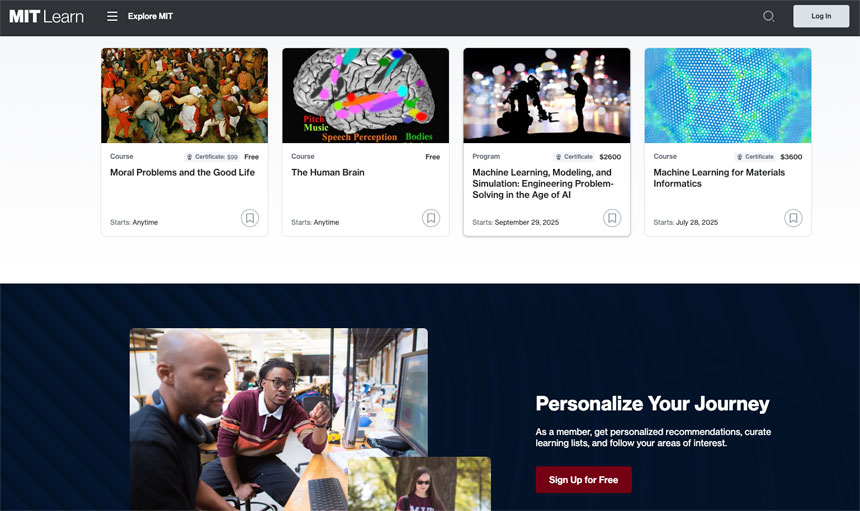
The Massachusetts Institute of Technology introduced this month MIT Learn, an AI-based platform featuring a personalized website with over 12,700 non-degree learning resources, most of which are available for free.
“MIT Learn marks the beginning of an ambitious project that aims to redefine how MIT distributes knowledge and connects with learners worldwide,” explained the institution.
Created by MIT Open Learning, this lifelong learning platform features introductory and advanced courses, upskilling and reskilling programs, and other resources, including videos, podcasts, “all for every stage of your learning journey,” according to the institution.
Open Learning’s product offerings comprise OpenCourseWare, MITx, and MicroMasters programs.
The AI-enabled assistant, called “AskTim”, helps learners find courses and resources aligned with their personal and professional goals. It also provides a summary of a course’s structure, topics, and expectations, enabling more informed decisions before enrollment.
This AI agent can answer users’ questions about lectures, create flashcards of key concepts, and provide instant summaries.
The tutor guides the learner through problem sets, leading them toward the next step without revealing the answers.
The platform features sophisticated search, browsing, and discovery capabilities, complemented by the “Ask Tim” bot.
However, the AI assistant has been introduced in a limited set of courses and modules as the MIT Open Learning team wants to gather insights and improve the learning experience before expanding more broadly.
For example, in signature courses such as Molecular Biology: DNA Replication and Repair, Genetics: The Fundamentals, and Cell Biology: Transport and Signaling, learners can interact with an AI assistant by asking questions about a lecture, requesting flashcards of key concepts, and obtaining instant summaries.
Dimitris Bertsimas, Vice Provost for Open Learning, explained, “MIT Learn elevates learning with personalized recommendations powered by AI, guiding each learner toward deeper understanding. It is a stepping stone toward a broader vision of making these opportunities even more accessible to global learners through one unified learning platform.”
“MIT Learn is a whole new front door to the Institute,” added Christopher Capozzola, Senior Associate Dean for Open Learning. “It transforms how people engage with what we offer digitally.”
Former Provost Cynthia Barnhart, who, under her direction, developed MIT Learn in cooperation with Sloan Executive Education and Professional Education, stated that this project is “the latest step in a long tradition of the Institute providing innovative ways for learners to access knowledge.” “This AI-enabled platform delivers on the Institute’s commitment to help people launch into learning journeys that can unlock life-changing opportunities.”
MIT became the first higher education institution to provide educational resources free of charge to anyone in the world in 2001. Today, 24 years later, the institution advances with MIT Learn, its “mission to disseminate knowledge globally.”