Hypercompetitive AI hiring: There’s not enough people to fill these jobs.
Source: Youtube
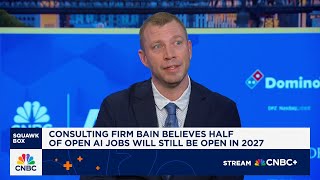
Hypercompetitive AI hiring: There’s not enough people to fill these jobs.
Source: Youtube

AI reasoning models were supposed to be the industry’s next leap, promising smarter systems able to tackle more complex problems.
Source: Youtube

IBL News | New York
Researchers at MIT presented a model called SEAL (Self-Adapting Language Models) that enables LLMs to learn to generate their own synthetic training data based on the input they receive and learn from their experiences. This AI model that never stops learning tries to mimic human intelligence.
Currently, the latest AI models can reason by performing more complex inference. By contrast, the MIT scheme generates new insights and then folds them into its own weights or parameters.
The system includes “a reinforcement learning signal that helps guide the model toward updates that improve its overall abilities and enable it to continue learning,” explained MIT at Wired.
The researchers tested their approach on small and medium-sized versions of two open-source models, Meta’s Llama and Alibaba’s Qwen. They say that the approach ought to work for much larger frontier models, too.
Researchers noted that SEAL is computationally intensive, and it isn’t yet clear how best to schedule new periods of learning.
“Still, for all its limitations, SEAL is an exciting new path for further AI research, and it may well be something that finds its way into future frontier AI models,” said these researchers at MIT.

Five years after the pandemic forced schools online, what’s the real future of distance education in a world shaped by AI, hybrid models, and evolving student needs?
Source: Youtube

How technology growth continues to demand more electricity, especially within the world of AI.
Source: Youtube

Reimagining workforce sustainability in the AI age.
Source: Youtube

Artificial intelligence (AI) and machine learning (ML) are versatile technologies that have drastically lowered the cost of data production and analysis, potentially accelerating global decarbonisation and addressing socioeconomic issues.
Source: Youtube

Halifax professor Ed McHugh says he’s seen a spike in students using AI to cheat.
Source: Youtube

Teachers are stretched thin, but artificial intelligence could help.
Source: Youtube

IBL News | New York
Paris-based lab Mistral announced its first family of AI reasoning models, called Magistral, fine-tuned for multi-step logic, improved interpretability, and a traceable thought process, unlike general-purpose models.
It follows the release of OpenAI’s o3 and Google’s Gemini 2.5 Pro.
Magistral works through problems requiring step-by-step deliberation and analysis for improved consistency and reliability. In this regard, it mimics human thinking through logic, insight, uncertainty, and discovery.
Magistral comes in two variants, both suited for a wide range of enterprise use cases, from structured calculations and programmatic logic to decision trees and rule-based systems.
• Magistral Small, a 24 billion parameter open-source version, available for download from the AI dev platform Hugging Face under the Apache 2.0 license.
• Magistral Medium, a more powerful, enterprise-grade version, is in preview on Mistral’s Le Chat chatbot platform and the company’s API, as well as third-party partner clouds.
Purpose-built for transparent reasoning.
The release of Magistral follows the debut of Mistral’s “vibe coding” client, Mistral Code.
Founded in 2023, Mistral builds AI-powered services, including Le Chat and mobile apps. It’s backed by venture investors like General Catalyst. It has raised over $1.24 billion to date.