Apple is negotiating with major media and publishing organizations seeking permission to use their news articles to train their generative AI systems, The New York Times reported.
The news organizations contacted by Apple include Condé Nast, publisher of Vogue and The New Yorker; NBC News; and IAC, which owns People, The Daily Beast, and Better Homes and Gardens.
Apple has floated multiyear deals worth at least $50 million to license this material. Apple declined to elaborate.
AI companies have been accused of taking written material from across the internet without the permission of the artists, writers, and coders who created it, leading to several copyright lawsuits.
In a statement, an OpenAI spokesman said to The New York Times that the company respects “the rights of content creators and owners and believes they should benefit from A.I. technology,” citing its recent deals with the American Journalism Project and the German publisher Axel Springer.
.
Coursera released this month its third annual Job Skills Report, identifying the year’s fastest-growing competencies.
It highlights that leadership, AI, and cybersecurity are the skill areas that have witnessed the most remarkable surge in the Coursera platform.
The report is based on insights from five million enterprise learners affiliated with 3,000 businesses, 3,600 higher education institutions, and governments in over 100 countries.
Many of Coursera’s fastest-growing skills align with WEF’s fastest-growing global jobs, including AI and machine learning specialists, business intelligence specialists, information security analysts, and data analysts. Fastest growing skills for 2024 were:
The Job Skills Report of 2024 identifies eight trends:
#1: All leadership skills for supporting teams are a growing priority, particularly those on empathy, strategic leadership, and employee development. Managers are encouraged to increase their focus on leading teams with empathy, team building, and team management.
#2: AI-related skills drove record-breaking course enrollment. Coursera’s 800 AI-related courses attracted 6.8 million total enrollments this year. The course Generative AI for Everyone from DeepLearning.AI was the fastest-growing course in 2023.
Over 450,000+ learners are enrolled in AI-translated content.
The other top genAI courses published on Coursera in 2023 were:
#3: The demand is surging for cybersecurity and information security skills. There’s an estimated shortfall of nearly 3.5 million cybersecurity workers.
#4: The fastest-growing skills are business skills, particularly in digital marketing and customer experience.
#5: Data visualizations and overall skills to read, understand, analyze, work with, and communicate with data continue to be among the fastest growing. Data literacy and storytelling to achieve organizational goals are in huge market demand.
#6: Web development and cloud computing skills remain high. Investments in these skills can help meet ongoing skill shortages and the need for technical employees to stay current with emerging technologies.
#7: Audit, copyright, and data skills for providing oversight and compliance are increasingly essential, particularly among learners affiliated with government programs.
#8: Curated learning paths, like Professional Certifications and Specializations, are driving the largest skill rank changes. These curated learning paths can improve business productivity, boost student employability, and improve internal mobility.
The most popular courses in Coursera in 2023 were:
2U, owner of edX.org, is running out of cash and is facing an existential change in 2024, wrote educational analyst Phil Hill in a report issued after the company’s long-time CEO and Co-Founder, Christopher “Chip” Paucek, stepped down and was replaced by the existing CFO, Paul Lalljie [in the picture].
“There is no apparent way for 2U to meet its debt obligations by 2025,” Phil Hill stated.
“The company will likely survive, but it will undergo some significant changes from bankruptcy, from selling off assets, from additional layoffs, or more likely from some combination.”
2U market capitalization was $107 million yesterday. In the last year, the company lost 79.32% of its stock value. Debt holders now control $980 million.
“Bankruptcy is increasingly likely. 2U could pursue a structured bankruptcy in 2024 to alleviate its debt obligations while continuing to operate the company. Keep in mind that we have seen EdTech companies successfully manage bankruptcy, such as Cengage from 2013 / 14. There are signs that the markets already understand 2U’s situation.”
The probability of bankruptcy is over 58%, according to an analysis mentioned by Phill Hill.
• “The basic issue at hand is that 2U holds nearly $1 billion of debt with a significant portion ($380 million minimum) that must be paid off in early 2025, and the company does not have the cash or ability to generate profits to be able to cover the debt maturity.”
• “2U had roughly $41 million in cash & equivalents as of September 30th, and it generated roughly $32 million in cash (adjusted unlevered free cash flow) in the past 12 months – that level of operations is not going to work.”
• “2U’s ‘portfolio management’ efforts to ‘transition out of certain degree programs’ are also intended to generate short-term cash, mostly to deal with the debt problem. But the combination of cash and likely cash flow (augmented by portfolio management) is in the neighborhood of $150 million, not nearly enough to handle the debt obligations. This means that the only way 2U survives is if it can renegotiate or refinance the debt.”
.
A massive public dataset named ‘LAION-5B’ that served as training data for popular AI image generators such as Stable Diffusion was found to contain thousands of instances of child sexual abuse material (CSAM), stated a study published yesterday by Stanford Internet Observatory (SIO), a watchdog group based at the Californian university.
This organization urged companies to take action to address a harmful flaw in the technology they build. Removal of the identified source material was currently in progress.
The report found more than 3,200 images of suspected child sexual abuse in the giant AI database LAION, an index of online images and captions that’s been used to train leading AI image-makers,
The Stanford Internet Observatory (SIO) worked with the Canadian Centre for Child Protection and other anti-abuse charities to identify the illegal material and report the original photo links to law enforcement.
These entities examined the LAION-5B dataset using a combination of PhotoDNA perceptual hash matching, cryptographic hash matching, k-nearest neighbors queries, and ML classifiers.
“This methodology detected many hundreds of instances of known CSAM in the training set, as well as many new candidates that were subsequently verified by outside parties. We also provide recommendations for mitigating this issue for those that need to maintain copies of this training set, building future training sets, altering existing models, and the hosting of models trained on LAION-5B.”
LAION-5B doesn’t include the images themselves and is instead a collection of metadata including a hash of the image identifier, a description, language data, whether it may be unsafe, and a URL pointing to the image. A number of the CSAM photos found linked in LAION-5B were hosted on websites like Reddit, Twitter, Blogspot, and WordPress, as well as adult websites like XHamster and XVideos.
The German non-profit LAIONsaid that “it has a zero-tolerance policy for illegal content,” and announced that their public datasets would be temporarily taken down, to return back after update filtering in the second half of January.
.
Over 3,200 private venture-backed U.S. companies, which raised $27.2 billion, have gone out of business this year, according to The New York Times.
Moreover, investors fear that the failure and collapse of once-promising tech start-ups will increase in the coming months.
VC firms are deciding which young companies are worth saving and urging others to shut down or sell.
Many companies are being forced to shut down before they run out of cash, returning what remains to investors. Others are stuck in “zombie” mode — surviving but unable to grow.
In the last six weeks, high-profile companies have filed for bankruptcy or shut down.
Among them is WeWork, which raised over $11 billion, the health care firm Olive AI ($852 million raised), the freight start-up Convoy ($900 million raised), and home construction start-up Veev ($647 million).
In August, Hopin, a start-up that raised more than $1.6 billion and was once valued at $7.6 billion, sold its main business for just $15 million.
Last month, Zeus Living, a real estate start-up that raised $150 million, said it was shutting down. Plastiq, a financial technology start-up that raised $226 million, went bankrupt in May. In September, Bird, a scooter company that raised $776 million, was delisted from the New York Stock Exchange because of its low stock price.
From 2012 to 2022, investment in private U.S. start-ups ballooned to $344 billion. The flood of money was driven by low-interest rates and successes in social media and mobile apps.
.
Nvidia invested in 35 AI start-ups in 2023, almost six times more than last year, according to estimates by Dealroom. It both leads rounds itself and invests alongside VC firms.
These investments made Nvidia the most active large-scale investor in AI, outstripping iconic VCs in Silicon Valley, such as Andreessen Horowitz and Sequoia.
All of the invested companies are Nvidia customers, whether using its GPU chips or its software.
The company’s portfolio includes Inflection AI, Cohere, Hugging Face, CoreWeave, and Mistral.
“NVentures looks to generate healthy returns from its investments, while its corporate development team could invest for more strategic purposes,” Mohamed Siddeek said.
.
Training a custom model from scratch using OpenAI’s GPT-4 may take several months, with pricing starting at $2 to $3 million, according to the company.
This high price sparked a discussion among practitioners on Twitter, now known as X. Many users agreed that a much smaller pre-trained base model with fine-tuning on top of it would cost ten times less.
OpenAI justifies the price by stating:
“The Custom Models program gives selected organizations an opportunity to work with a dedicated group of OpenAI researchers to train custom GPT-4 models to their specific domain.”
“This includes modifying every step of the model training process, from doing additional domain-specific pre-training to running a custom RL post-training process tailored for the specific domain.”
“Organizations will have exclusive access to their custom models. This program is particularly applicable to domains with extremely large proprietary datasets—billions of tokens at minimum.”
On the other hand, OpenAI announced Data Partnerships, an initiative intended to work with organizations to produce public and private datasets for training AI models as a way to combat models that contain toxic language and biases.
To work with data and PDFs in those large-scale datasets, OpenAI says that it uses world-class OCR technology and automatic speech recognition (ASR) to transcribe spoken words.
.
It takes $2-$3M to train a custom model from scratch using OpenAI!!
You rarely, if ever, need to go this route. Yes, even if you are a rich F500 who has money to burn 🤣
Instead, you take a much smaller pre-trained base model and fine-tune on top of it.
I want to bring your attention to the fact that Microsoft defacto owns OpenAI now, and either you break out of that control structure entirely, or you become Corporate Vice President of Microsoft AI in 2…
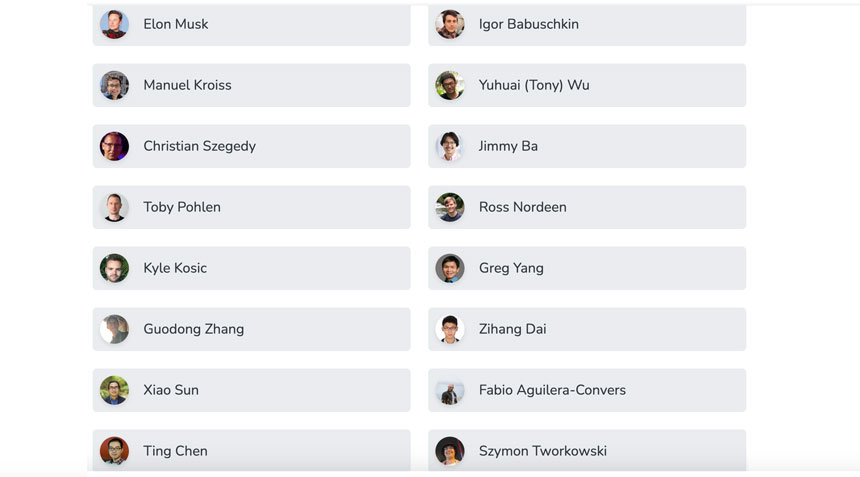
X.AI, the AI start-up launched by Elon Musk in July, filed with the SEC to raise up to $1 billion in an equity offering.
The company, which released a chatbot called Grok, already brought in $135 million from investors.
“Grok is designed to answer questions with a bit of wit and has a rebellious streak, so please don’t use it if you hate humor!”X.AI wrote on its website, adding, “It will also answer spicy questions that are rejected by most other AI systems.”
Grok, X.AI has real-time knowledge of the internet, including access to all of X, giving it a leg up on all other chatbots.
It aims to compete directly with ChatGPT, Bard, and Claude. However, Musk said that Grok has been designed to be anti-woke and lacks the political correctness built into other chatbots.
Grok started rolling out to X Premium Plus users this month at $16 a month, per month.
“We are a separate company from X Corp, but will work closely with X (Twitter), Tesla, and other companies to make progress towards our mission,” X.AI says on its website.
People working on X.AI include alumni of DeepMind, OpenAI, Google Research, Microsoft Research, Twitter, and Tesla.
.
Mistral AI, the 22-people French start-up founded seven months ago by researchers from Google and Meta, raised $415 million (or 385 million euros) at a valuation of $2 billion.
Investors include the Silicon Valley venture capital firms Andreessen Horowitz and Lightspeed Venture Partners.
Also, this month, Mistral opened beta access to its platform services so people can build their own chatbots.
The start-up also released Mixtral 8x7B, a high-quality sparse mixture of expert model (SMoE) with open weights, handling a context of 32k tokens, and licensed under Apache 2.0.
It handles English, French, Italian, German and Spanish and shows strong performance in code generation.
“Mixtral — pre-trained on data extracted from the open Web — outperforms Llama 2 70B on most benchmarks with 6x faster inference. It is the strongest open-weight model with a permissive license and the best model overall regarding cost/performance trade-offs. In particular, it matches or outperforms GPT3.5 on most standard benchmarks.”
Rivals like OpenAI and Google said that Mistral, which releases its technology as open-source software, can be dangerous, arguing that the raw technology could be used to spread disinformation and harmful material.
The Mistral platform serves three endpoints: Mistral-tiny, which serves Mistral 7B Instruct v0.2; Mistral-small (Mixtral 8x7B); and Mistral-medium.
The French Finance Minister pointed to Mistral as providing the European continent a chance to challenge U.S. tech giants.
In the sphere of open-source, the American company Meta has been at the forefront. This year, it released an LLM called LLaMA.
.
Google vs. Mistral: a tale of two AI launches and a case study in knowing your audience
Google announced their new model two days ago. It was named Gemini, and it wafted in with a blog post, brand guidelines, a press tour, and a polished sizzle reel that later turned out to be… pic.twitter.com/5v5EzOTDbB
Google announced yesterday that it was making its new AI model, Gemini Pro, available to developers and enterprises. It has been released via the Gemini API, and it’s free for now. SDKs are also available for Gemini Pro to help to build apps.
Last week, Google started to roll out Gemini, which comes in three sizes: Ultra, Pro, and Nano.
“The faster way to build with Gemini is with Google AI Studio, a free, web-based developer tool that enables you users to develop prompts and then get an API key to use in their app development,” said the company.
Google intends that users migrate from AI Studio to Vertex AI. Early next year, the company plans to launch Gemini Ultra, its largest and most capable model for complex tasks.
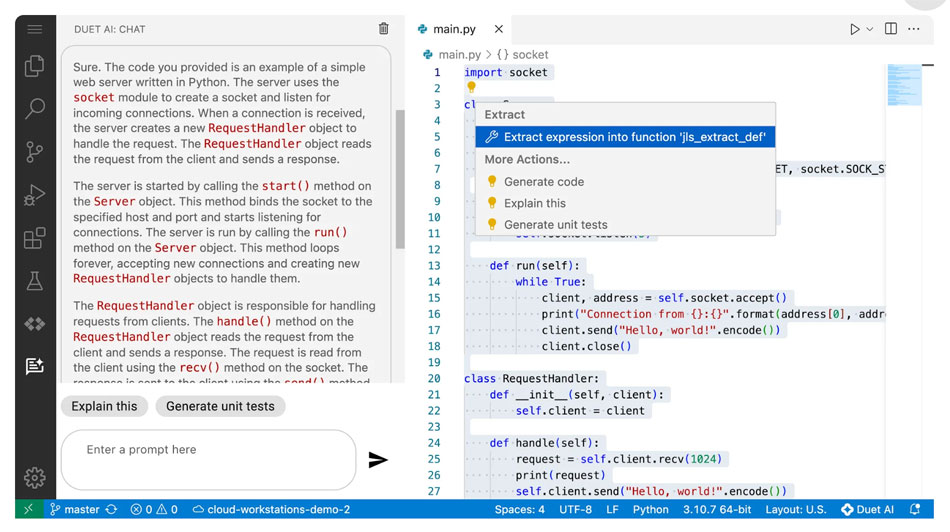
Yesterday, Google announced that Duet AI for Developers will be launched in Q1 of 2024. It will compete with GitHub GPT-based Copilot.
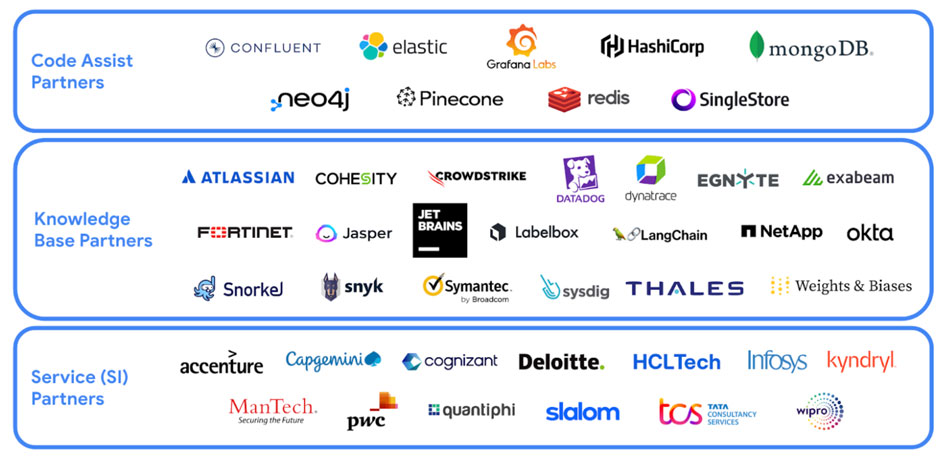
Google’s partners adding support for coding with Duet AI for Developers include Confluent, Elastic, Grafana Labs, Hashicopr, MongoDB, Neo4j, Pinecone, Redis, and SingleStore.
In addition, Google Cloud’s image-generation capabilities have been upgraded with Imagen 2. This feature is now generally available for Vertex AI customers on the allowlist.
.