AI candidate tests boundaries of Colombian election law.
Source: Youtube

AI candidate tests boundaries of Colombian election law.
Source: Youtube

Trump promises to release documents about “extraterrestrial life”.
Source: Youtube

Oil reaches its highest in six months amid tensions between the US and Iran.
Source: Youtube

As AI reshapes how we learn, solve problems, and express ideas, its influence on human creativity has never been more profound—or more paradoxical.
Source: Youtube
IBL News | New York
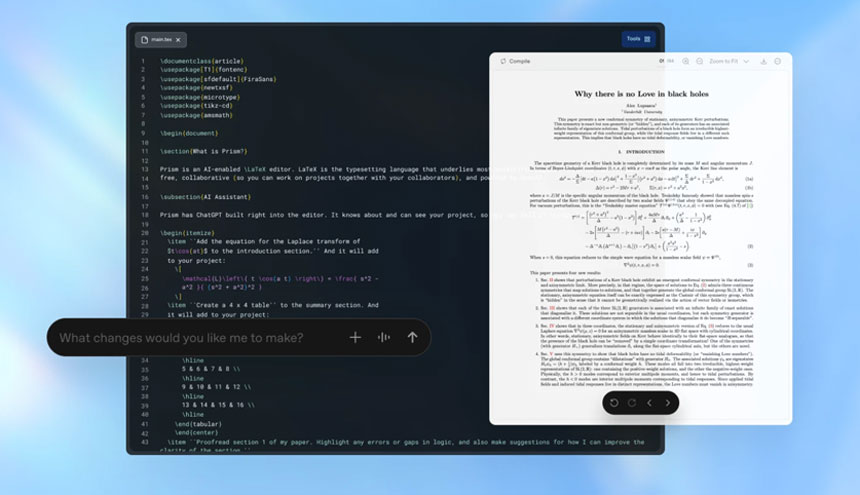
OpenAI introduced last month ‘Prism’, a free, cloud-based workspace for scientists to write and collaborate on research, with the model GPT‑5.2 for mathematical and scientific reasoning integrated directly into the workflow.
Built for collaboration at scale, Prism includes unlimited projects and collaborators: co-authors, students, advisors, and reviewers, often across institutions and geographies, as it is. It is available today to anyone with a ChatGPT personal account. There are no subscriptions or seat limits.
More powerful AI features will be made available through paid ChatGPT plans over time.
The company believes that while AI will play a meaningful role in how science advances, much of the everyday work of research, such as drafting papers, revising arguments, managing equations and citations, and coordinating with collaborators, remains fragmented across disconnected tools.
Researchers often move between editors, PDFs, LaTeX compilers, reference managers, and separate chat interfaces, losing context and interrupting focus.
“Prism is our first step toward addressing this fragmentation,” said OpenAI. “Advanced reasoning systems like GPT‑5 are helping push the frontiers of mathematics, accelerating the analysis of human immune-cell experiments, and speeding up experimental iteration in molecular biology.”
Prism brings drafting, revision, collaboration, and publication preparation into a single, cloud-based, LaTeX-native workspace.
Specifically, researchers can:
Rather than operating as a separate tool alongside the writing process, GPT‑5.2 works within the project itself, with access to the paper’s structure, equations, references, and surrounding context.
Prism builds on the foundation of Crixet, a cloud-based LaTeX platform that OpenAI acquired and has since evolved into Prism as a unified product.
This allowed the company to start with a strong base in a mature writing and collaboration environment and to integrate AI in a way that fits naturally into scientific workflows.
“By making high-quality scientific tools easier to adopt and broadly available, we hope to enable more researchers—across institutions, disciplines, and career stages—to participate fully in the scientific process,” said OpenAI.
“In 2025, AI changed software development forever. In 2026, we expect a comparable shift in science. Prism is an early step toward that future.”
• Prism access at prism.openai.com.

Fears about artificial intelligence shake the stock markets.
Source: Youtube

The UK police arrest former Prince Andrew for alleged misconduct.
Source: Youtube

Speaking at the India AI Impact Summit 2026 in New Delhi, Anthropic CEO Dario Amodei highlighted the rapid evolution of artificial intelligence, stating that ‘there are only a small number of years for AI models surpassing the cognitive capabilities of most humans for most things.’
Source: Youtube

After decades working in technology across both the US and China, Alvin W. Graylin sees three possible paths for the future of AI: one where tech giants create a class of trillionaires, one where competition escalates into war or one where humanity builds and shares this technology for the common good.
Source: Youtube