During its annual event for developers, and following an extension of its partnership with OpenAI, Microsoft’s CEO, Satya Nadella [in the picture above], announced this week new AI developments on its products, including an AI-powered Bing in Windows 11 and Skype, and Copilots in Dynamics 365, Microsoft 365, and Power Platform.
The software giant also unveiled that it’s adopting the same plugin standard that OpenAI introduced for ChatGPT — such as OpenTable, Expedia, Instacart, Kayak, Atlassian, Adobe, ServiceNow, Thomson Reuters, and Zillow — enabling interoperability across ChatGPT and Microsoft’s 365, Teams, and other copilot offerings.
In addition, ChatGPT Plus will have Bing — which includes citations — as the default search.
During the Microsoft Build conference, the company also introduced Azure Machine Learning prompt flow — for developers to construct prompts — and Microsoft Fabric for analytics.
Microsoft Fabricincludes data engineering, data integration, data warehousing, data science, real-time analytics, applied observability, and business intelligence, all connected to a single data repository called OneLake.
It comes with a Copilot, allowing users to create dataflows and data pipelines, generate code and entire functions, build machine learning models, or visualize results.
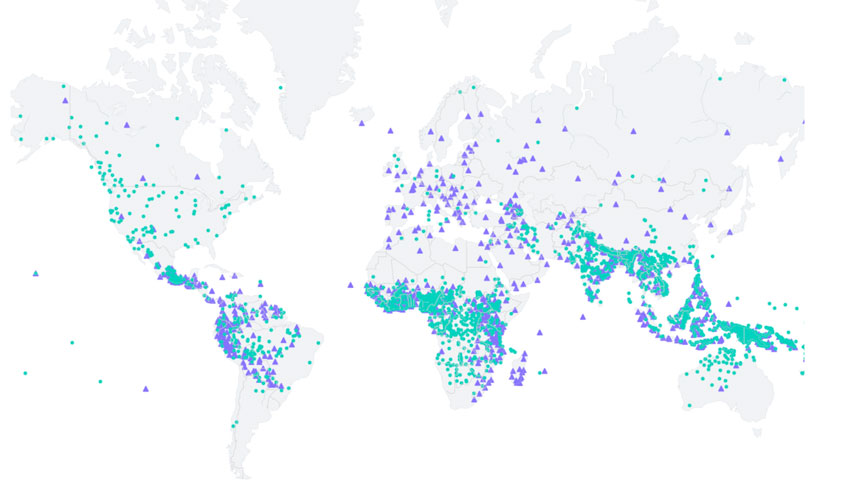
Meta released this week as open-source software an AI model called Massively Multilingual Speech (MMS) that can recognize over 4,000 spoken languages and produces text-to-speech in over 1,100 languages.
Today, existing speech recognition models only cover approximately 100 languages — a fraction of the 7,000+ known languages spoken on the planet.
Machines with the ability to recognize and produce speech can make information accessible to many more people, including those who rely entirely on voice to access information.
Speech recognition and text-to-speech models typically require training on thousands of hours of audio with accompanying transcription labels.
“Through this work, we hope to make a small contribution to preserve the incredible language diversity of the world,” said Meta.
Meta combined wav2vec 2.0, its self-supervised learning, and a new dataset that provides labeled data for over 1,100 languages and unlabeled data for nearly 4,000 languages.
To collect audio data for thousands of languages, Meta turned to religious texts, such as the Bible, that have been translated into many different languages and whose translations have been widely studied for text-based language translation research.
These translations have publicly available audio recordings of people reading these texts in different languages. As part of this project, Meta created a dataset of readings of the New Testament in over 1,100 languages, which provided, on average, 32 hours of data per language.
By considering unlabeled recordings of various other Christian religious readings, Meta increased the number of languages available to over 4,000.
“We also envision a future where a single model can solve several speech tasks for all languages. While we trained separate models for speech recognition, speech synthesis, and language identification, we believe that in the future, a single model will be able to accomplish all these tasks and more, leading to better overall performance,” Meta said.
OpenAI Founder Sam Altman [in the picture], President Greg Brockman, and Chief Scientist Ilya Sutskever proposed an international regulatory body for the governance of superintelligence—future AI systems.
“It would be unintuitively risky and difficult to stop the creation of superintelligence,” they said in a blog post on their website.
This agency — “something like an IAEA for superintelligence efforts” — would inspect systems, require audits, test for compliance with safety standards, place restrictions on degrees of deployment and levels of security, and track compute and energy usage.
“Within the next ten years, AI systems will exceed expert skill level in most domains, and carry out as much productive activity as one of today’s largest corporations,”they explained.
“Major governments around the world could set up a project that many current efforts become part of, or we could collectively agree that the rate of growth in AI capability at the frontier is limited to a certain rate per year.”
Meta, which owns Facebook, WhatsApp, and Instagram, was hit yesterday with a fine of $1.3 billion (€1.2 billion) by the European Union’s privacy regulator — in this case, Ireland’s Data Protection Commissioner (DPC) — over the transfer of personal data of Facebook users to servers in the United States.
In 2021, Amazon was fined 746 million euros for violating EU privacy laws.
The European Data Protection Board announced the fine in a statement Monday, saying it followed an inquiry into Facebook by the Irish Data Protection Commission, the chief regulator overseeing Meta’s operations in Europe.
This Commission said that the processing and storage of personal data in the United States contravened Europe’s signature data privacy law, known as the General Data Protection Regulation (GDPR).
The fine is the largest ever levied under GDPR.
“Facebook has millions of users in Europe, so the volume of personal data transferred is massive. The unprecedented fine is a strong signal to organizations that serious infringements have far-reaching consequences,” said Andrea Jelinek, chair of the European Data Protection Board.
Meta has also been ordered to cease the processing of personal data of European users in the United States within six months.
Meta said it would appeal the ruling, including the fine. There would be no immediate disruption to Facebook in Europe, it added.
The company said the root of the issue stemmed from a “conflict of law” between US rules on access to data and the privacy rights of Europeans.
“This decision is flawed, unjustified and sets a dangerous precedent for the countless other companies transferring data between the EU and US,” said Meta.
The move highlights ongoing uncertainty about how global businesses may legally transfer EU users’ data to servers overseas.
Dublin is home to the European headquarters of Apple, Meta [Its Ireland’s headquarters in the picture above], Twitter, and Google, which have created thousands of jobs in the country and boosted its economic growth. Ireland’s low corporate tax rate of 12.5% has been a major factor in luring these firms.
The ambitions of the e-commerce giant have surfaced in recent job postings. One listing stated that Amazon is “reimagining search with an interactive conversational experience,” aiming to assist users in finding answers to questions, comparing products, and receiving personalized suggestions.
The company stated, “This will be a once-in-a-generation transformation for Search.” It will be a “new AI-first initiative to re-architect and reinvent the way we do search through the use of extremely large-scale next-generation deep learning techniques.”
According to some surveys, over half of US shoppers start their product searches on Amazon.com, which is a higher share than Google.
During an earnings call last month, Amazon’s Chief Executive Officer, Andy Jassy, mentioned that generative AI technology “presents a remarkable opportunity to transform virtually every customer experience.”
AI search startup, San Francisco–based Perplexity.ai, which was launched in December 2022 and reached two million monthly active users in four months, announced it raised $25.6 million in series A.
The funding round was led by Peter Sonsini of New Enterprise Associates (Board member, Databricks) with participation from seed round investors Elad Gil (Founder, Color Health), Nat Friedman (Former CEO of GitHub), Jeff Dean (SVP, Google AI) and Bob Muglia (Former President of Microsoft), as well as new investors Susan Wojcicki (Former CEO of Youtube), Paul Buchheit (Creator of Gmail), Soleio (Designer of Messenger, Dropbox), and Databricks Ventures.
Analysts saw remarkable the presence of six current and former AI researchers at Google.
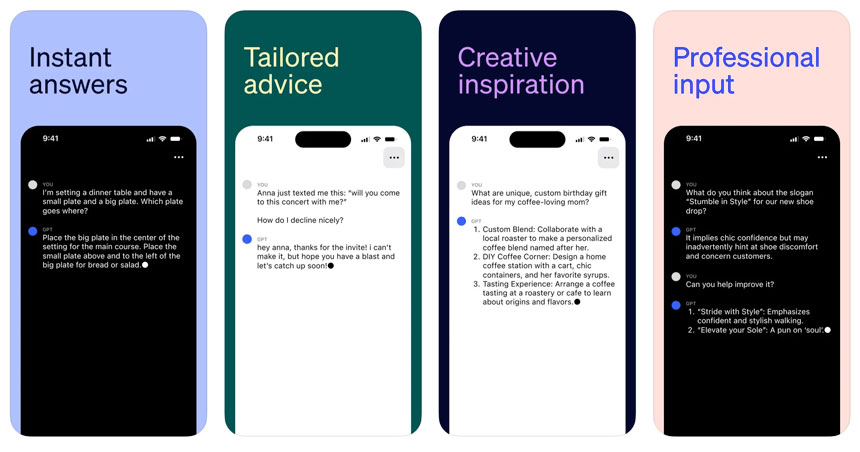
On its search results, the Perplexity platform offers up a new model by providing citations to every answer and allowing attribution for sources of information for verification. Recently, it released an iPhone iOS app with instant answers, cited sources, voice search, follow-up questions, and thread history.
Since its launch, Perplexity has been releasing new features to users every week.
The funding in Perplexity is one of the latest deals in the booming AI industry. Character.AI, also founded by former Googlers, recently raised $150 million. Adept, another AI startup, announced it had raised $350 million from investors including Spark Capital and General Catalyst.
Announcing Perplexity AI’s iPhone app and series A funding! Perplexity provides instant answers and cited sources on any topic, now available on iPhone. With follow-up questions, voice search, and thread history, learn and explore faster than ever before.📱https://t.co/qvWT8Zrcekpic.twitter.com/ZsVupfpK1K
The next iteration of Perplexity has arrived: Copilot, your interactive AI search companion. 🚀🤖 Perplexity Copilot guides your search experience with interactive inputs, leading you to a rich, personalized answer, powered by GPT-4. Try it for free at https://t.co/ut3wdOwUEdpic.twitter.com/AGrgBELOAE
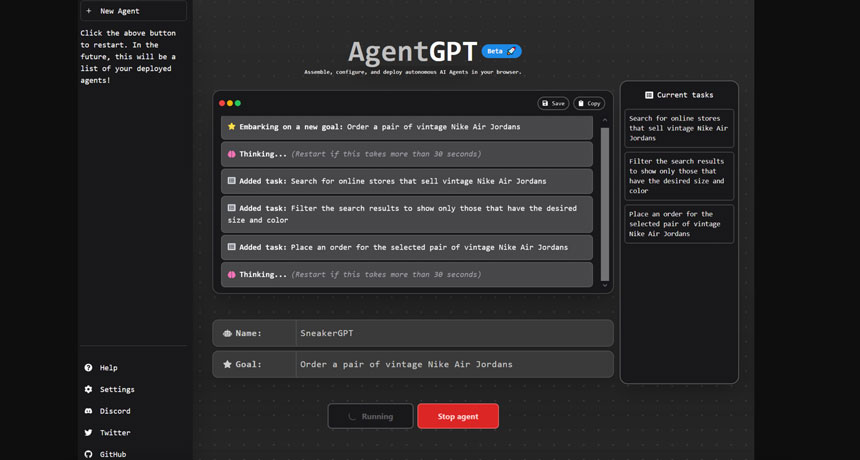
AI agents like Auto-GPT, AgentGPT, BabyAGI, and GodMore are the latest trend in the Large Language Models (LLMs) area, using OpenAI’s ChatGPT architecture to automate tasks.
While ChatGPT requires a prompt for every new step, AI agents can take an overarching goal such as “grow my educational software business” and perform various tasks such as developing a sales strategy, identifying target clients, writing a video or podcast script, or building a website.
However, these AI agents are still in development and may not always produce accurate or reliable results.
Auto-GPT Created by game developer Toran Bruce Richards, Auto-GPT is currently an open-source on GitHub, that requires to install a development environment like Docker, or VS Code with a Dev Container extension. Also, a paid API key from OpenAI is needed.
BabyAGI.
It’s also available in a repository on GitHub. To use it, OpenAI or Pinecone API key and Docker software is required.
AgentGPT and GodMore.
They are user-friendly applications for non developers.
Probably nothing 🤯
🤖 An AI agent that autonomously does sales prospecting on its own with GPT-4.
The European Union amended AI Act on May 11th, 2023. If passed and enacted, it would ban U.S. companies such as OpenAI, Amazon, Google, and IBM from providing API access to generative AI models. This amended act would also sanction American open-source developers and software distributors, such as GitHub if unlicensed generative models became available in Europe.
This means that any model that is made available in the European Union without first passing extensive and expensive licensing would be subject to massive fines of €20 million or 4% of worldwide revenue.
Essentially, the European Union is threatening to sanction an important part of the American tech ecosystem by ordering large tech companies to put small businesses out of business.
The AI Act has extraterritorial jurisdiction. If enacted, enforcement would be out of the hands of EU member states. A European government could be compelled by third parties to seek conflict with American developers and businesses.
Open-source developers, including open-source LLMs, would have to register their “high-risk” AI project or foundational model with the government and expensive risk testing would be required. Registration will also require disclosure of data sources used, computing resources (including time spent training), performance benchmarks, and red teaming.
APIs — meaning, third parties implementing an AI model without running it on their own hardware — would be essentially banned. That would include implementation examples like AutoGPT and LangChain.
However, European small businesses are exempt from undergoing a stringent permitting review project before launch.
Third parties would have the ability to file lawsuits to force a national AI regulator to impose fines.
American experts said that “this is a deeply corrupt piece of legislation; the most likely effect of such a policy is to create a society where the elite have access to R&D models, and nobody else – including small entrepreneurs.”
OpenAI’s Founder and CEO, Sam Altman, testified before Congress for the first time on Tuesday, calling on U.S. lawmakers to regulate fast-advancing AI technology.
During his hearing before the U.S. Senate subcommittee on privacy, technology and the law on Tuesday, he welcomed regulation, including independent audits, a licensing regime and system of warnings similar to nutritional labels on food.
When asked by senators about AI’s ability to predict and influence public opinion in relation to the upcoming election, Altman [in the picture above] outlined his fears over the potential for misuse of AI spreading “interactive disinformation.”
“These models are getting better in their ability to manipulate, persuade, provide sort of one-on-one interactive disinformation, and this is a significant area of concern,” he said.
The hearing comes as regulators and governments around the world step up their examination of the technology, amid growing concerns about its potential abuses and crimes performed by bad actors.
EU lawmakers last week agreed on a tough set of rules over the use of AI, including restrictions on chatbots such as ChatGPT.
Earlier this month, the U.S. Federal Trade Commission (FTC) and the UK competition watchdog fired warning shots at the industry.
The FTC said it was “focusing intensely on how companies may choose to use AI technology”, while the UK’s Competition and Markets Authority plans to launch a review of the AI market.
The US Congress is also looking into how to craft regulations to govern the technology, and plans to speak to more sources from the industry in the coming months.
“If this technology goes wrong, it can go quite wrong. And we want to be vocal about that. We want to work with the government to prevent that from happening,” Altman said.
Christina Montgomery, vice-president and chief privacy and trust officer at IBM, and Gary Marcus, a professor emeritus at New York University, also testified at the hearing.
More specifically on how the Federal Government should regulate companies like his, the CEO of OpenAI — the startup behind ChatGPT — laid out a three-point plan:
Form a new government agency charged with licensing large AI models, and empower it to revoke that license for companies whose models don’t comply with government standards.
Create a set of safety standards for AI models, including evaluations of their dangerous capabilities. For instance, models would have to pass certain tests for safety, such as whether they could “self-replicate” and “exfiltrate into the wild” — that is, to go rogue and start acting on their own.
Require independent audits, by independent experts, of the models’ performance on various metrics.
Notably absent from Altman’s proposals: requiring AI models to offer transparency into their training data, as the expert witness Gary Marcus called for, or prohibiting them from being trained on artists’ copyrighted works.
![Microsoft Adds New Tools, Copilots, and Plugins Into Its Products [Video]](https://cms.iblnews.org/wp-content/uploads/2023/05/microsoftceo.jpg)



![Sam Altman Called on U.S. Congress to Regulate Generative AI Technology [Video]](https://cms.iblnews.org/wp-content/uploads/2023/05/openaiceo.jpg)