Nearly half of students prefer a hybrid class format, while 54% of faculty favor a fully in-person environment. This poses a challenge for institutions to align the two groups’ differing preferences.
This is the main conclusion of Barnes & Noble College Insights’ annual College 2030 research report, which highlights the idea that students and institutions are now on the path to preparing for a post-pandemic future.
“The world has adapted and developed solutions to conquer COVID-19, and higher education must do the same, revising offerings and solutions to best accommodate emerging student needs,” says the report.
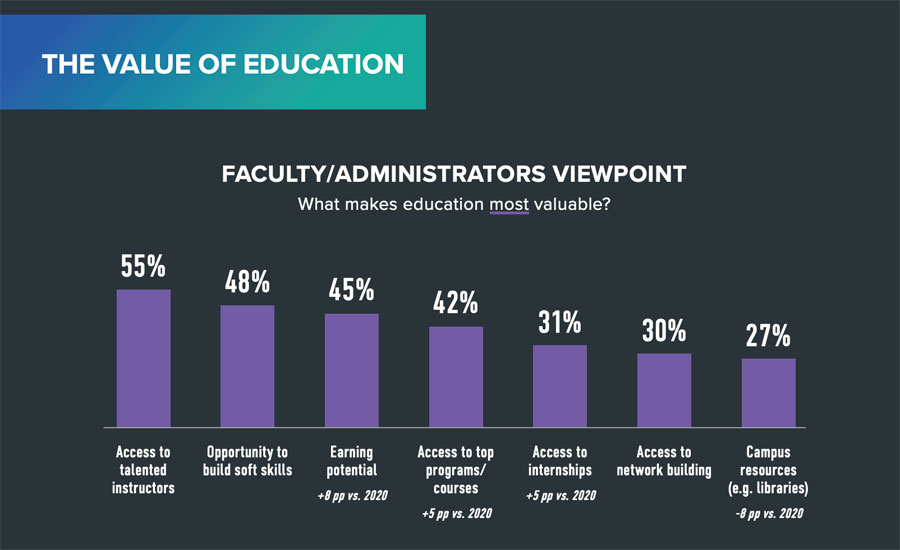
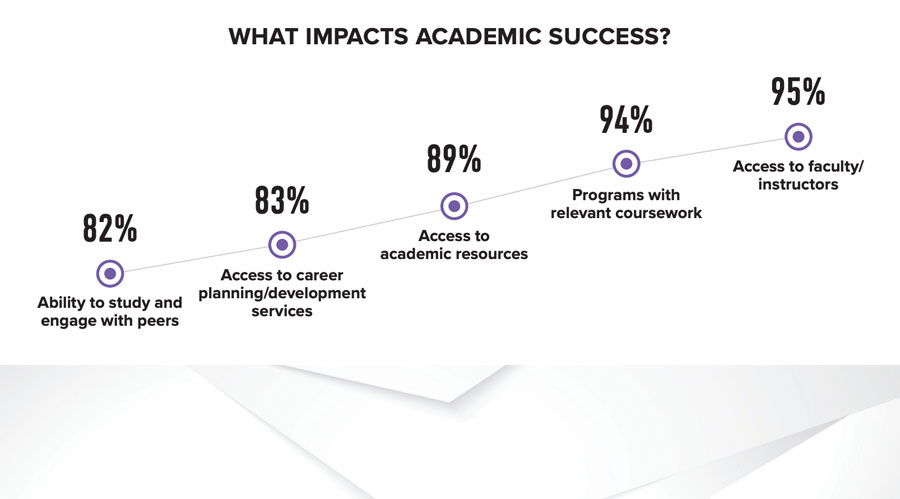
The report suggests that enhancing the value of higher education can be achieved by offering more tangible career prep programs and developing soft skills.
“While students felt their courses are preparing them for years beyond college, they still want more career preparation support – such as building out the educational experience with soft skills development and tangible resources around networking, resumes, job searching, and mentorship.”
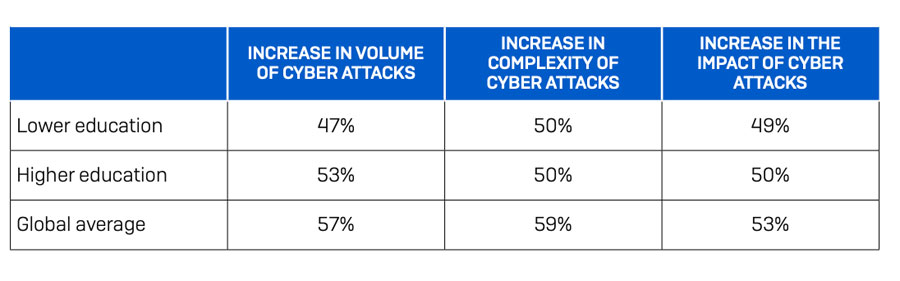
A 64% of higher education organizations were hit by ransomware in 2021, in a jump of 44% from the previous year, according to a report from Sophos, a global cybersecurity leading firm.
For issuing this report report, titled “the State of Ransomware in Education 2022”, the company surveyed 5,600 IT professionals in 31 countries, including 730 respondents from the education sector during January and February 2022.
Sophos concluded that “the education sector is poorly prepared to defend against a ransomware attack, and likely lacks the layered defenses needed to prevent encryption if an adversary does succeed in penetrating the organization.”
The increased numbers of successful ransomware attacks are part of a broader threat environment that has affected organizations across all sectors.
Around 50% of educational organizations reported that they paid the ransom to restore data, compared with the global average of 46%.
While paying the ransom almost always gets you some data back, the percentage of data restored after paying has dropped over the last year. On average, in 2021 lower education organizations that paid the ransom got back 62% of their encrypted data and higher education organizations got back 61% of their encrypted data. This is in line with the global average of 61%.
“The key takeaway here is that paying the ransom will only restore a part of your encrypted data and you cannot count on the ransom payment to get you all your data back,” said Sophos.
The Dartmouth Board of Trustees elected Sian Leah Beilock, a leading cognitive scientist and current president of Barnard College, as the institution’s 19th President last week.
Beilock’s election by the board of trustees followed a global search by an 18-member committee drawn from Dartmouth faculty, staff, students, alumni, and trustees after President Hanlon announced in January that he would step down on June 30, 2023.
Sian Leah Beilock, 46, will be the first woman to lead Dartmouth College in the institution’s more the 250-year history. She will succeed Philip J. Hanlon ’77, who will step down at the end of the coming academic year after a decade in the role.
Sian Leah Beilock will assume office on July 1, 2023.
“Sian is a leader with the aspirational vision to build our research enterprise, further our tradition of excellence in undergraduate education, and expand our global impact; she embraces the teacher-scholar model and brings experience from a world-class R1 institution as well as a distinctive liberal arts college,” said Elizabeth Cahill Lempres ’83, Thayer ’84, Chair of the Board of Trustees.
“It is an immense honor to join Dartmouth, one of the nation’s most storied institutions of higher learning, and I am even more deeply moved by what lies ahead,” Beilock said. “It is clear to me that Dartmouth’s tight-knit learning community, together with world-class research and scholarship, is an enormously powerful vehicle for the creation of outstanding ideas with real impact.”
Before joining Barnard, Beilock served as Executive Vice Provost of the University of Chicago, where she was the Stella M. Rowley Professor of Psychology and an officer of the university.
Beilock is one of the world’s leading experts on the brain science behind “choking under pressure” and the brain and body factors influencing all types of performance. Her 2017 TED talk has been viewed more than 2.5 million times.
Existing data infrastructures in higher education institutions are outdated and disorganized, while these organizations are struggling to implement data governance systems and are lagging behind the adoption of AI and big data analytics products.
Another key finding points to the fact that higher education institutions are increasingly asked to support decisions with data.
The 2022 EDUCAUSE Horizon Report Data and Analytics Edition highlights that this data-focused culture presents challenges when serving students. “Only measurement matters has become a common catchphrase as institutions are increasingly being asked to adhere to data-drive decision-making processes,” concludes the report.
The economic environment is adding more pressure on Academia’s managers. : “Public opinion on the value and ROI of a traditional college degree has continued on a downward trend, and underfunded and understaffed institutions lack the data and analytics capabilities for measuring and reporting compelling evidence of their value to skeptical consumers. New for-profit alternative credentialing centers have risen to meet the demand for education and training, and their advanced analytics capabilities enable them to identify and target learner preferences and needs. ”
In this context, some institutions are investing, even creating chief data officer positions and reorganizing roles. In this regard, Educause’s Horizon Report suggests that “the CIO needs to envision ways to retrain IT staff with emerging skills in data ops and retool IT departments with technologies necessary to deliver a modern architecture.”
In addition, “the institutional researcher needs to play a leadership role in data literacy work. And the chief academic officer needs to encourage appropriate use of data to inform decisions related to faculty, curriculum, and students.”
Overall, experts agree that the approach that could best support institutional goals and business practices would be based on unifying data sources into a centralized data lake or connecting information systems that previously were “siloed” in different departments or offices.
edX.org, currently a 2U (Nasdaq: TWOU) company, announced the launch and availability of its first two courses in partnership with Meta/Facebook on augmented reality (AR) effects using Spark AR this week.
There will be two months (16 – 20 hours per week), of self-paced courses, priced at $268 or free without a credential.
Spark AR Studio is an augmented reality platform for Mac and Windows that allows for the creation of AR effects and filters for AR experiences.
“The metaverse has vast potential to change how we experience and access education, much like how various technologies came together ten years ago to increase access to high-quality education at scale with MOOCs,” said Anant Agarwal, edX Founder and Chief Open Education Officer at 2U.
As part of its partnership with edX, Meta will provide a voucher for free access to its Spark AR Certification exam to the first 200 learners who complete the Spark AR for Beginners program on edX.org and receive a certificate of completion from edX.
Learners who complete the certification will gain access to the Meta Career Programs Job Board, an exclusive job platform that connects learners who are certified in any Meta Certification with affiliated employers looking to hire talent.
“Courses in the Spark AR curriculum will empower students to become the next generation of creators with skills needed to build for the metaverse,” said Leticia Jauregui, Global Head of Meta Immersive Learning.
In the beginning of July, Meta (Facebook) announced five new Professional Certificates on the Coursera.org platform on Software Engineering.
A majority of 62% of U.S. employers are contributing to the talent crisis by requiring degrees for entry-level jobs, even though nearly half, 43%, admit that skills training credentials are more important than a degree when considering a candidate for a position.
In addition, more than a quarter, 26%, filter the candidate pool because “that’s the way it’s always been done.”
This is what the Cengage Group’s 2022 Employability Report states when analyzing what is causing the job crisis, as 65% of employers say that they are struggling to find talent in the U.S.
Only 38% of U.S. adults have a four-year degree. “These degree requirements and employers’ mixed messages about what’s actually needed for job eligibility caused half of all recent graduates not to apply for entry-level jobs because they didn’t feel qualified,” says the report after collecting data from 1,000 U.S. hiring decision-makers.
“While employers continue to implement outdated degree requirements, they seemingly contradict themselves by ranking skills training credentials (43 percent) and real-world experience (28 percent) more important than a two or four-year degree (26 percent) when considering an entry-level candidate.”
This outdated mindset and lack of focus on a candidate’s skills and experience are the main drivers of the talent crunch, according to the educational company.
Michael Hansen, CEO of Cengage Group, highlighted that “this outdated mindset and degree stigma is not only widening the labor gap, it’s costing businesses time and money and turning away potential talent.”
Nearly half of employers, 48%, don’t require a degree because they believe candidates can attain the proper skills through life experience, internships, skills training credentials, stackable credentials and hands-on experience outside of an institution.
“For a number of fields, including several in-demand industries like healthcare, technology and skilled trades, the future of work – thanks to the accelerating pace of technological change – will not depend only on a degree. It will instead focus on a candidates’ skills, experiences and potential to upskill or train in new fields,” said Hansen.
Only in IT, there are 3.85 million unfilled jobs in the U.S.
The report points out that today’s talent expects employers to invest in their continued learning and career development, and most employers, 77%, say free employer-sponsored education offerings are a differentiator for recruitment and retention in this tight labor market.
Three in four employers, 75%, offer employer-paid/employer-sponsored education opportunities, with 61% offering online education opportunities. Outside of providing education, 78% of employers say they offer the flexibility needed to pursue education opportunities.
Engageli.com, a learning platform launched by Coursera’s co-Founder Daphne Koller in 2020, along with two more founders, announced yesterday its expansion into the corporate learning and development market (L&D) beyond its existing higher education business. The firm said it expects to deploy its first corporate solution for a client in Q3 of 2022.
In 2022, the global L&D market size will reach $357 billion, with $165 billion in North America, being the average worldwide annual spend per employee of $1,300, according to data company Statista.
“The outpouring of requests from numerous corporations and L&D professionals showed us there is tremendous demand to support learning and development in a business setting, especially as more and more corporations are going fully remote,” said Dan Avida, Co-Founder and CEO.
The Engageli platform was designed in 2020 to answer to Zoom’s teaching limitation, attracting huge funding by investors — over $47 million.
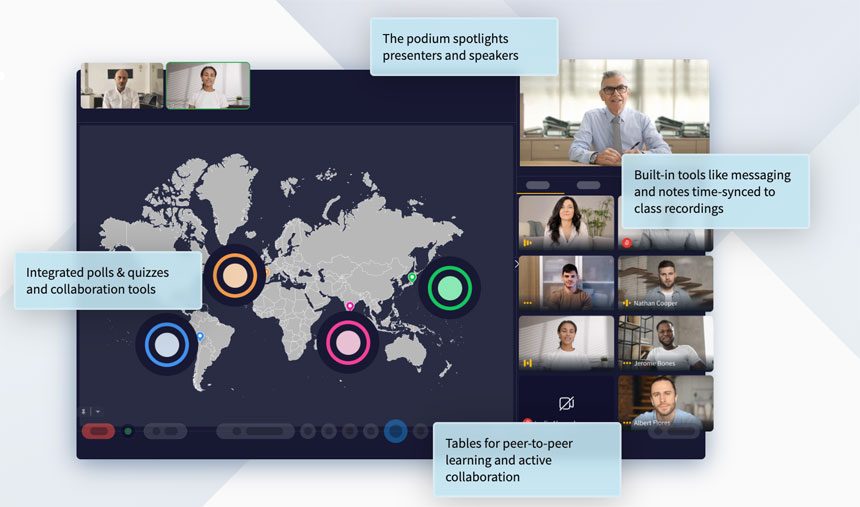
The company describes its approach as a tool based on active learning principles that recreates a small-group, in-person learning experience, while promoting collaboration and discussion.
According to Engageli, these will be the key features on its L&D platform:
● Comprehensive platform supporting multiple native communication channels, synchronous, asynchronous, and hybrid learning for large classes of up to 700 learners
● Threaded Q&A, note-taking, chat functionalities, and the ability for learners to easily interact with their peers and facilitators during and after the session
● Ability to integrate interactive polls and quizzes (i.e., single choice, multiple-choice, text-based) directly into training materials to gauge employee comprehension and participation
● Persistent tracking of employee attendance, engagement, and participation within and across sessions with detailed analytics available to facilitators in a dashboard or through API for integration into existing systems
● Unique virtual classroom created for each training or onboarding session that is recorded with closed captioning for interactive and collaborative, asynchronous access via an Engageli Playback Room.
● Secure platform with single sign-on (SSO), secure provisioning of users through SAML 2.0, one-time passwords (OTP), and OAuth 2.0 to eliminate the need for multiple login credentials
An overwhelming majority of employers, 93%, say that “soft skills play a critical role in their decision about whom they want to hire.” This statement was made by Ian Siegel, CEO at ZipRecruiter, in the company’s recent report, The Job Market Outlook for Grads.
“Those soft skills include things like showing up on time, willingness to learn, enthusiasm, and a can-do attitude,” he added.
These are the soft skills employers have looked for most frequently in jobs posted on ZipRecruiter in the past 12 months:
Soft Skill
Number Of Jobs On ZipRecruiter Listing The Skill As A Requirement11 (As Of May 1, 2022, Rounded To The Nearest 100k)
According to ZipRecruiter, in any hiring process, technical skills are typically the main criteria, while soft skills can be important dealbreakers. Difficult software engineering software-related skills are the most sought-after skills.
The top technical skills are:
Technical Skill
Number Of Jobs On ZipRecruiter Listing The Skill As A Requirement12 (As Of May 1, 2022, Rounded To The Nearest 100k)
The University of Michigan (U-M) announced this week the appointment of its new President, Santa J. Ono, 59, a biomedical researcher who previously served as President of the University of Cincinnati and Senior Vice Provost and Deputy to the Provost at Emory University.
Santa J. Ono will be the institution’s 15th president and first of Asian descent (he is of Japanese heritage.) Born in Vancouver, Canada, he earned a bachelor’s degree in biological science at the University of Chicago and a doctorate in experimental medicine from McGill University in Montreal.
He will officially step into the U-M role on October 13, taking over from interim President Mary Sue Coleman, who has been filling the role since January, when former president Dr. Mark Schlissel was fired after being accused of having an affair with a subordinate.
His nomination was voted unanimously by the Board of Regents during a special meeting on July 13 in Ann Arbor. (Under the Michigan Constitution, the board is responsible for electing the university president.)
His appointment followed a comprehensive search that began in February. A presidential search committee that included students, faculty, staff, alumni, and regents worked with the executive search firm Isaacson to identify and review candidates. An online survey collected additional thoughts from more than 1,000 respondents.
Dr. Ono is the leader of the University Climate Change Coalition, a network that connects 23 of the world’s leading research universities and university systems committed to accelerating climate action. He also serves as chair of the U15 Group of Canadian Research Universities, a collective of research-intensive institutions similar to the Association of American Universities.
“The University of Michigan is recognized worldwide as being at the pinnacle of public higher education,” Ono said. “It is a singular honor to be chosen to lead such an extraordinary institution. I look forward to embracing the university community and supporting their education, scholarship, innovation, and service.”
He has taught at Johns Hopkins University, Harvard University, and University College London. While at the University of Cincinnati, he also served as a professor of pediatrics at Cincinnati Children’s Hospital Medical Center.
Ono will receive a base salary of $975,000, subject to annual increases at the Board of Regents’ discretion, and $350,000 in deferred compensation starting after the first year. He also will receive regular university benefits and supplemental contributions to a retirement plan, housing in the President’s House, an expense allowance, and the use of an automobile and a driver, all in accordance with university policies.
The university’s main campus in Ann Arbor includes 19 schools and colleges. There also are regional campuses in Dearborn and Flint and a nationally ranked health system, Michigan Medicine.
As one of the nation’s top public universities, U-M has been a leader in research, learning, and teaching for more than 200 years.
Ono is married to Wendy Yip, who trained as an immunologist at McGill and as a lawyer at Boston University. They have two daughters, Juliana and Sarah.
Instructure (NYSE: INST), the maker of Canvas LMS, celebrated this week its annual conference, InstructureCon, with 10,000 virtual users registered to attend the event, talks, and announcement of partnerships and new features. Instructure is one the last companies still celebrating a virtual gathering, despite almost all of the industry has already moved to face-to-face conferences. Next year, InstructureCon will take place in person in Denver, July 25-28, 2023.
These are some of the product updates on its learning platform:
Discussions redesign: the user interface now allows for quoting replies, tagging respondents with @mentions, and the capability of flagging or reporting replies.
Assignment enhancements for students: an improved submission workflow includes a progress tracker for each assignment, clear submission options, improved access to rubrics and feedback, and access to each attempt if multiple are given.
Course pacing: a feature that allows the automatic distribution of due dates with different start dates based on an instructor’s defined pace, all to better support outcomes-based, or competency-based education (CBE).
SpeedGrader and Gradebook improvements: updates that streamline grading workflows.
Canvas Studio and Canvas Credentials Updates
Canvas Studio updates: Canvas Studio now supports media uploads from Vimeo and automates uploading from Zoom. With improved analytics, instructors can understand how students engage with course videos.
Canvas Catalog updates: time-saving updates streamline purchasing and enrolling in courses, including in multiple listings simultaneously.
Canvas Credentials: after the purchase of Badgr, the micro-credentialing tool was rebranded as “Canvas Badges” and “Canvas Credentials,” a suite of tools with unlimited badging, analytics, and personalized pathways.
Mastery Product Updates
Mastery, Instructure’s competency-based solution for K-12 assessment allows teachers to identify what students know and don’t know, standard by standard, in real-time when they can most influence learning. Recent improvements include the following:
Enhanced Integration with Canvas
Assessment content additions: expanded high-quality district assessment offerings in several states.
Expanded tools, workflows, and accommodations: new text-to-speech options and improved reporting features.
Elevate Product Updates
The recent updates to Elevate and student performance help give educators a complete picture of their students, curriculum, and programs. For example:
New Assessment Analytics Edition of Elevate K-12 Analytics: gives school districts the ability to compare student outcomes in the Mastery Connect AMS with state assessment results and to disaggregate by demographics and enrollment.
“Group Perspectives,” like recently released student perspectives, Group Perspectives will soon enable highly-visual and interactive views of outcomes for student groups, such as classrooms, schools, English Language Learners, and more.
Elevate Data Quality: planned enhancements include a new user interface and added features such as custom rule writing, user management, and integration with Elevate K-12 Analytics will provide additional assurances of downstream data quality in the analytics platform.
Impact Product Updates
Integration: Impact is expanding to even more products in the Instructure Learning Platform.
Impact Virtual Assistant for Tier 1 Institutions (currently in beta): this will allow educators to intervene earlier with users and anticipate and resolve questions or issues.
In terms of new partnerships, Instructure announced further partnership integration with 40 popular EdTech solution providers, including AWS, Google for Education, Microsoft, Terracotta, eLumen Insights, Turnitin, Cidi Labs, Blindside Networks (BigBlueButton), Pathify, Terracotta, and InSpace.

 • PDF Download: Barnes & Noble College Insights’ annual College 2030 Report