Author: IBL News

  • Video Becomes the Preferred Teaching Method, States a Research

    Video Becomes the Preferred Teaching Method, States a Research

    IBL News | New York

    Education professionals agree that video is essential to students’ academic experience. Moreover, video has become the preferred teaching method since it engages more than text-based content and increases students’ satisfaction and performance.

    This is the main finding of a global survey done by video platform provider Kaltura across several countries, including the U.S., UK, and Germany.

    The research, titled The State of Video in Education 2022 highlights that the pandemic was a major accelerator for online and hybrid modalities. “It’s been a paradigm shift for educators,” says the research. A total of 94% of these new-to-online educators say that they will continue to use a hybrid learning model even after in-person classes resume.

    Respondents of the survey say they feel comfortable using video technology. In fact, they would like to see their institution use more video. “Video has clearly become intuitive and easy to use for most educators.”

    The majority of respondents reported using video to support course delivery. Among the top uses of video are:

    • Synchronous remote teaching and learning
    • Supplementary course material
    • Lecture capture
    • Completely asynchronous courses with on-demand video and/or recorded video messages
    • Student assignments
    • Virtual office hours
    • Personal introductions of teachers and/or students
    • Flipped classrooms
    • Student assessment

    Uses of video outside the classroom include:

    • Internal staff/instructor training
    • Recorded campus events
    • Live campus events
    • Internal staff communication
    • External marketing
    • Library media collections

    .

  • The Open edX Conference Returns to In-Person Format: April 26 – 29, Lisbon, Portugal

    The Open edX Conference Returns to In-Person Format: April 26 – 29, Lisbon, Portugal

    IBL News | New York

    The Open edX organization will return to an in-person annual conference after two years of virtual gatherings due to the COVID pandemic.

    The 2022 Open edX Conference will take place in Lisbon, Portugal, on April 26 – 29, 2022. It will be hosted by the Nova School of Business & Economics and Fundação para a Ciência e a Tecnologia (FCT).

    The conference will explore, according to the organizers, “the future of work and how open technology can be leveraged to up-skill, re-skill, and deliver life-long learning to employees and students alike.”

    Attendees will explore innovations and advancements in technologies and instructional design and course creation, along with new features pertaining to the Open edX platform.

    The names of keynote speakers and conference presenters will determined this month.

    Developers interested in speaking can submit their presentation idea. Call for Proposals — for a 45-minute breakout session, a 10-minute lightning talk, or a 90-minute or 3-hour tutorial/workshop — will be open until February 20th, 2022.

    .


  • A Research Suggests that Career-Connected Learning is the Key for the Job-Skills Crisis

    A Research Suggests that Career-Connected Learning is the Key for the Job-Skills Crisis

    IBL News  | New York

    Almost one-third of all jobs worldwide — over 1 billion jobs in total — will be transformed by technology in the next decade. Millions of jobs will be displaced, but millions more will be created. Those new jobs will pay more and offer better career opportunities. The fastest-growing job categories are six times more likely to pay over $100,000 than the slowest-growing categories.

    That’s the scenario forecasted on research crafted by the global consultancy firm Bain & Company on career-connected learning. The study highlights that employers are struggling to fill those jobs, and young people are struggling to access them.

    Bain’s research also shows:

    • For example, youth unemployment in the US is near twice the total unemployment rate. Youth underemployment—which measures the number of young people who have more education than their job requires—remains high in the US, with 40% of recent college graduates qualifying as underemployed, according to Bain & Company.
    • Only one in five entering freshmen ultimately earn a family-sustaining wage one year after graduation.
    • Half of the recent graduates report feeling financially stable, and two-thirds of young people feel unfulfilled in their careers or pessimistic about the future.
    • Around 60% of good job postings — those that pay above a living wage and have limited vulnerability to automation — require at least a four-year degree, yet only about a quarter of jobs require the specific skills taught in those programs.
    • Only 28% and 21% of US Black and Hispanic adults, respectively, own a bachelor’s degree or higher, putting the majority of these populations out of the running for most good jobs.

    According to Boston-based Bain, career-connected learning (CCL) is the key to making those opportunities available to students who too often find access to such jobs beyond their reach.

    Well-designed CCL pathways close that gap by combining classroom learning with meaningful on-the-job work experience that leads to door-opening postsecondary degrees and credentials, according to the company.

    “It’s a better, more engaging educational experience while also offering employers a sustainable, profitable way to find great talent from a deeper and more diverse talent pool,” said Abigail Smith, a leader in Bain & Company’s Social Impact Education practice.

    Some countries, such as SwitzerlandAustraliaGermany, and Singapore, have scaled highly effective CCL systems that are both student-centered and market-driven.

    They’ve rejected the false dichotomy between “academic instruction” and “career education” and built educational pathways that provide both while meeting the needs of students and employers alike.

    .


  • Pearson Purchases Certification Platform Credly for $200 Million

    Pearson Purchases Certification Platform Credly for $200 Million

    IBL News | New York

    Global education group Pearson announced this week the acquisition of certification company Credly for $200 million. Pearson, which already owned 20% of Credly (valued at $40 million), will add this company to its Workforce Skills division.

    The full Credly team, including Jonathan Finkelstein, Founder and CEO of Credly, will join Pearson.

    Andy Bird, Chief Executive of Pearson, said that this purchase “is another important step in accelerating our strategy in the workforce skills market.” “The growing skills gap is putting enormous pressure on the labor market, making verified credentials more essential than ever before,” he added.

    Credly complements Pearson’s recent acquisition of Faethm, an AI and predictive analytics company focused on workforce trends.

    Credly offers a platform for organizations to award employees and students digital credentials that verify their skills and help connect them with opportunities. Over 2,000 organizations use Credly. The company’s revenue was $13.3 million in 2021.

  • Universities Face Existential Threats Unless They Transform Their Operating Models

    Universities Face Existential Threats Unless They Transform Their Operating Models

    IBL News | New York

    The future of the university as we know it is under threat, says a report from EY (Ernst & Young). This research recommends that to survive, universities take a “future-back” approach, looking to 2030, reinvent themselves by setting a radical transformation in the operating models. Disruption from temporary remote learning may be just the tip of the iceberg.

    The report, titled Are universities of the past still the future?, highlights that challenges thrown by the COVID pandemic could rapidly develop into existential threats for universities. Leaders from institutions in the US, UK, India, Singapore, and Australia participated in the research.

    “Technology will continue to change the game across the higher education sector and universities need to start thinking and planning now for how they’re going to address the need for reinvention and fit into the post-secondary and lifelong learning landscape of the future,” said Catherine Friday, EY Global Education Leader.

    EY adds five bold scenarios:

    • “Universities must use digital learning experiences to augment what makes them unique and reinvent their learning delivery around that to meet the needs of tomorrow’s students and lifelong learners.”

    • “Universities need to recognize that the power is shifting rapidly into the hands of the learner. Therefore, they need to provide the type of personalized, flexible learning options that students desire.”

    • “Universities have lost their monopoly on accreditation, and non-degree, lifelong-learning credentials are becoming mainstream. Universities have to prepare for a world where location or brand reputation is less important to learners than the measurable quality and effectiveness of their teaching and learning outcomes in helping learners reach their individual career and life aspirations.”

    • “Research is the lifeblood of universities, from deciding rankings to attracting the best minds to producing value for society, but it is costly and is heavily subsidized by tuition fee revenues. Universities could shift to prioritize commercial, demand-driven research, collaborating more closely with industry and capital markets and then working with governments for better funding for non-commercial research of national or international value and significance.”

    • “Technology is helping those in developing countries to access higher education in new ways, allowing universities to expand their reach exponentially. Western universities looking for new markets have a huge opportunity to partner with in-country providers to roll out sought-after, high-quality education in these growing markets, using technology to do so at scale and a price point that is affordable locally.”

    As a summary, Ernst & Young states that “universities need to innovate for a future that accommodates both degrees and micro-credentials, intellective and job-ready skills, and synchronous and asynchronous learning, using online or hybrid delivery models. Scenario planning will support a “future-back” approach to help university leaders envision a new era for higher education.”

  • Cengage Buys Cybersecurity Training Provider Infosec for $190.8 Million

    Cengage Buys Cybersecurity Training Provider Infosec for $190.8 Million

    IBL News | New York

    Boston-based Cengage Group acquired Infosec, a cybersecurity education provider, for $190.8 million, in a transaction expected to close in the first quarter of 2022, the company reported.

    With this purchase — announced yesterday —, Cengage Group expands into the online cybersecurity professional training field, currently a $1 billion market. It is expected to grow to $10 billion annually by 2027.

    Michael E. Hansen, CEO of Cengage Group, stated that “with our scale and resources, more cybersecurity professionals will have access to an affordable and faster option to develop the skills they need.”

    Cengage will integrate Infosec into its Workforce Skills business division. Since its founding in 2004, Infosec has already trained more than 100,000 cybersecurity professionals. This platform host 1,400+ hands-on cybersecurity courses while providing the option to upgrade to boot camp style, instructor-led training to prepare for certifications.

    As the world shifted to remote and hybrid working environments, the frequency of cyber-attacks rapidly increased. As a result, the need for skilled and knowledgeable cybersecurity professionals has grown, driving the U.S. Bureau of Labor Statistics to identify information security analysts as the tenth fastest-growing occupation over the next decade, with an employment growth rate of 31%.

    Today, there are nearly 600,000 unfilled cybersecurity jobs in the U.S., with more than half requiring at least one certification. Globally, the number of open cybersecurity positions is 3.5 million.

    Cengage Group, which targets job seekers, pointed out in recent research on the “Great Resignation” that 78% of those who have recently resigned from a job pursued online training courses or certificate programs — essential to landing a new job.

  • Domestika Reaches Unicorn Status After Raising $110 Million

    Domestika Reaches Unicorn Status After Raising $110 Million

    IBL News | New York

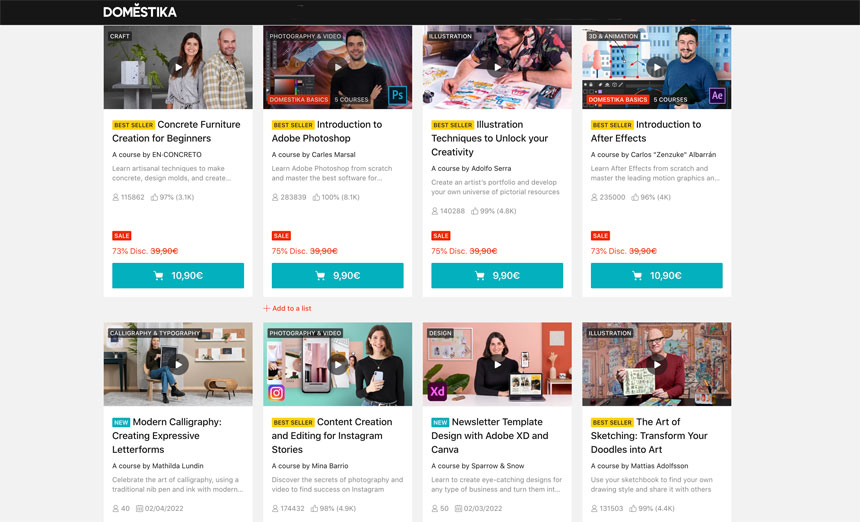
    Learning platform and community Domestika reached unicorn status with a valuation of $1.3 billion after closing a round of a $110 million Series D. The financing was led by Zeev Ventures with additional investors, including GSV Ventures. According to the company’s data, it hosts 8 million learners and over 1,300 teachers around the world.

    Berkeley, California-based platform serves like-minded creative amateurs, hobbyists, and professionals. It offers over 2,000 courses taught by 1,300 professionals, covering topics from illustration and design to crafts and digital marketing.

    All of the content is curated and produced in-house through its studios in 12 countries in Europe and the Americas, the company claims. Each of the courses is subtitled and translated into English, Spanish, Portuguese, German, Italian, French, Polish, and Dutch.

    “Our community has grown from humble beginnings, as a small forum for creatives in Spain to over 8 million users around the world,” said Julio G. Cotorruelo, Domestika’s co-founder and CEO. “We plan to fuel this growth by expanding our offering in various languages and by continuing to bring the highest level of creative training in an accessible and affordable way.”

    “GSV Ventures is so proud to align with the team at Domestika, who prove every day that learning should be social, joyful, and beautiful,” said Deborah Quazzo, Managing Partner at GSV Ventures.

  • January 2023

    January 2023

    JAN 5 – 8, 2023 – Las Vegas, NV & Online
    CES 2023

    JAN 16 – MARCH 10, 2023 – Online
    EDUCAUSE New Managers Institute

    JAN 16 – 20, 2023 – Davos, Switzerland
    World Economic Forum Annual Meeting

    JAN 18 – 20, 2023 – San Francisco, CA
    AAC&U 2023 Annual Meeting

    JAN 23 – MARCH 17, 2023 – Online
    EDUCAUSE Data Literacy Institute

    JAN 23 – 26, 2023 – New Orleans, LA
    FetC Future of Education Technology Conference

    ———
    Class Central: Online Learning Conferences Calendar
    10 Times.com: Events

  • February 2023

    February 2023

    FEB 5 – 8, 2023 – Washington, DC
    Community College National Legislative Summit

    FEB 12 – 15, 2023 – Las Vegas, NV
    Instructional Technology Council 2023 eLearning Annual Conference

    FEB 12 – 17, 2023 – Las Vegas, NV
    TDWI Las Vegas Conference – Data and Analytics Education Conference
    (Co-located with the Executive Summit for Analytics)

    FEB 15 – 17, 2023 – Blacksburg, Virginia
    15th Annual Conference on Higher Education Pedagogy

    FEB 15, 2023
    CIO’s Future of Work Summit North America

    FEB 15 – 16, 2023 — San Francisco, CA
    Deep Learning Summit

    FEB 16 – 18, 2023 — San Antonio, TX
    National Conference on Education by AASA

    FEB 19 – 22, 2023 — Washington, DC
    2023 AIEA Annual Conference – International Higher Ed

    FEB 22 – 24, 2023 – Las Vegas, NV
    2023 NAIS Annual Conference

    FEB 27 – MARCH 1, 2023 — Dallas, Texas
    Digital Credentials Summit 2023

  • August 2023

    August 2023

    AUGUST 6 – 11, 2023 – San Diego, CA
    TDWI San Diego

    AUGUST 29 – 31, 2023 – San Francisco, CA
    Google Cloud Next