Author: IBL News

  • Class Central Starts Developing a Social Learning Platform for Open Courses

    Class Central Starts Developing a Social Learning Platform for Open Courses

    IBL News | New York

    ClassCentral.com announced it’s developing a social learning platform for open courses.

    Class Central Cohorts are our attempt to add a social layer to free online courses,” said Dhawal Shah, CEO and Founder of Class Central.

    Currently, two courses are open to experimentation: Wharton Marketing and Dino 101.

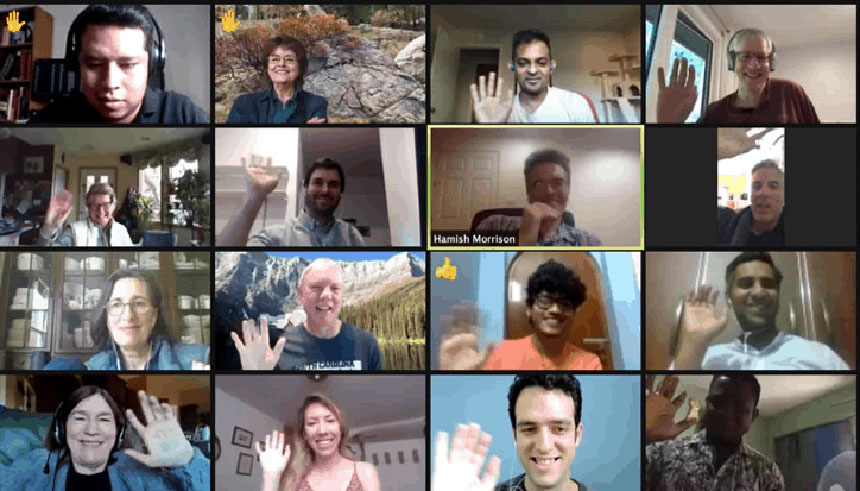
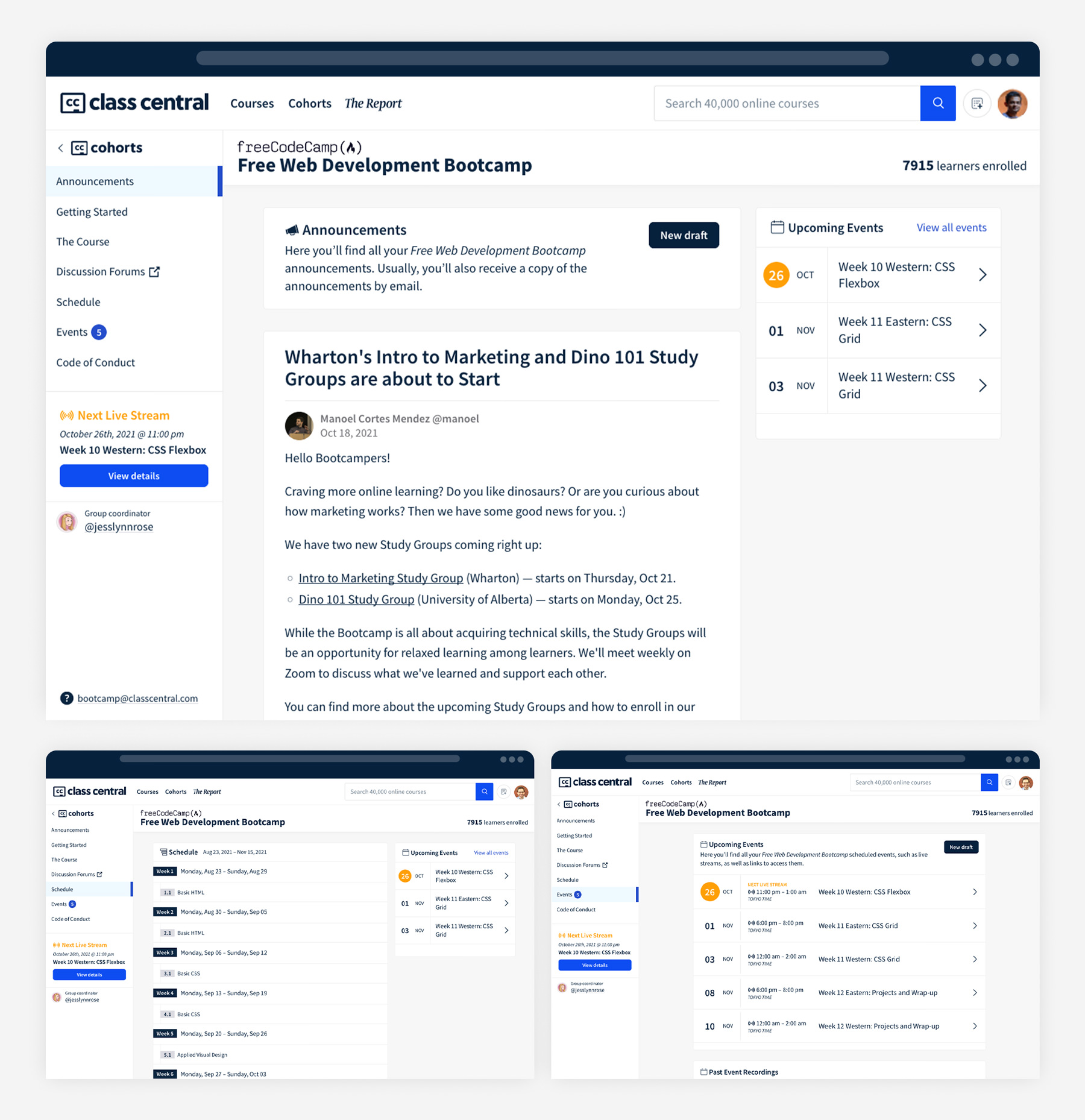
    A Class Central Cohort features three main components: an online course, discussion forum, weekly Zoom sessions, or live streams.

    Class Central built a website where learners access the study schedule, upcoming streams and recordings, and Discourse forums.

    Coordinators accept enrollments, create a study schedule, post announcements, and weekly updates, and create events (for Zoom sessions) that are sent to learners automatically.

    The legendary Barbara Oakley, who has 4 million learners on Coursera, participated in the study groups as a student.


  • Accenture Finds Six Segments of Students, Based on Learning Mindsets

    Accenture Finds Six Segments of Students, Based on Learning Mindsets

    IBL News | New York

    Research from Accenture, ‘Serving all students: A survey of learner mindsets’, offered a deeper understanding of higher education students and opportunities for institutions after the COVID pandemic.

    Changes already underway — such as a reduced pool of “traditional” students, the need for lifelong credentialing and skilling, and the rise of alternative education providers — accelerated.

    “Education institutions, now more than ever, are looking to evolve how they serve existing students as well as how they adapt to serve new student segments,” said Samantha Fisher, Managing Director of Accenture’s Education Practice.

    “Learning and acquiring new skills across a workers’ career is increasingly essential for employees and organizations to flourish, and the challenge demands a deeper understanding of learning mindsets.”

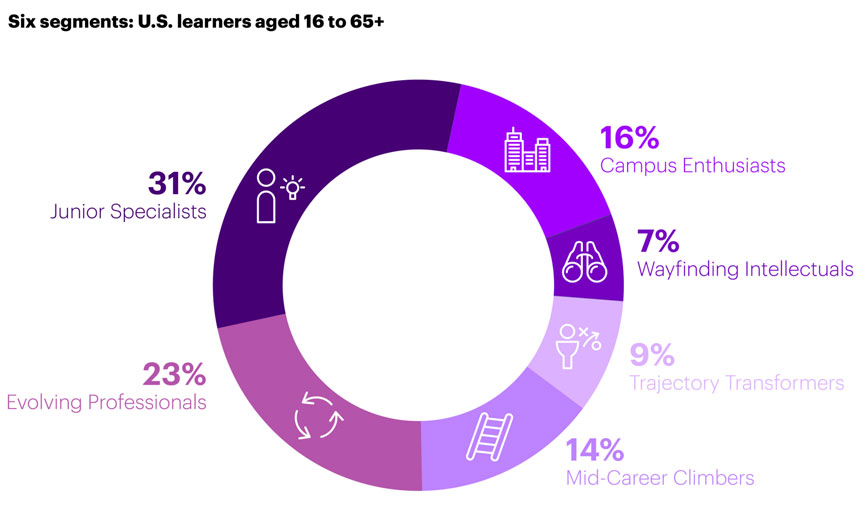
    The survey by Accenture conducted a survey of 6,500+ post-secondary learners revealed six distinct segments of learners, clustered based on learning mindsets, goals, and emotions rather than demographic factors or type of institution — as noted in the graphic above.

    “Campus Enthusiasts” representing 16% of respondents, are academically-oriented young people, seeking an immersive and exploratory college experience. They are generally full-time students, with social and career extracurriculars, and most will be seeking their first professional job upon degree completion.

    “Wayfinding Intellectuals” representing 7% of respondents, are working toward their first degree, highly driven by intellectual curiosity, and often interested in staying within academia. They seek a more traditional learning experience, preferring in-person enrollment and learning.

    “Junior Specialists” are the largest cluster, representing 31% of respondents. They are motivated by real-life application of coursework, internships, and building networks to enter an identified field upon graduation. Most are enrolled or plan to enroll in a four-year institution full-time and committed to pursuing a degree in a professional field, such as healthcare or business. They tend to be relatively more reliant on loans and scholarships, have lower-incomes, and be less interested in school culture and social opportunities.

    “Evolving Professionals” representing 23% of respondents, have higher incomes and more work experience. Driven by intellectual curiosity, they are looking to expand their interests and career options rather than developing specific skills tied to their employer. Many are studying technology or business. A majority are pursuing a traditional degree, but a sizable minority are enrolled in or intend to enroll in a certificate program. They tend to be older than the previous three segments, and many have started families.

    “Mid-Career Climbers” representing 14% of respondents, seek to advance their careers through special credentials closely tied to their current or a future employer. They tend to work full-time, and place a premium on program flexibility (e.g., full online or online hybrids), and are the most likely group to enroll in certificate programs and institutions outside of colleges and universities.

    “Trajectory Transformers” representing 9% of respondents, are striving to achieve career advancements by changing roles or industries by obtaining specific skillsets in a short amount of time. They focus heavily on value and potential outcomes, are the oldest group with the most work experience, and are among the most price-sensitive learners. Many are or will be first-generation college students.
     

  • Udemy’s Stock Recovers Until Reaching Its IPO Price of $29 Per Share

    Udemy’s Stock Recovers Until Reaching Its IPO Price of $29 Per Share

    IBL News | New York

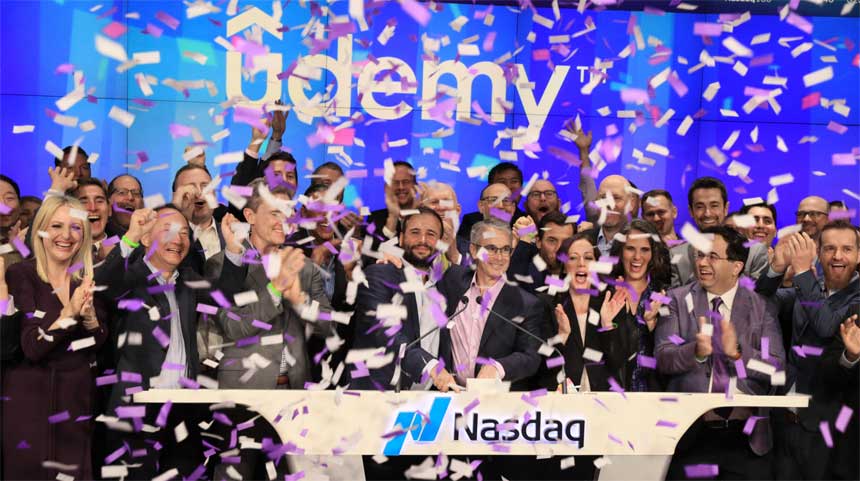
    Udemy Inc (Nasdaq: UDMY) recovered on Monday, November 1, with a jump of 6.25% to $29.05 after a failed IPO debut last Friday.

    On Monday, November 1, Udemy’s stock grew above $29 of the IPO offer price, giving the company a market value of $4.02 billion.

    San Francisco-based Udemy.com sold 14.5 million shares Thursday at the top of a marketed range of $27 to $29 to raise $421 million.

    The company was valued at $3.2 billion in private investment last year.

    Udemy’s revenue for the first six months of the year was $251 million, up from $201 million the year before. Its net loss narrowed to $29 million from $52 million a year ago.

    Udemy provides online video courses across a variety of categories, including web development, marketing, and business. The company said it had more than 201 million course enrollments last year with over 44 million users globally.

    In the risk-factors section of the prospectus, Udemy acknowledges that it’s in a highly competitive market, including Coursera Inc., Pluralsight Inc., and LinkedIn Learning.

    Its corporate customers include Citigroup Inc., Jaguar Land Rover, PayPal Holdings Inc., and Box Inc.

    Udemy’s biggest investor is Insight Partners, which with its affiliates owns more than 30% of the company’s shares after the listing. Other top shareholders, according to Udemy’s filings with the U.S. Securities and Exchange Commission, include MIH Edtech Investments, which is a unit of Prosus NV, and Norwest Venture Partners.

  • UPenn Becomes the First Ivy League School to Accept Enrollment Payment in Crypto

    UPenn Becomes the First Ivy League School to Accept Enrollment Payment in Crypto

    IBL News | New York

    UPenn’s Wharton School launched an online executive education program that will accept enrollment payment in various cryptocurrencies, including Bitcoin, Ethereum, and USD Coin, becoming the first Ivy League or U.S. business school.

    In a written statement last week, the University of Pennsylvania’s (UPenn) announcement came alongside the launch of its six-week the “Economics of Blockchain and Digital Assets” course, which will begin on January 3, 2022.

    “We designed this program for business professionals and executives from a range of backgrounds, including traditional finance, management, and tech,” said the Program’s Academic Director, Wharton professor, and Blockchain author, Kevin Werbach. 

    The school will partner with blockchain consulting firm Prysm Group to offer the certificate program.

    PwC expects blockchain to boost global GDP by US$1.8T by 2030, indicating that the applications of this technology are only beginning to reveal themselves. Furthermore, Deloitte found that 83 percent of businesses are discussing or working on cryptocurrencies in the context of solutions or strategies.


  • edX Launched a First MicroBachelors Program with IBM in Cloud Application

    edX Launched a First MicroBachelors Program with IBM in Cloud Application

    IBL News | New York

    edX Inc., now part of 2U, recently announced its first MicroBachelors program with IBM in Full Stack Cloud Application Development.

    This program of 11 courses in seven months and at $600 is credit-backed and worth up to three college credits from Thomas Edison State University.

    It is designed for learners with no prior programming or cloud experience and sets them for an entry-level role as a full stack developer — one of the top 15 tech jobs for 2021.

    The development of edX MicroBachelors programs is supported by American Student Assistance, Boeing, Lumina Foundation, the Truist Foundation, Walmart, the Jeremy M. and Joyce E. Wertheimer Foundation, and the Yidan Prize Foundation.

    “IBM is committed to creating learning content on edX that is accessible, affordable, and relevant, and this MicroBachelors program does just that,” said Rav Ahuja, Global Program Director IBM Skills Network.

  • Retiring After a Career in Higher Ed? Sarasota, Naples, and Daytona Beach, Among the Best Places

    Retiring After a Career in Higher Ed? Sarasota, Naples, and Daytona Beach, Among the Best Places

    IBL News | New York

    Where will you retire when you finish your career in education?

    There is a high chance your retirement place will be Florida — as long as you don’t choose Cancun or any other Latin American resort!

    The U.S. News & World Report unveiled this month the 2021-2022 Best Places to Retire in the U.S. The list evaluates the country’s 150 most populous metropolitan areas based on how well they meet Americans’ expectations for retirement. Housing affordability, retiree tax rates, health care, and happiness scores are some of the criteria.

    Florida metro areas captured most of the top 10 spots this year. Sarasota maintained the number 1 spot, followed by Naples, and Daytona Beach.

    Emily Brandon, U.S. News Senior Editor for Retirement, explained that “after over a year of staying at home, many people are dreaming about a Florida beach retirement.”

    Pennsylvania metropolitan areas also had a strong showing at the top of the rankings, with Lancaster and Allentown at the top.

    This is the full ranking:

    1. Sarasota, FL
    2. Naples, FL
    3. Daytona Beach, FL
    4. Melbourne, FL
    5. Lancaster, PA
    6. Tampa, FL
    7. Fort Myers, FL
    8. Port St. Lucie, FL
    9. Ann Arbor, MI
    10. Pensacola, FL
  • A Family-Owned, Private University in Spain Builds a Campus in a Modern Skyscraper

    A Family-Owned, Private University in Spain Builds a Campus in a Modern Skyscraper

    IBL News | Madrid, Spain

    A private university in Spain opened this month campus in a skyscraper in Madrid, as shown in the picture. The inauguration took place last week.

    IE University’s new campus will host 3,800 undergraduate students in the IE Tower, a modern, high-tech, sustainable building that resembles, only in shape, the United Nations headquarters in New York.

    The building looms large amid four other corporate skyscrapers populated by executives from PwC, KPMG, and other global corporations.

    For IE University, a school that teaches in English and has been operating as a business school for over four decades, the 180-meter tall tower is a landmark achievement. Spain’s national and Madrid’s regional governments shared this view.

    This building, visible all over Madrid, Spain, occupies 35 floors filled with 64 classrooms, 50,000 square meters, and 7,000 square meters of green space.

    It includes exhibition halls, a creativity center, a sports zone with swimming pools, and even a meditation room. The classrooms are equipped with technology to simultaneously deliver face-to-face and online sessions.

    The IE Tower expects to house 6,000 students within five years.

    The owner of the IE University [in the picture below] is a prominent, well-connected to the Monarchy, Spaniard entrepreneur and art collector Diego del Alcázar, 71. He privately funded the school 48 years ago. Today his 37-year-old son, Diego de Alcázar Benjumea, operates as a Vice President.


  • Private Equity Owned Anthology Closes the Purchase of Blackboard

    Private Equity Owned Anthology Closes the Purchase of Blackboard

    IBL News | New York

    Anthology reported this week it completed the previously announced merger with decades back pioneering Blackboard.

    Private equity investment firm Veritas Capital (“Veritas”) will own the combined entity, which will operate under the name of Anthology. The Blackboard name will be part of the brand portfolio, according to the organization.

    Two other equity firms Leeds Equity Partners (“Leeds”) and Providence Equity Partners LLC (“Providence”), Blackboard’s previous majority owner, will own minority stakes.

    The company’s headquarters will be in Boca Raton, Florida. Blackboard’s office in Reston, Virginia, will be maintained.

    Jim Milton will operate as Chairman and CEO. Mr. Milton said in a statement, “The combined broad set of capabilities of Anthology and Blackboard — including teaching and learning, student information systems, enterprise resource planning, community engagement, student success, and student engagement — will provide our clients with a full suite of enterprise-level products and services that enable institutions to not only focus on data-driven decisions but completely transform both student and institutional success.”

    With Blackboard under its control, Anthology claims to own “the world’s largest modern edtech ecosystem and expanded portfolio of solutions,” while it will focus “on accelerating innovation.”

  • Western Governors University Partners with the National Governors Association

    Western Governors University Partners with the National Governors Association

    IBL News | New York

    Western Governors University (WGU) announced this week a strategic partnership with the National Governors Association (NGA) to “build best practices in state policy that will result in greater access to higher education.”

    The partnership is built upon the record of WGU online, which after 25 years, has produced 250,000 graduates and 120,000 enrolled students in all 50 states. Its competency-based education model, along with its management, has resulted in one of the success stories in American higher education in the last decades.

    The idea, back in 1997, of a bipartisan group of 19 Governors was designed to serve learners in the post-industrial area. This focus on skills-based education has exploded in the last year as a result of the pandemic.

    Through this partnership, WGU and NGA aim to provide a path forward for learners highlighting skill development.

    “Our partnership with the NGA will help democratize education now and in the future,” said Scott Pulsipher, President at WGU.

    Further elaborating on the skills ecosystem, on October 27-28 will take place the NGA’s State Strategies for Skills and Lifelong Learning Systems conference.

    [Disclosure: IBL Education, the parent company of IBL News, serves as one of its customers WGU by developing an Open edX-based ecosystem]

  • Experts Say that the Spending in Global Education and EdTech Will Experience a Massive Increase

    Experts Say that the Spending in Global Education and EdTech Will Experience a Massive Increase

    IBL News | New York

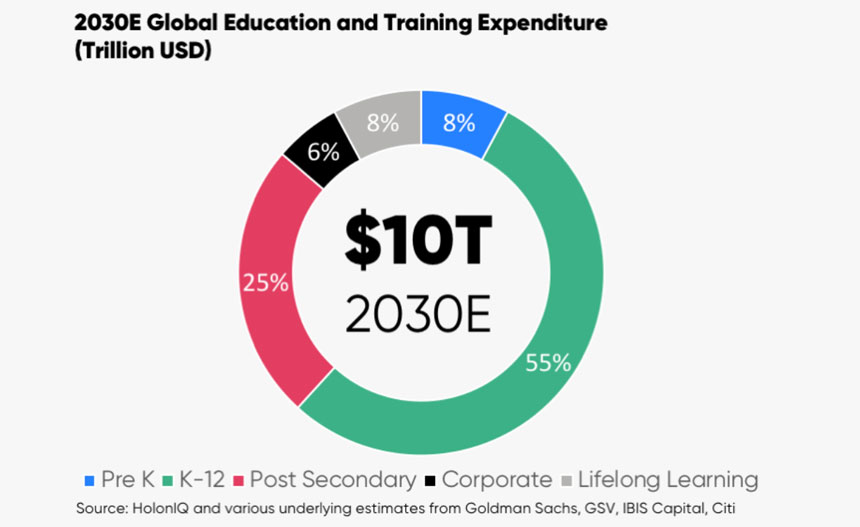
    The spending on education will reach at least $10 trillion by 2030, reflecting a massive expansion in technological solutions related to re-skilling and up-skilling in developed countries. This data, provided by HolonIQ, shows larger growth than the cloud services sector, which Allied Market Research predicts will reach $through 1.6 trillion by 2030.

    “EdTech holds the potential to better shape our future workforce and it shows why the future of education is just as important as the future of work,” writes Gauthier Van Malderen, CEO at U.K.- based Perlego, on Crunchbase.

    The next decade will see an additional 350 million post-secondary graduates and nearly 800 million more K12 graduates than today, according to HolonIQ.

    Asia and Africa are the driving force behind the expansion. Experts say that the world needs to add 1.5 million teachers per year on average, approaching 100 million in total, to keep pace with the unprecedented changes ahead in education around the world.

    According to UNICEF, during the pandemic, 83 percent of governments faced with the closure of schools chose to utilize online solutions to deliver education. However, while 50 percent of education time is digital, less than 5% of spending is on digital education tools, according to Brighteye Ventures.

    “Now is the moment to rethink how education is delivered and build a hybrid model with greater accessibility, affordability, and inclusivity at its core,” said Gauthier Van Malderen. “As we enter the third academic year disrupted by the pandemic, we should be having the same conversations around a permanent change in education to improve access and outcomes for learners.”