Samsung Galaxy Z Fold 8 Ultra and Z Flip 8 Hands-On: New Chips, Higher Prices
Source: Youtube

Samsung Galaxy Z Fold 8 Ultra and Z Flip 8 Hands-On: New Chips, Higher Prices
Source: Youtube

Trump: Netanyahu ‘wants me to stay involved’ in Iran
Source: Youtube
Mikel Amigot, IBL News | Louisville, Kentucky
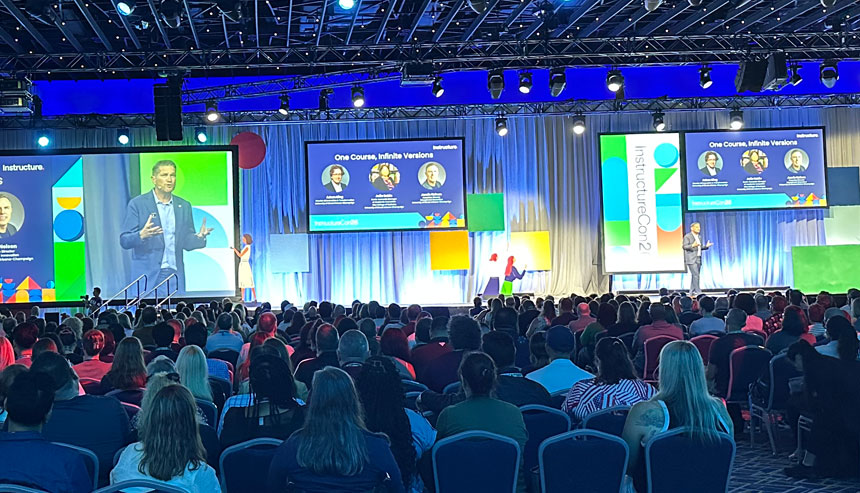
Over 3,000 educators, administrators, and edtech professionals gathered this week in Louisville, Kentucky, for InstructureCon 2026, Instructure’s flagship annual conference.
Under the theme “Education in the Making,” the three-day event (July 21–23, 2026) delivered keynote addresses from renowned thinkers, a sweeping product roadmap, the launch of a new AI venture studio, and a landmark survey on AI adoption in education.
With over 200 sessions, workshops, and meetups spanning artificial intelligence, workforce readiness, accessible design, and evolving learner needs, InstructureCon 2026 was both a display of technological ambition and a test of whether Instructure can rebuild the trust compromised by the cybersecurity breach that struck its Canvas LMS on April 25, 2026,
Instructure’s CEO, Steve Daly, addressed “the incident”, as they called the data breach caused by the criminal organization ShinyHunters, promising transparency, honest communication, and every effort to rebuild trust through consistent action.
The company announced two new practical security features: one to download courses and another to fully remove all non-essential data on Canvas LMS.
• “It will be a defense at every layer, annual verification, and external audits.”
• “There will be faster detection and remediation, more frequent external validation, and more open collaboration.”
However, “We cannot predict a world without zero incidents; future attacks, in fact, will be more frequent and damaging,” said Armin Molavi, Chief Marketing Officer [in the picture below].
Also, the week prior to the conference, Instructure assessed a separate security threat disclosed against ShareFile, the third-party platform being used for secure data delivery. The company emphasized the ShareFile issue “did not involve Canvas or any Instructure systems.”
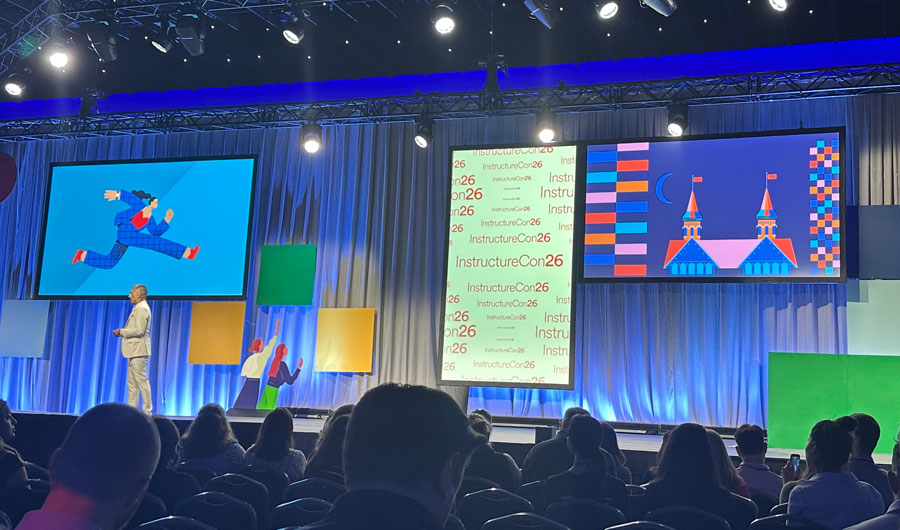
Daly shared what Instructure described as “a bold vision for how education and technology can move forward together in a time of rapid change,” framing the company’s evolution “from a learning management system provider to a comprehensive, future-ready learning ecosystem.” He emphasized that the rate of technological and workforce change will continue to accelerate and positioned Instructure as the partner to help institutions navigate it.
In the opening of the conference, guest speaker Michael Horn, co-founder of the Clayton Christensen Institute for Disruptive Innovation and one of education’s most recognized voices, challenged the audience to rethink AI’s role in education, not merely as an efficiency tool, but as a force that can “restore what education was always supposed to be: connection, curiosity, and purpose.”
He argued that AI should liberate educators from administrative burden, freeing them to spend more time genuinely engaging with students.
The biggest talking point of Day 1 was Instructure’s new research on the state of AI in education. Covering 1,125 respondents across educators, higher education students, and K-12 parents and guardians, the survey revealed a stark adoption gap:
Chief Learning Officer Melissa Loble framed these findings as validation for its IgniteAI strategy—embedding AI tools directly into existing Canvas workflows so educators can benefit from AI without needing to become AI specialists themselves.
On the second day of the conference, Instructure announced the launch of Instructure Foundry, a standalone venture studio within Instructure dedicated to innovation by developing “AI-native” educational products outside the traditional Canvas roadmap.
Designed to move faster than the core product team and experiment with ideas that don’t fit neatly into a learning management system, Foundry represents Instructure’s bet that the future of edtech requires startup-speed innovation backed by institutional-scale infrastructure.
Foundry’s inaugural project is Project Athena, an AI-powered study coach that delivers in-context learning through Canvas. Unlike generic AI tutoring tools, which operate without awareness of a student’s specific academic context, Athena pulls from a student’s actual Canvas environment — syllabi, course materials, assignments, and upcoming assessments — to generate:
Chief Product Officer Shiren Vijiasingam emphasized that Athena addresses a “context gap” that plagues existing AI tutoring tools. “Most AI tutoring tools have a critical gap: they generate explanations without the context of what students are actually learning and require students to find, organize, and upload course materials themselves,” he said.
On the sensitive topic of data privacy — particularly acute given the breach — Instructure was explicit: student conversations with Athena will not be used to train external AI models, access to Canvas data will be read-only and governed by existing user authorizations, and students retain full ownership of their data.
During the event, the Canvas LMS Product Roadmap was announced
Vijiasingam said, “Educational technology, powered by AI, can strengthen the connection between educator and student, amplify the voice and impact of the educator, and provide a personalized learning experience that improves student success.”
He added that AI-driven efficiency should translate into “time savings that allow educators to use their time in higher quality and more meaningful ways, spending it where it matters most.”
Instructure announced plans to update more than 20 key Canvas workflows throughout 2026, including:
The Canvas platform owner concluded that the LMS — already the place where courses, grades, and student data live — is the natural home for AI in education.
By embedding AI directly into Canvas rather than building standalone products, Instructure is arguing that AI works best when it has context, and no tool has more educational context than the learning management system.

Single Points of Failure Offer VCs a New Opportunity: Overmatch’s Hitzig
Source: Youtube

Powerful tornado slams Wisconsin neighborhood
Source: Youtube

Microsoft: OpenAI/Hugging Face Incident Signals a New Era of AI Security
Source: Youtube

Three Dead After Shooting at Seattle Food Festival
Source: Youtube

Oura Ring 5 Had Me Cheating on My Wedding Ring | All Things Mobile
Source: Youtube

Georgia school shooter was obsessed with mass shooters, messages show
Source: Youtube

IBL News | New York
OpenAI and Anthropic are quietly lobbying Washington regulators to restrict open-source AI models, even as Sam Altman publicly said he supports open-source AI, The New York Times reported yesterday.
The two leading frontier model companies are now publicly clashing with the rest of the tech industry over whether open-source models from China should be freely available or restricted.
David Sacks, Co-Chair, President’s Council of Advisers on Science & Technology, criticized Anthropic and OpenAI, posting:
“The entire tech industry (save for Anthropic) has come out in favor of open source AI. So what happens next? Will Anthropic change its lobbying efforts? Not likely.”
In recent years, Silicon Valley technologists have shown their divide over how AI software should be created, and last week that argument reached a boiling point.
On one side, Anthropic and OpenAI claim that AI models are too dangerous to be developed in the open and must be tightly controlled — by businesses like themselves — for safety. On the other hand, the rest of the tech industry, including giants like Microsoft and Nvidia, contends that open-source AI models must remain open for people to further develop technologies and build new businesses.
On Friday, Satya Nadella, Microsoft’s CEO, posted that open-source software was “essential to a healthy A.I. ecosystem.” Jensen Huang, Nvidia’s chief executive, said in his first-ever post to X that “the world needs both frontier closed models and frontier open models.” [see Nvidia’s CEO video below]. Both signed a letter supporting open source, which was also signed by executives at Meta, Palantir and IBM.
The escalating fight stems from China’s rapid progress in open-source AI models, which are freely available to use and build on. In recent weeks, two Chinese start-ups, Z.ai and Moonshot AI, have released models that rival those from Anthropic and other American labs. Anthropic and OpenAI have claimed that Chinese companies built the models by improperly harvesting data from their AI systems, which they said should not be allowed.
But companies like Microsoft and Nvidia, which rely on open-source models to spur demand for their cloud computing services and chips, said that open-source software was important to advancing the technology with shared knowledge and that it would let more people examine its security.
Silicon Valley start-up founders argue that constraining open-source software will cement OpenAI’s and Anthropic’s lead in AI.
The entire tech industry (save for Anthropic) has come out in favor of open source AI.
So what happens next? Will Anthropic change its lobbying efforts? Not likely. Now the gaslighting begins:
“Nobody is trying to ban open source.”
“We just want to limit who can use it.”
“We…
— David Sacks (@DavidSacks) July 26, 2026