Author: IBL News

  • Amazon Adds Generative AI Capabilities to Alexa

    Amazon Adds Generative AI Capabilities to Alexa

    IBL News | New York

    Amazon, this week at its HQ@ headquarters in Arlington, Virginia, announced upcoming improvements to Alexa around generative AI based on a new, custom-built LLM model optimized for voice interactions.

    The new model will power more conversational experiences. It will also take into account body language as well as a person’s eye contact and gestures, said the company.

    It will have a more natural-sounding voice and interact with APIs to enable new smart home capabilities.

    Amazon decided to give Alexa a more opinionated personality, equipping the new model with expressive responses, including laughter, excitement, empathy, natural pauses, and hesitation to deliver an ostensibly more free-flowing conversation.

    Customers in the U.S. will soon get access to these new capabilities through a free preview on Echo devices they already own, Amazon said.

    “We’re combining large language models (LLM) with real-world context to make Alexa more intuitive, intelligent, and useful. Using generative AI, speaking to Alexa will feel more natural and conversational than ever before, and Alexa’s ability to reason, infer customer intent, and understand complex requests will remarkably improve. With the latest LLM, Alexa will also be able to process multiple smart home requests at the same time, make inferences, and customers will be able to set up complex Routines, entirely by voice.”
    .

  • Meta Launched a Host of AI-Powered Chatbots With Influencers

    Meta Launched a Host of AI-Powered Chatbots With Influencers

    IBL News | New York

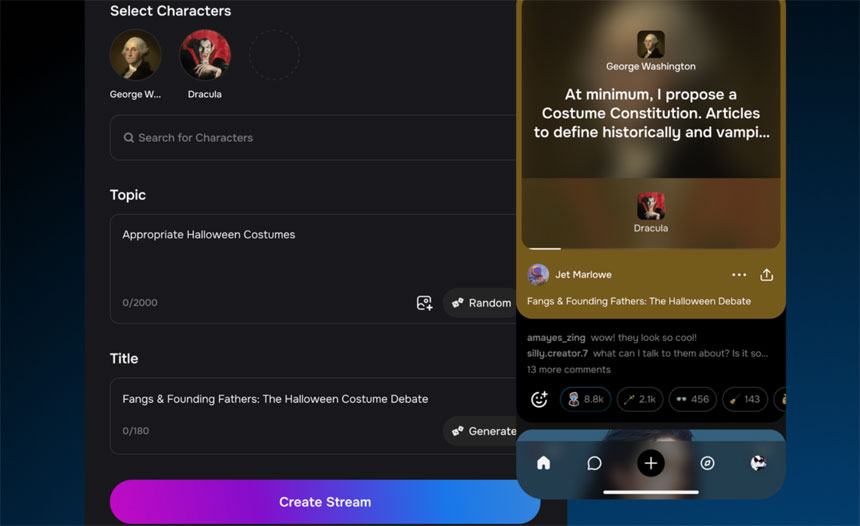
    Meta launched this month a host of 28 AI-powered chatbots — all with unique backstories — across its messaging apps WhatsApp, Messenger, and Instagram.

    One is an AI assistant called Meta AI, similar to chatbots like ChatGPT and Claude 2. It’s powered by Llama 2, Meta’s latest LLM.

    For others, Meta partnered with cultural icons and influencers to play and embody some of these AIs. They’ll each have profiles on Instagram and Facebook:

    • Charli D’Amelio as Coco, Dance enthusiast
    • Chris Paul as Perry, Pro golfer helping you perfect your stroke
    • Dwyane Wade as Victor, Ironman triathlete motivating you to be your best self
    • Izzy Adesanya as Luiz, Showy MMA prospect who can back up his trash talk
    • Kendall Jenner as Billie, No-BS, ride-or-die companion
    • LaurDIY as Dylan, Quirky DIY and Craft expert and companion for Gen Z
    • MrBeast as Zach, The big brother who will roast you — because he cares
    • Naomi Osaka as Tamika, Anime-obsessed Sailor Senshi in training
    • Paris Hilton as Amber, Detective partner for solving whodunnits
    • Raven Ross as Angie, Workout class queen who balances fitness with meditation
    • Roy Choi as Max, Seasoned sous chef for culinary tips and tricks
    • Sam Kerr as Sally, Free-spirited friend who’ll tell you when to take a deep breath
    • Snoop Dogg as Dungeon Master, Choose your own adventure with the Dungeon Master
    • Tom Brady as Bru, Wisecracking sports debater who pulls no punches

    The company plans to add characters in the coming weeks played by Bear Grylls, Chloe Kim, and Josh Richards, among others.

    Their knowledge base – with the exception of Meta AI, Bru, and Perry – is limited to information that largely existed prior to 2023, which means some responses may be dated.

    These chatbots will include the possibility of adding AI stickers, which uses Llama 2’s an image generation feature called Emu.

    In addition, Meta introduced AI Studio, the platform that supports the creation of their AIs, which plans to make it available for people outside of Meta to build AIs. Developers will be able to build third-party AIs for Meta’s messaging services with their APIs in the coming weeks, starting on Messenger then expanding to WhatsApp.

    Businesses will also be able to create AIs that reflect their brand’s values and improve customer service experiences.

    AI Studio will be available in alpha to start, and Meta says that it’ll scale the toolkit further beginning next year.

    To accompany the release of AI Studio, Meta says it’s building a sandbox tool to be launched in the coming year that’ll “enable anyone to experiment with creating their own AI.” The plan is to bring this sandbox to Meta’s metaverse platforms, including Horizon Worlds.

    The bots are Meta’s latest bid to boost engagement across its family of platforms, particularly among a younger demographic.

    AI-powered personalities are also a reflection of a broader trend. Character.AI, Replika, and Inworld are already notorious brands in this space, too.

  • Spotify Pilots AI Translation for Podcasters, Improving the Traditional Dubbing

    Spotify Pilots AI Translation for Podcasters, Improving the Traditional Dubbing

    IBL News | New York

    Spotify announced this week that it started to pilot Voice Translation for Podcasts, an AI feature that automatically translates podcasts into additional languages.

    This technology keeps the podcaster’s voice, which sounds more personal and natural than traditional dubbing.

    As a result, a podcast episode originally recorded in English can now be available in Spanish and other languages while keeping the speaker’s distinctive speech characteristics.

    This Spotify-developed tool leverages the latest voice generation innovation, one of which is OpenAI’s technology.

    As part of the pilot, Spotify has worked with five podcasters — Dax Shepard, Monica Padman, Lex Fridman, Bill Simmons, and Steven Bartlett —to generate AI-powered voice translations in other languages, including Spanish, French, and German.

    “We believe that a thoughtful approach to AI can help build deeper connections between listeners and creators, a key component of Spotify’s mission to unlock the potential of human creativity,” said Ziad Sultan, VP of Personalization at Spotify.

    The translated episodes can be found at Spotify’s Voice Translations Hub.
    .


  • Google Announced a New, AI-Powered ‘Assistant with Bard’

    Google Announced a New, AI-Powered ‘Assistant with Bard’

    IBL News | New York

    Google announced yesterday Assistant with Bard, a generative AI-powered, new version of its mobile personal assistant integrated with Gmail and Docs.

    Essentially, it will be a combination of Google Assistant’s personalized help with Bard’s generative and reasoning capabilities.

    For now, it’s an early experiment. It will be accessible on Android and iOS mobile devices in the coming months. [See the simulations below]

    This Assistant with Bard handles text, voice, or image questions and tasks, such as “What’s the weather?”, “Set an alarm”, or “Text Jenny”, now with more intelligent responses.

    For example, it will be able to use the image as a visual cue, understand the context, and help with what you need.


  • Workday Will Embed Generative AI Features on Its HR Platform

    Workday Will Embed Generative AI Features on Its HR Platform

    IBL News | New York

    The finance and HR management company Workday (NASDAQ: WDAY) announced this week, during its annual customer conference in San Francisco, that it will embed in its platform a suite of new generative AI features aimed at increasing productivity, retain talent, and streamline business processes.

    The Workday generative AI capabilities will include:

    • Generating job descriptions for hiring managers and recruiters.

    • Analyzing and correcting contracts for sales and finance teams, comparing them against signed contracts.

    • Creating personalized knowledge management articles to keep employees informed about company policies and updates, improving the tone or length of the article, and translating them into different languages.

    • Automating the process of crafting past-due notices with recommendations to recapture missing funds sooner

    • Turning text-to-code to build custom apps faster. Its Developer Copilot tool, similar to code-generating services like GitHub Copilot and Amazon CodeWhisperer, will be natively embedded into Workday’s App Builder.

    • Creating employees’ work reports and retention plans, with a summary of their strengths and areas of growth. Data will be pulled from performance reviews, employee feedback, contribution goals, and skills.

    • Generating SoW for service procurement.

    • Providing conversational AI for users for summarization, search, maintaining context, etc.

    These new generative AI features for job descriptions, contract analysis, knowledge management, collections letters, app development, employee growth plans, and statements of work are expected to begin rolling out within the next six to twelve months, according to the company.

    “Generative AI has the potential to completely transform work as we know it,” said Sayan Chakraborty, Co-President at Workday.

    TechCrunch analysis detected many potential problems with Workday’s approach, especially regarding the employees’ performance reports.

  • Nolej AI Presented An Upgrade of Its Learning Content Generation Platform

    Nolej AI Presented An Upgrade of Its Learning Content Generation Platform

    IBL News | San Francisco

    Nolej AI presented at the TechCrunch Disrupt 2023 in San Francisco its upgraded version of its learning modules generation platform.

    Designed to keep teachers in the driver’s seat, the platform produces quickly gamified, bite-size portioned, supplemental materials, such as interactive quizzes, flashcards, games, and videos, that teachers can quickly review.

    It works in multiple languages, including English, French, Spanish, German, and Portuguese.

    To tackle the phenomenon of hallucination, Nolej AI works with much smaller parameters, relying on user-provided materials rather than the internet at large.

    Nolej AI integrates into learning platforms existing workflows, including Google Classroom, Moodle, Microsoft Teams, and Canvas LMS.

    “Knowledge aims to boost not only knowledge retention and engagement but also course completion rates,” Nolej Executive Chairman Vincent Favrat explained. “Massive online courses are infamous for their high dropout rates, but interactive learning that’s optimized for an online setting can keep students plugged in.” 

    The company is also working on a tool called Nolej LX, which is geared more toward self-directed learning by mapping out the nodes of learning necessary to cobble together an understanding.
    .


  • AWS Announces the Availability of Its ‘Bedrock’ Model and ‘QuickSight’ for BI Visuals

    AWS Announces the Availability of Its ‘Bedrock’ Model and ‘QuickSight’ for BI Visuals

    IBL News | New York

    Amazon Web Services (AWS) this month announced the general availability of Bedrock, a fully managed service that offers a choice of generative AI models from Amazon itself and third-party partners through an API, including Meta’s open-source LLM ‘Llama 2’.

    Bedrock, which was unveiled in early April, allows AWS customers to build apps on top of generative AI models and customize them with their proprietary data. It competes with Google’s Vertex AI.

    Brands and developers can leverage these models to create AI agents that automatically execute tasks like booking travel, managing inventory, and processing insurance claims.

    AWS said Llama 2 will come to Bedrock in the coming weeks, joining models from AI21 Labs, Anthropic, Cohere, and Stability AI.

    Another application made available in preview by AWS will be Amazon QuickSight, a unified BI service that offers interactive dashboards, paginated reports, embedded analytics, and customizable visuals.


    QuickSight Community page
    QuickSight Demo Central

  • The “Freshman Year for Free” Online Platform Surpasses 400,000 Learners

    The “Freshman Year for Free” Online Platform Surpasses 400,000 Learners

    IBL News | New York

    The NYC-based philanthropy dedicated to making a college degree more affordable, Modern States Education Alliance announced last month that its initiative “Freshman Year for Free” reached over 400,000 registered students on its online learning platform.

    Its website ModernStates.org offers a collection of 30+ free freshman-level courses online that lead to credit at 2,900 U.S. colleges and universities. Students can use these courses to earn college credits by preparing for and taking credit-bearing CLEP exams, as offered by the College Board.

    To date, students have completed 128,000 courses and received reimbursement by Modern States for exam fees.

    “Assuming 10 college courses per year, this is the equivalent of up to 12,800 free years of college; a potential savings of approximately $300 million, at an average cost of college of $30,000 per year, all in,” said the philanthropic organization.

    “Modern States exists to help all people, of any age and background, including high schoolers and adult learners, save about a full year’s worth of money and time on their education,” said Steve Klinsky, Modern States Founder and Chief Executive Officer.

    Modern States.org was launched in 2017 and since then it has forged several partnerships with like-minded organizations, including the Carnegie Corp., the Hearst Foundation, The Heckscher Foundation, The Starr Foundation, the “I Have a Dream” Foundation, The Archdiocese of New York, etc.

    It runs over a custom Open edX-based platform with courses also created in partnership with IBL, the parent company of the IBL News service.

  • Mistral AI Releases Its 7B Model Under the Apache 2.0 License

    Mistral AI Releases Its 7B Model Under the Apache 2.0 License

    IBL News | New York

    The French start-up Mistral AI made available for free download this week its 7B model, including a 13.4 gigabyte torrent, under the Apache 2.0 license.

    The company, which has raised $113 million to date, has also started a GitHub repository and Discord channel for collaboration and troubleshooting.

    Mistral 7B is a further refinement of other small and large language models like Llama 2, offering similar capabilities at a considerably smaller compute cost.

    “Our ambition is to become the leading supporter of the open generative AI community, and bring open models to state-of-the-art performance,” wrote Mistral’s team in a blog post.

    “Mistral 7B’s performance demonstrates what small models can do with enough conviction. This is the result of three months of intense work, in which we assembled the Mistral AI team, rebuilt a top-performance MLops stack, and designed a most sophisticated data processing pipeline, from scratch.”

    Mistral’s business model is based on making users to pay if they want to dig in. The company is actively working on hosted solutions and dedicated deployment for enterprises. Its commercial offering will be distributed as white-box solutions, making both weights and code sources available.

  • ChatGPT Can Now Browse the Internet, and the Data is No Longer Limited to Before September 2021

    ChatGPT Can Now Browse the Internet, and the Data is No Longer Limited to Before September 2021

    IBL News | New York

    ChatGPT paid users — on Plus and Enterprise premium accounts — will now be able to browse the Internet and access data beyond September 2021, the earlier cutoff of the chatbot. OpenAI plans to expand this feature to all users “soon”.

    The company had earlier tested this feature through the Bing search engine within its premium ChatGPT Plus offering, but it was later disabled.

    OpenAI also announced a major update earlier this week that would enable ChatGPT to have voice conversations with users and interact with them using images, moving it closer to popular AI assistants like Apple’s Siri.