Author: IBL News

  • Noodle Will Launch a University Partnership Platform with a Sharing Fee of 15% to 35%

    Noodle Will Launch a University Partnership Platform with a Sharing Fee of 15% to 35%

    IBL News | New York

    New York-based, John Katzman-created OPM (Online Program Manager), Noodle, announced last week an online platform intended for universities interested in the lifelong learning market. Columbia Business School, University of Michigan, and Case Western Reserve University have already have signed on as partners. 

    “Noodle’s platform puts university brands front and center, and provides learners with a better experience from start to completion,” said Noodle CEO and Founder John Katzman.

    Scheduled for early 2022, the platform has been developed in partnership with D2L (Desire to Learn LMS), AstrumU, and other providers.

    “Unlike other platforms that take 50-65% of revenues from universities, Noodle’s platform asks for only 15-35%,” added Katzman.

    The platform provides AI-powered recommendations, microsites, teaching assistants, and counselors, as well as collaboration tools like chat/video messenger and group newsreels. It also allows schools to share their own content and those of other universities.

    “The chances that everything you’ve learned by age 21 will take you through retirement are increasingly slim,” said Nikhil Sinha, an advisor to Noodle.


  • Michael Crow Proposes a Radical Change in Higher Ed through Technology-Enabled Design [Video]

    Michael Crow Proposes a Radical Change in Higher Ed through Technology-Enabled Design [Video]

    IBL News | New York

    Michael Crow, President at Arizona State University (ASU), advocated during the ASU+GSV Summit last week in San Diego, that the U.S. universities should be redesigned so they can take responsibility for student success and deliver knowledge through technology and adaptive learning.

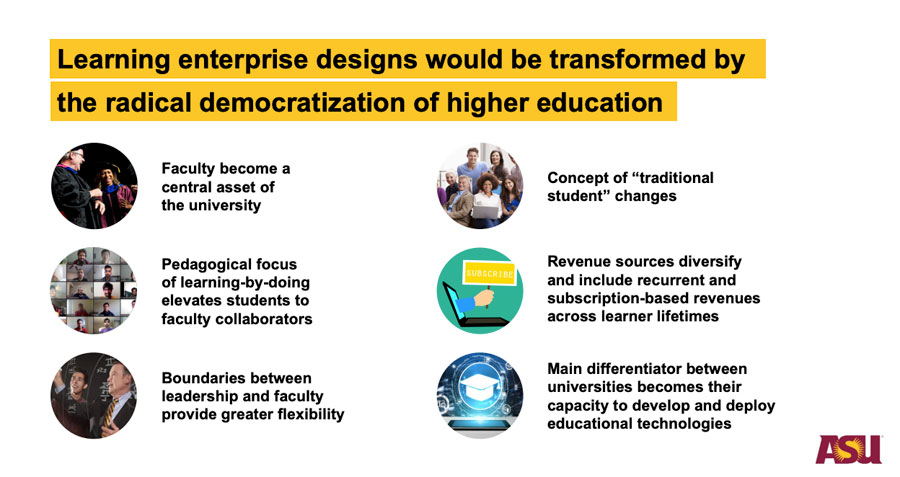
    “We propose the radical democratization of higher education through technology-enabled design,” he stated.

    Throughout a 25-minute talk [Slides in PDF], he stressed that “ASU is emerging as a National Service University.” “We are a prototype; a new type of public university.”

    “National Service Universities aspire to accelerate positive social outcomes through the seamless integration of cutting-edge technological innovation and scalability,” he said on August 10 during his talk titled “Transforming higher education to create the future we want.”

    He highlighted that the “main differentiator between universities becomes their capacity to develop and deploy educational technologies.”

    “Our faculty is the driver,” noted ASU’s President. Moreover, “faculties are the central assets of universities.” In his view, innovation should be executed around this idea.

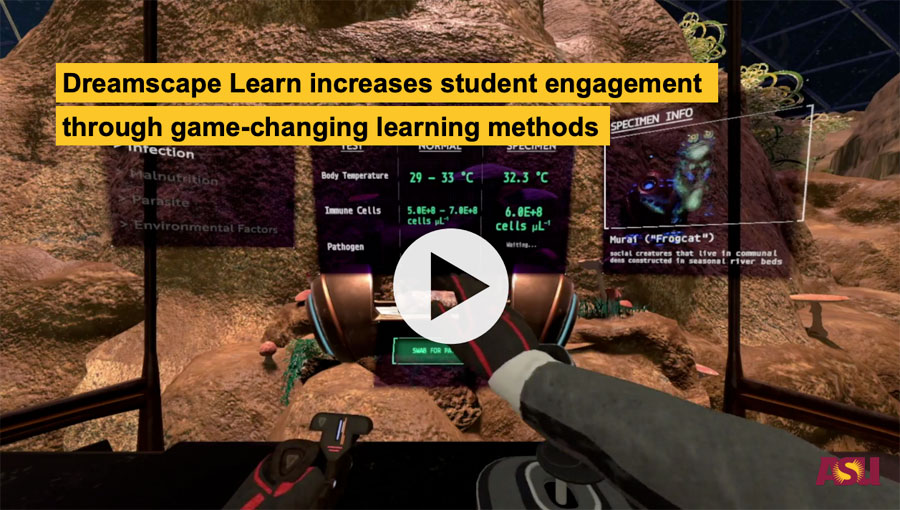
    Among other initiatives, he mentioned the project of Dreamscape Learn, “that increases student engagement through game-changing learning methods.”

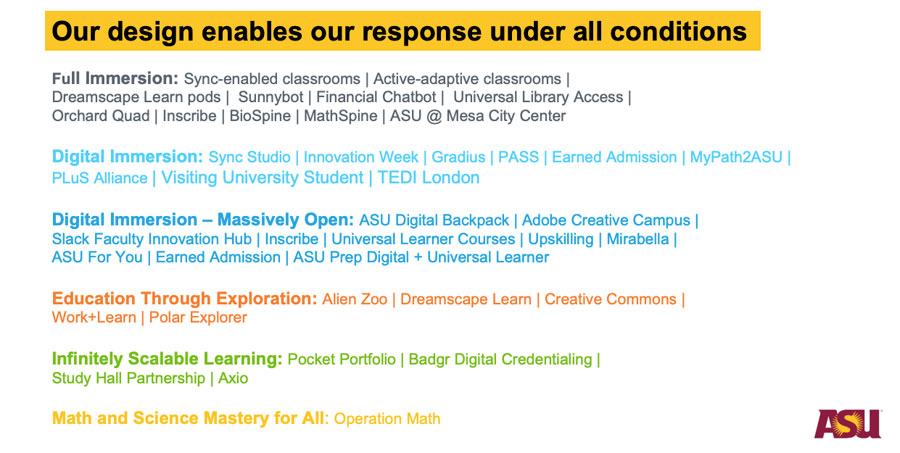
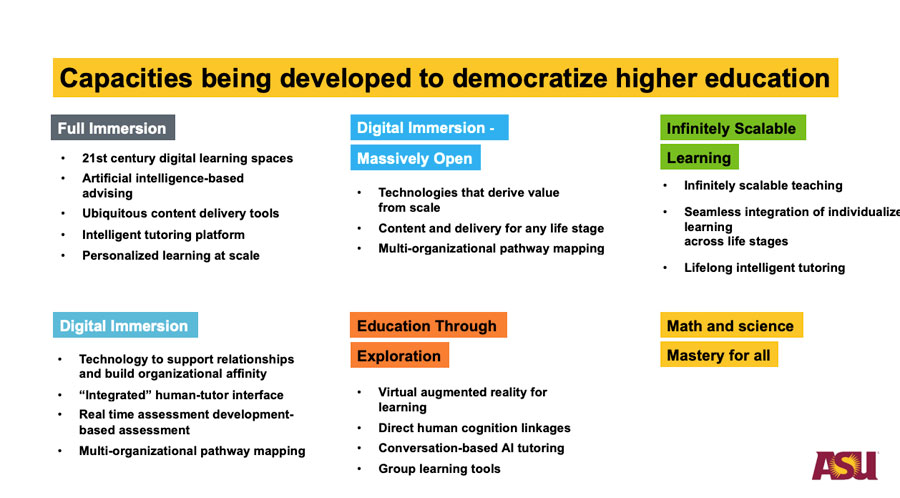
    At the end of his presentation, Michael Crow detailed the capacities developed by ASU to democratize higher ed: Full Immersion, Digital Immersion, Infinitely Scalable Learning, Education through Exploration, and Math and Science Mastery for All.

    Complete Talk:


    Selected Slides:


  • Cornell University Defies the COVID Pandemic and Refuses to Teach Online

    Cornell University Defies the COVID Pandemic and Refuses to Teach Online

    IBL News | New York

    Online teaching is here to stay and hybrid experiences are the norm today, as almost every speaker agreed during the ASU+GSV leading ed conference, which took place this week in San Diego.

    Now, a question arises: What are your options as an institution when you have a beautiful campus, follow your own business model, and enjoy a powerful brand? You can certainly defy the COVID fears and threat of upcoming variants and call everyone back to campus. That seems to be Cornell’s approach.

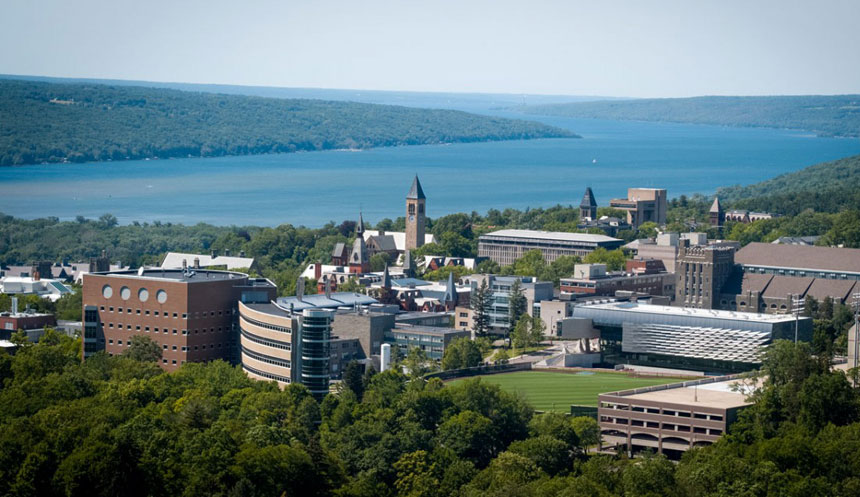
    This week, the Ithaca, New York-based university said that there will not be any remote teaching this semester, and it won’t consider any faculty request to instruct at a distance instead of in person. “Remote teaching is not an allowable substitute for in-person instruction.”

    In a letter addressed to faculty and instructional staff, Cornell’s Provost, Michael Kotlikoff, and Vice Provost for Undergraduate Education, Lisa Nishii, said that the institution, following “a rigorously scientific approach,” has determined that “it is appropriate to return our students, faculty and instructional staff to campus in order to resume normal in-person residential instruction.”

    “In-person teaching is considered essential for all faculty members and instructional staff with teaching responsibilities. Accordingly, the university will not approve requests, including those premised on the need for a disability accommodation, to substitute remote teaching for normal in-person instruction.”

    Some scholars have questioned the legality of Cornell’s stance in light of the ongoing COVID-19 pandemic, as Inside Higher Ed reported.

  • Emeritus Raises $650 Million and Reaches a Whopping Valuation of $3.2 Billion

    Emeritus Raises $650 Million and Reaches a Whopping Valuation of $3.2 Billion

    IBL News | New York

    Singapore-based Emeritus reached this week a valuation of $3.2 billion after closing a whopping round of $650 million, according to the company. The financing was led by Accel and SoftBank Vision Fund 2.

    Emeritus said that “proceeds will be used to develop new courses in conjunction with university partners, create new products and industry verticals, expand the company’s business serving governments and enterprises, double-down on new geographical markets, and fund acquisitions.”

    Founded in 2015 and with a staff of 1,400 employees today, the company recently bought iD Tech, expanding into the K12 space.

    According to its data, “Emeritus is on track to realize more than $500 million in bookings this year, making it the fastest-growing ed-tech skilling platform. Nearly two-thirds of its paid learner base is located outside the United States, with the company growing more than three times annually in emerging markets.”

  • The CEO of 2U Inc States that His Company Believes in the Open Source Movement [Video]

    The CEO of 2U Inc States that His Company Believes in the Open Source Movement [Video]

    IBL News | New York

    On the last day of the ASU+GSV Summit, Chip Paucek (CEO of 2U Inc.) and Anant Agarwal (CEO of edX) appeared together for the first time publicly, with the mission to convince skeptics and critics of the goodness and benefits for the industry of their recent merger.

    The two executives appeared on stage in the main session of the third and final day of the ASU+GSV Summit, which took place in San Diego this week. Deborah Quazzo, Managing Partner of GSV Ventures moderated this fireside chat.

    Chip Paucek and Anant Agarwal shared the same message of alignment in the mission and plans for the future. “The mission commitment made this deal,” 2U’s CEO said, and the edX chief responded, “No doubt.”

    “We will become the most powerful learning platform in the world,” said Paucek. “2U is Alphabet and edX, Google.”

    Acknowledging the difficulties of merging a Wall Street traded corporation with an educational non-profit organization, Anant Agarwal said: “Profit and non-profits are like oil and water, but in this case, 2U has legally abide by our mission.”

    Deborah Quazzo asked about the Open edX open-source software, which will be governed by a newly created non-profit organization by MIT and Harvard University. Chip Paucek insisted on 2U’s commitment to becoming the first contributor to the Open edX software, and said: “We believe in the open-source movement.”

    Anant Agarwal reinforced the idea by saying that “2U has become the world’s biggest developer of Open edX.”

    Chip Paucek also disclosed that Anant Agarwal’s son, Akash was working as an intern at 2U, which helped in their two organizations’ alignment.

    Agarwal highlighted that the Open edX will be enhanced with the new influx of financial resources, and anticipated that “AI will be built in a broader way.”

    Executives of the two organizations traveled to San Diego to meet and know each other, and for two days socialized and tried to bond.

    IBL News Video: Conversation on the future of Online Education: Deborah Quazzo talks to Chip Paucek (2U) and Anant Agarwal (edX) 

  • Coursera Reduces Its Fees to Partners to Trigger More Online Degrees

    Coursera Reduces Its Fees to Partners to Trigger More Online Degrees

    IBL News | New York

    Coursera (NYSE: COUR) announced this week a new tiered fee structure in an attempt to encourage university partners to produce more online degrees.

    With the new arrangement, Coursera will progressively reduce its service fee from 40% to 25%.

    To date, Coursera was splitting its revenues with university partners in a sharing model of 60% – 40%.

    Now universities that produce more online degrees might get 75% of the revenue in the highest tier of activity.

    The new structure will first roll out in North America and Europe.

    “Our new fee structure better supports universities that want to offer more degrees online,” said Jeff Maggioncalda, CEO at Coursera.

    The University of Illinois at Urbana-Champaign — which offers four degrees on the platform — and the University of Colorado Boulder — with two performance-based degrees — are reportedly among the first to embrace the new structure.

    With a global audience of 87 million learners, Coursera claimed that the number of degrees universities offer on its platform has grown by 55%.

    The new tiered arrangement might affect the direct competitor, edX, a property of 2U.

  • The ASU+GSV Summit Attracts Thousands of Attendees in San Diego

    The ASU+GSV Summit Attracts Thousands of Attendees in San Diego

    IBL News | New York

    With unprecedented measures against the COVID Delta variant — reflected in the request of double vaccination and PCR test for attendees — the leading EdTech conference in the world, the ASU+GSV Summit begun yesterday.

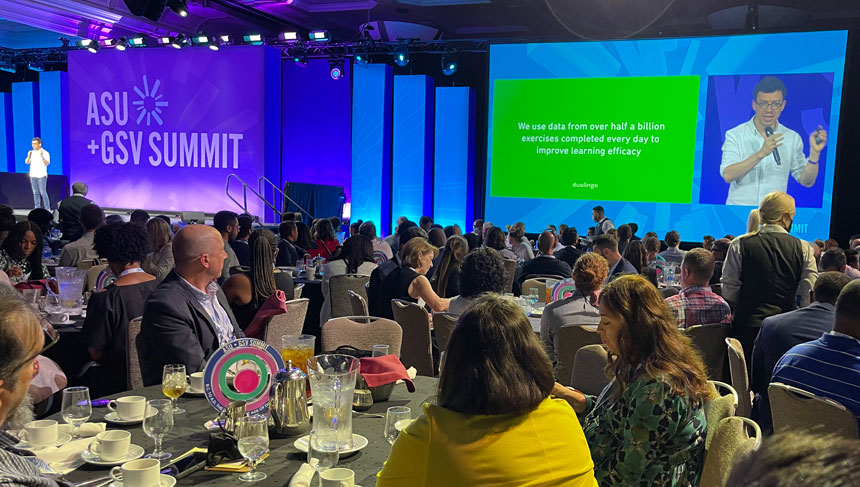
    Around 3,000 attendees flocked to San Diego’s Manchester Grand Hyatt Hotel, where the three-day event is taking place this week (9-11 August). A mix of wealthy investors looking for opportunities, rising start-ups, successful and aspiring entrepreneurs, academic presidents, and managers paid $3,500 for the entrance — nonprofit organizations paid one-third of it.

    Organizers managed the event smoothly, without the need to enforce the mandatory rule of wearing masks. The exception happened during lunchtime in the large ballroom of the hotel where hundred of attendees stayed maskless.

    The atmosphere among participants was relaxed. ASU+GSV insisted on the message, advertised on large screens, “We’re family”, in an attempt to calm the anxiety due to COVID / Delta. However, some speakers canceled at the last minute, afraid of the Delta variant spread. Moderators of the panels avoid mentioning it, and those speakers were simply removed.

    The 12th edition of the ASU+GSV adopted a hybrid format, with many talks broadcasted through the app. Virtual registration was free. The video stream worked fine.

    The event features 600+ speakers on a variety of subjects tackling higher-ed, K-12, workforce, and global education concerns. The summit includes the GSV Cup pitch competition for pre-seed and seed-stage education technology startups for $1 million in prizes. More than 700 startups have been judged by over 150 venture capitalists across the globe. The top 10 will compete at the summit, and the audience will vote for the winners.

    Arizona State University (ASU) President, Michael Crow, was once again the involuntary star due to his permanent focus on innovation. He participated in the first three panels in the morning, developed all in a tiny room packed with attendees. “We are at the beginning of innovation. Everything has been transformed except education,” he said.

    During the panel titled “Hollywood and Higher Ed Meet Up”, Michael Crow presented, along with film producer Walter Parkes, the Dreamscape Learn project, “a learning breakthrough initiative”, in his words.

    A staff of 125 people works on this exploration project based on creating immersive, Hollywood-quality virtual environments where students interact with an avatar.

    Crow criticized the fact that there is almost no national investment in education. “The U.S. laboratories are dedicated to everything but education.”

    Another initiative presented yesterday was the “Cintana Alliance,” a partnership between ASU and consultant and investor Doug Becker’s company, intended to introduce a new model for global universities.

  • Duolingo Plans to Expands Into an App for K-12 Students

    Duolingo Plans to Expands Into an App for K-12 Students

    IBL News | New York

    Duolingo is designing a math app for younger learners, the start-up disclosed in an interview of its CEO Luis von Ahn to TechCrunch.

    It seems that this app, which goes beyond Duolingo’s language teaching field, might be oriented to K-12 students between 3rd and 8th grade.

    In order to accelerate the development of the math app, Duolingo plans to execute an acquisition strategy.

    Von Ahn and his co-founder, Severin Hacker, thought about making Duolingo a math app before they jumped on language learning, as the company mentioned in its prospectus,

    Math-focused EdTech companies include Khan Academy, Brilliant.org, Photomath, Numerade, and the recently acquired Symbolab.

    Further details are expected to be revealed in the upcoming Duocon annual event, on August 20.

    Listed in the stock market at the end of July, Duolingo (NASDAQ: DUOL) reaching a valuation of over $5 billion, after a significant increase from $102 per share at the IPO to $134 today.

    Last week, Duolingo’s stock declined over 10%, as Chinese authorities removed from some app stores in China, signaling the government’s crackdown on for-profit education.


  • Robinhood, Now Featured as a Meme Stock, Had a Wild Week with a Gain of 56%

    Robinhood, Now Featured as a Meme Stock, Had a Wild Week with a Gain of 56%

    IBL News | New York

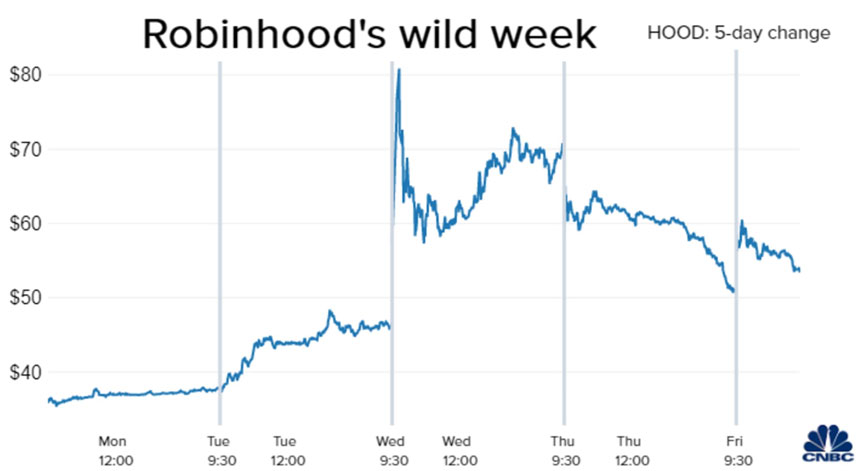
    The free-commission trading app Robinhood (NASDAQ: HOOD) closed a wild week trading up with a gain of 56.5%, after another jump of 7.9% this Friday. The stock ranked among the most actively traded companies valued at more than $500 million. The surge added $30.2 billion of market value to the controversial start-up.

    This wild ride contrasted with the lackluster debut on the Nasdaq last week.

    Analysts agree to feature Robinhood — whose app helped fuel the memeification of the market — as a meme-stock. The presence of amateur investors fueling rallies is truly confusing fundamental analysts.

    “It has officially become a meme stock, and this week’s wild ride could be just the beginning if legions of amateur investors pull money from their old favorites to buy more shares while insiders are dumping them,” wrote Bailey Lipschultz for Bloomberg.

    This meme status resembled the stock rallies of AMC and GameStop earlier this year.

    Insisting on this volatility, Eric Schiffer, chairman of Patriarch Organization, a Los Angeles-based private equity firm, said, “investors need to recognize that this is going to trade like a crypto or other meme-related stocks in the short run and they could see significant positional changes.”  

    Skeptics note on Thursday’s 27% drop after the news that existing stockholders would sell up to 97.9 million shares over time. On Friday, Robinhood reiterated that it was not selling any stock for now.

    “Robinhood is not itself selling any additional securities but filed the Resale S-1 on behalf of certain of its shareholders pursuant to a pre-existing contractual obligation,” Robinhood said.

    Anyway, the SEC would need to approve any transaction after Robinhood’s second-quarter earnings on August 18.

    The three-day rally of the stock began on Tuesday and it was triggered by news that Cathie Wood’s exchange-traded funds were snapping up shares. It was refueled when options started trading Wednesday.

    The market consensus is that when meme traders strike, the volatility will be unprecedented like it’s happening with crypto stocks.


  • Target Joins Walmart and Starbucks Offering Tuition-Free College Education

    Target Joins Walmart and Starbucks Offering Tuition-Free College Education

    IBL News |  New York

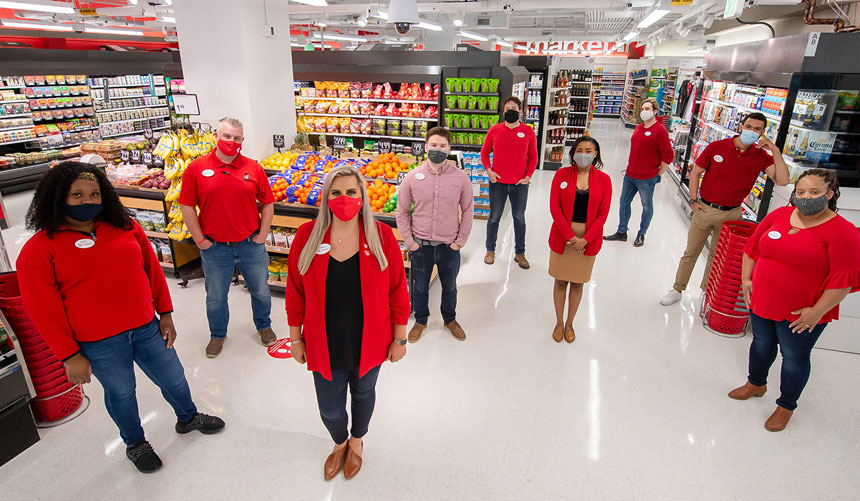
    In a bid to attract workers, Target announced an education program that will cover the cost of tuition on associate and undergraduate degrees at over 40 select institutions, including the University of Arizona, Oregon State University, University of Denver, and Morehouse College.

    It also will help pay for graduate school costs as well as master’s degrees — paying up to $10,000 each year.

    This way, Target joins other large corporations in the retail and hospitality business, such as Walmart, Chipotle, and Starbucks, that offer similar debt-free education along with payments toward graduate programs. Their goal is to attract job candidates in a competitive market.

    Developed in partnership with Guild Education, Target’s program will apply to part and full-time workers, starting this fall.

    The national retailer will cover — in direct payments to the academic institution — the full cost for 250 programs aligned to its business, such as computer science, information technology, and business management. If an employee chooses a different specialty or seeks a graduate degree, Target will pay up to $5,250 each year.

    Over the next four years, Target said that it plans to invest $200 million in its education program.

    Last week, Walmart announced that starting August 16, it would cover 100% of the cost of college tuition and books for its employees at the company and Sam’s Club.