Mamdani’s advice to New Yorkers ahead of heat dome
Source: Youtube

Mamdani’s advice to New Yorkers ahead of heat dome
Source: Youtube

IBL News | New York
Anant Agarwal, the founder of the edX platform, professor at MIT, and, since 2021, Chief Academic Officer at 2U, was hired as CEO of Grady, a Millburn, New Jersey-based, faculty-founded AI start-up specializing in grading and feedback. Agarwal will remain Founder and Senior Advisor at edX/2U.
“Grady holds every student to the instructor’s standard, and it keeps the instructor in charge. It effectively supercharges faculty and teaching assistants,” said Agarwal.
Founded by two university professors, Periklis Papakonstantinou of Rutgers University and Anastasios Sidiropoulos of the University of Illinois at Chicago, it is currently backed by Neotribe Ventures.
“Every student deserves precise, fair feedback that helps them grow, whether in a ten-person seminar or a four-hundred-person course, at an Ivy or a community college,” explained Papakonstantinou.
The instructor sets the standard, and Grady applies it across the course, so the same work is judged the same way whether it is the first assessment graded or the 80th. Students get detailed feedback while the material is still fresh, and faculty get back hours otherwise spent grading, along with a clearer view of the concepts a class has not yet grasped.
In conversation with IBL News this week, Anant Agarwal [in the picture] said,
“What drew me to Grady is the problem it takes on. Feedback and grading are incredibly important parts of learning and among the hardest to do well in a constrained educational system. At edX, we tried to build AI grading as far back as 2012, and I know firsthand how difficult it is. When I saw what Periklis and Anastasios had built, I was initially skeptical, so I tried it on my own MIT assignments. I was blown away! It graded handwritten work, schematics, and sketches, providing detailed feedback and requiring no training.”
“I have long believed that AI has the potential to make every teacher a super teacher. Grady is the clearest example of that I have seen. It keeps the instructor fully in control, steering, reviewing, and editing the feedback and grades before they reach students, and it gives faculty their time back for the human parts of teaching that matter most. Used this way, AI amplifies the teacher rather than replacing them.”
“This is an inflection point for education, much like the arrival of online learning was 15 years ago. I am energized to be building again and to help shape how AI strengthens teaching and learning in the years ahead.”
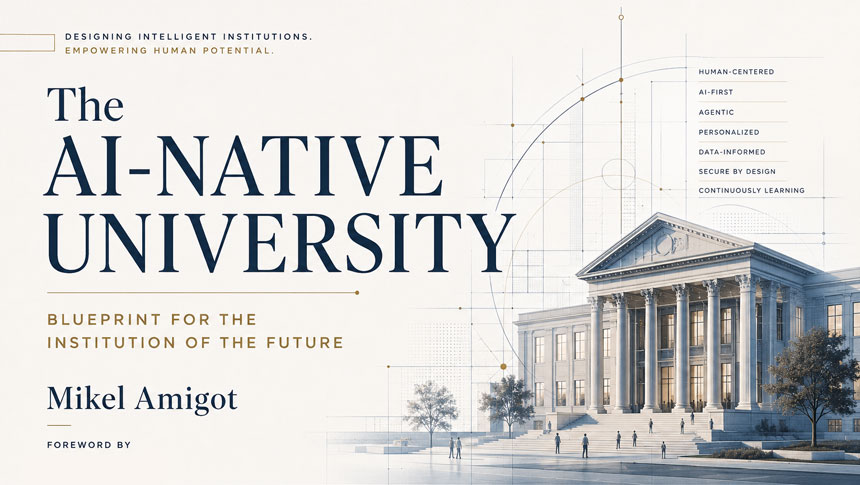
Mikel Amigot
Why This Book Had to Be Written
Every generation inherits a university shaped by the technologies of the one before it.
The medieval university was built around manuscripts and oral instruction. The Industrial Revolution gave rise to the modern research university. The computer transformed administration. The internet connected classrooms across continents. Cloud computing made education global.
Each technological revolution changed not only the tools universities used, but also how they fulfilled their mission. Artificial intelligence (AI) represents the next transformation. Yet this book is not about using AI in higher education. It is about reimagining the university itself.
Much of today’s conversation focuses on isolated applications: AI tutors, automated grading, chatbots and agents, plagiarism detection, content generation, or research assistants. These innovations are important, but they are incremental improvements to an institutional model designed long before artificial intelligence existed.
Adding AI to a university is like adding electricity to a factory built for steam power. The technology helps, but it does not fundamentally redesign the system. An AI-native university begins with a different question: If we were designing a university today, knowing that artificial intelligence exists, what would we build?
This question changes everything. It changes how students learn, how faculty teach, how research is conducted, how decisions are made, how institutions are governed, and, overall, how universities fulfill their mission to society.
Being AI-native does not mean replacing professors with machines. It does not mean automating every decision. Nor does it mean chasing the latest technology trend. Instead, it means designing an institution in which human and artificial intelligence work together intentionally. Faculty become even more essential as mentors, scholars, and creators. Students receive unprecedented levels of personalized support. Administrators gain intelligent partners that reduce complexity and improve decision-making. Researchers accelerate discovery while preserving academic rigor and integrity.
Throughout my career working with colleges and universities, I have had the privilege of witnessing both the extraordinary strengths of higher education and the immense challenges it faces. Institutions are being asked to educate more diverse learners, prepare graduates for rapidly evolving careers, expand access, improve outcomes, reduce costs, and innovate faster than ever before—all while operating under increasing financial and organizational pressure.
Artificial intelligence does not solve these challenges on its own. But it offers us the opportunity to redesign the institution in ways that were previously impossible.
This book proposes a blueprint for that redesign. It draws from years of collaboration with universities, technology leaders, faculty members, instructional designers, administrators, and students. It combines practical experience with an optimistic vision: that AI can strengthen, rather than diminish, the core values of higher education.
The university has endured for nearly a thousand years by continuously adapting to profound societal change. Artificial Intelligence is another such moment—not one to fear, but one to shape with wisdom, purpose, and courage.
The future of higher education will not be determined by artificial intelligence alone, but by the leaders who choose how to design institutions that use it wisely. This book is an invitation to those leaders. Not simply to adopt AI. But to build the AI-native university.
Mikel Amigot is a Spanish-American technology entrepreneur, software architect, and visionary in Artificial Intelligence for Higher Education. As the CEO of ibl.ai, he has dedicated his career to designing intelligent systems that empower universities and schools to teach, learn, conduct research, and operate more effectively in the age of AI.
Over the past decade, Amigot has worked alongside university presidents, provosts, CIOs, faculty members, instructional designers, and technology leaders to develop AI platforms that enhance every aspect of the academic enterprise—from personalized learning and student success to institutional analytics, administrative automation, and autonomous AI agents.
His work is driven by a simple belief: Artificial Intelligence should amplify human potential, not replace it. Rather than viewing AI as another educational technology, he sees it as the foundation for a new generation of institutions that are more personalized, more adaptive, more accessible, and better equipped to fulfill higher education’s enduring mission.
In The AI-Native University, Amigot introduces a comprehensive framework for redesigning colleges and universities around AI as a foundational institutional capability. Drawing on years of experience building AI platforms for higher education, he presents a practical blueprint for leaders seeking to prepare their institutions for the decades ahead.
Beyond technology, Amigot is passionate about the intersection of education, leadership, ethics, Christianity, and innovation. His mission is to help institutions harness artificial intelligence responsibly while preserving the human relationships, intellectual curiosity, and pursuit of knowledge and wisdom that define the university.
The AI-Native University is the first in a series of works exploring how AI will transform education, organizations, and society.
The Next Great Transformation
How universities evolved:
Why Today’s Model Is Breaking
What Is an AI-Native University?
Every Student Has a Personal AI Mentor
The New Role of Faculty
Faculty evolve from lecturers to:
Personalized Learning at Institutional Scale
Curriculum That Evolves
Admissions Without Friction
AI-driven:
Student Success Never Sleeps
AI for:
The Autonomous University
Every administrative department transformed:
The AI Workforce
AI-Augmented Scholarship
Institutional Intelligence
Moving beyond dashboards:
The AI Operating System
The university becomes an intelligent platform.
Topics include:
Designing an AI Agent Ecosystem
A framework for specialized agents across the institution:
How intelligent agents collaborate as a unified institutional ecosystem.
Governance, Ethics, and Trust
Leading Institutional Transformation
A Day in the Life of an AI-Native University
Follow one day in the lives of:
See how artificial intelligence quietly supports each role throughout the day.
The Roadmap
A phased implementation model:
Phase 1: AI-Enabled University
Phase 2: AI-Integrated University
Phase 3: AI-Orchestrated University
Phase 4: AI-Native University
For each phase:
Building the Institution That Learns
Appendix A — AI-Native University Maturity Model
Appendix B — Institutional Readiness Assessment
Appendix C — AI Governance Framework
Appendix D — AI Operating System Reference Architecture
Appendix E — The Institutional Agent Catalog (100+ examples organized by function)
Appendix F — Executive Implementation Roadmap (36 Months)
Appendix G — Glossary of AI-Native Higher Education Terms
IBL News | New York
Anthropic’s Mythos 5 is partially back, as about 100 trusted US organizations, primarily cybersecurity companies and critical infrastructure providers, do have access. Project Glasswing members, including Apple, Google, Cisco, Nvidia, and Microsoft, are authorized.
The company’s two most powerful AI models got pulled offline two weeks ago under a US government directive. Currently, Anthropic is actively negotiating to bring Fable 5 back for general use.
Claude Mythos 5 is Anthropic’s strongest cybersecurity model. It can autonomously find software vulnerabilities at a scale, such as thousands of high-severity flaws across every major OS and browser, including a 27-year-old OpenBSD bug and chained Linux kernel exploits.
That power is why it got locked down. The concern is that bad actors could use it to attack systems just as fast as defenders use it to protect them.
Since June 12, we’ve been working closely with the US government to restore access to Claude Mythos 5 and Fable 5. Today, the government notified us that Mythos 5, our strongest cybersecurity model, can be redeployed to a set of US organizations that operate and defend critical…
— Anthropic (@AnthropicAI) June 27, 2026

Rocket Lab Targets SpaceX's Starlink Dominance in New Deal | Bloomberg Tech 6/29/2026
Source: Youtube

Andrew Young on the State of the Union as America Marks 250 Years
Source: Youtube

Teaching Kids About Digital Money: From Piggy Banks to Mobile Apps | All Things Mobile
Source: Youtube

Drone video captures day 5 after Venezuela twin quakes
Source: Youtube

IBL News | New York
OpenAI may delay its planned 2026 IPO (initial public offering) until next year, according to the New York Times,
The San Francisco-based AI company is weighing whether to go public this year or hold off until 2027, as it aims to reach a $1 trillion valuation, up from the company’s last private valuation of $730 billion.
OpenAI confidentially filed its S-1 paperwork with the SEC on June 8.
Traders on the prediction market platform Kalshi think an OpenAI initial public offering will be announced by March 1, 2027.
Previously, OpenAI was widely expected to go public in 2026, the same year as Anthropic’s.
Also, at the beginning of June, OpenAI’s chief rival Anthropic confidentially filed for an IPO. Traders on Kalshi think there’s a 70% chance that Anthropic will officially announce a public market debut by December.
The New York Times said SpaceX’s public market debut — the first of what was expected to be several mega-cap IPOs this year — has made OpenAI’s advisors more cautious.
OpenAI has worried that Elon Musk’s company’s initial rally and subsequent fall signal that retail investors may have less interest in buying.
But a cascade of recent developments has caused OpenAI’s executives to shift away from their most aggressive aspirations. Top of mind is what has happened to Elon Musk’s SpaceX after its I.P.O. this month. It was the largest ever, raising more than $85 billion and reaching a valuation of
At its debut, SpaceX reached a valuation of $1.77 trillion, but since then the stock has been on a downward slide, with shares slumping to $153 at the end of Thursday’s trading day after reaching a high of $202 last week.
Moreover, investors question now whether AI companies will live up to their sky-high promises.
OpenAI reported roughly $13 billion in revenue in 2025, one of the people said, a number the company hopes to triple this year. OpenAI said this year that it was generating $2 billion in monthly revenue and has more than 2 million business customers.
OpenAI, run by Sam Altman [in the picture above], is currently spending heavily on marketing and recruiting high-profile engineering talent from companies like Meta and Google. It is exploring other revenue streams, including dabbling in placing ads within ChatGPT and striking e-commerce deals with companies like Shopify and Stripe that would allow users to buy things from online stores within ChatGPT.