IBL News | Madrid, Spain
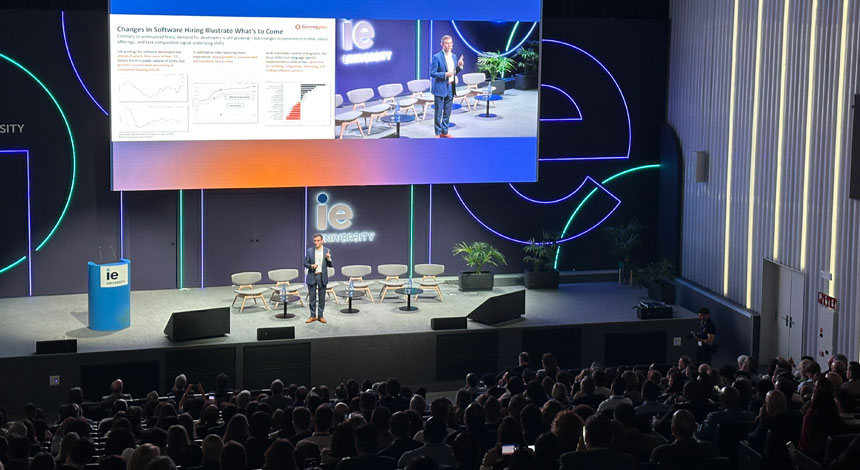
“Not many jobs will go away; AI’s impact will be on skills, but not on jobs,” said Matt Sigelman, President of The Burning Glass Institute, when delivering his latest labor market data research on how AI is restructuring work. “The changes in the software industry illustrate what’s to come.”
Sigelman was prominently featured in the run-up to the 10th World Bank Group Global Education Conference: “Building Skills for Tomorrow’s Jobs”, which took place in Spain, from June 17–19, 2026.
Over 400 leaders from higher education, industry, technology, and public policy attended three days of panels, fireside chats, and a dedicated AI Day at this conference, organized by The World Bank Group (WBG) and hosted across IE University’s campuses in Madrid and Segovia.
In a parallel event, lifelong educator Paul LeBlanc, former President of SNHU and currently a Visiting Scholar and Special Advisor at the Harvard University Graduate School of Education (HGSE), presented his upcoming book, “Reclaiming Purpose: The University in the AI World,” which will be launched on July 23.
LeBlanc said that “now there is a unique opportunity to get back to the university’s original mission.” He explained, “We are going to have precision learning, a highly precise model against an all-fit model.”
- “Universities are the answer to the world’s problems, as they have the mission to make the world better.”
- “We will move from the knowledge economy to the care economy.”
- “No one is built with the AI speed.”
- “Universities need to structure their data for creating a holistic student profile in this AI age. Now data is seated in silos. First, we need data together.”
 The Building Skills for Tomorrow’s Jobs” conference landed on a forceful message: the challenge of the AI era is skills, not jobs. The data show little evidence of mass employment displacement, but dramatic changes in what happens inside jobs.
Drawing on a dataset of 65 million US career histories and billions of job postings, the Burning Glass Institute found that approximately 30% of the skills required for an average job have changed over the past decade. Competencies that once remained relevant for a decade or more can now become obsolete within a few years of graduation.
“Only about 13% of credentials lead to meaningful wage gain,” stated Matt Sigelman, President of The Burning Glass Institute. “We need a nutrition label on credentials, so employers know what skills a worker has and what qualifies them for a particular job.”
Participants interviewed by IBL News agreed that AI handles entry-level tasks well, which creates a temptation for employers to eliminate junior positions. They shared Sigelman’s calling to governments to work with industry to define credential standards tied to real economic outcomes — not enrollment numbers.
Beyond the job market, the conference program touched upon at least seven key themes, according to IBL News’ analysis:
1. AI and Automation — How AI is redefining job roles, skill requirements, and entry points across industries, not just technology.
2. Generative AI in Education — How LLMs and digital platforms are transforming teaching, assessment, and institutional operations.
3. Future Skills — Consensus that creativity, collaboration, adaptability, and digital fluency are now baseline requirements. Technical knowledge alone has a shorter shelf life than ever.
4. Lifelong Learning — The degree-then-career model is dead. Continuous upskilling and reskilling are a necessity, especially for informal workers, care workers, and employees in shrinking sectors.
5. Work-Integrated Education — Real-world job exposure, co-curricular activities, and experiential learning embedded in degree programs, not as optional extras.
6. University–Industry Partnerships — The biggest actionable theme. Multiple panels argued that curricula must be co-designed with employers and updated in near real time, rather than on 5-year review cycles.
7. Job Clustering — Emerging career pathways based on evolving skill requirements, moving beyond traditional job titles to transferable skill profiles.
According to The World Bank, remarkable examples during the conference were:
• Spain: Santander Open Academy now offers hundreds of free AI and cybersecurity courses, reaching millions of learners in a single year — faster than any traditional curriculum process.
• Argentina: World Bank Group is supporting a university–mining company partnership project to create 10,000+ direct jobs and 50,000 indirect jobs by 2033.
• Malaysia: IFC is investing in Asia Pacific University of Technology and Innovation (APU) to scale tech and innovation programs across Southeast Asia.
• Philippines: The government is incorporating Google Career Certificates and AWS certifications into the national qualifications framework, as the BPO industry pivots to cloud and AI.
• Industry certifications: AWS, Microsoft, Google, Cisco, and Salesforce credentials were highlighted as signals of real productivity, often more current than academic degrees.
• IBM: Cited by the Burning Glass Institute as a company that made a concerted effort to remove degree requirements — reinstating them in some cases, but measuring and analyzing where skills-based hiring was working and where it wasn’t.
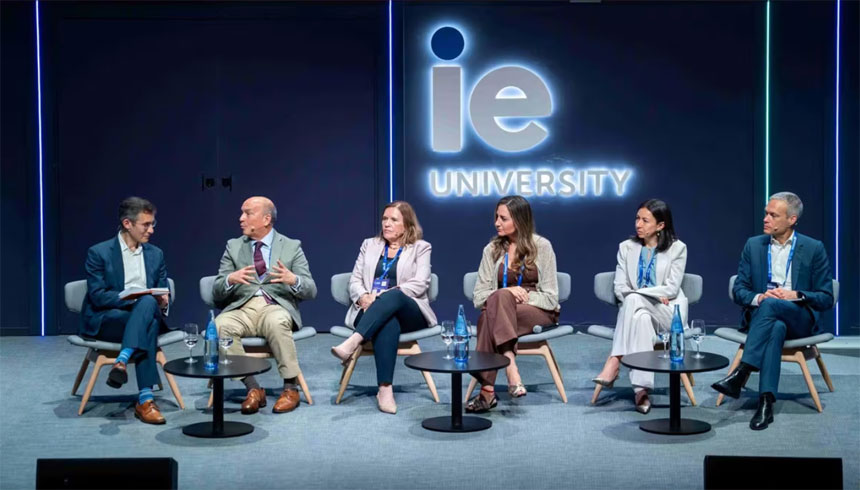
Among the panelists, leaders from IE University and Camilo Jose Cela University reflected on how economic, technological, and geopolitical forces are simultaneously reshaping education, employability, and entrepreneurship. They highlighted the profound implications of AI and digitalization, particularly at a time when 1.2 billion young people in developing countries are expected to enter the workforce in the next 10–15 years.
Manuel Muñiz, Rector, IE University:
“Periods of profound economic, technological, and geopolitical transformation place extraordinary demands on societies and institutions. The responsibility of universities is not simply to respond to change, but to help people understand it, navigate it, and ultimately shape it.”
Juan José Güemes Barrios, VP of Strategy and President of the Center for Entrepreneurship & Innovation, IE University:
“AI is not replacing human talent; it is redefining its value. As machines take over routine tasks, uniquely human capabilities — judgment, creativity, and an entrepreneurial mindset — become the real competitive advantage. Our responsibility, as educational institutions, is to prepare people not for the jobs that exist today, but for the opportunities we are not yet able to imagine.”
Nieves Segovia, President, SEK Education Group:
“Universities must evolve from teaching-centered institutions into connection nodes within broader ecosystems of learning, innovation, and social development — bridging the academic world, the business sector, social organizations, media, and public administrations.” “Beyond transmitting knowledge, higher education institutions are called to facilitate connections, build trust, and contribute to collective responses to the great challenges of our time.”
No formal signed commitments emerged or were published, but participants implied consensus on the idea that
universities are becoming platforms, not just campuses. The conversation pointed toward institutions acting as ecosystem orchestrators — connecting academic, corporate, governmental, and civil society actors.