Geoffrey Hinton is known as the ‘godfather of AI’, but after working in big tech he’s now warning of the dangers of this fast advancing technology.
Source: Youtube

Geoffrey Hinton is known as the ‘godfather of AI’, but after working in big tech he’s now warning of the dangers of this fast advancing technology.
Source: Youtube
IBL News | New York
Andreessen Horowitz posted the fifth edition of its Top 100 Gen AI Consumer Apps, reflecting data on how AI usage is evolving.
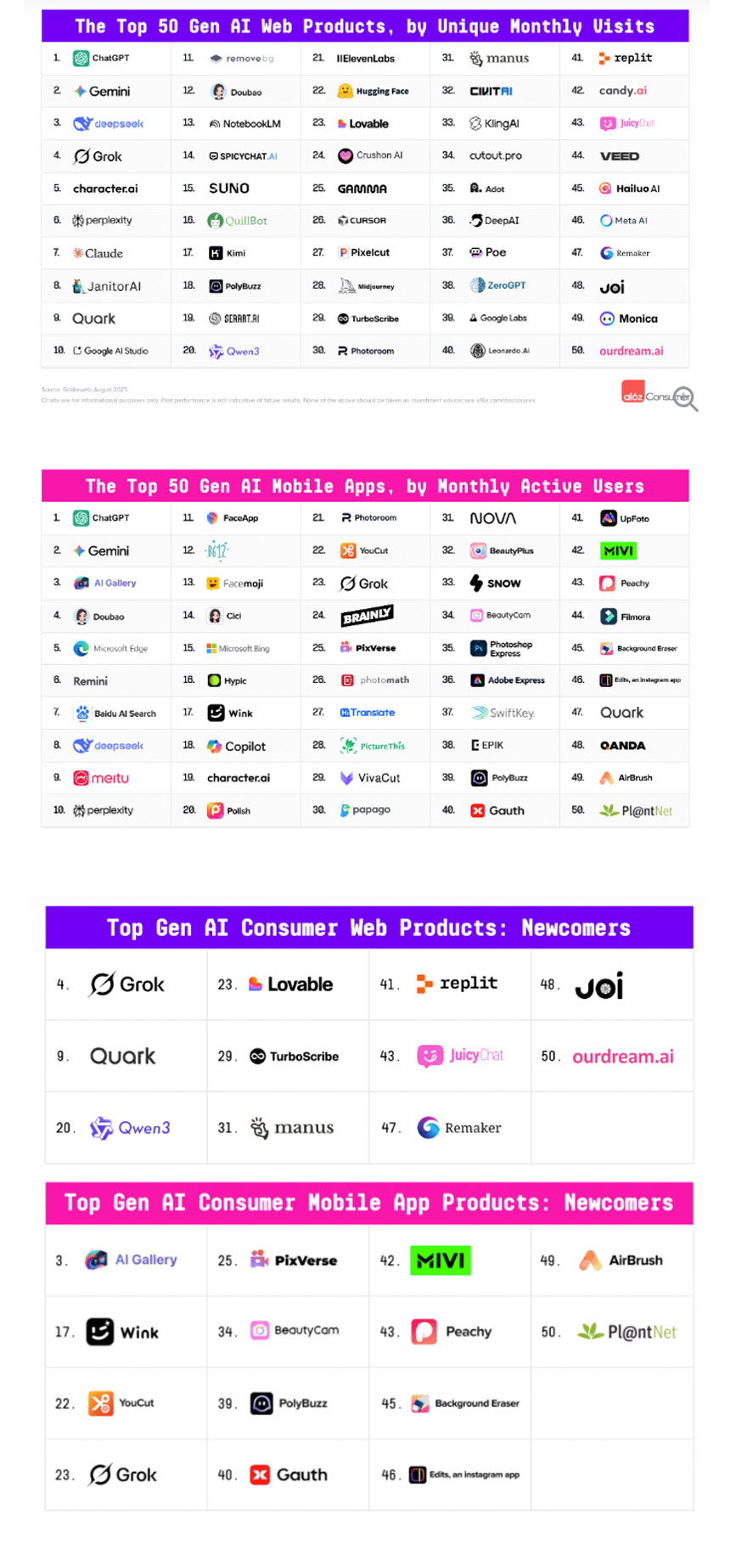
In the battle of the LLM assistants, ChatGPT still led, while Google, Grok (with its AI companion avatars and anime avatar Ani), and Meta were narrowing the gap.
DeepSeek, Claude, and Perplexity were on top, too.
As takeaways, Google listed four entrants on the web. Gemini came in second place behind ChatGPT, with 12% of ChatGPT’s visits on the web.
Google’s AI Studio, NotebookLM, and Labs became viral products. Labs hosts Flow, where users can try out video model Veo 3, Doppl (clothing try-on), Portraits (AI coaches), and Project Mariner (an agentic browser).
On the web list, three companies with over 75% of their traffic coming from China rank in the top 20: Quark, Alibaba’s “all-in-one” AI assistant, Doubao, Bytedance’s general LLM product, and Kimi, a chatbot from startup Moonshot AI.
Other Chinese apps include Hailuo and Kling (video generation models), SeaArt (image generation), Cutout Pro (image editing), and Manus and Monica (prosumer/productivity).
Chinese video models have an advantage over Western-developed models, both because there are more researchers focused on video in China and fewer IP regulations, which likely allows for training on copyrighted data.
An estimated 22 of the 50 apps were developed in China, while only three are primarily used in China. There is particularly heavy concentration in the photo and video category, as Meitu alone produced five entries: Photo & Video Editor, BeautyPlus, BeautyCam, Wink, and Airbrush. Bytedance is also a significant player, producing Douban (a general LLM assistant), Cici, Gauth (an edtech platform), and Hypic (a platform for photo/video editing).
Vibe coding apps are doing well. Examples are Bolt, Lovable, Replit, and database provider Supabase.
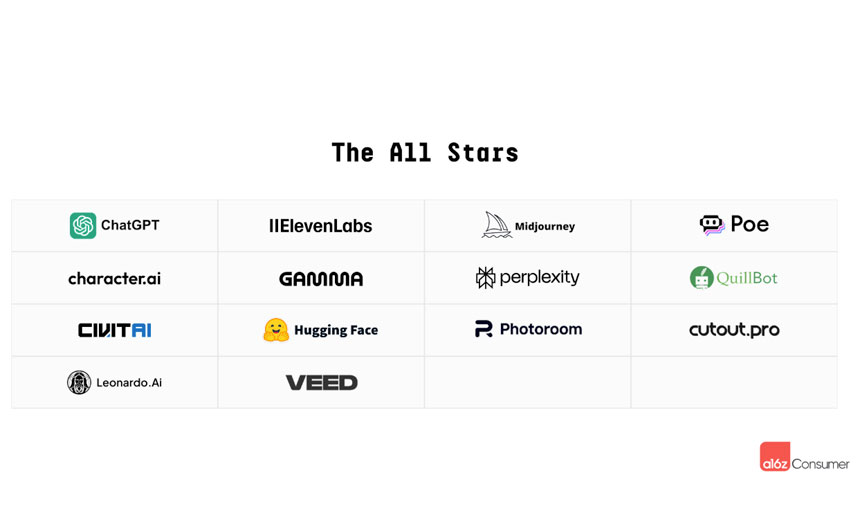
In consumer behavior with AI, the list shows general assistance (ChatGPT, Perplexity, Poe); companionship (Character AI); image generation (Midjourney, Leonardo); image and video editing (Veed, Cutout); voice generation (Eleven Labs); productivity tools (Photoroom, Gamma, Quillbot); model hosting (Civitai, HuggingFace), DeepAI (general assistance), JanitorAI (companionship), Pixelcut (image editing), and Suno (music generation).
Many utilize API-available or open source models from other companies, and some behave as model aggregators.
Listmakers come from just five countries: the U.S., the UK (Eleven Labs, Veed), Australia (Leonardo); China (Cutout Pro); and France (Photoroom, HuggingFace).
Midjourney is famously bootstrapped, and Cutout Pro has also not fundraised.
Links: Top 50 Gen AI Consumer Web Products
Adot AI
Candy Network
Character.ai
ChatGPT
Civitai
Claude
CrushOn
Cursor
Cutout
DeepAI
Deepseek
Doubao
Eleven Labs
Gamma
Gemini
Google AI Studio
Google Labs
Grok
Hailuo
Hugging Face
JanitorAI
Joi
Juicychat
Kimi
KlingAI
Leonardo
Lovable
Manus
Meta AI
Midjourney
Monica
NotebookLM
OurDream.ai
Perplexity
Photoroom
Pixelcut
Poe
Polybuzz
Quark
Quillbot
Qwen
Remaker
Remove.bg
Replit
SeaArt
Spicychat
Suno
Turboscribe
Veed
ZeroGPT
Links: Top 50 Gen AI Consumer Mobile Apps

Questions raised over AI rollout in schools.
Source: Youtube

Politicians, scientists, Nobel Prize winners and many leading artificial intelligence researchers have put out an urgent call for binding international measures over the use of AI.
Source: Youtube

Vineyard workers harvesting grapes are getting some help from an artificial intelligence-assisted electric tractor.
Source: Youtube

Artificial intelligence is set to become an integral part of the Australian economy. From robots to supercomputers, we are processing information faster than ever, and it is set to revolutionise the economy. Across everything from the technology sector to education, health care, and professional services, AI promises to reshape commerce and industry.
Source: Youtube
As more teens turn to artificial intelligence and AI chatbots, parents are asking: what is digital literacy and when should we start talking about it?
Source: Youtube

Oklahoma could be on the path to leading the nation in using artificial intelligence to monitor people on parole and probation.
Source: Youtube
As more teens turn to artificial intelligence and AI chatbots, parents are asking: what is digital literacy and when should we start talking about it?
Source: Youtube