Author: IBL News

  • Time to Cancel Your Ed Conference? Facebook Pulls Out of Its Biggest Event; Microsoft Follows

    Time to Cancel Your Ed Conference? Facebook Pulls Out of Its Biggest Event; Microsoft Follows

    IBL News | New York

    The Covid-19 coronavirus is prompting major tech conferences around the world to pull out of their events.

    Yesterday, Facebook announced the cancelation of its biggest event of the year, the F8 conference, over coronavirus-outbreak concerns and “in order to prioritize the health and safety of our developer partners, employees and everyone who helps put the event on,”  said the company in a statement.

    The conference, scheduled to be held in San Jose, California, on May 5th to 6th with an attendance of 5,000 people, will be replaced by “a combo of locally hosted events, videos, and live-streamed content,” Facebook said without providing further details.

    The cancellation highlights how the Covid-19 or coronavirus –which has infected so far over 81,000 people and killed more than 2,700, mostly in China– is causing widespread disruption.

    In the case of Facebook, the company recently pulled out of the March 9 Global Marketing Summit on March 9th, a 5,000-person marketing conference held in San Francisco. In addition, the company said its supply chain for hardware has been disrupted and its employees have been told not to travel to China. Meanwhile, employees who have visited China are being asked to work from home, according to Bloomberg.

    Facebook’s announcement followed other high-profile cancellations, including Microsoft and Unity, which pulled out of the Game Developers Conference scheduled for March 16th to 17th in San Francisco.

    In addition, Workday on Wednesday announced the cancellation of its March 2 sales conference. Two weeks ago, the Mobile World Congress, the largest trade show for mobile phones, was canceled in Barcelona, as well.

    San Francisco in State of Emergency

    The San Francisco Bay Area has some of the highest travel rates to and from China when compared to other regions in the US. On Tuesday, the mayor of San Francisco declared the city to be in a state of emergency, although there are still zero confirmed cases of the novel coronavirus in the city.

    The question now is whether other major conferences on tech and education as well will do the same. Google and Apple are also scheduled to have major conferences in the San Francisco Bay Area in May and June, respectively. For now, Google has confirmed that it is currently planning to host its I/O conference on May 12 to 14 in Mountain View.

    SXSWEdu

    South by Southwest  (SXSWEdu), the largest upcoming edtech conference, that attracts over 30,000 people, said it plans to continue with the event on March 13 to 22, although it recognizes having “a handful of cancellations.”

  • A Practical Course from MIT on edX Teaches How to Shape Your Future in the Age of AI

    A Practical Course from MIT on edX Teaches How to Shape Your Future in the Age of AI

    IBL News | New York

    MIT released a free, practical, eight-week-long course that provides resources and tools to plan a career path in the age of increasing dominance of artificial intelligence.

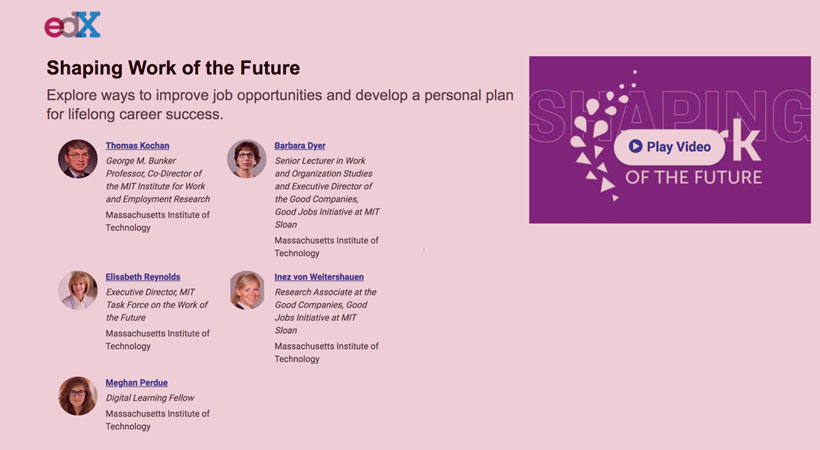
    The course, Shaping Work of the Future, is available through MITx on edX and may be accessed at any time of the year. So far, over 17,000 learners have enrolled in the class.

    Participants are eligible to sign up and receive an MITx Certificate upon completion.

    Now in its sixth year, Shaping Work of the Future, has added new content, such as case studies and lectures from MIT’s leading technology and workplace academics. This year’s partnerships include, among others, the World Economic Forum and the International Labor Organization.

    “The course goes beyond the headlines and focuses instead on what steps we can actually take to impact the future of work along with future-proofing our own skillset,” said the authors.

    The key to this year’s new content are findings from the initial report by the MIT Task Force on the Work of the Future with a focus on how to improve the quality of jobs, reduce income inequality and provide opportunities for long-term career success for everyone in the labor force. Additionally, featuring a case study on Optimax Systems, Inc.’s innovative management philosophy built on three key pillars, along with a a discussion on the ways participants can bring their ideas to fruition around the creation of a new social contract.

    Co-designers of the course includes Thomas Kochan, George Maverick Bunker, the Professor of Management at MIT’s Sloan School of Management, and the co-director of the MIT Institute for Work and Employment Research, and Elisabeth Reynolds, executive director of the MIT Task Force on the Work of the Future and the MIT Industrial Performance Center.

    Kochan has contributed two new lectures on “High Road Business Practices” and “The Role of Government” to the curriculum. Meanwhile, Dr. Reynolds’s contributed lectures on “Geography of Work” and “Policy Recommendations from the Task Force.”

    David Autor, Ford Professor of Economics at MIT, added a new lecture on “Work of the Past: Work of the Future”.

    “If we take the right actions, we can empower workers to build rewarding careers and shape the future of work in ways that meet the needs of individuals, families, economies, and societies,” said Prof. Kochan. “To do so, we first need to understand how work is changing, how firms can compete and prosper while still supporting good jobs, how to update the policies, institutions, and practices governing the world of work, and then outline a path for everyone to help build a new social contract. That’s what this course is all about!”

    Session topics are:

    Class 1: Challenges & Opportunities for Work: Today and Tomorrow

    Class 2: The Past Century of Work

    Class 3: How Emerging Technologies are Changing Work

    Class 4: Rethinking Skills and Education

    Class 5: The Role of Business in Shaping Work

    Class 6: The Role of Labor in Shaping Work

    Class 7: The Role of Civic Institutions and Government in Shaping Work

    Class 8: Putting it all Together: Social Contract Phase 2 and Developing a Personal Impact Plan


  • Cornerstone OnDemand Acquires Saba for $1.4 Billion

    Cornerstone OnDemand Acquires Saba for $1.4 Billion

    IBL News | New York

    Cornerstone OnDemand (NASDAQ: CSOD), a provider of talent management and professional development software, said it agreed to acquire Saba, which develops similar products and services, in a cash and stock deal valued at nearly $1.4 billion.

    “The combined company will have more than 75 million users and serve approximately 7,000 organizations, of all sizes, around the globe,” said the company in a statement on Monday.

    Founded in 1997, Saba went public in 2000. In 2015, it was acquired by private equity firm Vector Capital for $300 million. With 1,400 employees, Saba was serving over 4,600 corporate clients.

    This acquisition of Saba marks the second acquisition this year for Cornerstone OnDemand, which purchased the French skill development platform Clustree in January for $18.5 million in cash.

    Cornerstone’s shares didn’t lately perform well. The stock lost 32% in the past year, and performance has been even worse within this past week, with 33.2% down. After Cornerstone’s quarterly earnings conference call and the announcement of the deal, the loss has been 28.4%. The capitalization of the company is $3.55 billion.

    On a conference call with analysts, Adam Miller, CEO of Cornerstone, said:

    “We believe this transaction enables us to build a sustainable business for the long term. We have a shared passion for people development and will help thousands of organizations and millions of people around the world to overcome the skills divide. To provide a sense of the reach of this combination, a 2019 pro forma entity would have delivered nearly $820 million of ARR and $775 million in subscription revenue. When we first began to evaluate this transaction, we recognize that the time was right to do this deal. The talent management industry has rapidly evolved over the last several years. And as we look ahead to the next wave of industry innovation and took stock of the share size of our global market opportunity, we saw the acquisition of Saba is an excellent way to position Cornerstone for the long-term growth and innovation.”

    Cornerstone separately reported fourth-quarter revenue of $149.6 million, up 8.2% from a year ago. Most of that revenue was subscription-based. Net income for the fourth quarter was $9.4 million, or 15 cents a share.

    For 2019, Cornerstone reported revenue of $576.5 million, up 8.5%, with a net loss of $4.1 million, or 7 cents a share.


  • Udemy Claims a Valuation of $2 Billion and Announces 5,000 Corporate Clients

    Udemy Claims a Valuation of $2 Billion and Announces 5,000 Corporate Clients

    IBL News | New York

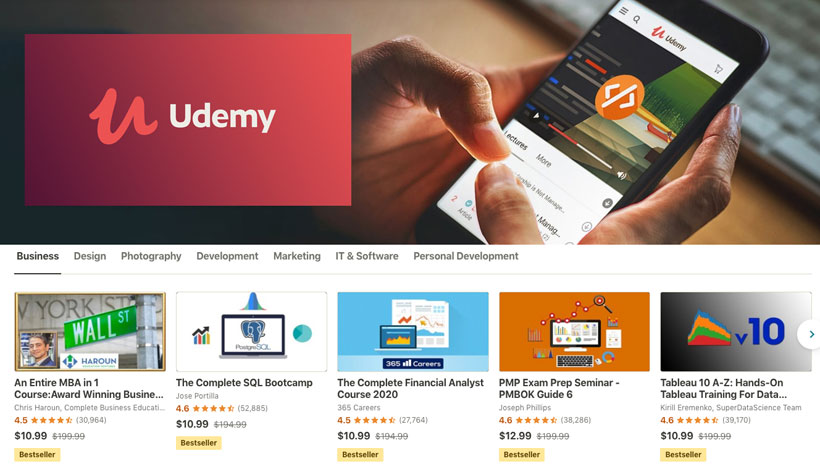
    Udemy.com claimed a $2 billion valuation, while announcing an investment of $50 million from its long-time partner in Japan, Benesse Holdings.

    “Udemy and Benesse are incredibly synergistic businesses. This investment is the next progression in our business relationship and demonstrates our confidence in what we can accomplish together,” said Tamotsu Adachi, CEO at Benesse Holdings. “The funding round follows a year of considerable growth for the Udemy globally,” explained Gregg Coccari, CEO at Udemy.

    Founded in January 2009, Udemy is one of the largest marketplaces for learning and teaching online, with 50 million students, a catalog of 150,000 courses, and 57,000 instructors.

    The San Francisco-headquartered company assures that it has issued over $350 million in lifetime payments to instructors, following its revenue-sharing model.

    According to its own data, Udemy for Business – the subscription-based access to 4,000+ courses for corporations – reached the milestone of serving over 5,000 corporate customers globally, including Adidas, Booking.com, Pinterest, Toyota, and Wipro, in 2019.

    Last year also, it introduced Learning Paths, enabling organizations to build personalized experiences and achieve specific outcomes, such as employee onboarding and career development.

    Unlike MOOC platforms like Coursera, edX, Udacity, and FutureLearn–that have partnered with universities and companies for content–Udemy allows anyone to create a course.

    To date, Udemy has raised more than $200 million in venture capital. In addition to Benesse Holdings, Udemy has attracted investors such as Stripes, Insight Venture Partners, and Norwest Venture Partners.


  • LabXchange.org Provides an Overview of the Features of Its Open edX-Based Science Platform

    LabXchange.org Provides an Overview of the Features of Its Open edX-Based Science Platform

    IBL News | New York

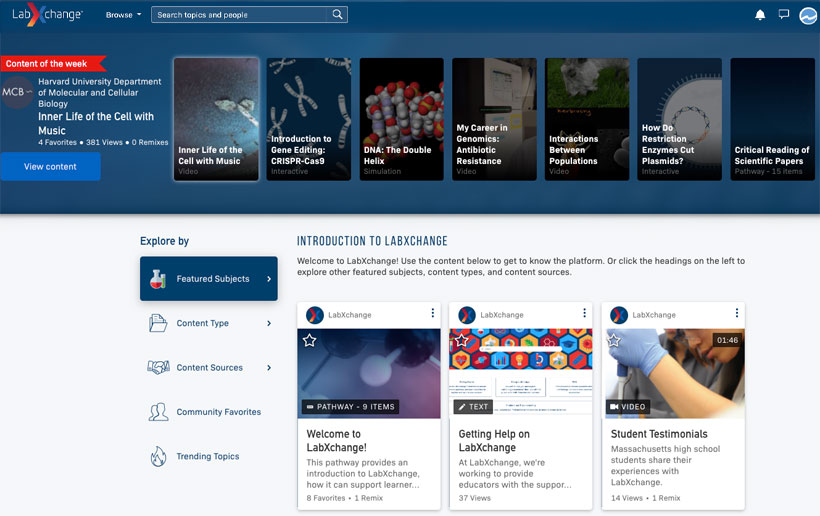
    edX provided this month with an overview of some of the technical features of LabXchange.org—Harvard University’s and Amgen Foundation’s recently launched new science education platform. These include a tool called Blockstore, Content Libraries version 2, a new XBlock Runtime, anonymous access, and a new visual assessment editor.

    Powered by Open edX open-source software and integrated with edX.org, the LabXchange platform uniquely allows users to freely combine assets together to create and share their own “learning pathways”, which contain videos, text, graphics, assessments, lab simulations, and other instructional assets. Much of the content focuses on the biological sciences.

    “You can actually pick the ones you want, sequence them into a learning pathway, and create a much shorter experience that’s really tailored to exactly what you need to learn,” explained Professor Robert Lue, Harvard’s faculty director of LabXchange. “We aim to address some of the gaps with current virtual learning, such as the lack of flexibility in the course structure.”

    The development of the platform and the program took two years. As a founding sponsor, the Amgen Foundation provided $11.5 million in grants. edX and European provider OpenCraft developed the code –partially available on GitHub.

    According to the Open edX website, these are the six most prominent features:

    • Single Sign On. Users can use a single account to learn on both LabXchange.org and edX.org, as the same LMS technology powers both sites.
      This was implemented using the auth-backends plugin, which allows any Django-based application to share user accounts with an Open edX instance.
    • XBlocks. Each piece of content on the LabXchange site, such as a video or interactive simulation, is an XBlock, just like each component of an edX or Open edX course. Most of the XBlocks used for LabXchange are identical to the versions used to build courses on edX.org, although many have a stylesheet applied to match the visual style of the LabXchange site. A few unique XBlocks are used for new content types unique to LabXchange, such as case studies or interactive simulations.
    • Blockstore. Blockstore is the next-generation content storage system for the Open edX platform, designed to replace the previous “modulestore” and “contentstore” systems that store data in MongoDB. Blockstore is versioned, scalable, format-agnostic, and file-based. That means that it provides a consistent foundation layer that can store video assets, XBlock definitions (OLX), metadata/tags, courses, and other things we haven’t yet thought of. Blockstore is designed to be able to hold terabytes of such data without losing performance. It’s also deliberately simple, creating a platform that developers can use to build experimental Open edX features and plugins much more easily than ever before.
    • Content Libraries v2, built using a new XBlock Runtime v2. This XBlock introduces the concept of “Learning Context” to the Open edX platform, where a learning context can be a course, a content library, a LabXchange pathway, a blog post, an admissions test, or any other virtual place where learning can happen. Using the LabXchange site, educators can search these content libraries to find content and assemble learning assets (XBlocks) into new learning pathways.
    • Anonymous Access – Users can use many features of LabXchange without needing to register an account, including viewing and interacting with learning assets (XBlocks).
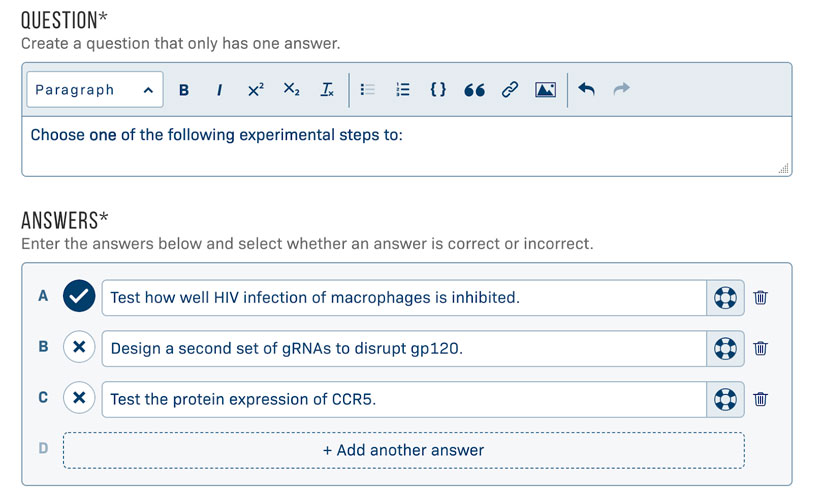
    • Visual Assessment Editor. LabXchange uses a new visual UI and style editor for problems designed to simplify both learning and authoring. It will be available to all in a future version of Open edX Studio. (See the graphic below).


    IBL News, January 24: Harvard and Amgen Announce LabXchange.org, an Open Platform with Scientific Content

  • Imperial College Launches a Free Course Explaining the Science Behind the Response to the Coronavirus

    Imperial College Launches a Free Course Explaining the Science Behind the Response to the Coronavirus

    IBL News | New York

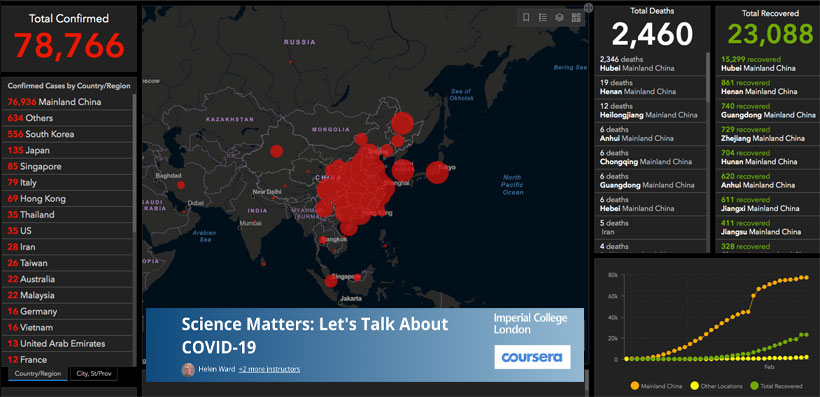
    As the coronavirus (COVID19) spread goes on, with 2,460 deaths and 78,630 infected so far, online learning resources multiply.

    This month, Imperial College London launched on Coursera a free online course about the science behind the response to the virus outbreak.

    Science Matters: Let’s talk about COVID19” features on video experts from the MRC Centre for Global Infectious Disease Analysis and Abdul Latif Jameel Institute for Disease and Emergency Analytics who have been working on modeling the epidemic, estimating the epidemic size, transmissibility, and severity since the first confirmed cases.

    The course provides with updates on the state of the epidemic and deals with topics including:

    • Basic Reproduction Number (R0) of an infection
    • Case Fatality Rate: Why it varies and why that matters
    • Community participation and the role of social media
    • Economics of an outbreak
    • Developments of a vaccine in real-time epidemics
    • Clinical presentations of COVID19

    Imperial College’s School of Public Health has launched a number of open specializations including “Epidemiology for Public Health”, “Foundations of Public Health Practice” and “Statistical Analysis for Public Health”. These specializations are part of Imperial’s first fully online degree, the Global Master of Public Health, also available via Coursera.

  • Udacity Releases a Program for Executives Looking to Incorporate AI into their Businesses

    Udacity Releases a Program for Executives Looking to Incorporate AI into their Businesses

    IBL News | New York

    Udacity will launch on February 25 an “AI for Business Leaders” Executive Program in partnership with BMW.

    The Founder and Chairman of Udacity, Sebastian Thrun, a German-American educator, and entrepreneur, made the announcement during his visit to the BMW Group in Munich yesterday.

    The course takes four to eight weeks to complete and it costs $799. It has been co-designed with the German automotive corporation.

    The program introduces the technical foundations and business applications of AI to executives responsible for making strategic technology decisions within their companies.

    For the capstone project, participants will need to develop and implement an AI strategy for their own company or with a predefined business scenario for an automotive manufacturer, or a news and telecommunications conglomerate.

    Professor Erik Brynjolfsson, Director of MIT’s Initiative on the Digital Economy, Schussel Family Professor at MIT, and co-author of The Second Machine Age, worked with Udacity to develop this Executive Program.

    Syllabus of the Program (PDF)
    Blog Post at Udacity

  • Coursera’s and U-M’s Data Science Specialization Will Cost $1 to Chinese Students

    Coursera’s and U-M’s Data Science Specialization Will Cost $1 to Chinese Students

    IBL News | New York

    In response to the coronavirus (Covid-19) outbreak, Coursera and the University of Michigan (U-M) announced that they will offer students in China three of their most popular Data Science Specializations for $1 a month for the next six months.

    The Specializations are Python for Everybody, the most popular specialization on Coursera; Python 3 Programming; and Applied Data Science with Python. Each specialization includes all the features of the paid version, including faculty instructors and final certifications.

    The University of Michigan School of Information (UMSI) has had a longstanding relationship with China.

    “A substantial number of Chinese students choose to learn with the school as part of its residential degrees.  Some UMSI faculty received education or degrees in China, and some conduct research there. So when we heard about the challenges faced by scholars and collaborators in China, we knew we wanted to do something to express our concern and lend a hand,” Jeff Maggioncalda, Chief Executive Officer of Coursera explained yesterday in a blog post.

    “We wanted to make a valuable contribution to our scholarly colleagues from China during this difficult time,” he added.

    Coursera’s Specializations are a series of online courses with credentials recognized across industries. Their pricing varies, with an option to pay monthly subscriptions ranging from $39 to $89.

    The University of Michigan also offers Data Science Specializations through its Michigan Online portal.

    The coronavirus, or Covid-19, has already infected more than 75,000 people in two months, and of them, 2,130 have died.

  • Course Hero: $100M in Revenue, 1M Subscribers, and a Valuation of $1.1 Billion

    Course Hero: $100M in Revenue, 1M Subscribers, and a Valuation of $1.1 Billion

    IBL News | New York

    The Redwood, California-based Course Hero education company, reached this month the billion-dollar valuation mark, after securing a $10 million Series B round from NewView Capital. This VC also put another $30 million into the company, purchasing shares held by employees and staffers.

    Valued exactly at $1.1 billion, Course Hero is now part of the so-called unicorn club, along with Coursera, Udacity, Guild Education, and Duolingo.

    Course Hero became profitable six years after it was founded in 2006. Since then, it grew rapidly as it provided students with a web place to share notes, assignments and other study materials from classes. In 2014, the startup raised $15 million in a Series A round, led by GSV Capital and IDG Ventures. Since then, the have been expanding by adding 24/7 homework help and tutoring services.

    In 2019, the company with 200 employees, surpassed $100 million in revenue, largely from a subscriber base of 1 million, each paying between $10 and $40 per month.  In addition, more than 30,000 college educators across the U.S. and Canada have signed up for the faculty portal.

  • Instructure’s CEO Steps Down and the Board Approves a Tender Offer to Acquire All Outstanding Shares

    Instructure’s CEO Steps Down and the Board Approves a Tender Offer to Acquire All Outstanding Shares

    Mikel Amigot | IBL News, New York

    Instructure (NYSE: INST) announced yesterday that Dan Goldsmith will be stepping down as CEO and as a member of the Board of Directors within two weeks. Goldsmith will remain with the company until March 6 “to help with the transition”, while a new replacement is sought through an executive search firm.

    Dan Goldsmith will receive a “golden parachute compensation” of over $12 million, sources exclusively told IBL News.

    This manager [in the picture, above] joined Instructure as president in June 2018 and became CEO in January 2019.

    The reason why he abruptly resigned or was removed was not officially disclosed, although investment banks speculated that the move increased the likelihood of the transaction getting completed. Apparently, Thoma Bravo’s offer of $49 per share was not sufficient to convince opposing investors.

    Also, yesterday, Instructure’s Board approved Thoma Bravo’s revised proposal based on buying the company at $49 per share in cash through a “tender offer” designed to acquire all outstanding shares of common stock directly from stockholders.

    “We encourage all stockholders to tender their shares in support of the transaction,” said Josh Coates, Executive Chairman of the Instructure Board of Directors.

    Pursuant to the revised agreement, Instructure finally announced that it will no longer hold the vote on the special meeting with stockholders, scheduled for February 25, 2020.


    IBL News’ Coverage of the Instructure Sale to Equity Firm Thoma Bravo