Author: IBL News

  • Opinion: Who Has the Time to Enroll in College Programs?

    Opinion: Who Has the Time to Enroll in College Programs?

    By Mikel Amigot

    With the job market changing so rapidly, our current knowledge is becoming outdated more quickly.

    Innovation in AI, data sciences and technology requires refreshed skills.

    When you work 60 hours per week, who has the time and energy to enroll in traditional college programs?

    Taking well-designed, learner-oriented online courses is the answer – throughout our lifetime.

    Stanford University’s vision for Higher Education in 2025 points to an interesting model: students take a few courses to gain skills and fill a job, and later return to school to add needed skills, following a continuous cycle until retirement.

    We will subscribe to college like we access Netflix or Amazon Prime.


            Mikel Amigot is the Founder of IBL News and IBL Education (Open edX)         

  • Overseas Freelancers Offer to Install Basic Open edX for $160

    Overseas Freelancers Offer to Install Basic Open edX for $160

    What is the minimum cost of installing a basic, by-default Open edX platform?

    The lowest price is free. Bitnami and OpenIBL.com offer a pre-configured image of the platform, with the possibility of adding more features.

    There are low-cost hosted services such as eduNEXT, OpenCraft and Appsembler.

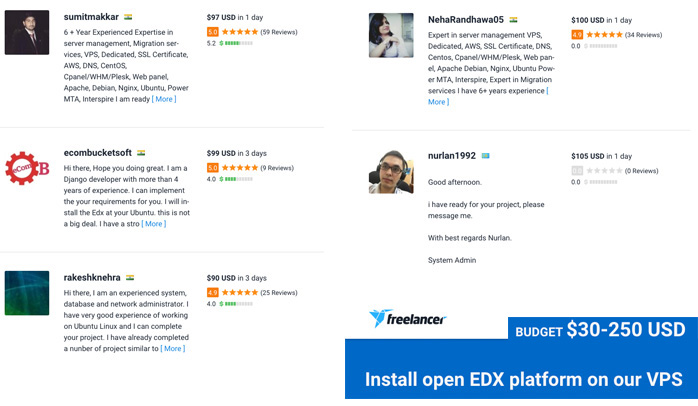
    And there is an increasing market of overseas freelancers who work on a very low budget.

    Freelancer.com recently posted this announcement: “We want to install Open edX on our VPS in a native manner. Our VPS is running Ubuntu 16.04. Budget $30-$250”.

    The request, written with some grammatical errors, was even demanding a document describing the installation process, which was described as “a bit tricky”, “with some errors”.

    Over 15 developers, mostly from India and Venezuela, responded to the request, trying to be hired for the job. The average bid was $162. Many freelancers were bidding $100.


  • United Nation’s Sustainable Development Courses on edX.org

    United Nation’s Sustainable Development Courses on edX.org

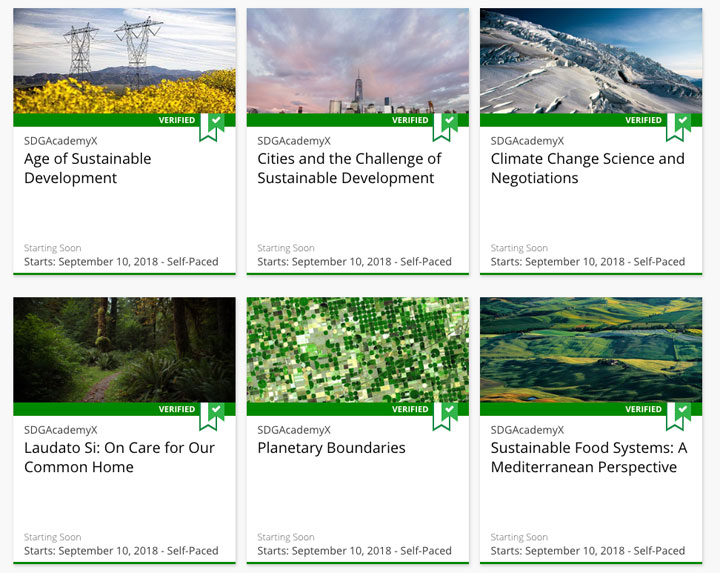
    SDG Academy, an initiative of the United Nations Sustainable Development Network (SDSN), will release 13 of their existing courses on edX.org this September, after joining the edX consortium.

    These free, graduate-level courses on sustainable development address the challenge of how people, communities, governments, and companies coexist, cooperate and collaborate in order to save the planet.

    Classes are taught by experts, under the leadership of Professor Jeffrey D. Sachs, from Columbia University. Most of the courses start on September 10 as part of the SDG Academy Fall semester.

    One of the notable courses revolves around Pope Francis’ Laudato Si encyclical. It raises the ecological crisis that humanity has created and issues a moral clarion call for urgent action to protect the earth. Its introductory video, below, is narrated by Bono. The course lasts for less than two hours.

    https://youtu.be/sW5rwlQPRrE


    Presentation video of the 10-week “Sustainable Food Systems: A Mediterranean Perspective” course:

    https://youtu.be/owMaxgwGclU


  • Open edX  | August 2018 Newsletter : Hawthorn, Jupyter Notebook, Georgia Tech, Campus-IL…

    Open edX | August 2018 Newsletter : Hawthorn, Jupyter Notebook, Georgia Tech, Campus-IL…

    Newsletter format  |  Click here to subscribe ]

    AUGUST 2018 – NEWSLETTER #8  |  More stories at IBLNews.org


    HAWTHORN

    • Hawthorn.1 Is Finally Here – edX Launches Its Eighth Version of the Platform

    • Open edX Hawthorn’s New Features

    • Hawthorn’s New Features Reviewed by the Community


    JUPYTER NOTEBOOK

    • Open IBL Jupyter Notebook: New Distribution of Open edX on AWS’ AMI Community

    • The 2018 Jupyter Notebook Conference Highlighted the Success of this Tool in Education


    COURSES & PROGRAMS

    • IBM’s CognitiveClass.ai Launches Two Professional Programs on edX.org

    • Georgia Tech Launches a Master’s Degree for $10K on edX.org

    • Op-Ed: Freshman Year Can Be Free Online For Anyone

    • Two MIT Professors Recognized For Their Methods and Technologies on edX’s MOOCs


    STRATEGY

    • NVIDIA Adds New Improvements to Its Open edX Training Ecosystem

    • Campus-IL, Israel’s National Open edX Platform, Consolidates Its Project

    • Podcast: Vermont Oxford Network (VON) Learning Platform In Depth

    University at Buffalo Explores How to Incorporate Virtual Immersive Pedagogy on MOOCs


    This newsletter about Open edX is a monthly report compiled by the IBL News journalist staff, in collaboration with IBL Education, a New York City-based company that builds data-driven, revenue-oriented learning ecosystems and courses with Open edX. If you enjoy what you read please consider forwarding it to spread the word. Click here to subscribe. 

    Archive:
    Newsletter #7 July 2018
    Newsletter #6 June 2018
    Newsletter #5 May 2018
    Newsletter #4 April 2018
    Newsletter #3 November 2017

    Newsletter #2 Octubre 2017
    Newsletter #1 Sept 2017

    Read also the latest IBL Newsletter on Learning Innovation

  • Hawthorn’s New Features Reviewed

    Hawthorn’s New Features Reviewed

    The new Open edX Hawthorn includes many new features and updates and, three weeks after its launch, the community keeps exploring them.

    Nate Aune, CEO at Appsembler, posted his discoveries on a recent post.

    This is a summary:

    • More granularity on how the learner is progressing without having to rely on graded assignments. Green completion checkmarks appear in the navigation bar when a learner completes a unit. Additionally, a unit is marked as “complete” when the learner has viewed all video and HTML content and has submitted answers to all problems. This feature has to be activated through the Django admin.
    • Ability to offer both video streaming options with adaptive video streaming. Video streaming automatically adapts to the learner’s connection speed. This is especially advantageous when accessing from mobile phones which run on lower-speed internet connections
    • A new mobile app with a streamlined finding new courses and bulk downloading videos all at once features, as well as more languages.
    • Updated HTML components in Studio to give course authors easier formatting and image insertion. Texts can be aligned left or right, centered, or fully justified. Images can be added directly without uploading them beforehand; it requires to activate this feature in Django admin.
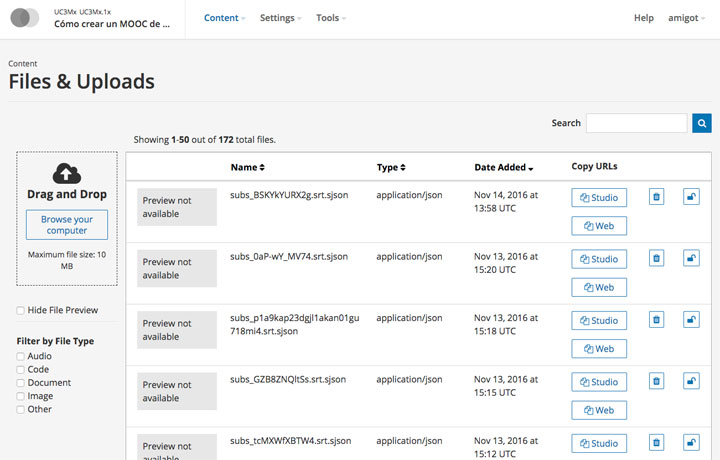
    • Improved Files & Uploads page with filters and drag and drop in the Studio CMS.
    • Weekly email message to learners listing course highlights as a way to keep them engaged. Activation of this feature requires several steps, as described in the documentation.
    • A user retirement feature to remove data in response to user requests for deletion following the European GDPR.
    • Improved learning profile page and discussion forum (with email report to users).
    • Ability to purchase all the courses in a program in one transaction, optionally with a discount.
    • Transferable student records.


  • Two MIT Professors Recognized For Their Methods and Technologies on edX’s MOOCs

    Two MIT Professors Recognized For Their Methods and Technologies on edX’s MOOCs

    Two MIT instructors were recognized with the 2018 MITx Prize for Teaching and Learning on edX.org MOOCs:

    • Chris Caplice, executive director of the MIT Center for Transportation and Logistics [left on the picture], received the award for his work on the MicroMasters Program in Supply Chain Management, which includes five 13-week courses and mirrors what MIT does in on-campus classes. Caplice is praised for his “dedication to creating a high-quality learner experience both in the courses and beyond, and his work to ensure the value of the credential through a rigorous assessment.”
    • Justin Reich, executive director of the MIT Teaching Systems Lab, was selected for his work on 11.154x (Launching Innovation in Schools). This six-week course encourages educators to apply the learning in a collaborative environment.

    The two instructors were selected from a pool of individuals who made significant contributions to the MITx MOOC coursework offered on edX.org in 2017.

    The prize, in its second year, is part of MIT’s effort to encourage content developed with new methods and technologies intended to engage online learners.


  • The 2018 Jupyter Notebook Conference Highlighted the Success of this Tool in Education

    The 2018 Jupyter Notebook Conference Highlighted the Success of this Tool in Education

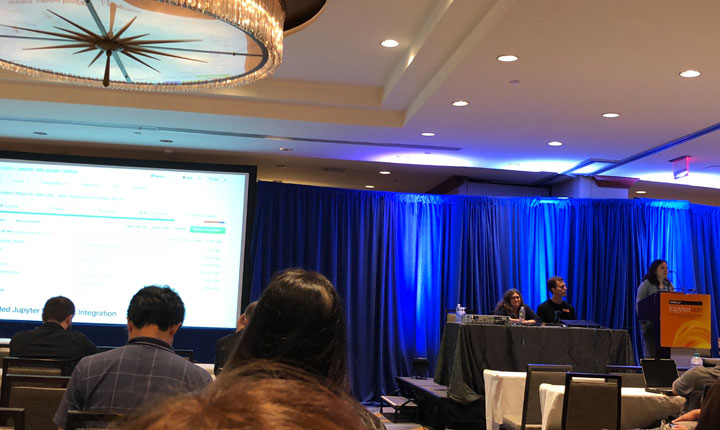
    The 2018 Jupyter Notebook conference, which took place last week in New York, dedicated this year roughly 20 percent of its talks to education (11 talks in total), a significant increase from 2017 when only a keynote and off-program session were scheduled.

    Professor Lorena Barba, from the George Washington University, set the tone, with a talk alongside Robert Talbert, from Gran Valley State University, about the flipped learning experiences with Jupyter. Prof. Talbert described it as “a new pedagogical model, where the instructor is a guide”, while Prof. Barba said that “Jupyter is a new genre of OER”. Also, “it is about discovering activities by working through structured computational software”.

    Scholars from Berkeley University explained how the institution successfully uses Jupyter Notebook on edX online classes, with 1,000 students in data8, plus 10,000+ in a free online edX version. Rob Newton, from Trinity School, advocated the use of Jupyter “for every schooler”, especially in Statistics and Calculus courses. In a passionate keynote, Carol Willing, from Cal Poly San Luis Obispo, highlighted that “Jupyter creates value and connects people”. Quoting Walt Disney, she said, “if you dream it, you can build it”Jessica Forte, from Jupyter [in the picture], praised the IBL Education work by integrating Jupyter into the Open edX platform and pointed the audience to the code on Github.

    The future of Jupyter in education was unanimously considered as extremely promising, and speakers agreed on the characterization of Tim O’Reilly –who was seen at the conference– on Jupyter, which this year received the ACM Software System Award, as “the next big thing”.

    At the beginning of the conference, Fernando Perez, Paco Nathan, and Brian Granger, who chaired the conference, summarized speakers, sponsors and attendants’ view with the sentence “Jupyter makes us successful”.

    Jeffrey Poore described in his blog Jupyter’s possibilities:

    “Jupyter is a powerful tool that should be a part of almost anyone’s toolbox. It might seem like it is a tool that is focused on Data Science and Machine Learning, but in actuality, it is way more than that. It can be a teaching tool, a code IDE, a presentation tool, a collaborative tool, and much much more. With tools like Jupyter Lab that are easily extensible, there is almost nothing that you couldn’t do directly in it.” 

    “Another example allowed you to play mp4 movie files. A third extension let you browse GitHub repositories. Extensions are written in NodeJS and can use UI technologies like ReactJS. If you can build it for a standalone website, you can build it to run inside a Jupyter Lab instance. This opens up possibilities for dashboards, applications, monitoring tools, and more. You could literally run your entire business through Jupyter Lab.”


    This is a selection of tweets:

     

  • University at Buffalo Explores How to Incorporate Virtual Immersive Pedagogy on MOOCs

    University at Buffalo Explores How to Incorporate Virtual Immersive Pedagogy on MOOCs

    Virtual immersive pedagogy is a hot area in higher-education.
    The University at Buffalo, part of the SUNY system, has announced that it will increase its research on how to incorporate VR and AR into forthcoming MOOCS.

    The emerging role of virtual and augmented reality tools in the teaching-learning and research space is a key innovation area within the SUNY (State University of New York) system.

    New research abstracts along with discoveries virtual immersive pedagogy will be presented at a SUNY’s FACT Symposium scheduled on November 9, 2018, in Albany, NY.

    Last July, the University at Buffalo (UB) demonstrated a robot safety course that integrated VR. That course was built on the new UB’s Open edX platform.

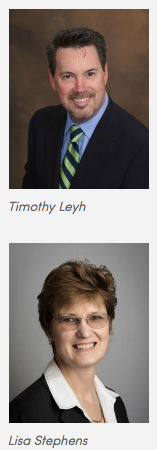
    “Virtual reality is rapidly advancing, enabling us to develop computer-generated learning environments that closely mimic the real world. In turn, students can interact with these environments in real-time, offering a richer educational experience,” said Timothy Leyh, executive director The Center for Industrial Effectiveness at UB.

    “This successful experiment could be a blueprint for colleges and universities looking to implement VR and other innovations into their online course offerings,” said Lisa Stephens, PhD, assistant dean of digital education in UB’s School of Engineering and Applied Sciences.

    UB’s partners in the project included the School of Engineering and Applied Sciences, the College of Arts and Sciences, the Center for Educational Innovation, and UB Information Technology.

    Other universities, such as Harvard, have been working to incorporate virtual reality into MOOCs. However, this approach to online learning is still in its infancy, which led UB and its partners to develop their own strategy for applying the technology.

    “The UB team is working to deliver virtual reality on a massive scale that includes built-in feedback for students and faculty,” said Lisa Stephens, PhD, assistant dean of digital education in UB’s School of Engineering and Applied Sciences.

    Multiple units at UB are collaborating, in addition to several partners, to launch an array of continuing education classes, and this VR test became part of that initiative.  “Fortunately, we were already working with IBL Education to help with the rollout, and when Crosswater Digital Media and Docola agreed to help with the pilot, we had the perfect expertise to realize this vision,” said Jay Stockslader, director of continuing education for UB’s College of Arts and Sciences.

    “The demonstration with collaborative robots captured in high-quality, 360-degree video was a great success. Imagine universities, companies and other organizations having the ability to train people how to work with robots in a realistic yet safe environment. People will already have vast experience before walking on to the job site,” adds Stephens.

    UB will launch a full collaborative robot safety course, without VR, on Sept. 4 on the Coursera learning platform.


  • Open IBL Jupyter Notebook: New Distribution of Open edX on AWS’ AMI Community

    Open IBL Jupyter Notebook: New Distribution of Open edX on AWS’ AMI Community

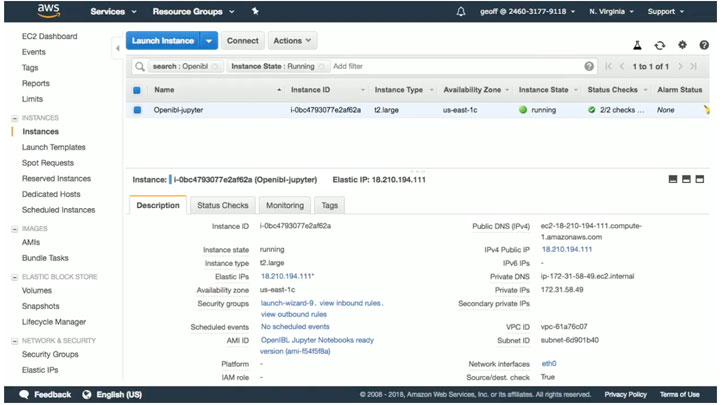
    IBL Education is launching today a Jupyter Notebook – ready Open edX distribution. Open IBL Jupyter Notebook is built on the Ginkgo.2 version of Open edX. This release is free and is ready to go from the AWS (Amazon Web Services) AMI community.

    In June, the IBL engineering team launched Open IBL, an easy-to-handle, production-ready distribution based on Open edX’s Ginkgo.2, which was equipped with a command-line builder. These two screencast videos explained the installation and configuration process. (Video 1, Video 2)

    This week, in parallel with the Jupyter Conference in New York (Aug 22-24), and also as a contribution to the educational community, IBL launches another version of the Open IBL distribution which includes the two recent Jupyter Notebooks-related Xblocks:

    1. Jupyter Notebook Viewer XBlock. It allows from any public Jupyter Notebook (e.g., in a public repo on GitHub), pull content into a course learning sequence using only the URL, and optional start and end marks (any string from the first cell to include, and the first cell to exclude). As a result of it, course authors will be able to develop their course content as Jupyter Notebooks, and to build learning sequences reusing that content, without duplication. It also has the added benefit that the development of the material can be hosted on a version-controlled repository. [See IBL’s post about the XBlock, and the code repository—the XBlock is open source under a BSD3 license.]

    2. Graded Jupyter Notebook XBlock. It allows to create an assignment using the nbgrader Jupyter extension, then insert a graded sub-section in Open edX that will deliver this assignment (as a download), auto-grade the student’s uploaded solution, and record the student’s score in the gradebook. The XBlock instantiates a Docker container with all the required dependencies, runs nbgrader on the student-uploaded notebook, and displays immediate feedback to the student in the form of a score table. [See IBL’s post, and the code repository—the XBlock is open source under BSD3.]

    This Open IBL Jupyter Notebook distribution has been created with the strategic and pedagogical support of Lorena A. Barba group, from The George Washington University.

    DEMO of Open IBL Jupyter Notebook

    Prof. Barba has been teaching with Jupyter for the last five years. Her first open teaching module using Jupyter was “CFD Python”, released in July 2013. In 2014, Barba developed and taught the first massive open online course (MOOC) at the George Washington University: “Practical Numerical Methods with Python.” The course was written entirely as Jupyter Notebooks, and it was self-hosted on a custom Open edX site (where it amassed more than 8000 users over 3 years).

    Jupyter is a set of open-source tools for interactive and exploratory computing. At the center of them is the Jupyter Notebook, a document format for writing narratives that interleave multi-media content with executable code, using any of a set of available languages (of which Python is the most popular).

    The two mentioned XBlocks, a brainchild of Prof. Lorena Barba and implemented by her tech partners at IBL Education, were presented at the 2018 Open edX Conference last May 30 in Montreal, Canada. Prof. Lorena Barba, from GW, and Miguel Amigot II, CTO at IBL Education, presented those two software extensions, intended to better integrate Jupyter into the Open edX platform.

    Barba, Lorena A.; Amigot, Miguel (2018): Jupyter-based courses in Open edX: Authoring and grading with notebooks. figshare. Presentation: https://doi.org/10.6084/m9.figshare.6553550.v1
  • Podcast: Vermont Oxford Network (VON) Learning Platform In Depth

    Podcast: Vermont Oxford Network (VON) Learning Platform In Depth

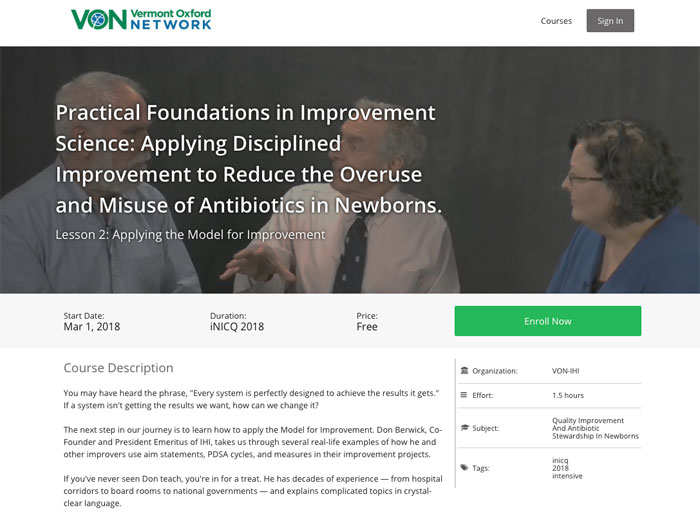
    The Open edX software-based Vermont Oxford Network (VON), a nonprofit collective of multidisciplinary medical professionals founded in 1998, has developed a uniquely collaborative, evidence-based learning network among clinicians of over 1000 neonatal intensive care units and hospital nurseries around the world.

    Denise Zayack and John McGregor, two of the VON’s program leaders, elaborated on their social and collaborative learning strategies, in a podcast–conversation with John Leh, a known independent educational consultant on his “Talented Learning Show”.

    VON’s learning platform, which uses the Open edX technology [disclosure: deployed by IBL Education], allows neonatal healthcare clinicians to earn credit and work together to gain knowledge and develop a learning improvement project they’ll continually modify over time.

    “We integrated different types of scaffolded learning to segment the content so they can focus on specific topics as work through a particular project and determine how they should best teach that to their users. So the learning experience has to be flexible, yet very targeted and segmented at the same time,” explained John McGregor.

    The Talented Learning Show Podcast: How Does Social Learning Improve Infant Healthcare?