Author: IBL News

  • Learning Innovation | May 2018: Jupyter, Open Source in Education, Teachable, General Assembly, Edmodo…

    Learning Innovation | May 2018: Jupyter, Open Source in Education, Teachable, General Assembly, Edmodo…

    MAY  2018  –  NEWSLETTER #11 ON LEARNING INNOVATION

    MOOCs have become a big business, with Coursera making $100 million in annual revenue and $70 million for Udacity.

    Project Jupyter received the ACM Software System Award, joining an illustrious list of projects that include Unix, the Web, and Java.

    Bain Capital will buy Penn Foster, a workforce-skills firm that dates back to late 1800s.

    Google released Grasshopper, a free app aimed at adults that teaches beginner coding skills via puzzles and quizzes.

    Open source technology will win in digital education, predicts Mark Walker, an engineer at edX.

    Entry-level hiring is broken, and the solution is to outsource this task, advocates Ryan Craig, author and an investor in this area.

    • Coursera launched six new degree courses and a certificate called Mastertrack, similar to edX’s MicroMasters.

    Teachable, which claims more than 7 million students, raised $4 million in funding.

    Investing in analytics is a priority among higher education leaders, according to a study.

    General Assembly was acquired by Switzerland’s Adecco Group for $412.5 million in cash.

    Thinkful acquired another coding bootcamp, Bloc, this year. In January, it bought Viking Code School.

    Edmodo, a leading, although unprofitable, social learning community with 90 million registered users, sold its business to China’s NetDragon for $137.5 million.

    ASU+GSV Summit attracted this year in San Diego over 4,100 people and 350 CEOs. EdSurge summarized what happened there.

    NYC Data Science Academy launched an online option for students who are not able to attend their in-person bootcamp classes.


    The IBL newsletter is a topic-curated email report compiled by Michael Amigot, Founder at IBL Education, a company specialized in Open edX technology and video course production at scale. If you enjoy what you read please consider forwarding it. Click here to subscribe.

    Archive:
    IBL Newsletter #10 – April 2018
    IBL Newsletter #9 – March 15, 2018
    IBL Newsletter #8 – March 1, 2018
    IBL Newsletter #7 – February 2018
    IBL Newsletter #6 – January 31, 2018

    IBL Newsletter #5 – January 15, 2018
    IBL Newsletter #4 – December 2017
    IBL Newsletter #3 – November 2017
    IBL Newsletter #2 – October 2017
    IBL Newsletter #1 – September 2017
  • MOOCs Become a Big Business

    MOOCs Become a Big Business

    The three big MOOC providers – Coursera, edX.org, and Udacity – have built effective marketing channels, having a unique competitive advantage because of their lower user acquisition costs of in the online degree space compared to traditional players.

    “MOOCs have become big business,” concludes the expert Dhawal Shah, director of Class-Central.com. Both the online degree and the corporate learning markets are their new revenue sources.

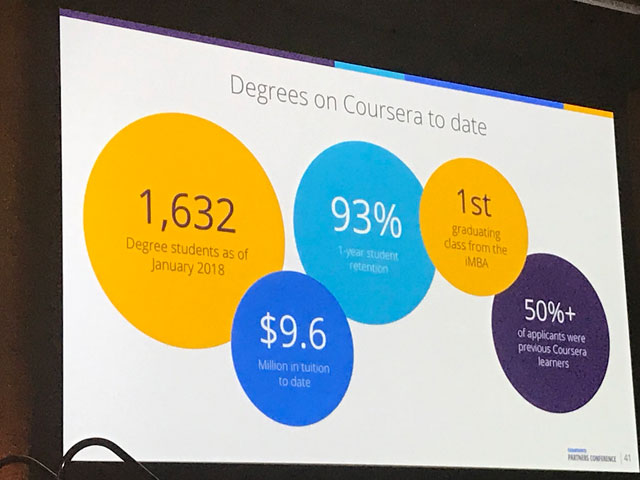
    • Coursera, with 1000+ corporate partners, is making $100M in annual revenue, according to Class-Central.com. Along with the launch of six new MOOC-based online degrees, Coursera recently disclosed they made $9.6M in tuition from their online degrees.
    • Udacity, with over 400 employees, got $70M in revenues in 2017, up from $29M in 2016.

    This optimistic atmosphere was shared two weeks ago in San Diego, during the ASU+GSV summit.  A panel of the top leaders provided hints, but no numbers, on the future of education and training at scale.

    • “Every degree will be offered online,” said Jeff Maggioncalda, CEO at Coursera. “Coursera for Business grew 300 percent last year”, he added. “CEOs want these programs for their employees”.
    • “We see many employees taking these MOOC-style courses”. “People will be constantly upskilling,” said Anant Agarwal, CEO at edX. “Education is now much more modular.” “Modularity and stackability are very important”.
    • “Now we see a job description and we do the curriculum”, revealed Vishal Makhijani, CEO at Udacity.

    Below is the video of the entire talk.

    “MOOCs Afters The “Madness”
    Moderator: Louise Rogers, Strategic Advisor, GSV Acceleration Fund
    Anant Agarwal, CEO, edX;
    Li Chao, President, Xuetang;
    Jeff Maggioncalda, CEO, Coursera;
    Vishal Makhijani, CEO, Udacity


  • Exponential Growth on Adoption of Open edX Websites and Courses

    Exponential Growth on Adoption of Open edX Websites and Courses

    The growth of deployed Open edX websites and produced courses significantly accelerated in the last year: from 340 websites to over 800, and from 240 courses to more than 800.

    These data come from the edX organization‘s internal research and are shown in the graphic above.

    The majority of these websites and courses are located out of the United States, although some big Open edX ecosystems have been released in the country; namely, NVIDIA‘s Deep Learning Institute to train engineers, Global Knowledge‘s new platform or George Washington University‘s Engineering initiative with courses using Jupyter technology.

    More details will be provided during the 2018 Open edX conference. Specifically, four edX managers will address the edX growth subject during a talk titled “The State of Open edX”. Also, Global Knowledge and GW’s representatives will talk about their projects.


  • An Open edX XBlock to Load Content from a Jupyter Notebook

    An Open edX XBlock to Load Content from a Jupyter Notebook

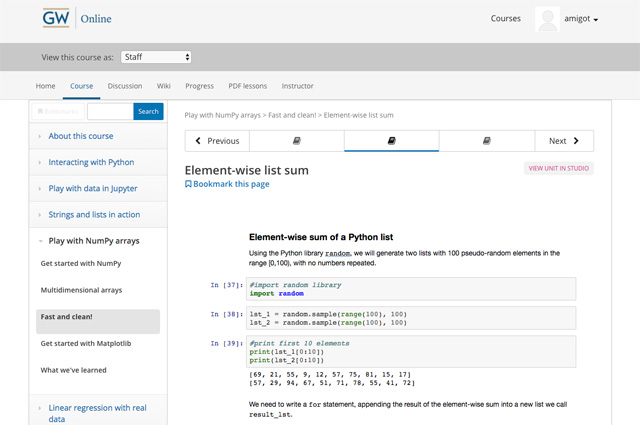
    George Washington University’s Professor Lorena Barba has announced the release of the Jupyter Viewer XBlock for the Open edX platform. This tool, developed in collaboration with IBL Education, allows to dynamically display content from a Jupyter notebook available on a public URL. It is available now as open source software on GitHub.

    Prof. Barba used the XBlock in the second half of her course module, Get Data Off The Ground with Python.

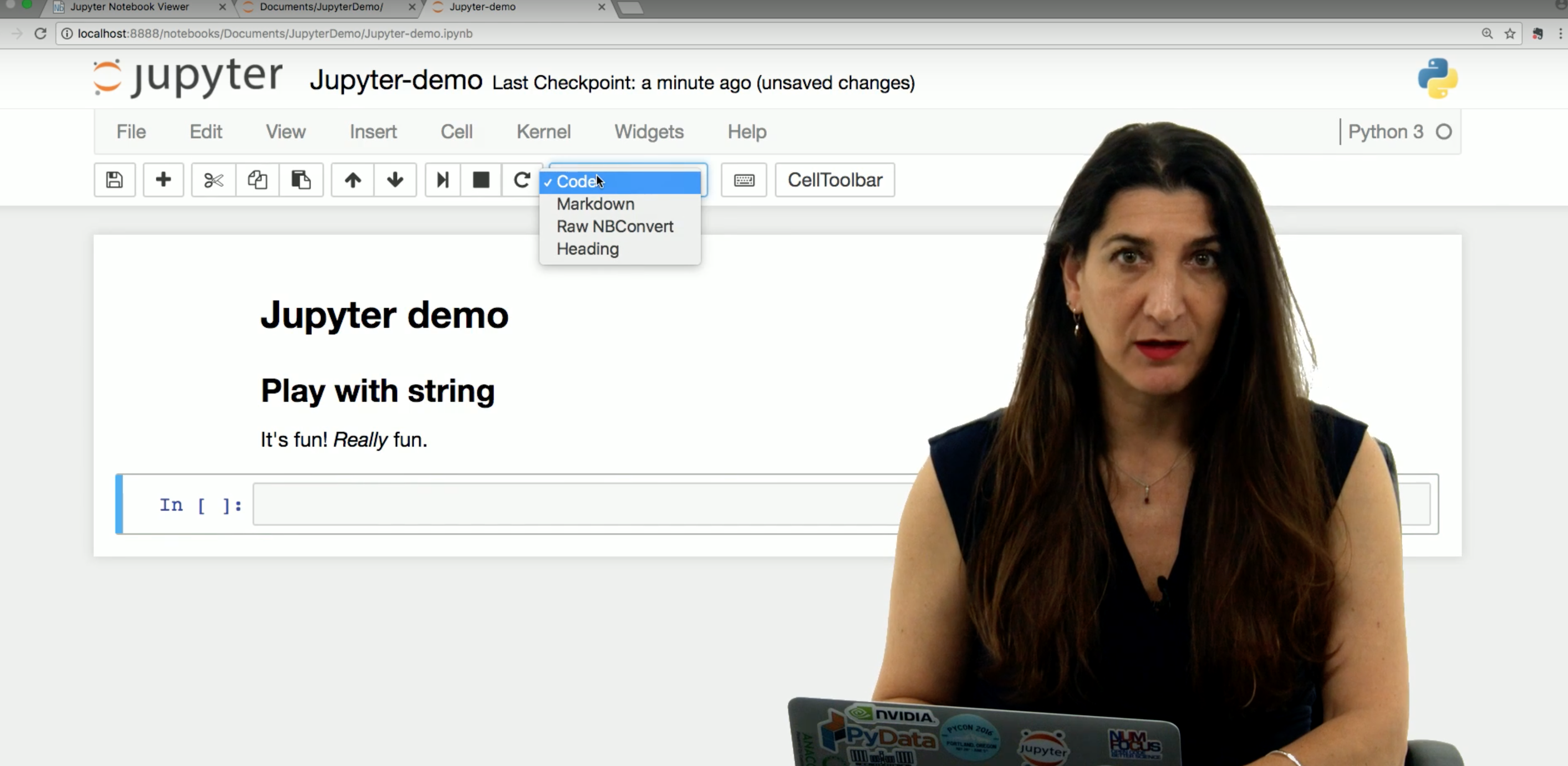
    “Jupyter is a killer app for education. Many people are writing lessons, tutorials, whole courses and even books using Jupyter. It is a new genre of an open educational resource (OER). What if you want to create an online course on Open edX using content originally written as a Jupyter notebook? You certainly don’t want to duplicate the content, much less copy-and-paste. This XBlock allows you to embed the content dynamically from a notebook available on a public URL,” said Prof. Lorena Barba.

    “This is the first of a series of integrations between Jupyter Notebooks and Open edX. It takes care of the code visualization problem, especially that which distinguishes between inputs and outputs,” said Miguel Amigot, CTO at IBL Education.

    Along with this XBlock, Lorena Barba and Miguel Amigot will present during the 2018 Open edX conference (May 29-31, Montreal, Canada), a solution for grading student work submitted as an uploaded notebook.


  • Redis Labs Launches an Introductory Course on an Open edX Platform

    Redis Labs Launches an Introductory Course on an Open edX Platform

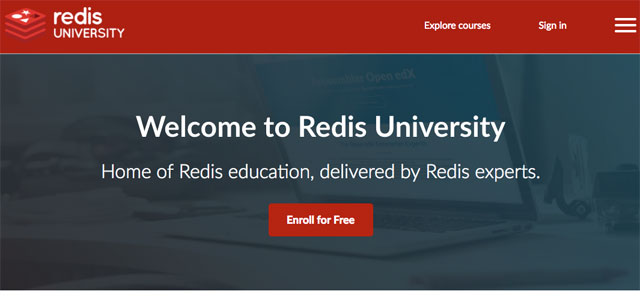
    Redis University is a new online destination launched last week by Redis Labs with the goal of training its community of developers.

    So far it only includes a foundational course: a six-week / 15-hour, free course titled “RU101 – Introduction to Redis Data Structures”. It will start in June 2018 and be taught by Alvin Richards, Chief Education Officer at Redis Labs (see intro video below).

    This initial course is designed as an introduction for developers at the beginning of their journey. It will include video tutorials, quizzes, demos and assignments with firm due dates. Learners will be able to explore the Redis Enterprise solution for free while sharing information and discussing applications and use cases with their peers.

    Students who complete it with grades of 65 percent or higher will receive certificates and online badges for their LinkedIn profiles.

    Redis plans to launch two courses this year and run each of them twice, focusing initially on developers.

    “Redis University was designed to foster that sense of community by opening the door to new users and use cases. We want to give everyone in the ecosystem the opportunity to explore the full breadth of the Redis platform and share ideas that could spark future innovation,” explained Mr. Richards.

    Redis University has been built using the automatic “Tahoe by Appsembler” tool to create Open edX-based websites.

  • Harvard and Microsoft Test Adaptive Learning for the Open edX Platform

    Harvard and Microsoft Test Adaptive Learning for the Open edX Platform

    An adaptive learning architecture for the Open edX platform has been tested in the last months by a research group led by Harvard University and Microsoft.

    This project, called ALOSI (Adaptive Learning Open Source Initiative), is based on creating an open source adaptive engine powering individualized learning and assessment pathways. This software includes the Bridge for Adaptivity and the ALOSI adaptive engine, two applications supporting a common framework for experimentation that integrates several modular components.

    The ALOSI architecture integrates seamlessly via LTI with edX, Canvas and other LMS’s as well as independently with content repositories.  ALOSI uses Bayesian Knowledge Tracing—a  machine learning algorithm—to power the individualized pathways.

    During the 2018 Open edX Conference, Andrew Ang, a research data engineer from Harvard University, will show this modular architecture for adaptive learning.

    Mr. Ang will demonstrate the use of this system with the Microsoft MOOC on edX, “Essential Statistics for Data Analysis Using Excel”, and how the mentioned research group used various advanced features of Open EdX (LTI provider, course blocks API, import/export, content experiments).

  • Some of the of Most Innovative Sessions at the 2018 Open edX Conference

    Some of the of Most Innovative Sessions at the 2018 Open edX Conference

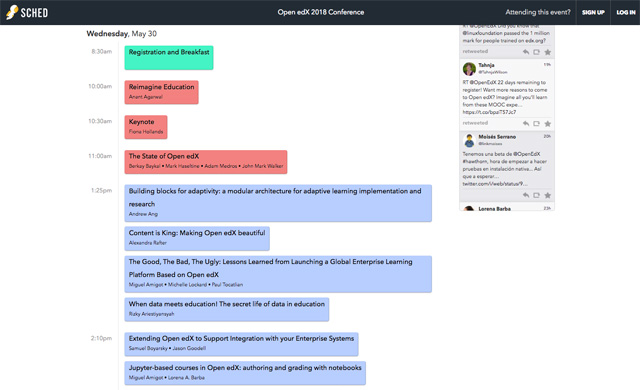
    The 2018 Open edX conference schedule was finally disclosed this week, with workshops intended for beginners and advanced users, either in academia, enterprise or educational organizations. This is the URL, https://openedx2018.sched.com/

    Some of the of most innovative sessions will be the following:


    Class-Central: Sessions We’re Excited About at the 2018 Open edX Conference
    • IBL: Open edX 2018 Conference Speaker Schedule Released

  • edX Releases the Hawthorn Beta Version of the Open edX Platform

    edX Releases the Hawthorn Beta Version of the Open edX Platform

    edX released this week a beta version of the Hawthorn Open edX platform. Its branch name is open-release/hawthorn.beta1.

    This beta version is based on edX code master branches of April 18. Essentially, it provides developers a marked version to test installation and migration of the code, which the edX organization encourages to do as a way to get feedback.

    The release candidate of the Hawthorn Open edX software is now officially expected by the end of May, ready for the Open edX developers conference, scheduled for May 29-31 in Montreal, Canada.


    ——-

    Hey all,

    The first test release of Hawthorn is now available. “open-release/hawthorn.beta1” is the branch name. It is based on the master branches as of April 18.
    We’re doing this a little differently than previous releases.  This is not a release candidate: we have not made the hawthorn.master branches yet.  There is more work we want to get onto master before creating the true Hawthorn branches.  This beta gives people access to a marked version they can use to test installation and migration, while there is still plenty of time for us to address issues.
    There are some things that are not ready yet:
    • We don’t have consolidated release notes of what is new since Ginkgo
    • We don’t have Docker images yet, so there is no devstack support.  We’re working on building those images in the next few weeks.
    • We don’t have updated documentation
    As a reminder: in Hawthorn and beyond, devstack will be based on Docker, and fullstack is gone.
    We expect to have a Hawthorn release candidate by the end of May.
    Please try out this code, and let us know what you find.  There is a #hawthorn-beta channel in Slack, or you can reply here.
    Thanks,
    –Ned.
  • An Ethics Course for Artificial Intelligence Developers

    An Ethics Course for Artificial Intelligence Developers

    Finally a course about ethics on Artificial Intelligence!

    Microsoft has launched on edX “Ethics and law in data and analytics”, a six-week, self-paced, free course to learn how to apply ethical and legal frameworks to initiatives in the data profession.

    This edX course, which is part of the Microsoft Professional Program in Artificial Intelligence, will allow students to explore practical approaches to data and analytics problems posed by work in Big Data, Data Science, and AI.

    Also, they will be able to investigate applied data methods for ethical and legal work in Analytics and AI.

  • Open edX | April 2018: Hawthorn, Conference, NVIDIA…

    Open edX | April 2018: Hawthorn, Conference, NVIDIA…

    Newsletter format  |  Click here to subscribe ]

    APRIL 2018 – NEWSLETTER #4

    • edX announced that the Hawthorn Open edX release will happen this May, after four months of delay.

    • The Open edX 2018 Conference speaker schedule (May 29-31, Montreal) has been announced.

    • The NVIDIA Deep Learning Institute (DLI) launched a deeply integrated, distributed and built-to-scale Open edX ecosystem with custom labs for certified instructor-led training and self-paced courses.

    • Over 5,000 students (3,000 Boeing employees) have completed the Architecture and Systems Engineering course series developed by MITx in collaboration with Boeing and edX.

    • Professor Lorena Barba, from GW, announced an open online course on computing for engineers: Get Data Off The Ground with Python on the GW Engineering platform.

    • edCast redefined its commercial focus, transitioning from an Open edX hosting company into a marketplace for corporate learning content providers.

    • CEO of edX, Anant Agarwal, suggested to U.S. Secretary of Education Betsy DeVos to tie federal financial aid to new credentials in education such as MicroMasters and professional certificates rather than traditional on-campus degrees.

     edX partnered with Microsoft and General Electric to provide Massachusetts residents with subsidized online courses and guaranteed job interviews.

    • Global Knowledge launched its learning platform with over 100 on-demand courses. This platform is a heavily customized solution with the Open edX version at its core.

    • Bitnami launched a new version of the Open edX platform based on the ginkgo.2 version.

    • The Linux Foundation passed the one million mark for people trained at edX.org.

    • Frontline Systems launched Solver.Academy, an Open edX-based online learning platform.

    • Bibblio, a platform which provides course recommendations, developed the Bibblio XBlock with Proversity educational consultant.


    The IBL Newsletter about Open edX is a topic-curated email report compiled by Michael Amigot, Founder at IBL Education, a New York City-based company that builds data-driven learning platform and courses with Open edX. If you enjoy what you read please consider forwarding it to spread the word. Click here to subscribe.

    Archive:
    Newsletter #3 November 2017
    Newsletter #2 Octubre 2017
    Newsletter #1 Sept 2017

    Read also the latest IBL Newsletter on Learning Innovation