Category: Top News

  • “Arming Our Teachers It’s Just Ludicrous,” Says Education Secretary Cardona

    “Arming Our Teachers It’s Just Ludicrous,” Says Education Secretary Cardona

    IBL News | New York

    U.S. Education Secretary Miguel Cardona said yesterday in a hearing on Capitol Hill that those calling for arming teachers in schools are showing a lack of respect for the profession.

    “I think it’s a further reflection of the lack of respect that this profession has, and I would stand against that,” he stated.

    In response to a question from Sen. Brian Schatz, D-Hawaii, during the Senate Appropriations Committee, Cardona stated: “To think that arming our teachers and now having them be responsible for discharging a firearm in our schools, it’s just ludicrous to think about.”

    This comment comes after 19 children and two adults were killed in a mass shooting at a Uvalde, Texas, elementary school last month. The attack was one of several shootings recently, including one in Buffalo, Tulsa, and Philadelphia.

    Some Republicans are calling for school security enhancements by arming teachers and administrators.

  • The University of Phoenix President Resigned Amid an Inquiry

    The University of Phoenix President Resigned Amid an Inquiry

    IBL News | New York

    George Burnett resigned as President of the University of Phoenix after the U.S. Department of Education opened an investigation on his prior job management at another for-profit institution, Westwood College. USA Today broke the news last week.

    Westwood College, a for-profit college that closed in 2016, faced tension with regulators over deceptive advertising among other concerns. The U.S. Department of Education has already canceled $130 million in student loan debt in connection to claims from students who attended Westwood in Westminster, Colorado.

    “He has stepped down as president and board member of the university, effective June 1, 2022,” confirmed a Phoenix spokeswoman, Andrea Smiley. “Because Mr. Burnett believes this request could take some time to address, and not wanting to distract from the university’s mission of providing career-relevant higher education to working adults,” she added.

    George Burnett was appointed head of the University of Phoenix in February 2022.

    The department requests included questions about how long Burnett worked at the college and its parent company, Alta Colleges, and his role in the school’s advertisements, recruitment strategies, and job placement reports.

    Chris Lynne, the university’s chief financial officer, will serve as interim president.

    The University of Phoenix is one of the nation’s largest for-profit providers of online college education. It has 75,000 students, and it received about $930 million in federal money meant for student financial aid in the fiscal year 2020-2021.

  • Cornerstone Completed Its Acquisition of the EdCast LXP Platform

    Cornerstone Completed Its Acquisition of the EdCast LXP Platform

    IBL News | New York

    Clearlake Capital VC-backed Cornerstone OnDemand, Inc. announced that it completed the acquisition of EdCast in May.

    The former CEO of EdCast, Karl Mehta, was appointed to lead the new EdCast business unit within Cornerstone.

    Another consequence of the integration is that now, Cornerstone is offering the EdCast platform to its customers through the website. On AWS Marketplace the brand integration is still pending and only EdCast features its platform.

    The EO Santa Monica, California-based Cornerstone, Himanshu Palsule, said that “combined with the EdCast team, the company is fast-tracking our commitment to platform-agnostic innovation.”

    The company said that “it will roadmap a single-user experience for customers across people growth and development, providing tighter data connectivity, deepened skills intelligence, and a single pane of insight and analytics across the entire Cornerstone portfolio.”

    Organizations will be able to bring their own external LMS, content, performance, recruiting, and HRIS solutions.

  • Harvard University Endowment Saw a Decline of 43% in Its Stock Portfolio in 2022

    Harvard University Endowment Saw a Decline of 43% in Its Stock Portfolio in 2022

    IBL News | New York

    The Harvard Management Company (HMC), which holds Harvard University’s $53.2 billion endowment, tripled its shares portfolio of Meta — formerly known as Facebook —, despite its stock price declining by more than 43% in the first quarter of 2022.

    Only three of the 44 companies in HMC’s public portfolio saw their stock price rise during the first quarter of 2022, according to its latest disclosure required by the SEC for large assets management firms. The overall losses came as the market suffered a significant decline in 2022.

    The Harvard Crimson reported recently about all of this.

    Nearly all of HMC’s direct public investment lies in the technology, biotechnology, and pharmaceutical sectors.

    During the first quarter, HMC invested in Vigil Neuroscience — which develops treatments for neurodegenerative diseases — and Pardes Biosciences — which develops antiviral treatments for Covid-19. The fund liquidated its position of $138 million on Royalty Pharma, a company that helps fund clinical trials for novel drug treatments.

    The company’s investments in Meta and Alphabet accounted for half of HMC’s $990 million public securities portfolio on March 31, 2022.

    Around 34% of endowment’s assets lie in private equity, while 33% are in hedge funds.

    HMC doesn’t invest in any ETF holdings, which were all liquidated in the last quarter of 2021.

  • The Biden-Harris Administration Will Forgive $5.8B in Federal Loans to Students of Corinthian Colleges

    The Biden-Harris Administration Will Forgive $5.8B in Federal Loans to Students of Corinthian Colleges

    IBL News | New York

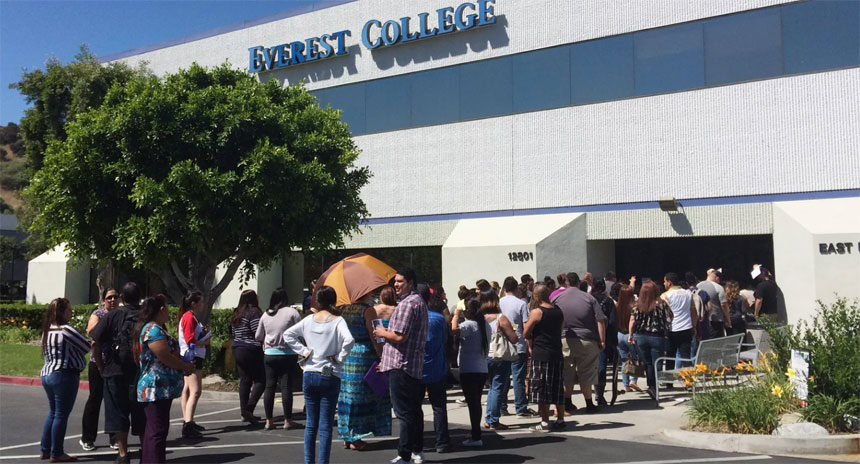
    The Biden administration said this week that it will forgive all of the loans held by 560,000 students who attended the defunct Corinthian Colleges, one of the nation’s largest for-profit college chains, before it collapsed in 2015 after it was found guilty of defrauding students.

    This debt amounts to $5.8 billion and is the largest single debt cancellation ever by the Federal Government. This Corinthian College discharge is twenty times larger than the Marinello Schools of Beauty, a predatory for-profit organization that deceived 28,000 students.

    “For far too long, Corinthian engaged in the wholesale financial exploitation of students, misleading them into taking on more and more debt to pay for promises they would never keep,” said Education Secretary Miguel Cardona. Corinthian Colleges mislead students about job placement prospects after graduation.

    Vice President Kamala Harris announced the group discharge yesterday.

    In 2013, Kamala Harris, at the time California’s Attorney General, sued Corinthian for using fraudulent advertising and other predatory practices.

    At its peak, Corinthian had more than 110,000 at 100 campuses across the country.

    In 2015, the Education Department joined the investigation and fined the organization $30 million. This event made Corinthian sink into bankruptcy, closing its 28 campuses with 16,000 students.

    Later, over 1,000 students went on strike, refusing to pay back their student loans.

    Today, the Biden administration will automatically forgive students’ debts. Borrowers will even be refunded on past payments if they still have an outstanding balance. However, borrowers who have fully paid off their loans will not be refunded.

    Borrowers and their advocates celebrated the Corinthian decision as a watershed moment.

    However, former Education Secretary Bill Bennett called the debt forgiveness “regressive” and a “mistake.” “Now, Corinthian Colleges were a scam, and they were putting a scam on a lot of students. They deserve some punishment and some accountability, but that does not mean the taxpayers have to pay for that, which is what we are doing here,” he added.


  • The Metaverse Virtual-Reality Technology Might Contribute $3 Trillion to GDP

    The Metaverse Virtual-Reality Technology Might Contribute $3 Trillion to GDP

    IBL News | New York

    While Facebook is doubling down on the Metaverse by rebranding itself as META — and even changing its ticket symbol on Nasdaq, new reports predict that this virtual-reality world will experience an astonishing growth.

    According to a recent white paper from Analysis Group, in partnership with Meta Platforms, Inc. (NASDAQ: FB) says that Metaverse can contribute $3 trillion to global GDP by 2031. It would mean a 2.8% contribution to the economy.

    Besides Meta (Facebook), other publicly traded companies, such as NFT Technologies Inc. (NEO: NFT), Marathon Digital Holdings, Inc. (NASDAQ: MARA), Funko, Inc. (NASDAQ: FNKO), and Hall of Fame Resort & Entertainment Company (NASDAQ: HOFV) are working to build experiences and games for the Metaverse.

    “This virtual-reality world has the ability to transform education, health care, manufacturing, job training, communications, entertainment, and retail,” says the report.

    “One way to think about the Metaverse is as a set of interconnected digital spaces, including immersive XR experiences that combine the digital and physical worlds, in which individuals can easily move between different spaces and experiences as well as interact and collaborate with other people who are not in the same physical space.”

    However, Metaverse will need mass adoption, and that’d mean broader take-up of VR headsets, AR glasses, and other technologies.

    “As with the Internet and other technologies, the form and shape of the Metaverse will materialize slowly at first, and only after a critical mass of adoption is achieved, will its full potential begin to take more concrete shape.”

    Anyway, the pathway to the Metaverse of Facebook won’t be easy. Yesterday, the stock fell 2.8% following the news that COO Sheryl Sandberg was stepping down from her long-time position. Sandberg helped guide Facebook from its early days starting in 2008.


  • The FBI Alerts that U.S. Academic Access Credentials Are on Sale on the Dark Web

    The FBI Alerts that U.S. Academic Access Credentials Are on Sale on the Dark Web

    IBL News | New York

    Russian cybercriminal forums offer U.S. college and university credentials for sale from a few to multiple thousands of dollars. Last week, the FBI warned that public and dark web forums were advertising credentials and network access information, especially privileged user accounts.

    This exposure could lead to cyber attacks against individuals or organizations, said the Bureau. “Credential harvesting against an organization is often a byproduct of spear-phishing, ransomware, or other cyber intrusion tactics.”

    COVID-themed phishing attacks to steal university login credentials, with users and passwords, ramped up recently.

    In May 2021, over 36,000 email and password combinations for email accounts ending in .edu were identified on a publically available instant messaging platform.

    The FBI recommends colleges and universities establish and maintain strong liaison relationships with the field offices in their region. “Through these partnerships, the FBI can assist with identifying vulnerabilities to academia and mitigating potential threat activity.”

    Some specific recommendations are:

    • Keep all operating systems and software up to date.
    • Implement user training programs and phishing exercises for students and faculty to raise awareness about the risks of visiting suspicious websites, clicking on suspicious links, and opening suspicious attachments.
    • Require strong, unique passwords for all accounts with password logins and establish lock-out rules for incorrect password attempts. Avoid password reuse across multiple accounts or stored on the system where an adversary may gain access.
    • Require multi-factor authentication (MFA), preferably using phishing-resistant authenticators, for as many services as possible – particularly for accounts that access critical systems, webmail, virtual private networks (VPN), and privileged accounts that manage backups.
    • Reduce credential exposure and enforce credential protection by restricting where accounts and credentials can be used and by using local device credential protection features.
    • Segment networks to help prevent unauthorized access by malicious actors or the spread of malware.
    • Identify, detect, and investigate abnormal activity with network-monitoring tools that log and report all network traffic, including lateral movement on a network.
    • Use anomaly detection tools that identify an unusual increase in traffic and failed authentication attempts.
    • Enforce the principle of least privilege through authorization policies. Account privileges should be clearly defined, narrowly scoped, and regularly audited against usage patterns.
    • Secure and closely monitor remote desktop protocol (RDP) use.
    • Document external remote connections.
  • The Obamas and Airbnb’s CEO Launch a $100M Scholarship Fund for Public Service

    The Obamas and Airbnb’s CEO Launch a $100M Scholarship Fund for Public Service

    IBL News | New York

    Former President Barack Obama and his wife Michelle joined forces with Brian Chesky, founder and CEO of Airbnb, to establish a $100 million college scholarship fund called the Voyager Scholarship, the Obama-Chesky Scholarship for Public Service.

    Set with a $100 million personal contribution from Brian Chesky to the Obama Foundation, the fund will support college students pursuing careers in public service.

    “This scholarship gives college students financial aid to alleviate the burden of college debt, meaningful travel experiences to expand their horizons, and a network of mentors and leaders to support them,” explained the Obama Foundation.

    The deadline to apply is this upcoming June 14, 2022, as explained on the official website.

    The scholarship will support 100 students in the first year and grow to assist more students committed to developing careers in public service. It will be a two-year program intended for students in their junior and senior years of college in the U.S.

    Students will be invited to an annual summit that will help to define their public service journey. At the summit this fall, they will meet with President Obama and Brian Chesky to talk about the role of empathy and understanding in leadership.

    After graduation, they will join the Obama Foundation’s global community, giving them access to the Foundation’s resources and programming.

    “We need a generation of leaders who are willing to cooperate and build bridges, but it’s hard to build a bridge if you haven’t seen the other side of the river,” said Chesky in an announcement video [below].


  • Stanford Will Launch a Summer Program for High-Growth Start-Ups

    Stanford Will Launch a Summer Program for High-Growth Start-Ups

    IBL News | New York

    Stanford Graduate School of Business (GSB) will launch a four-week residential, immersive program that will bring together entrepreneurs, business leaders, VC investors, and preeminent faculty this summer.

    The program, called Stanford dy/dx, will equip 25 high-growth start-up teams with the knowledge and capabilities to rapidly grow and scale as they continue their entrepreneurship journey.

    “This program gives participants access to the world-class education that Stanford GSB offers,” said Jonathan Levin, the Philip H. Knight Professor and Dean of Stanford Graduate School of Business.

    Garth Saloner, dy/dx faculty co-director and the Botha-Chan Professor of Economics, mentioned that the VCs “that shaped the programs, ideas, and content, and identified participating companies” will be Accel, Index Ventures, Lightspeed Venture Partners, and Sequoia Capital.

    Anne Beyer, dy/dx faculty co-director and the Staehelin Family Professor of Accounting, added: “We hope that the relationships participants build through this program will allow them to support each other during their time here and beyond.”

    In a shared statement from Accel, Index Ventures, Lightspeed Venture Partners, and Sequoia Capital, the dy/dx venture allies expressed: “dy/dx will push entrepreneurs to develop the business acumen needed to thrive in an increasingly complex and competitive landscape.”

    The participating companies will come from domestic and international destinations, including Europe, Australia, and South America.

    In addition to enjoying the program curriculum, dy/dx start-up teams will receive investment in their ventures.

  • IBM Signed a Multi-Year Collaboration Agreement with Amazon Web Services

    IBM Signed a Multi-Year Collaboration Agreement with Amazon Web Services

    IBL News | New York

    Unable to beat AWS or the next two cloud providers (Azure and Google Cloud), IBM has joined AWS by signing a multi-year collaboration agreement. IBM will make a variety of its software available as a service on AWS Marketplace.

    The deal includes joint investments to make it easier for companies to consume IBM’s offerings and integrate them with AWS. There will be integrated go-to-market, developer training, and software development programs for vertical markets, such as travel, oil, and gas.

    The IBM offerings on AWS will cover technologies such as AI, security, and sustainability. The products are built on Red Hat OpenShift Service and cloud-native apps on AWS.

    Other services currently available on AWS Marketplace include IBM API Connect, Db2, IBM Maximo Application Suite, IBM Security ReaQta and Security Trusteer, Security Verify, and Watson Orchestrate.

    With Arvind Krishna as CEO at IBM, the big blue has set partnerships with both long-time business partners and competitors alike, such as Salesforce, SAP, and Microsoft Azure.

    The company also made open source more integral to its software strategy, evidenced by the $34 billion acquisition of Red Hat.

    Also, IBM has doubled down on its commitment to hybrid clouds, while AWS and Microsoft have battled for leadership in the public cloud market.

    At the end of 2021, AWS controlled 33% of the cloud infrastructure services market, with Azure owning 22% and Google Cloud with 9%. IBM — the owner of Softlayer — is fifth behind Alibaba in the low single digits, according to market researcher Statistica.

    According to experts, IBM has failed to distinguish what its value is compared to competitors, especially when targeting data scientists and developers.