Category: Top News

  • SUNY’s Class on Solar Energy and Panel Installations Gets Over 50,000 Enrollments

    SUNY’s Class on Solar Energy and Panel Installations Gets Over 50,000 Enrollments

    IBL News | New York

    Suny Online’s Solar Energy Basics course on Coursera hit this month a milestone of 50,000-plus enrollments.

    Launched in 2019, the course is in the top 10 enrollments of SUNY courses on the Coursera platform, out of approximately 60 courses.

    The course, subtitled into eight languages, was developed by Dr. Neal Abrams, Associate Professor in the Department of Chemistry with instructional design and technical support from the Open Academy.

    This class offers an introduction to the fundamentals of solar power as it applies to solar panel system installations. It teaches to compare solar energy to other energy resources and explains how solar panels, or photovoltaics (PV for short), convert sunlight to electricity.

    Solar Energy Basics is one of three courses on solar energy for Coursera developed by Abrams to provide learners with a foundation for designing photovoltaic systems.

    The second course, Solar Energy System Design was launched in the summer of 2020. The third one will launch this summer.

    Abrams has also been using these courses as part of a credit-bearing course this semester on the online Sustainability Management program, SUS 496- Solar Power: PV Design & Installation.

  • The French OpenClasrooms.com Raises $80 Million for Its International Expansion

    The French OpenClasrooms.com Raises $80 Million for Its International Expansion

    IBL News | New York

    Paris, France-based educational platform OpenClassrooms.com raised $80 million in a Series C round.

    The financing, led by Lumos Capital C, attracted also funding from GSV, the Chan Zuckerberg Initiative (CZI), and Salesforce Ventures. Existing investors General Atlantic and Bpifrance invested once again in the company.

    The startup, which claims to host two million learners per month on its vocational training courses, said that it will use the funds for international expansion and product development.

    OpenClassrooms’ courses, in French, English, and Spanish, include a mix of video resources, online reading, real-life projects, and individual mentoring sessions. Users can choose among 54 training programs and get a diploma. Some of them are French-state-recognized bachelor and master diplomas.

    The company offers a guarantee that learners will find a job, mostly through career coaching, or they will receive their money back. In France, students can pay for OpenClassrooms courses using those public subsidies received to fund professional education.

    In addition, the French company offers courses, especially related to apprenticeships, to 1,400 companies.

    The platform still offers short free classes.


  • Google Creates a Program to Train Previously Incarcerated Jobseekers

    Google Creates a Program to Train Previously Incarcerated Jobseekers

    IBL News | New York

    Over 600,000 people make the transition from prisons to society each year. They often face systemic barriers to entering the workforce.

    Intending to provide economic opportunities, Google is partnering with several non-profit organizations (Center for Employment Opportunities, Defy Ventures, Fortune Society, and The Last Mile) in order to implement a program designed to train more than 10,000 formerly incarcerated individuals on digital skills required to get a job or start businesses.

    The initiative called Grow with Google Career Readiness for Reentry builds upon the company’s existing criminal justice work, which includes $40 million in Google.org grants.

    The program consists of training with a project-based and video learning curriculum. The learning includes job search and readiness skills, how to make a resume using web-based tools, and how to send professional emails — as well as more advanced topics like including entrepreneurship and using spreadsheets to make a budget for your business.

    Several partners will also provide job placement support or help place learners into paid apprenticeships and entrepreneur-in-residence programs.


  • The Linux Foundation and CNCF Issue a Free Kubernetes on Edge Training on edX.org

    The Linux Foundation and CNCF Issue a Free Kubernetes on Edge Training on edX.org

    IBL News | New York

    The Linux Foundation and Cloud Native Computing Foundation (CNCF) launched a course about cases and applications of Kubernetes at the edge through practical examples and hands-on lab exercised.

    Introduction to Kubernetes on Edge with K3s (LFS156x) is a free 15-hour course on edX.org, intended for those interested in learning more about Kubernetes and deploying applications or embedded sensors in edge locations.

    Programming experience is also not strictly required. Students will need to be able to run Docker on their computers.

    The course covers how to deploy applications to the edge with open source tools such as K3s and k3sup; those tools can be applied to low-power hardware such as the Raspberry Pi.

    The course was developed by Alex Ellis, a CNCF Ambassador and the Founder of OpenFaaS and inlets.


  • Kahoot Acquires Clever Inc. for $500M to Expand Its Presence in the U.S.

    Kahoot Acquires Clever Inc. for $500M to Expand Its Presence in the U.S.

    IBL News | New York 

    Norwegian EdTech game-based platform Kahoot! announced yesterday the acquisition of Clever Inc, a California-based platform widely used by U.S. K-12 schools. The final pricing will be between $435 and $500 million, depending on Clever’s performance this year.

    By purchasing Clever, which will keep its brand, Kahoot will dramatically increase its presence in the U.S. market.

    Founded in 2012, Clever claims to have served 20 million students monthly, that is, half of all U.S. students in 2020 in 89,000 schools. The company provides a popular single-sign-on network that simplifies accessible learning.

    It has partnered with 600 application developers, including Khan Academy, McGraw Hill, Zoom, and Google Classroom. Its billed revenues are around $44 million.

    Tyler Bosmeny, CEO and co-founder of Clever, said, “being part of the Kahoot! the family will give us the opportunity to continue our mission and accelerate our plans to serve international markets.”

    Eilert Hanoa, CEO at Kahoot!, pointed out, “we are improving our offerings with Kahoot! at Work towards enterprises with Kahoot! Spirit and our acquisitions of Actimo and Motimate, the acquisition of Clever will strengthen our offerings towards schools, districts, and families in Kahoot! at School and Kahoot! at Home.”

  • Coursera’s Stock Price Drops Despite Analysts’ Endorsement

    Coursera’s Stock Price Drops Despite Analysts’ Endorsement

    IBL News | New York

    Coursera (NYSE: COUR), which became public on March 31st, dropped on Wednesday the 5th almost 8%, despite receiving analysts’ support regarding the first-quarter report. Investors still consider that the educational company is overvalued. On Thursday, the stock suffered another significant decline of 7.21%, until $38.98.

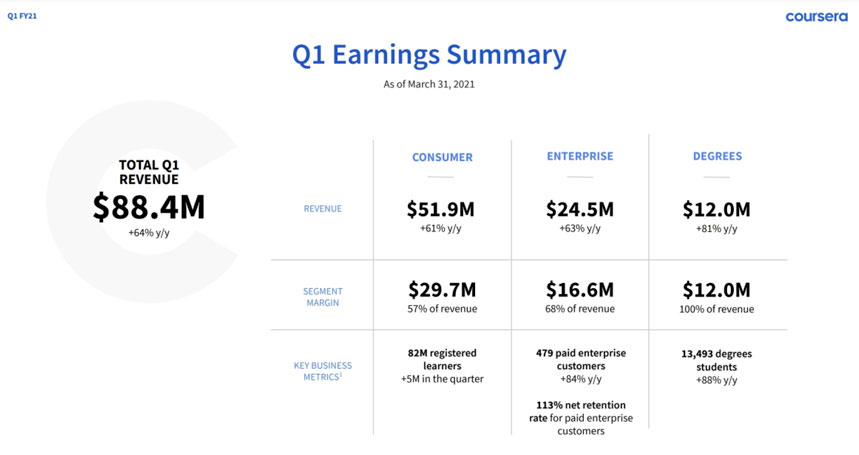
    The online learning platform announced a loss per share of 40 cents, compared to 45 cents a year earlier, with revenue of $88.4 million, versus $53.8 million for the same period in 2020, a growth of 64%.

    Net loss was $18.7 million or 21.1% of revenue, compared to $14.3 million or 26.6% of revenue a year ago.

    The company forecasted second-quarter revenue of $89 million to $93 million.

    In its initial public offering, Coursera (ticker: COUR) sold 15.73 million shares at $33 each. The stock has since rallied about 36%. On Wednesday, shares were down to $42.

    Josh Baer, from Morgan Stanley, wrote: “Coursera beat every estimate and metric we track in Q1, and we see positive estimate revisions ahead as the durability of growth and margin expansion is underestimated.”

    Analyst Sarang Vora, from Telsey Advisory Group, said: “We believe Coursera’s consistent focus on growing its content catalog and member base, combined with enhancements to its technology platform, should continue to boost results in 2021 and beyond.”

    Coursera’s CEO Jeff Maggioncalda was optimistic: “We believe the digital transformation of higher education is only in the early innings, and we see many opportunities to drive growth for Coursera in the years ahead.”

    “During the first quarter, we demonstrated our ability to scale all parts of our business with revenue growth of 64% year-on-year,” said Ken Hahn, Coursera’s CFO. “Our freemium model allows us to acquire learners at a low cost and meet their lifelong learning needs with a growing selection of premium, job-relevant content, and credentials.”

    Coursera disclosed other interesting data regarding its day-to-day operations:

    • The company added 5 million new registered learners during the quarter for a total of 82 million.
    • Enterprise revenue for the first quarter was $24.5 million, up 63% from a year ago. Paid Enterprise Customers increased 84% from a year ago to 479 businesses, governments, and campuses.
    • Degrees revenue for the first quarter was $12.0 million, up 81% from a year ago as prior cohorts scale and students begin newly launched programs. The total number of Degrees Students reached 13,493, up 88% from a year ago.


    • Coursera: Coursera Reports First Quarter Fiscal 2021 Financial Results

  • Outlier.org Raises Another $30 Million for Expanding Its Catalog of College-Level Courses

    Outlier.org Raises Another $30 Million for Expanding Its Catalog of College-Level Courses

    IBL News | New York

    Outlier.org announced this month that it raised $30 million in Series B funding, led by Google Ventures (GV). The company has raised a total of $46 million to date.

    “This latest round will enable us to build out the first two years of an accessible, exceptional college education at scale,” said Jeff Buening, COO at the company.

    Founded in 2019 by former co-founder of MasterClass’ Aaron Rasmussen, Outlier offers cinema-quality, credit–intended, intro-level online courses.

    The startup currently offers six classes, including Calculus I, Microeconomics, Astronomy, and Philosophy, with a goal of expanding to 14 by the end of 2022. Each course costs $400.

    Outlier has a five-year agreement with the University of Pittsburgh, with students receiving transferable college credits from the school and faculty at the University of Pittsburgh and Pitt-Johnstown providing academic oversight. This arrangement has generated some opposition from faculty members.


    https://youtu.be/KNMiAPTZvDM


  • Google Offers 40,000 Scholarships for Android and Cloud Developers in Africa

    Google Offers 40,000 Scholarships for Android and Cloud Developers in Africa

    IBL News | New York

    In partnership with Pluralsight and Andela, Google announced 40,000 scholarships to Android and Cloud developers in Africa. The search giant will give full scholarships with certifications to the top 1,000 students at the end of the training.

    The goal is to help to grow the startup ecosystem and entrepreneurship in Africa, said Nitin Gajria, Managing Director, Google Africa. The continent’s economy is expected to grow 5.25% in the next five years.

    This year, Google is opening applications for the 6th class of the Google for Startups Accelerator Africa program. It’s a three-month program that includes three intensive virtual training boot camps, mentorship, and Google product support. It’s expected to start on June 21; applications are open until May 14, 2021.

    In 2020, Africa’s first Google Developers Space (a hub for African developers, entrepreneurs, and startups) was launched in Lagos, Nigeria in order to support developer communities across Sub-Saharan Africa.

  • Dartmouth College Offers Its Students a Self-Service, AI-Based ChatBot

    Dartmouth College Offers Its Students a Self-Service, AI-Based ChatBot

    IBL News | New York

    Dartmouth College deployed an AI virtual assistant over Slack to improve communications among 10,000 students and faculty members during the COVID pandemic.

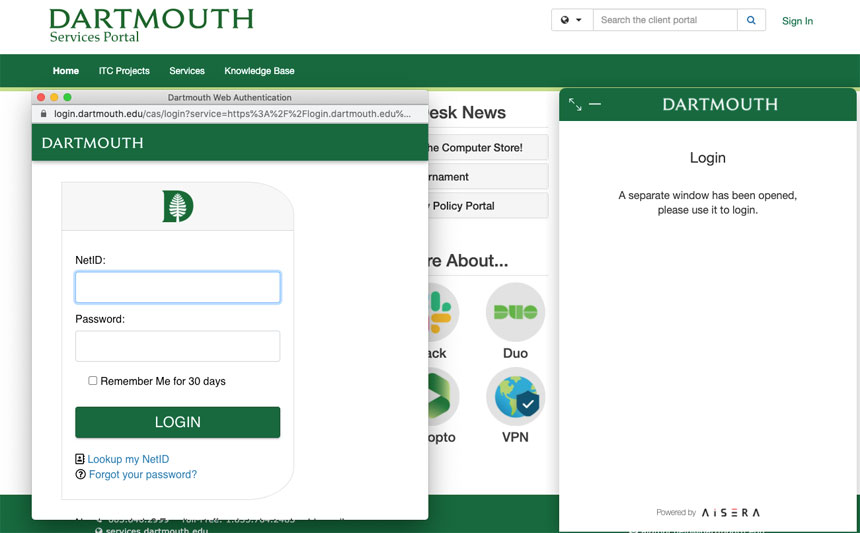
    This conversational, context-aware robot, called Dart InfoBot (DIB), answers questions about technology at Dartmouth and returns information and links to the institution’s Knowledge Base. If it doesn’t find the right information, it creates a ticket.

    DIB’s AI-driven service requires registering and login in with the students’ ID. It works on the institution’s services portal, which also allows voice phone conversation with service desk assistants as well as creating a ticket.

    The provider behind the AI service is Palo Alto, California-based Aisera.com.


  • Fortune Launches Its Higher Education Rankings with 2U as a Founding Sponsor

    Fortune Launches Its Higher Education Rankings with 2U as a Founding Sponsor

    IBL News | New York

    Fortune announced this week the launch of a website with articles, insights, and ongoing reporting intended to help readers develop skills and advance in their careers. 2U (Nasdaq: TWOU) is the founding advertising sponsor.

    The initiative, called Fortune Education, will include rankings and ratings of graduate, post-graduate, executive education, and other improvement programs. In 2021, Fortune will publish six higher education rankings.

    The first one is The Best Online MBA Programs of 2021.

    1. University of North Carolina—Chapel Hill (Kenan-Flagler)
    2. Indiana University—Bloomington (Kelley)
    3. Carnegie Mellon University (Tepper)
    4. University of Southern California (Marshall)
    5. University of Florida (Hough)
    6. University of Maryland—College Park (Smith)
    7. University of Pittsburgh (Katz)
    8. Syracuse University (Whitman)
    9. University of Massachusetts—Amherst (Isenberg)
    10. Rice University (Jones)

    Regarding the criteria, the company said that “it uses multiple data sets to formulate education rankings, including data provided by schools, a “Brand Score” that is calculated from a FORTUNE-Ipsos survey of hiring managers and business professionals, and a weighted “FORTUNE 1000 Score,” which considers business school alumni placement in the C-Suites of the biggest companies in the U.S.”