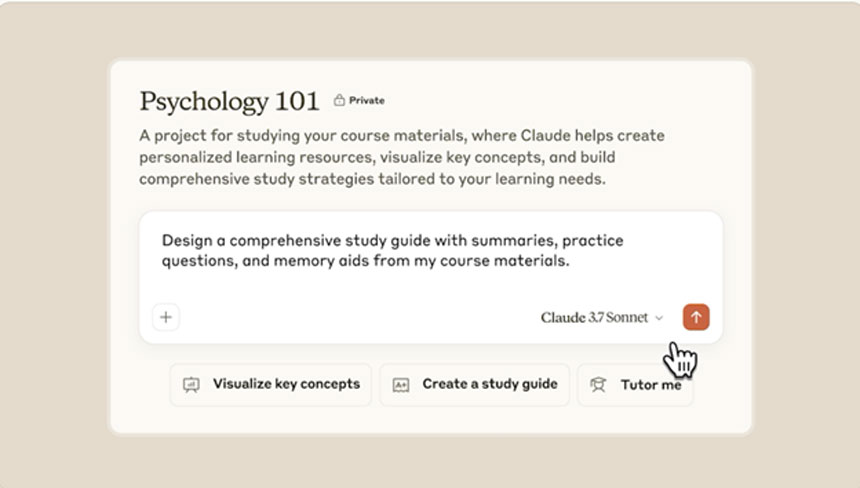
Anthropic launchedIntegrations this month, a new way to connect apps and tools to its AI assistant Claude. It also announced that it has expanded its Advanced Research capability to allow this chatbot to search the web, users’ Google Workspace, and its Integrations. These tools, available in beta for paid users, are part of the company’s effort to compete with Google’s Gemini and OpenAI’s ChatGPT.
In November, Anthropic launched its MCP (Model Context Protocol), an open standard connecting AI apps to tools and data. With Integrations, Claude can work seamlessly with remote MCP servers across web and desktop apps.
Several Integrations from Anthropopic partners, such as Atlassian, Zapier, Cloudflare, Intercom, Square, and PayPal, expand what Claude can do.
For example, the Atlassian Integration lets Claude summarize and create pages in Atlassian’s Confluence workplace software.
President Trump doubled down on his announcement last month and said he would remove the university’s tax-exempt status on Friday, adding, “It’s what they deserve.”
The Trump administration has frozen more than $2 billion of Harvard’s federal funding, and the university has sued.
If the tax-exempt revocation is confirmed, Harvard would have to pay federal income taxes on its revenue, and donations could be lost if donors can’t claim tax deductions on their gifts.
Philanthropic contributions account for about 45 percent of Harvard’s annual operating revenues.
Harvard University, the nation’s oldest and richest university (with an endowment of $53 billion), signaled Friday that it would resist President Trump’s renewed offensive, a move for which it said there was “no legal basis.”
“Such an unprecedented action would endanger our ability to carry out our educational mission,”the statement said. “It would result in diminished financial aid for students, abandonment of critical medical research programs, and lost opportunities for innovation. More broadly, the unlawful use of this instrument would have grave consequences for the future of higher education in America.”
Despite Mr. Trump’s assertion online and Harvard’s sharp response, it was not immediately clear Friday whether the I.R.S. was moving forward with revoking Harvard’s tax-exempt status. This change could typically occur only after a lengthy process, as the federal law prohibits the president from directing the I.R.S. to conduct tax investigations.
In recent weeks, Harvard has taken a confrontational posture toward the Trump administration, rejecting a roster of Federal government demands.
Those demands include that Harvard submit reports to Washington, alter its admissions and hiring policies, and bring in an outsider to examine “those programs and departments that most fuel antisemitic harassment or reflect ideological capture.”
A Harvard commentator explained how the endowment of the institution works. “Increasing the tax on Harvard’s endowment — or worse, stripping our tax-exempt status entirely — would utterly cripple this University.”
President Donald Trump signed seven executive orders on April 23 impacting elementary, secondary, and postsecondary education, addressing AI, school discipline, workforce development, apprenticeships, HBCUs, and accreditation, among other issues.
Leaders from labor, commerce, and education departments, including Secretary Linda McMahon, joined the president in the Oval Office. She released a statement about the orders.
Trump’s executive order on AI stated that it will ensure that “schoolchildren, young Americans, are adequately trained in AI tools so that they can be competitive in the economy years from now into the future as AI becomes a bigger and bigger deal.”
The order broadly seeks to improve K-12 education through AI and enhance teacher training on AI:
Establishes the White House Task Force on AI Education;
Establishes a Presidential AI Challenge, which will encourage and highlight student and educator achievements in AI, promote wide geographic adoption of technological advancement, and foster collaboration between government, academia, philanthropy, and industry to address national challenges with AI solutions.
Seek to increase participation in AI-related Registered Apprenticeships;
Establishes public-private partnerships to provide resources for K-12 AI education; and
Prioritizes the use of AI in discretionary grant programs for teacher training and prioritizes research on the use of AI in education.
Another executive order, “Preparing Americans for High-Paying Skilled Trade Jobs of the Future,” focused on modernizing American workforce programs. It seeks “to align with our country’s reindustrialization needs and equip American workers to fill the growing demand for skilled trades and other occupations.”
“My Administration will further protect and strengthen Registered Apprenticeships and build on their successes to seize new opportunities and unlock the limitless potential of the American worker.”
The order plans to reach and surpass 1 million new active apprentices.
In her statement, McMahon said, “Not every student needs to attend a four-year university to enter a family-sustaining career. The Trump Administration will support communities across the country offering career-aligned programs like apprenticeships and dual enrollment to meet the needs of their workforce best.”
The order stated that the administration’s policy is to support HBCUs. It established the White House Initiative on HBCUs and the President’s Board of Advisors on HBCUs.
“Many third-party accreditors have relied on a sort of woke ideology to accredit universities instead of accrediting based on merit and performance,” said a Trump administration representative.
“The Department of Education will create a competitive marketplace of higher education accreditors, which will give colleges and universities incentives and support to focus on lowering college costs, fostering innovation, and delivering a high-quality postsecondary education,” said Linda McMahon.
It also features a Discover Feed that enables users to explore how others are utilizing AI.
Meta is the first AI company to add a social component to its chatbot. Across the industry, AI chatbots and social media are converging. Elon Musk’s X has already integrated closely with Grok. OpenAI, meanwhile, is planning to add a social feed to ChatGPT.
The new Meta AI app is connected to meta.ai and serves as a companion app for its Ray-Ban AI glasses.
“While speaking with AI using your voice isn’t new, we’ve improved our underlying model with Llama 4 to bring you responses that feel more personal and relevant, and more conversational in tone. And the app integrates with other Meta AI features like image generation and editing, which can now all be done through a voice or text conversation with your AI assistant,” explained the company.
Currently, people use Meta AI daily across WhatsApp, Instagram, Facebook, and Messenger.
OpenAI upgraded its web search tool in the default model of ChatGPT, GPT-4, with shopping features and product recommendations, which include direct links to web pages where users can purchase products, although the company won’t receive any kickback from users’ purchases.
These results are related to categories like fashion, beauty, home goods, and electronics. They surface when a user query implies shopping intent, such as “gifts for someone who loves cooking,” the company announced this week.
The shopping outcomes will be based on structured metadata from third-party sources, including pricing, product descriptions, and reviews.
“These products are chosen independently and are not ads,” said the company. Any merchant can appear in the ChatGPT search as long as it has a discoverable site that is not blocking a web crawler called OAI-SearchBot.
Web owners might need to update theirrobots.txt file to ensure OAI-SearchBot has access.
“Publishers who allow OAI-SearchBotto access their content, can track referral traffic from ChatGPT using analytics platforms such as Google Analytics. ChatGPT automatically includes the UTM parameter utm_source=chatgpt.com in referral URLs, enabling clear tracking and analysis of inbound traffic from ChatGPT search results.”
OpenAI ensured that this web crawler was not used to train its AI foundation models with content.
Online shopping is one of Google’s most important businesses. Now, OpenAI is attempting to compete with rival Google by creating a more personalized experience for finding products and information on the internet.
Shopping
We’re experimenting with making shopping simpler and faster to find, compare, and buy products in ChatGPT.
✅ Improved product results
✅ Visual product details, pricing, and reviews
✅ Direct links to buy
Supabase, an open-source platform used by vibe coders and general developers for managing Postgres databases, achieved a $2 billion valuation after raising $200 million in its Series D round.
This funding round was led by Accel, with contributions from Coatue, Y Combinator, Craft Ventures, Felicis, and angel investors, including Kevin Weil from OpenAI, Guillermo Rauch from Vercel, and Taylor Otwell from Laravel.
Founded in 2020, and currently used by two million developers who manage 3.5 million databases, Supabase [its team in the picture above] introduced itself as an alternative to Google’s Firebase.
Its sign-up rate has just doubled in the past three months due to the Vibe coding movement, with apps like Vercel, Bolt, Lovable, Cursor, and Replit, among others.
Guillermo Rauch, CEO at Vercel, who first invested in Supabase in 2021, sees Vibe coding as a key tailwind for the startup.
Vercel, last valued at $3.25 billion, is widely viewed as a leader in the vibe coding movement.
OpenAI launched three new models — GPT-4.1, GPT-4.1 mini, and GPT-4.1 nano — in its API this month, featuring larger context windows (up to 1 million tokens) and improved performance in coding and instruction over GPT‑4o and GPT‑4o mini.
“To this end, the GPT‑4.1 model family offers exceptional performance at a lower cost,” said the company.
“For tasks that demand low latency, GPT‑4.1 nano is our fastest and cheapest model available; it delivers exceptional performance at a small size with its 1 million token context window.”
Only available via the API, GPT‑4.1 arrives as OpenAI rivals like Google and Anthropic released, respectively, Gemini 2.5 Pro, which also has a 1-million-token context window, and Claude 3.7 Sonnet. Also, Chinese AI startup DeepSeek launched an upgraded V3.
“OpenAI’s ambition is to create an “agentic software engineer,” as CFO Sarah Friar put it during a tech summit in London last month.
GPT-4.1 costs $2 per million input tokens and $8 per million output tokens. GPT-4.1 mini is $0.40/million input tokens and $1.60/million output tokens, and GPT-4.1 nano is $0.10/million input tokens and $0.40/million output tokens.
OpenAI CFO Sarah Friar on the race to build artificial general intelligence (Goldman Sachs’ Disruptive Tech Summit in London on March 5, 2025)
“And then the third that is coming is what we call A-SWE. We’re not the best marketers, by the way, you might have noticed. But Agentic… https://t.co/oFd0SKGu3S
Over 2,000 K-12 schools in 100 countries have installed Brisk’s Chrome extension, which allows teachers to write lesson plans, tests, and presentations, and grade work, since its launch in February 2025.
With 40 tools, the platform uses generative AI, computer vision, and other features.
The most popular tool in the stack, “Targeted Feedback,” uses generative AI to read student essays (on Google Docs) and create comments tailored to age, a grading rubric, or other standards. Before sharing anything with students, teachers can review and edit the comments.
“The existing edtech stack as we know it, which is around 140 different tools that the average teacher in the U.S. uses in a given school year, is not ready for AI,” said Brisk’s CEO and founder, Arman Jaffer.
The San Francisco-based Brisk raised $15 million in funding with investors such as Bessemer Venture Partners, Owl Ventures, South Park Commons, and Springbank Collective.
The funding will be used in part to build more tools, and in part to expand to more platforms. A Microsoft integration, aimed at the many Microsoft shop schools, is planned for autumn 2025.
OpenAI released the image generation feature of ChatGPT to its API on Wednesday, allowing developers to integrate it into their apps and services.
Launched in late March, this feature went viral for its ability to create realistic Ghibli Studio-style photos and AI action figures. Over 130 million ChatGPT users created more than 700 million images in just the first week of the tool’s availability, according to the company.
OpenAI’s natively multimodal model, gpt-image-1, can create images across different styles, follow custom guidelines, leverage world knowledge, and render text.
Developers can generate multiple images at a time using gpt-image-1 and control the generation quality, thereby adjusting the speed.
All images created are watermarked with C2PA metadata, allowing them to be identified as AI-generated by supported platforms and apps.
According to OpenAI, gpt-image-1 employs the same safety guardrails as image generation in ChatGPT.
Pricing is $5 per million input tokens for text and $10 per million input tokens for images, and $40 per million output tokens for images. That translates to around 2 cents, 7 cents, and 19 cents per generated image for low, medium, and high-quality square images, respectively.
OpenAI said that companies like Adobe, Airtable, Wix, Instacart, GoDaddy, Canva, and Figma are already using or experimenting with gpt-image-1. Figma’s Figma Design platform, for example, now allows users to generate and edit images via gpt-image-1, while Instacart is testing the model for images related to recipes and shopping lists.