JetBlue is expanding its JetBlue Scholars program to provide crew members a way to earn online master’s degrees at discounted rates of $13,000 to $30,000.
Participants will be able to seek degrees in leadership, business, information technology, aviation management and liberal arts from City University of New York School of Professional Studies, Louisiana State University Shreveport, Thomas Edison State University, University of Maryland University College and Western Governors University.
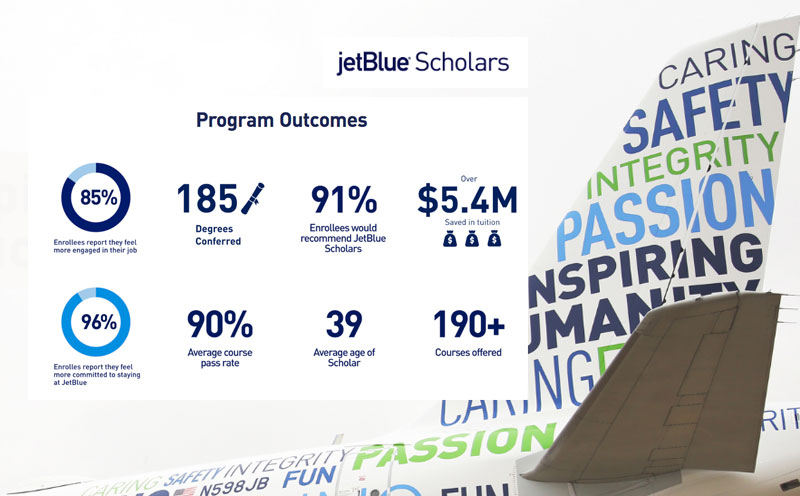
Since launching the program in 2016, more than 185 employees have earned a degree and over 700 crew members are currently enrolled. The completion rate is 93 percent, and the average time to complete a bachelor’s degree is 16 months.
“Our partner institutions share similar values with JetBlue and together we’re removing some of the complexity from the process. The online format allows flexibility, and low costs combined with specialized support is a great combination for our Scholars to earn advanced degrees at their own pace. These new Master’s Pathways will open up even more opportunities for crewmembers,” said Rachel McCarthy, head of talent and learning at JetBlue.
The JetBlue Scholars program also utilizes alternative college credit options, including new technology-based learning platforms like Study.com, Sophia.org, and StraighterLine.com.
JetBlue has joined a growing number of companies to offer employees access to certificates and online degrees as a corporate benefit.
With learning analytics and data mining, employers will be able to optimize workforce training. Learners’ engagement, performance, and trajectories can be examined and new ways to effectively acquire new knowledge are determined.
To prove it, a group of four specialists supported by Boeing (Michael Richey, Mark Cousino, Michael Ginda and Katy Börner) has written a paper introducing a set of metrics and visualizations to identify prototypical behavior and learning pathways.
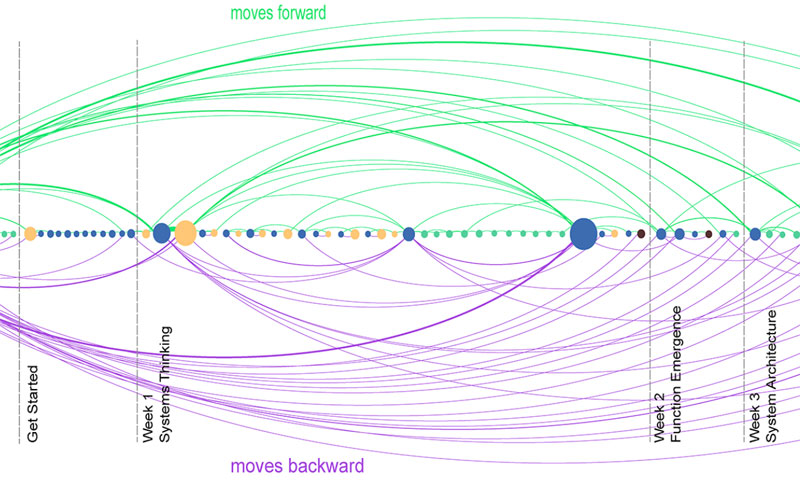
This research comes after validating over 30 million separate logged events that capture activities of 1,608 Boeing engineers taking the MITxPro Course, “Architecture of Complex Systems,” delivered in Fall 2016 on edX.
Visualization results show course structure and patterns of learner interactions with course material, activities, and assessments.
“In the information age, skills and knowledge required to perform professional jobs are changing rapidly. Proactive up-skilling and retraining of people are critical. Companies are spending billions of dollars each year to develop courses, train their existing workforce, and onboard new hires. Many companies resort to mass training; the majority being inefficient web-based and costly instructor lead training with some companies innovating in teaching and learning analytics to increase return on investment (ROI) for the many diverse learning and training interventions,” say the authors.
“Some companies encourage employees to pursue off-the-shelf courses that teach job-relevant skills; while other companies have engaged educational providers to co-create courses and certificates that meet industry-specific needs to help close the theory-practice gap.”
“Online courses and short topical certificates with proper instrumentation reduce costs, scale to a broad cohort of geographically dispersed learners, support (a)synchronous learning, and generate real-time, micro-level data from thousands of learners using different types and sequences of learning modules.”
Recent advances in course instrumentation and advances in learning analytics and data mining make it feasible to use detailed clickstream data to understand and support online teaching and learning
Graphics, maps and study results showcase a detailed clickstream data of 1,608 Boeing engineers’ learning engagement, performance, and trajectories.
The University of Oxford announced this week a £150 million ($191 million) investment in the way the institution teaches, researches, and shares the Humanities. Oxford has a nearly 1,000-year history of teaching the humanities.
This endeavor will come after a megagift of the same amount from Stephen A. Schwarzman, Jewish-American billionaire, philanthropist, and Chairman, CEO, and Co-Founder of Blackstone investment firm [in the picture].
This donation, the largest to Oxford in British history, will result in the creation of the Stephen A. Schwarzman Centre for the Humanities, which will be co-located in a newly-constructed building that will include a performing arts and exhibition center.
In addition, it will host the new Institute for Ethics in AI to explore crucial questions affecting the workplace and society. “If we don’t get AI right, in all probability, we will have much higher levels of disruption from the technologies, which would include higher levels of unemployment,” he said in an interview in The Wall Street Journal. “The number of displaced people could dramatically exceed the number of jobs created.”
“For the first time in the University’s history, Oxford’s programs in English; history; linguistics, philology and phonetics; medieval and modern languages; music; philosophy; and theology and religion will be housed together with a new library in a space designed to encourage experiential learning and bold experimentation through cross-disciplinary and collaborative study,” said an Oxford representative.
“The new Schwarzman Centre will open a vibrant cultural program to the public and will enable Oxford to remain at the forefront of both research and teaching while demonstrating the critical role the Humanities will play in helping human society navigate the technological changes of the 21st century,” commented Professor Louise Richardson, Vice-Chancellor of the University of Oxford.
“For nearly 1,000 years, the study of the Humanities at Oxford has been core to western civilization and scholarship. We need to ensure that its insights and principles can be adapted to today’s dynamic world,” said Stephen A. Schwarzman.
In October 2018, Mr. Schwarzman, 72 years old, who is close to President Trump, announced a foundational $350 million gift to establish the MIT Schwarzman College of Computing. In 2015, Mr. Schwarzman donated $150 million to Yale University to establish a first-of-its-kind campus center in Yale’s historic Commons building and has also gifted $50 million to the Inner-City Scholarship Fund, which provides tuition assistance to underprivileged children attending Catholic schools in the Archdiocese of New York. In 2013, he founded an international scholarship program, ‘Schwarzman Scholars‘, at Tsinghua University in Beijing to educate future leaders about China. At over $575 million, the program is modeled on the Rhodes Scholarship and is the single largest philanthropic effort in China’s history coming largely from international donors. In 2007, Mr. Schwarzman donated $100 million to the New York Public Library on whose board he serves.
With a personal wealth of $12 billion, he has served as an adjunct professor at the Yale School of Management and on the Harvard Business School Board of Dean’s Advisors.
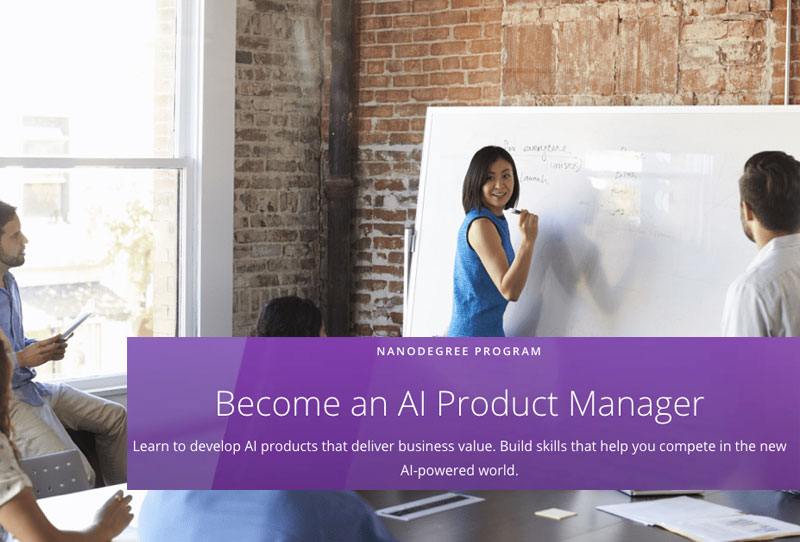
Udacity launched this week a course designed to teach learners without coding experience how to build AI-driven products and bring business value.
“Become an AI Product Manager” is a 2-month, 5-10 hours/week Nanodegree program, priced at $718, and starting on June 25.
It consists of six lessons and three projects, and it has been developed in partnership with San Francisco-based machine learning and artificial intelligence company Figure Eight.
“We built this course with Udacity to empower professionals to help build amazing products using AI, but aren’t coming to the table with a deep technical background,” said Alyssa Simpson Rochwerger, Vice President of Product at Figure Eight.
In this program, students will build fluency in Artificial Intelligence (AI) concepts, while scoping, evaluating, and planning a product that uses this technology. Learners will also get a chance to evaluate case studies to see what has actually worked across industries.
Udacity first collaborated with Figure Eight in 2018 to build its Data Scientist Nanodegree program. This program has seen 3,000+ enrollments in over 120 countries, according to Udacity. Many of these graduates have landed new jobs with employers including Capgemini, IBM, and Roche.
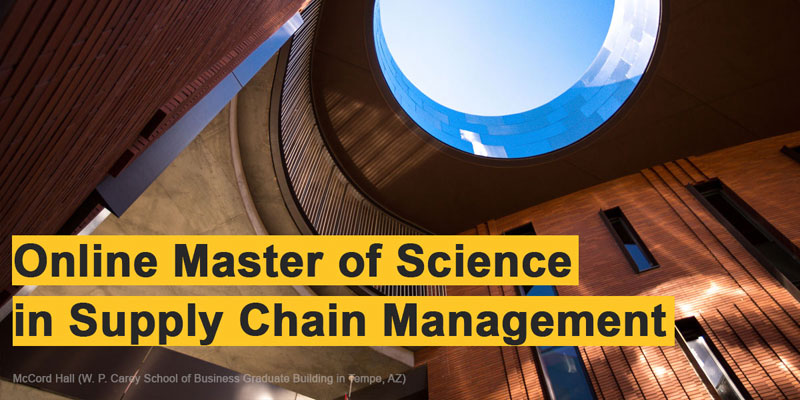
edX, Arizona State University (ASU), and MIT announced today the launch of an innovative, stackable online Master’s of Science in Supply Chain Management, starting in January 2020.
Learners who pass the MIT MicroMasters Supply Chain Management on edX.org will have the opportunity to transition to a full master’s degree from ASU’s W.P. Carey School of Business and ASU Online (also hosted on edX).
“This new offering truly transforms traditional graduate education by bringing together two top-ranked schools in supply chain management to create the world’s first stackable, hybrid graduate degree program. This approach to a stackable, flexible, top-quality online master’s degree is the latest milestone in addressing today’s global skills gap,”said Anant Agarwal, edX CEO and MIT professor.
“We believe there will be many students who are eager to dive deeper after their MicroMasters program to earn a master’s degree from ASU, and that more learners will be drawn to the MIT Supply Chain Management MicroMasters program as this new pathway to a graduate degree within the edX platform becomes available,”added Amy Hillman, dean of the W. P. Carey School of Business at ASU.
Students currently enrolled in, or who have already completed, the MITx Supply Chain Management MicroMasters program can apply now for the online Master of Science in Supply Chain Management from ASU, with an application deadline of Dec. 16.
With this new offering, the MIT Supply Chain Management MicroMasters program now offers learners pathways to completing a master’s degree at 21 institutions.
Master’s degrees on edX are stacked, degree programs with a MicroMasters program component.
I am excited to strengthen @edXOnline’s relationship with @ASU and @MIT to announce an innovative, top-ranked online Master’s degree program in Supply Chain Management – the world’s first stackable, online hybrid graduate degree program. https://t.co/1yVo65NudDpic.twitter.com/0n0PYsIFct
Billionaire investor, host of “Shark Tank” and Dallas Mavericks owner Mark Cuban takes online courses to stay up-to-date on programming languages and evolving technologies and make him a savvier investor.
“I’ve been on Amazon doing the Machine Learning tutorials, I’ve taken Python online classes, and I just started JavaScript neural networks,” disclosed Cuban on an interview with Andy Serwer at Yahoo Finance’s Influencers space.
“I’m not trying to be great at that [coding or machine learning], but I want to understand it so I understand all the nuanced elements of it and how it works so that I have an advantage,” he explained.
Mark Cuban has poured his money into more than 120 tech startups over the years.
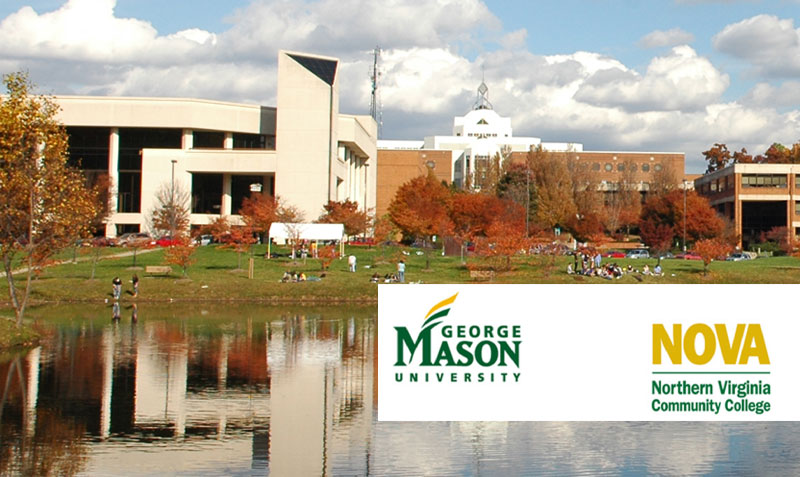
George Mason University (GMU) and Northern Community College (NOVA) are partnering with Amazon Web Services (AWS) to offer students a pathway to earn a Bachelor’s of Applied Science degree and pursue a career in cloud computing.
Both institutions worked with AWS Educate curriculum designers to create a degree program which will be mapped to in-demand technical skills required by Amazon and other employees in cloud services, cybersecurity, software development and DevOps.
Students will first earn an Associate degree at NOVA and transfer to George Mason to complete a four-year Bachelor’s degree.
“This degree pathway marks the beginning of a ground-breaking initiative that will deliver innovative educational opportunities to students across the commonwealth. The collaboration with AWS helps give our students, and our region, a competitive edge,” said Ángel Cabrera, president of George Mason University, at Campus Technology.
“We are delighted to be working with George Mason University and NOVA to turn the growing demand for cloud skills into pathways in technology for students from all backgrounds,” stated Teresa Carlson, vice president for worldwide public sector at AWS.
Amazon, which is building its second corporate headquarters in Northern Virginia, expects to bring 25,000 jobs to the region by 2030.
The online institution Capella University will have a brick-and-mortar presence. Last week, it opened its Campus Center in Atlanta, Georgia, where it has a large population of online learners.
Classes will continue to be taken online. The new center, located at 805 Peachtree St. NE, will serve as a networking hub for current learners and alumni, as well as a space to provide access to enrollment counselors and academic advisors. In addition, local employers will be able to conduct informational sessions.
“Contemporary learners juggle multiple responsibilities while pursuing a degree, including family and work responsibilities. Capella is committed to providing a flexible education with personalized support to help them succeed,”explained Dick Senese, president of Capella University. “While our learners will continue to take classes exclusively online, our new Atlanta Campus Center will offer in-person resources unique to most online education programs.”
Capella University, founded in 1993, offers bachelor’s, master’s and doctoral degrees, along with certificate courses, encompassing 50 programs and 132 specializations. It offers a competency-based learning format paired with a direct assessment model, called FlexPath, as well as a GuidedPath option, a more structured learning format, which features weekly preset deadlines and group discussions.
Google created this $49 a month program in early 2018. It was designed to take beginner learners to job readiness in about eight months.
There are 215,000 unfilled IT support staff roles nationwide, Google estimates. The average annual starting salary for these entry-level IT jobs is $52,000, federal data shows.
Around 70 percent of enrollees come from underrepresented populations in tech, including women, Latinos, African-Americans, veterans and learners without a college education.
Employers that are recruiting from the Google IT Support Certificate program include Bank of America, General Electric, Walmart, Wyndham Hotels, Sprint, Home Depot, H&R Block, Infosys, Intel and Cognizant.
Community colleges with a strong track record in workforce development are also successfully offering the certificate to their students with additional support and in-person instruction. Google partnered with an initial group of 25 community colleges in 2018 but intends to grow that number to 100.
The Internet giant provided a grant that allows community colleges to offer the program for free.
Some colleges are offering the course for credit as part of a degree program. Others are including it as part of their continuing-education programs.
“The IT support role, which involves troubleshooting and solving technical issues, typically doesn’t require a four-year college degree, so it should be a strong entry point for nontraditional talent,” Natalie Van Kleef Conley, Product Manager for Grow with Google, said in Inside of Higher Education.
Moving forward, Google wants to expand partnerships and move into new areas of tech training.
Are significant advancements in AI (Artificial Intelligence) going to eventually lead to the replacement of traditional teaching roles?
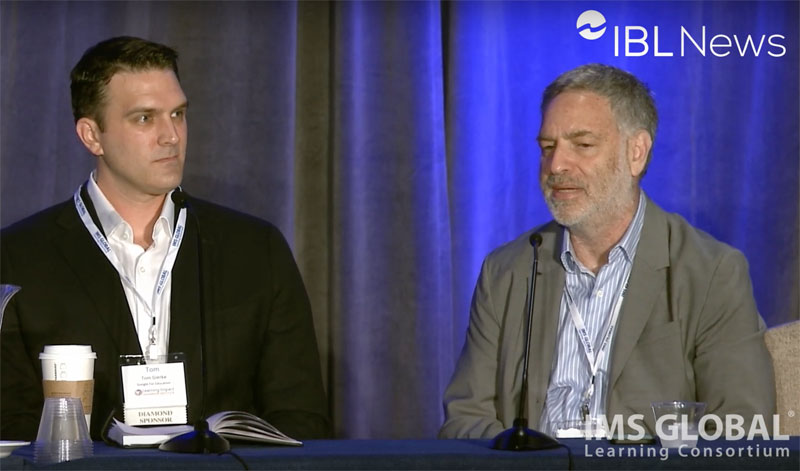
Attendees at an IMS Global Learning Consortium panel, last month in San Diego, were asked to contemplate this question. The panel, entitled “Is Artificial Intelligence the Future of Education?” featured the outstanding speakers Tom Gierke, Ari Chanen, Eric Cosyn, Yakut Gazi, and Alex Kaplan with Ray Schroeder moderating.
It’s no secret that AI is nested within the wave of innovation in online learning. As Kaplan mentioned, “AI is already playing a really active role in education today, and that this is really more about maturing of the offerings as opposed to is it happening or not?”
Along with the other panelists, Kaplan agreed: “AI is about augmenting and enhancing human capability, and not replacing human capability.”
“As AI gets integrated in education, the impact it is going to have is to expand the range of teaching modalities available to instructors and institutions,” said Cosyn. “The classic model, where the instructor addresses the whole class, that’s not going to go away, but the AI will function as a side teaching assistant.”
AI will allow information to surface regarding what material students need help with, Cosyn poses, and will play an important role within traditional models and new models of online teaching.
Gazi’s team has experience working with AI in online courses, first introduced three years prior as an AI teaching assistant which “farmed the previous discussion boards and used that as resources to answer student questions.”
While AI is instrumental in moving forward with online education, Gierke questioned the validity of commentators who think AI will replace traditional teaching techniques. “As much as AI is advancing, is it going to replace a teacher? I think we have to remember that the research shows that teachers are one of the most important factors in student outcomes… Advances in AI, can help [teachers] save time.”
To watch the full panel discussion, please click on the video below.