Category: Top News

  • Michael Crow at ASU GSV: Technologies and Policies We Need to Transform Education

    Michael Crow at ASU GSV: Technologies and Policies We Need to Transform Education

    Michael M. Crow, President at Arizona State University (ASU), talked today on a keynote during the ASU GSV Conference in San Diego about the importance of connecting the workforce with lifelong learning opportunities.

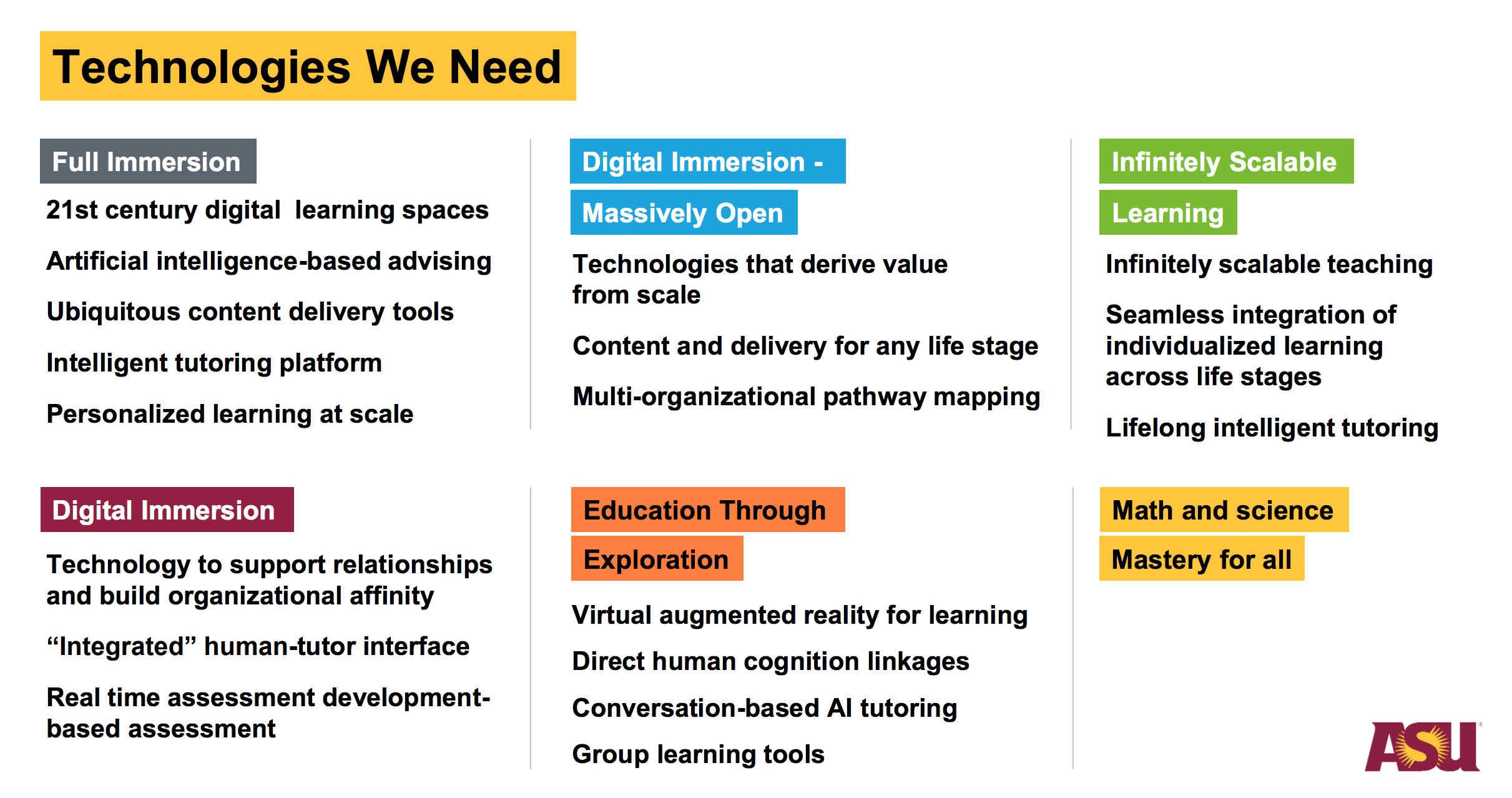
    He elaborated on ASU’s model and mentioned the “technologies we need” to achieve a maximum impact in education. He listed those technologies in the following six categories. Personalized learning at scale will be one of the requirements.

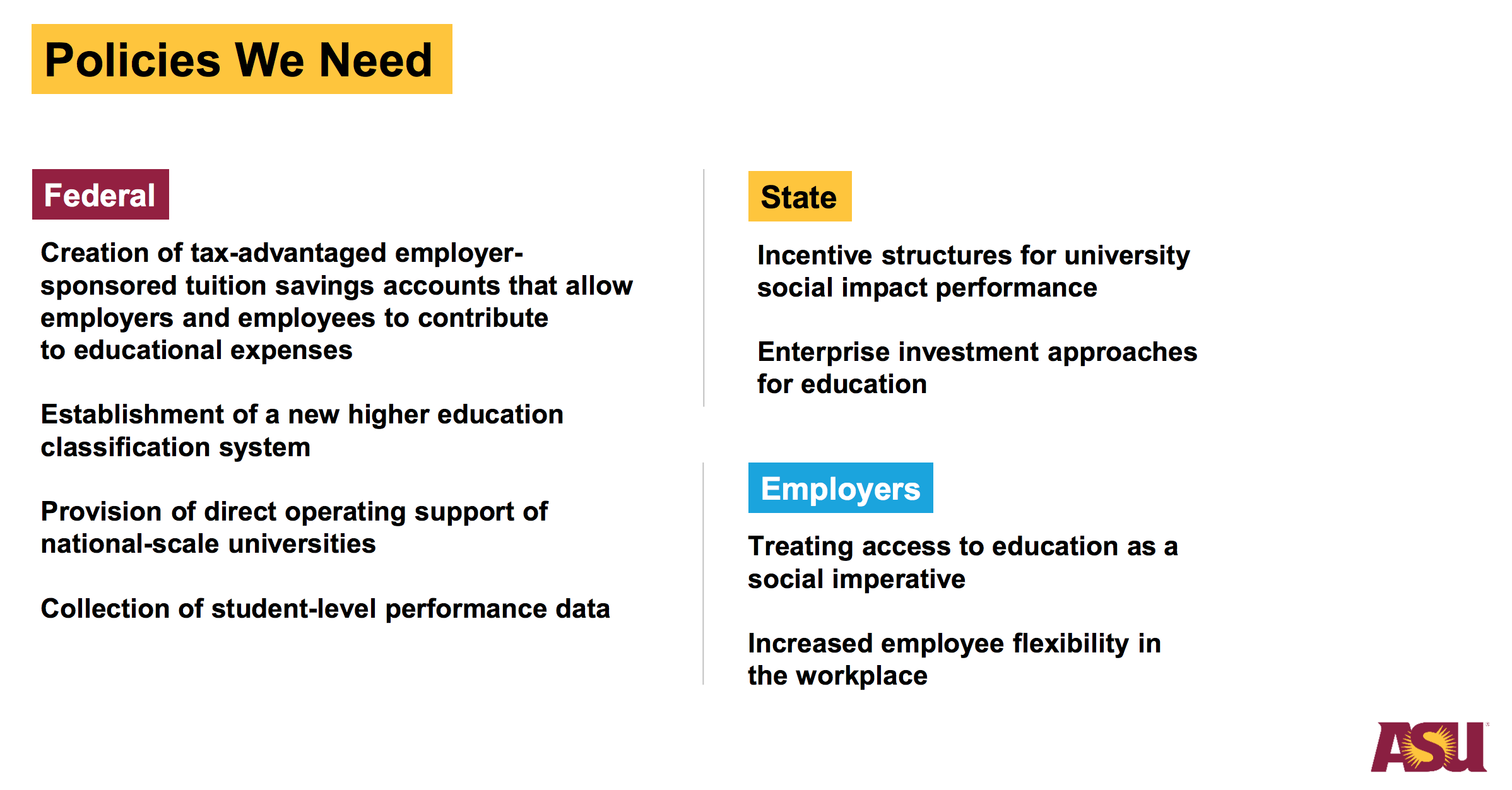
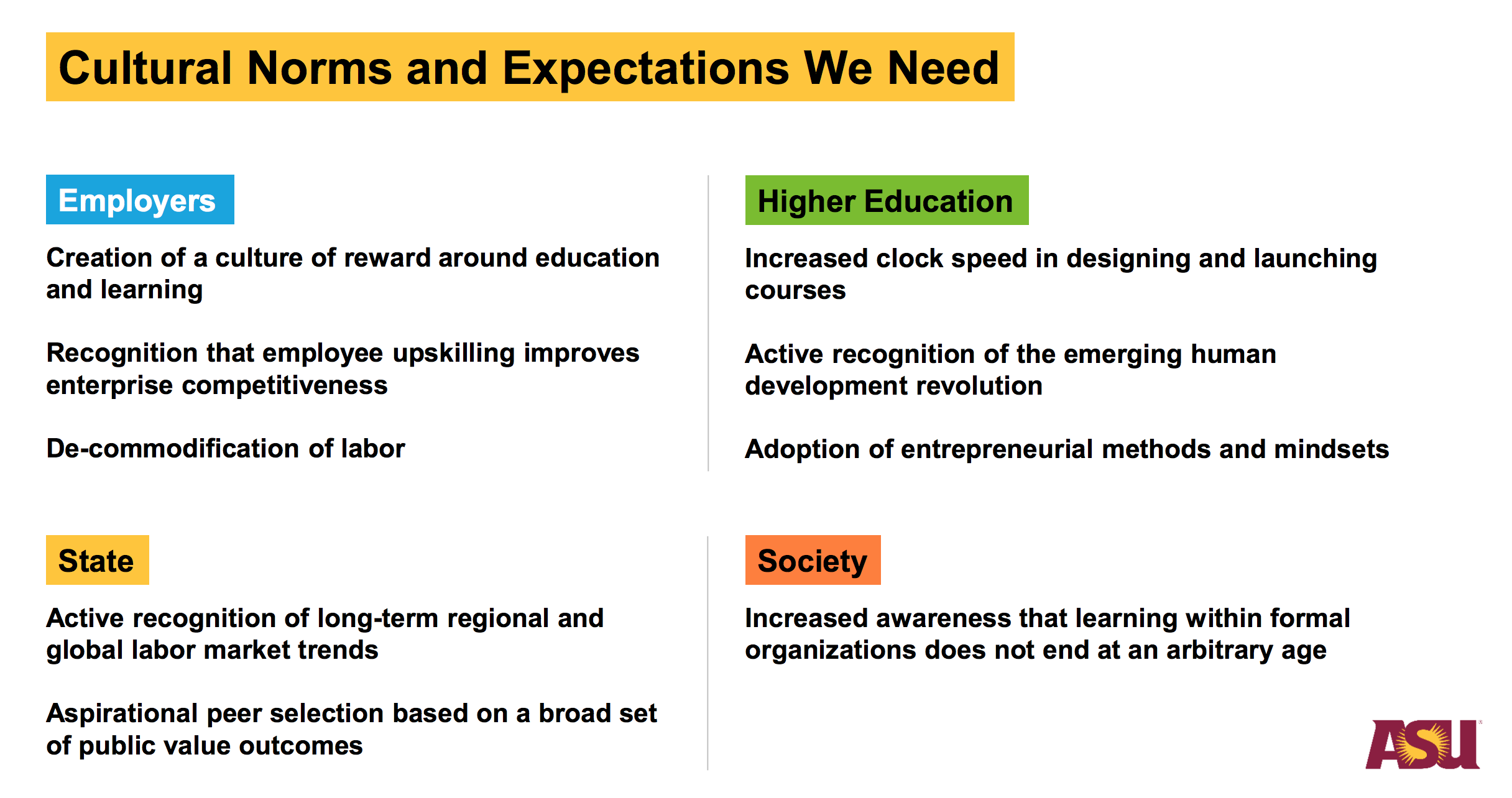
    Mr. Crow, who has transformed ASU into one of the nation’s leading public metropolitan research universities, explained that “there are some policies as well as cultural norms and expectations we need to accomplish”, as reflected in these slides.

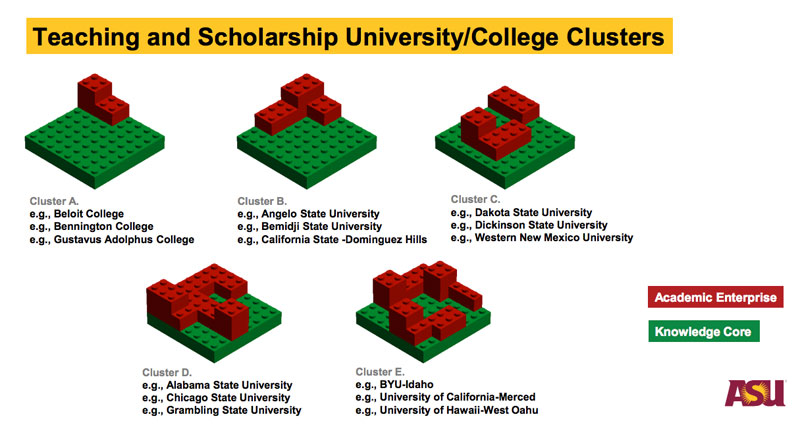
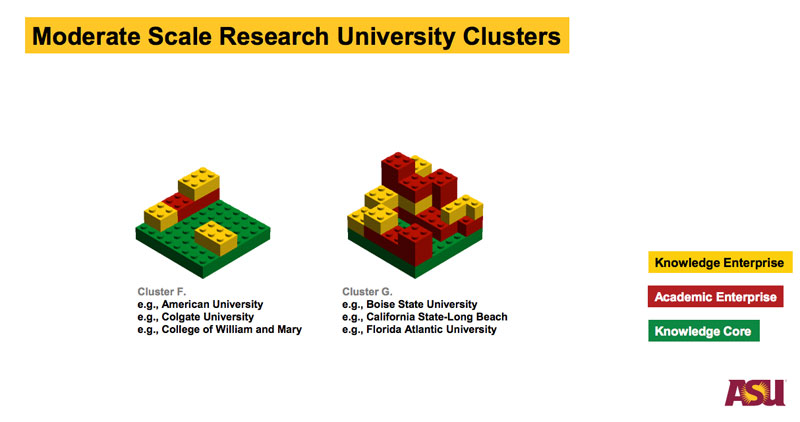
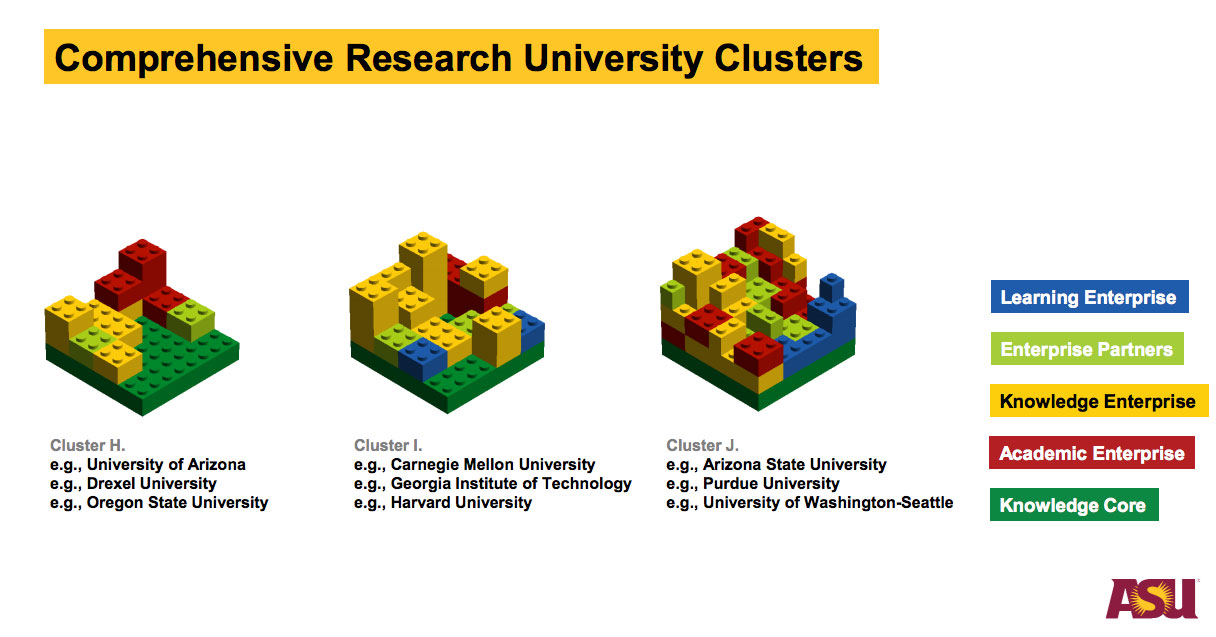
    The President of ASU stated that workplace partners are like “legos”, while “learning systems have multiple potential configurations”.

    At the kickoff of his talk, Michael M. Crow elaborated about how a universal learning system should be designed and what building blocks would be needed to create a new university.

    In this view, these are the three existing clusters:

    Exploring how corporations should help employees attain higher education, Crow highlighted ASU’s partnership with Starbucks, Adidas, and Uber.

    Kevin Johnson, CEO of Starbucks, revealed on Monday that about 12,000 Starbucks employees are taking ASU classes through the Starbucks College Achievement Plan, with about 3,000 graduates so far.

    “We find now that 50 percent of the graduates stay at Starbucks and get promoted faster and about 50 percent move on,” he said.  “In new applicants for jobs at Starbucks, nearly 20 percent indicate their primary reason is to get an education in partnership with ASU.”  

    Steve Ellis, Managing Partner at TPG Growth and the Rise Fund, said that a new model of education accessed via the workplace could help ease income inequality.

    “What would it take for us to create a movement that would make this a responsibility of all corporations and organizations? There was more than $800 billion of company stock bought back in 2018. What if we spent a tiny fraction of that to create programs like the Starbucks College Achievement Plan?”

    Resources:


  • Ray Schroeder: “Universities Have to Change To Meet Students’ Needs”

    Ray Schroeder: “Universities Have to Change To Meet Students’ Needs”

    Ray Schroeder Discusses The Plight of Small Colleges in the Age of Online Learning and the Promise of AI in Personalized Learning


    Henry Kronk | IBL News

    Professor Emeritus Ray Schroder finds it difficult to stop working. As the Associate Vice Chancellor for Online Learning at the University of Illinois Springfield and the founding director of the National Council for Online Education at the University Professional and Continuing Education Association (UPCEA), he has a lot on his plate.

    IBL News recently got in touch with Professor Schroder to discuss his current work and a few trends in online learning.

    The interview occurred on the afternoon of March 12th, and the first topic of conversation had to be the admissions scandal that had come to light that morning.


    Ray Schroeder
    : I think it has more than anything to do with the egos of parents. My older daughter was a National Merit Scholar, which meant she had admission to just about any place with full rides. But she chose a little place, Bradley University, and it fulfilled her dream of teaching. She’s quite successful.

    I’m a believer in the idea that going to the top-ranked schools doesn’t necessarily get you much more than the first job. After that, you really do have to prove yourself.


    Henry Kronk: A lot of the professional world has shifted its focus away from degrees and towards competencies. [Venture capitalist and entrepreneur] Peter Thiel was paying people a few years ago to drop out of college.

    Ray Schroeder: The variables include the fact that state funding to state universities has not risen. In Illinois, for two years, we had no budget. It’s difficult now, but we had no state dollars and we had to live off tuition, grants, and all that. Now tuition is going up. Students can’t afford it; they don’t think it’s worthwhile. We’re at $1.5 something trillion dollars in debt. I understand the tuition challenge. In our case, we try to make it as affordable as possible.


    Henry Kronk: I don’t want to get too political, but I wonder about the state funding question. A typical public institution takes roughly 17% of its total revenue from state appropriations. When half of that goes away, it’s a big deal. But it’s also not the entire story. Yet, so many education experts put all their chips on this one issue. It’s not that I don’t think states should increase their appropriations for higher ed, but the argument also strikes me as reductive. There’s more to the story of rising tuition than state funding going away.

    Ray Schroeder: I’ve written a little bit about this issue for Inside Higher Ed and the Association for Professional, Continuing, and Online Education (UPCEA). I started long, long ago. I was a reporter in the late ‘60s–the 1960s that is. I retired in ‘01 but came back the next day and started to work for this association at 1 Dupont Circle in D.C.

    We’re selling day-old doughnuts, maybe week-old doughnuts. We sell it like a doughnut maker, and it’s take it or leave it. That doesn’t work anymore. We’re so high-priced, and competition has gone so crazy with online learning. Anyone can enroll in any place. You have to have a product that is 1) relevant and 2) affordable. Our model is not in tune with what students and employers need. It used to be that we, that is, the professoriate, would decide, “You need to know Greek history,” or “You need to know this and that.”

    That’s all well and good, but we’re not the ones paying the bill. Society and times have changed. So we have to change. We have to be more relevant to meet their needs.

    I went to a small liberal arts school–Augustana College. Again, this was the ‘60s. It was great for me to get a broad education and then specialize at the graduate level. I don’t see that as being a large-scale model anymore.

    When we look at the at-scale models, like Georgia Tech’s computer science program, that’s affecting everybody. They found an efficient way to deliver a degree and they’re leveraging AI to give–I use this term cautiously–a personalized approach to serving students. An individualized approach would probably be the better term. Professor Ashok Goel there developed Jill Watson (an AI teaching assistant) and he continues to refine it.

    These are pieces of progress that we’re seeing. One of the questions I pose is: “What about University of Illinois Springfield?” We’re a little school, about 4,500-5,000 students. We’re losing students to at-scale universities like Southern New Hampshire University and Georgia Tech and Arizona State. I love the people there. They’re great; they’re innovative. I see UMass Online is just launching a new initiative as well. We lose students to these institutions. We’re not price competitive.

    You see every day a growing list of small colleges that have met their demise. It’s just like newspapers, right?


    Henry Kronk: I think that analogy works on certain levels. But in other ways, it doesn’t hold up. There can’t be a large volume of SNHUs, of ASUs, of Georgia Techs, in the online space. The amount of first time undergraduate students are dropping and projected to keep falling. It won’t be possible to keep every small U.S. college alive online.

    Ray Schroeder: I agree–if we imagine the institutions as they are now. If we adapt, if we provide micro certifications, if we allow for agile just-in-time learning, if we were to focus on areas where micro markets, perhaps even international markets, that isn’t the case. I was surprised to learn recently that Nigeria will have more people than the U.S. by 2030. Sub-Saharan Africa is growing like crazy. Look at China and India. There will be markets there to serve. There is potential.

    But we have to change. It’s very difficult in higher ed. I started teaching as an instructor at the [University of Illinois] Urbana campus in the College of Communication in 1971. I’ve been at this for close to half a century now. I’ve seen a lot of changes. But I haven’t seen anything like we’re seeing now, and for the past five years.

    Certainly, I was there in the mid-‘90s with the beginning of online learning, and that was very exciting as it disrupted higher ed. But it’s a lot less pleasant to be disrupted.


    Henry Kronk: When online learning started to become viable, a lot of people believed it would improve equity in higher education. The idea is, “We’re removing one more barrier.” Do you think that has played out, and to what degree?

    Ray Schroeder: I think it has among certain populations: single parents, motivated learners, mid-30s professionals. They all have a fairly successful track record online. But there are other populations it has not served.

    Online learning is far less effective for developmental students. These are the students who didn’t do well in Algebra, who didn’t do well in writing and literature, who don’t start college as competent writers. They have been failed by their middle schools and high schools. There are cultural issues there too, but these are students who have not developed the abilities that generally are expected at the university level.

    What we find, generally, is that community college students are less successful online than are, for example, our [UIS] students. We have 25 degrees online. Roughly half of them are degree completion programs. We require 30 credit hours to be completed before you can enter them. The hard work, with our students who have been incompletely taught, takes place at community colleges. Once they’ve developed to that ability, online works well.

    There’s also a loose observation that I would make–take it for what it is. The 35-year-old who’s paying out of pocket, who is a single parent, and whose job advancement depends upon completing the degree, is more motivated than an 18-year-old who is just coming out of high school, and for whom someone else is paying tuition. They just don’t have the same life experience. It takes self-motivation online because you don’t have a whole dormful of cohort saying, come on let’s go to school, let’s go to class.

    We have not successfully served those students who were not given the opportunity to meet certain standards in elementary and secondary school. That’s our challenge.

    This leads into one of the questions you posed [via email before the interview], which is, “How can artificial intelligence be used to customize and individualize learning for students?” It can quickly and individually diagnose what shortcomings there may be. It can know “this student didn’t learn about Greek philosophers, didn’t learn a certain level of vocabulary, didn’t reach a certain writing ability or this or that.” AI can respond to each of the students in a composition class of 30. It can say, “Take this module, go to this lesson in Khan Academy, before you begin working on this project.” If you have a class of 30, it’s very difficult for a faculty member to do that kind of individualized work. And so, commonly, we aim at the middle of course. It’s boredom for the advanced, and it’s a struggle for the less experienced students at the bottom.


    Henry Kronk: My response has to be: What makes you so sure AI can do that effectively?

    Ray Schroeder: Well, we’re seeing some of it already, but it is very early. AI is all about being given lots of examples. Deep learning takes those examples and begins to build algorithms. “If a student misuses this or does this, we know they tend to succeed when given this module.” It develops over time.

    It’s the same with AI making medical diagnoses. You have to feed in every new published study. There are about 700,000 peer-reviewed articles published every year in the field of medicine. My doctor doesn’t read all 700,000, but a computer can assimilate that in a few minutes and then go through a process of applying those to complaints, symptoms, lab results, etc. At the end, it can make a diagnosis and prescribe treatment.

    It’s the same in education. It’s about being able to collect all this data.


    Henry Kronk: I’m on board with the fact that AI bots can do a few things well. They do well with the assessment and diagnosis of students. They can also potentially do well in leading them on to the next step based on the steps that other successful students have taken in the past. But this is only getting at part of the process. It assumes that a student will be receptive to this kind of instruction. It’s going to involve at least some time on the computer and significantly less interaction with their instructor. Are you confident that it can be deployed successfully?

    Ray Schroeder: I’m confident that it will be. We’ll see incrementally more over the next decade. Candace Thille has done some pioneering work in the area of adaptive learning. Adaptive learning is the core–we used to do that in the ‘70s with PLATO. It was branching. Depending upon which wrong answer the student gave, it took them to the corresponding module. I think there’s a great advantage to high-touch faculty intervention. A faculty member wouldn’t stand away from the course, they would be there daily giving reinforcement. You know, ‘Great job, it’s so great that you learned that, what a creative response you gave.’ Getting a personal reinforcement is very positive. But the path tends to be drawn from a wide array of options from the computer.

    The computer can provide the reinforcement too. As I’m sure you’ve read about Jill Watson, people didn’t suspect she was a computer, it was all natural language–I said ‘she’–it was a computer program.

    But I digress. Yes, I’m confident it can work. I think it works best if there is human faculty oversight and engagement with the student. It takes both to be most successful.


    Henry Kronk: Let’s talk about the recent Personal Data Protection Commission’s recent AI governance framework. This document obviously wouldn’t have been produced if people didn’t have concerns about AI. Walk me through some concerns you have and let me know whether or not they are adequately addressed by this document.

    Ray Schroeder: It’s a beginning. Their attitude during their release in January was, “Test this out, get back to us with your thoughts, and we’ll revise it.” The late Stephen Hawking, [Steve] Wozniak, [Bill] Gates, Elon Musk–they all are worried about AI. They’re worried it will take control. It is very powerful. If it becomes self-cognizant–it already is to some extent–it can take over systems if we let it. There are many, many other smaller concerns along the way on how it might infringe on privacy, and the like.

    But the question becomes ultimately: Will we see a conflict of interest where the computer says, “I know what’s best for you, human, and therefore, I will do it”?

    To highlight this, I’ll use an example of self-driving cars. Let’s say an autonomous car is driving along and it comes to a predicament where there are two older people like me cutting across the road and it has two options: hit them or run up over the sidewalk and hit three children. How do you value that decision? Do you let the computer? Of course, you need to. The computer is driving the car. But how do you instill values? Who has the right to decide those values? What are those values?

    That’s a real scenario. There are a million others I’m sure.

    Applied to universities, it’s the same. Do we apply resources to the developing students or to the advanced? Do we put it in labs or social sciences? Colleges and universities will need to make these decisions. We need to have controls. Or at least we have to set standards and values.


    Henry Kronk: So how is quantum computing going to change the use of AI in personalized learning?

    Ray Schroeder: Quantum computing is going to speed up the process, perhaps by 10,000 times. What now takes 10,000 hours will take an hour. It will also give us the ultimate security. Normally, we would transmit information with a stream of data. That data goes from one place to another. If we use entangled Q-bits (as in bits, but quantum bits) information transfer will happen instantly with nothing in between. There’s no way to intercept it. If you do something to one particle, it happens to the other particle, even if it is 10,000 miles out in space.

    Those qualities are going to enhance security and enhance speed. That’s going to allow us to do more complex and more sophisticated functions.

  • 2U Acquires Trilogy Education and Duplicates Its Portfolio of Universities

    2U Acquires Trilogy Education and Duplicates Its Portfolio of Universities

    2U, the leading OPM, is paying $750 million to acquire Trilogy Education, a New York City-based boot camp specialized in building programs on coding, data analytics, UX/UI and cybersecurity.

    The deal — $400 million in cash and $350 million in 2U stock — will allow 2U to bump up its university portfolio, to 68 institutions from the existing 36, and expand into the continuing education market (around $366 billion).

    2U has currently a market cap of $3.85 billion and is publicly traded on Nasdaq.

    Trilogy has to date provided courses for 20,000 people and 1,200 instructors across 120 programs.

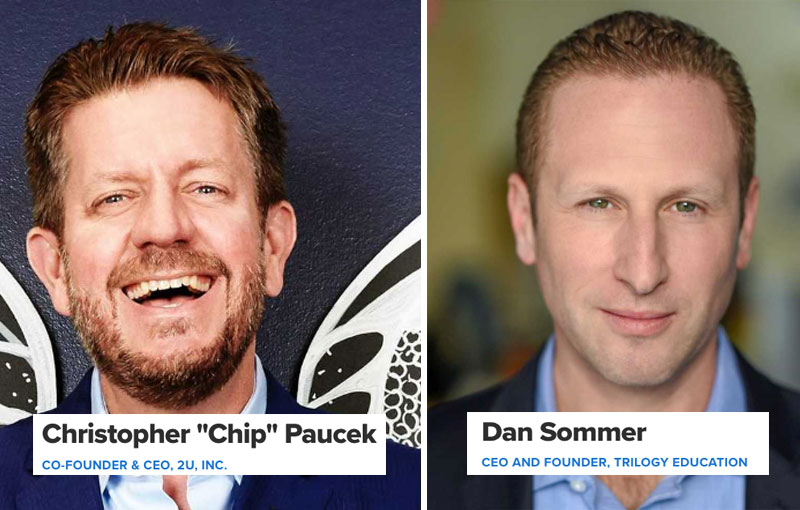
    “We expect the addition of Trilogy to accelerate our path to $1 billion in revenue by one year from 2022 to 2021,” 2U co-founder and CEO Christopher “Chip” Paucek said in a statement.

    This transaction fuels the controversy about commercial corporations and nonprofit universities partnering to build educational courses while making money.

  • Coursera Announces Two MOOC-Based Degrees from the University of Colorado Boulder

    Coursera Announces Two MOOC-Based Degrees from the University of Colorado Boulder

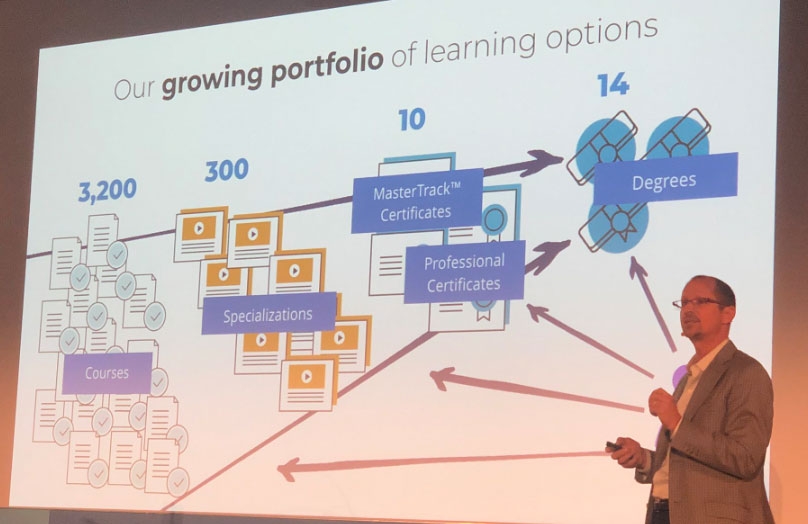
    Coursera, the leading MOOC platform, announced during its 2019 Partners Conference in London the launch of two more online degrees, both from the University of Colorado Boulder: a Master of Science in Electrical Engineering (MS-EE) and a Master of Science in Data Science (MS-DS). This brings the total number of degrees announced on Coursera’s platform to 14.

    Admission to both degrees will be performance-based, and there will be no prerequisites or an application. Students will need to pass a series of courses and obtain stackable credentials. The pathway to enrollment for the MS-EE is expected to open in 2019.

    Last week, Imperial College London announced a Master of Science in Machine Learning on Coursera. It will be one of the world’s first online master’s degrees in Machine Learning and Artificial Intelligence. [Research: Top Online Artificial Intelligence Courses and Programs].

    “Degrees continue to be the most valuable credential for career and economic mobility. In an era of rapid change and evolving skills, degrees and credentials are key to career advancement. The Coursera platform has been able to provide access to top quality degrees at a highly affordable cost,” said Jeff Maggioncalda, CEO of Coursera during the annual Conference (in the picture).

    Coursera.org, which competes with edX, Udacity, and FutureLearn, works with 190 top universities and industry partners and has accumulated 40 million registered learners, according to its latest data. Its Coursera for Business division has reported the launch of 97 new courses in February and March of this year, including 13 courses in Arabic, 10 in Spanish, and 11 in Russian.

    Here is a selection of tweets of the London Conference:


  • MIT’s ‘Intro to CS Using Python’ On EdX Reaches 1.2 Million Enrollments

    MIT’s ‘Intro to CS Using Python’ On EdX Reaches 1.2 Million Enrollments

    The “Introduction to Computer Science Using Python” course on edX has reached 1.2 million enrollments to date, becoming the most popular MOOC in MIT’s history, the institution reported.

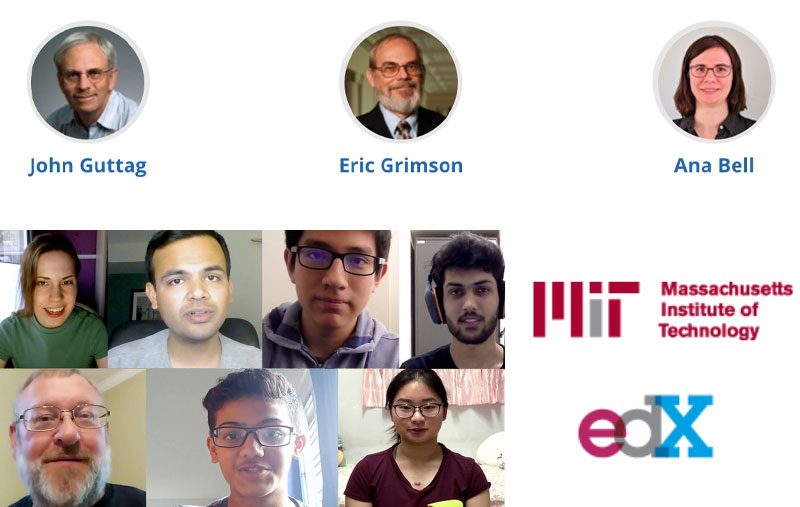
    Launched as an online offering in 2012, this course was derived from a campus-based and Open CourseWare subject at MIT developed and originally taught by John Guttag, the Dugald C. Jackson Professor of Computer Science and Electrical Engineering. It was initially developed as a 13-week course, but in 2014 it was separated into two courses, 6.00.1x and 6.00.2x.

    Also, it was one of the very first MOOCs offered by MIT on the edX platform.

    “This course is about teaching students to use computation, in this case described by Python, to build models and explore broader questions of what can be done with computation to understand the world,” said John Guttag.

    “It is designed to help students begin to think like a computer scientist,” says Grimson. “By the end of it, the student should feel very confident that given a problem, whether it’s something from work or their personal life, they could use computation to solve that problem.”

    “At its core, the 6.00 series teaches computational thinking,” adds Bell. “It does this using the Python programming language, but the course also teaches programming concepts that can be applied in any other programming language.”


  • EdX as a New OPM: “We Can Change the Economics of Customer Acquisition and Retention”

    EdX as a New OPM: “We Can Change the Economics of Customer Acquisition and Retention”

    Adam Medros, President and CCO at edX, explained in a video-interview with IBL News the new business model that edX Inc is adding to its strategy to become financially sustainable.

    Medros elaborated on the B2B, the edX For Business initiative, which he defined as “a natural extension of selling in bulk what is already available for B2C”.

    He also referred to edX’s new “Lean OPM” model. “Online Master’s is a fantastic market opportunity: we can change affordability, accessibility, and the cost of offering a degree,” he explained.

    “Together, with schools, we can change the economics of customer acquisition and retention”. “Our approach starts with stackability and modularity of courses”, added Mr. Medros.

    The determination to offer its services as a “Lean OPM” (Online Program Manager) was one of the relevant announcements at the 2019 Open edX conference last week in San Diego.“We are doing it differently from other OPMs. We give universities more control, and we are the only non-for-profit OPM”, said Anant Agarwal, CEO of edX.

    The main value of the edX (and Coursera, too) offer in this area is the cost of acquisition per learner. Usually, with 2U and other traditional OPMs the cost of getting a student goes beyond $5,000, experts told IBL.


  • Philanthropy University’s CEO Says MOOCs Are About Social ROI

    Philanthropy University’s CEO Says MOOCs Are About Social ROI

    With Capacity Building MOOCs, It’s About Social ROI: Philanthropy University’s Connor Diemand-Yauman in Conversation


    Henry Kronk | IBL News

    Online education is often billed as a means to open up avenues of learning to people and communities around the world who lack it. More often than not, however, online enrollments are filled by members of the developed world. That is not the case with Philanthropy University. The organization’s MOOCs, which focus on capacity building in the global south, have counted 75,000 enrollees from over 180 different countries in the last year. IBL News got in touch with CEO Connor Diemand-Yauman to learn more about the benefits and challenges of applying online learning to capacity building.

    Henry Kronk: When many people hear about MOOCs on Coursera, edX, FutureLearn or other platforms, they think North American or European professionals upskilling to get a raise or a better job. From what I know about Philanthropy U MOOCs, that’s not the case. Could you tell me a little about the target demographic or Philanthropy U MOOCs and what skills they impart?

    Connor Diemand-Yauman: Broadly speaking, we are focused on supporting the crucial, local layer of development. The local actors who are on the ground, solving challenges that they often have experienced themselves for the communities they are a part of. We see a particular opportunity to not only serve the local layer and these local actors world-wide but particularly in the global south. There is an incredible amount of crucial work that’s going on in the global south in the development sector. The success of these initiatives so often are attributed to local organizations’ on-the-ground work.

    If you look at them, if you trace the social supply chain, the local layer is often the foundational piece of that work. So we’re serving typically non-profit social enterprise leaders that are in smaller, more nascent, locally led organizations.

    To make it a little more concrete, one of our users is Dawn Brochenin. She opened up a preschool in an Eastern Cape village, citing that there weren’t any preschool or early childhood education services within a 50 km radius. When Dawn diagnosed this problem in her community, she stepped up and formed a local preschool called Ncinci One Montessori and started supporting 14 local children. Within 6 months, this grew to 30 children and she continued to meet this pressing local need. But Dawn, like so many of these local actors, hit constraints in her capacity. Her challenge wasn’t knowing what to do, but rater, how to do it better. In order for her to effectively grow her organization’s impact, she had to effectively grow her skills.

    With Philanthropy University, Dawn had the opportunity to take free online courses in measurement evaluation, project management, and fundraising. Through our platform, not only did she build these competencies, not only did she gain crucial skills that local leaders need, but she was also able to raise $6,000 in local crowdfunding that was enabled by our platform ecosystem of partners and resources.

    These are the types of users that we are so excited to serve. These users and these organizations have proven time and time again to be more effective and more enduring than their non-local counterparts, and they’re so often neglected in terms of their capacity building needs. So everything we do is focused on serving that local layer and those leaders like Dawn.


    Henry Kronk: Building MOOCs and fostering capacity building are two distinct efforts. How did the idea emerge to combine them at Philanthropy U?

    Connor Diemand-Yauman: So what do we mean by capacity building? The term has been around for a while, but, when you say it, it can mean totally different things to different people. When we say capacity building, we’re referring to an increase in the knowledge, output, management, skills, and other capabilities of an organization. It’s about the non-profit’s ability to deliver its mission more effectively. There are a lot of different forms that capacity building can take, but that is what we’re focused on.

    When you look at the history of capacity building and you understand broadly the landscape of different initiatives, it leads you pretty quickly to a lot of opportunity around more scalable education models, namely, MOOCs. So capacity building historically has been very high-touch and very high-cost. Specifically, the high cost is a high variable cost, meaning that every single individual you want to serve incurs an incremental cost to the provider. And this is typically in the form of individual experts being sent to work with NGOs on site for days or weeks.

    This works, but the problem is very few organizations actually get this white glove, high-touch support. In addition to that, we saw that the sector as a whole was very fragmented and siloed in their various approaches to capacity building. You would have dozens, even hundreds of organizations that would be teaching their own project management course or their own measurement and evaluation course to local actors. We saw significant inefficiencies at the sector level with this approach. So we thought, instead of creating dozens of siloed courses that were only available in these isolated encounters, let’s scale those to the world. What if, instead of creating dozens of static management courses, we created the highest quality course that could be accessible to anyone and would continuously be updated in response to feedback and needs? And what if we allowed different providers to not have to worry about reinventing the wheel and instead layer on additional supports when needed to an engaging, robust technology platform? All of these realizations led us to pursue a more scalable, technology-driven capacity building approach. And with our approach, we have gone in the other direction of the high variable cost. We have invested in significant fixed costs of standing up our platform and creating these courses, but have incurred minuscule variable costs, which allows us to serve organizations at scale.

    At the end of the day, when you think about Philanthropy University’s value to the sector, it’s about ROI. It’s about social ROI. We, as a society, invest billions of dollars in the development sector. By building the capacity of these organizations, we are building the ROI of that social investment. We are ensuring the money that goes into these organizations is better spent.


    Henry Kronk: You and Philanthropy University recently attended the World Economic Forum in Davos, Switzerland. In a LinkedIn post reflecting on the experience, you wrote: “We also had an intriguing conversation about new frontiers in capacity building and learning, chief among them artificial intelligence and machine learning. One participant remarked on the incredible talent and innovation concentrated within the largest technology firms, and the potential to direct this innovation toward learning and program development.”

    Could you flesh this idea out a little more and tell me what opportunities you see that could bring enhance learning and program development with AI?

    Connor Diemand-Yauman: I think the technology sector can often get very excited about the application of new technologies in ways that are often not grounded in reality or productive. I think there can be a lot of hubris in the tech sector around the opportunities and difficulties that local leaders face every day. You hear this trope often of Silicon Valley’s ability to transform development by ensuring that people can access everything they need through an app or that you can upskill every man, woman, and child by giving them a tablet. While these technologies can be instrumental tools and accelerants in our broader efforts to support the actors on the ground, it’s myopic to think that technology alone is what’s needed to give them the support that they require.

    With that said, I think there is tremendous opportunity to leverage technology to support this segment. With AI and machine learning, I think it comes down to, ‘how are we leveraging these innovations to better analyze, understand, and act upon the data that we’re collecting from our learners?’ We collect a tremendous amount of data about our users: what they’re learning, what they’re saying to one another, what they need, where they’re hitting pain points or blockers. AI presents a tremendous opportunity for us to continuously analyze these data in actionable ways in the service of the end user. How can we use these data to generate more tailored learning opportunities? How can we use these data to glean trends in the sector that key stakeholders need to be aware of? I think these are some of the most immediate and practical applications of AI.

    There is this holy grail of adaptive learning. But it is very complex. I think that true 100% adaptive learning modalities are further off than people think.


    Henry Kronk: In a lot of regions, especially in the global south, streaming an hour-long video might cost as much as a meal. What are some of the data infrastructure problems you run into delivering synchronous MOOCs to developing communities?

    Connor Diemand-Yauman: From the beginning, when we decided to orient our work around social change makers in the global south, we knew we needed to make a product that was optimized for accessibility. We knew that our users would be dealing with a unique set of challenges that we would have to work around. I bucket how we have addressed this issue of accessibility into three different buckets.

    First, we prioritized building a responsive web app, which allows us to deliver a learning experience to anyone on any device. This is really important considering the diversity of technology used across countries in our learner base. You need to be able to flex and adjust based on any number of different devices being used. So having a responsive web app has been very valuable in that sense.

    Second, we designed an Android mobile app that was designed to be an extension of the desktop app. This Android app allows users to download course materials when they have access to Wi-Fi and then consume that content on the go. One thing that we found in our user research was that, while most of our users are consuming content on mobile devices, and therefore often using limited data, the majority also have access to Wi-Fi at different points throughout the day that they can use.

    Finally, we have designed the courses themselves to be lightweight, meaning that not much bandwidth is needed in order to view or engage with the content. We’re also in the process of experimenting with ultra lightweight content, which has most of the video and interactive elements stripped out. We’re starting with the absolute bare bones to maximize the opportunities for consumption.

    And then there are other things we have done for data infrastructure. For example, we run all of our servers through AWS in Europe. That allows us to be closer to our users. I would say that the main data challenges we’re facing right now are around analysis. We’re in the process of rearchitecting our infrastructure in order to create a data warehouse. This change will decrease the level of effort needed for internal reporting and allow us to spend more time answering important questions about how best to serve our learners. We’re in the process of making greater investments in that infrastructure to ultimately free up more resources to serve our learners on the ground.


    Philanthropy University is involved in numerous capacity building efforts outside of online courses. One can learn more at their website.


  • A Successful Open edX Conference in San Diego. 2020’s Will Be in Portugal

    A Successful Open edX Conference in San Diego. 2020’s Will Be in Portugal

    Over 300 developers, educators, and industry leaders participated in the sixth Open edX Conference, celebrated at UC San Diego — “the largest Open edX conference ever”, as Anant Agarwal stated during the opening keynote.

    The event ran smoothly and was well organized by a team of a dozen edX staffers, who worked on the conference for seven months.

    New Open edX providers from countries like Argentina and the Netherlands attended for the first time, “to catch up with the community and learn about the future trends”, as Esteban Etcheverry, co-founder of AulasNeo told IBL News.

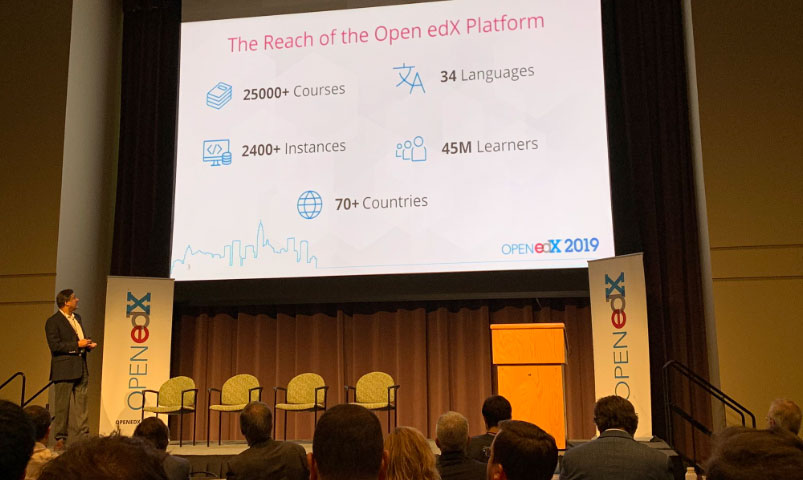
    Anant Agarwal, CEO at edX, disclosed that there are over 2,400 instances using this software, with more than 25,000 courses and 45 million learners in 70 countries.

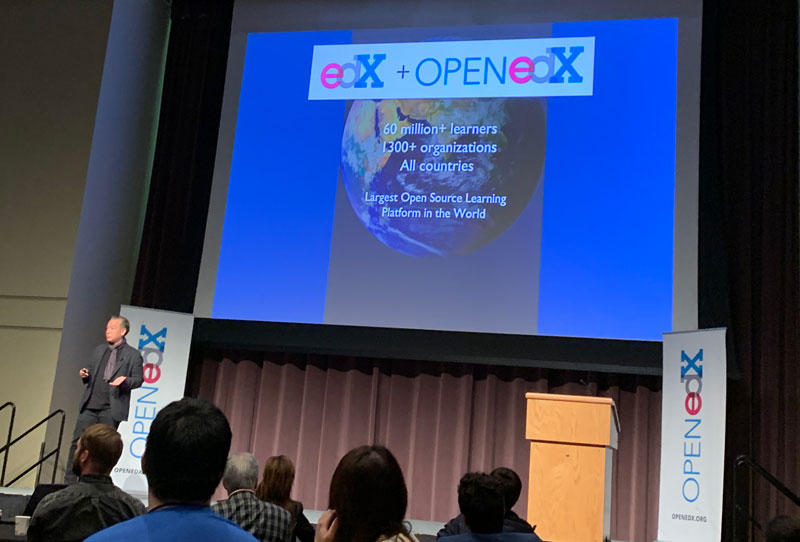
    Robert Lue, Professor at Harvard University and director of LabXchange, stated that “Open edX is the largest open source learning platform in the world, with 60+ million learners and 1,300 organizations.”

    Robert Lue presented the most innovative project on the Open edX universe: an extension of the platform, called Blockstore, which will allow to create personalized pathways.

    This tool, developed with a grant of $6.5 million from Amgen Foundation, notably enhances the edX platform’s user interface. It will be released in September 2019.

    In the software field, Ned Batchelder, Software Architect at edX, presented the ninth version of the platform, called Ironwood.

    One of the relevant announcements of the conference was related to the edX consortium’s business strategy: the determination to offer its services as a “Lean OPM” (Online Program Manager). “We are doing it differently from other OPMs. We give universities more control, and we are the only non-for-profit OPM”, said Anant Agarwal, CEO at edX.

    The main value of the edX (and Coursera, too) offer in this area is the cost of acquisition per learner. Usually, with 2U and other traditional OPMs the cost of getting a student goes beyond $5,000, experts told IBL.

    All of the talks and conferences were live streamed and recorded via YouTube.

    At the end of the event, it was announced that the 2020 Open edX conference will take place in Cascais, Portugal.

    Also, the edX architecture team disclosed that the 10th Open edX release will be named Juniper.

    YouTube Channel with the talks

  • UC San Diego Announces Their Caliper Analytics Integration With Open edX

    UC San Diego Announces Their Caliper Analytics Integration With Open edX

    The University of California San Diego announced yesterday the release of the Open edX Caliper Feed feature, a data solution that allows for the real-time collection of course activity to flow into an analytics tool.

    The project, developed by the university’s IT Services department along with Arbisoft and Amass, started when the institution found incompatibilities between campus analytics applications and the data format of test scores and other metrics on its 90 edX courses with 3.4 million students. The university had no effective way of using data, and it needed to find a workable solution.

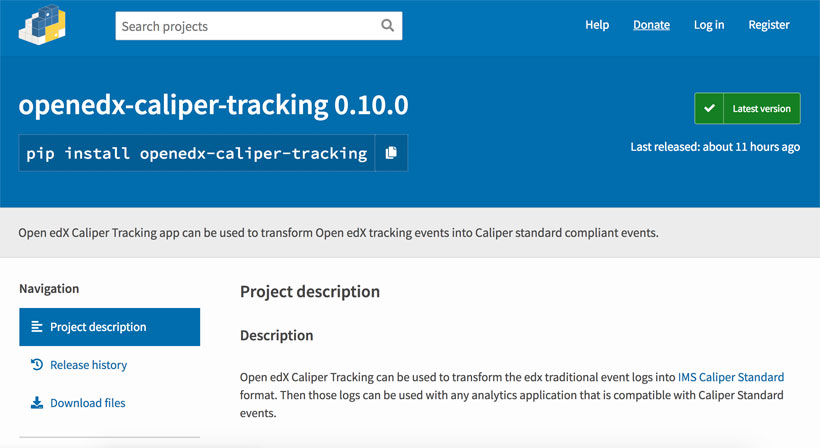
    The complete code is available for free at: https://pypi.org/project/openedx-caliper-tracking.

    Caliper is a standard format for capturing and presenting measures of learning activity. Access to real-time reporting helps instructors and course designers more effectively design classes and boost student success. For example, some students react better to auditory content, while others prefer visual or video-driven methods.

    Karen Flammer, Director of the Center for Digital Learning, at UC San Diego, said, “It’s a tremendous development; it’s not easy to see what parts of a course students are spending time on, what they are concentrating on and where they are struggling. From a practical standpoint, we’ll be able to use this data to assess and improve learning pathways. Obtaining access to this data supports delivering customized resources and activities tailored to the unique needs of each learner.”


    UC San Diego News Center: UC San Diego Updates edX Platform to Improve Online Learning Experience

  • Research: Top Online Artificial Intelligence Courses and Programs

    Research: Top Online Artificial Intelligence Courses and Programs

    Artificial Intelligence (AI) and Machine Learning algorithms are transforming entire industries and defining the next generation of software solutions.

    Experts in these data-driven technologies who understand natural language, speech, vision, etc. are in high demand.

    AI is estimated to create an additional $13 trillion of value annually by 2030, according to McKinsey Global Institute.

    This list features the most successful programs collected by IBL News.


    – MIT Management Executive Education and MIT CSAIL

    Artificial Intelligence: Implications for Business Strategy – Online Short Course

    • In collaboration with online education provider GetSmarter, subsidiary of 2U, Inc.
    • 6 weeks, excluding 1-week orientation; 6-8 hours per week, self-paced, entirely online; weekly modules, flexible learning
    • Program fees: $2,800
    • Certificate of completion from the MIT Sloan School of Management
    • 6 modules; personalized, people-mediated online learning experience
    • Brochure


    – MIT

    Deep Learning, Self-Driving Cars, Artificial General Intelligence

    • Collection of MIT courses and lectures on deep learning, deep reinforcement learning, autonomous vehicles, and artificial intelligence taught by Lex Fridman.


    – Imperial College London – Coursera.org

    Master of Science of Machine Learning


    – Emeritus Institute of Management

    Postgraduate Diploma in Machine Learning and Artificial Intelligence 

    • In collaboration with Columbia Engineering Executive Education
    • Starts on March 28, 2019
    • Duration: 9 months, online, 6-8 hours per week
    • Program Fees: $3,000. Payable in two equal installments. Non-refundable application fee: $50
    • Learning journey includes video lectures, discussions, quizzes, application assignments, capstone project, and live online teaching sessions
    • Two modules (Applied machine learning; Applied artificial intelligence) and a capstone project
    • Access upon completion to the Emeritus network


    – Emeritus Institute of Management

    Applied Artificial Intelligence Advanced Program

    • In collaboration with Columbia Engineering Executive Education
    • Starts on 28 Febrero 2019
    • Duration: 3 months, online, 6-8 hours per week. Twelve modules.
    • Program Fees: $1,200.
    • Pre-Requisites: Undergraduate knowledge of linear algebra (vectors, matrices, derivatives), calculus, basic probability theory. You should be comfortable with Python or any other programming language. All assignments/application projects will be done using the Python programming language.
    • Learning journey includes video lectures, discussions, quizzes, application assignments, capstone project, and live online teaching sessions


    – Columbia University – ColumbiaX on edX

    MicroMasters Program in Artificial Intelligence

    • 4 Courses for $1,080. Free Audit, with no certificate, graded assignments, and limited access
    • Each course is 8-10 hours per week, for 12 weeks, with an individual cost of $300
    • Courses in this program: Artificial Intelligence (AI), Machine Learning, Robotics, Animation and CGI Motion
    • Instructor-led format, with assignments and exams with due dates
    • Credit-eligible MicroMasters program credential
      If the learner is accepted in the Master of Computer Science, it will count 7.5 of the 30 credits required for graduation on-campus or online Master of Computer Science program. The program represents 25% of the coursework toward a Master’s degree in Computer Science at Columbia.
    • Video


    – Microsoft – edX.org

    Professional Program in Artificial Intelligence


    – Georgia Tech – edX.org

    Machine Learning

    • 14 weeks, 8-10 hours per week
    • Free. Add a Verified Certificate for $99
    • Intermediate level
    • English. Subtitles: English
    • Taught by Charles Isbell


    – Universidad Carlos III de Madrid (UC3M) – edX.org

    Introducción a la visión por computador: desarrollo de aplicaciones con OpenCV

    • 7 weeks, 5-7 hours per week
    • Free. Add a Verified Certificate for $50
    • Intermediate level
    • Spanish. Subtitles: Spanish
    • Taught by Arturo de la Escalera, José María Armingol, David Martín Gómez, Fernando García, Abdulla H. Al-Kaff


    – Stanford University – Coursera.org

    Machine Learning

    • 100% online, flexible deadlines, free online course (audit)
    • Approx. 55 hours to complete; 11-weeks; suggested: 7 hours/week
    • English. Subtitles in English, Chinese (Simplified), Hebrew, Spanish, Hindi, Japanese, Korean, Portuguese
    • Enrolling for a Certificate gives access to all course materials, including all videos, quizzes, and programming and graded assignments
    • One of the best and most popular courses at Coursera, with 2.2 million students
    • Taught by Andrew Ng, AI guru, Co-Founder at Corsera and Adjunct Professor at Stanford University


    – Deeplearning.ai – Coursera.org

    AI For Everyone

    • 100% online, flexible deadlines, free online course except for graded items (audit)
    • Approx. 11 hours to complete. Suggested: 4 weeks of study, 2-3 hours/week. Beginner level
    • $49
    • Certificate
    • English. Subtitles: English.
    • 4 Weeks: What is AI, Building All Projects, AI in Your Company, AI and Society
    • Taught by AI guru Andrew Ng


    – Deeplearning.ai – Coursera.org

    Deep Learning Specialization

    • 100% online, flexible deadlines
    • Approx. 3 months to complete. Suggested 11 hours/week. Intermediate level
    • $49 per month
    • English. Subtitles: English, Chinese (Traditional), Arabic, Ukrainian, Chinese (Simplified), Portuguese (Brazilian), Korean, Turkish, Japanese
    • 5 courses: Neural Networks and Deep Learning, Improving Deep Neural Networks: Hyperparameter tuning, Regularization and Optimization, Structuring Machine Learning Projects, Convolutional Neural Networks, Sequence Models.
    • Taught by AI guru Andrew Ng, with two teaching assistants.
    • NVIDIA’s Deep Learning Institute as an industry partner.


    – Google Cloud – Coursera.org

    Machine Learning with TensorFlow on Google Cloud Platform Specialization

    • 100% online, flexible deadlines
    • Approx. 1 month to complete. Suggested: 15 hours/week. Intermediate level
    • $49 per month
    • English. Subtitles: English, French, Portuguese (Brazilian), German, Spanish, Japanese
    • 5 courses: How Google does Machine Learning, Launching into Machine Learning, Intro to TensorFlow, Feature Engineering, Art and Science of Machine Learning.


    – University of Washington – Coursera.org

    Machine Learning Specialization

    • 100% online, flexible deadlines
    • Approx. 8 months to complete. Suggested 6 hours/week. Intermediate level
    • $49 per month
    • English. Subtitles in English, Korean, Vietnamese, Chinese (Simplified), Arabic
    • 4 courses: Machine Learning Foundations: A Case Study Approach; Machine Learning: Regression; Machine Learning: Classification; Machine Learning: Clustering & Retrieval
    • Taught by Carlos Guestrin, Amazon Professor of Machine Learning; and Emily Fox, Amazon Professor of Machine Learning


    – NYU Tandon School of Engineering – Coursera.org

    Machine Learning and Reinforcement Learning in Finance Specialization

    • 100% online, flexible deadlines
    • Approx. 5 months to complete. Suggested: 9 hours/week. Intermediate level
    • $49 per month
    • English. Subtitles: English.
    • 4 courses: Guided Tour of Machine Learning in Finance, Fundamentals of Machine Learning in Finance, Reinforcement Learning in Finance, Overview of Advanced Methods of Reinforcement Learning in Finance.
    • Taught by Dr. Igor Halperin


    – Imperial College London – Coursera.org

    Mathematics for Machine Learning Specialization

    • 100% online, flexible deadlines
    • Approx. 2 months to complete. Suggested: 12 hours/week. Beginner level
    • $49 per month
    • English. Subtitles: English.
    • 3 courses: Mathematics for Machine Learning: Linear Algebra, Mathematics for Machine Learning: Multivariate Calculus, Mathematics for Machine Learning: PCA.


    – National Research University – Higher School of Economics (HSE) (Russia) – Coursera.org

    Advanced Machine Learning Specialization

    • 100% online, flexible deadlines
    • Advanced level
    • $49 per month
    • English. Subtitles in English
    • 7 courses: Introduction to Deep Learning, How to Win a Data Science Competition: Learn from Top Kagglers, Bayesian Methods for Machine Learning, Practical Reinforcement Learning, Deep Learning in Computer Vision, Natural Language Processing, Addressing Large Hadron Collider Challenges by Machine Learning.
    • Taught by 21 instructors


    – School of Artificial Intelligence – Udacity

    Intro to Artificial Intelligence

    • Free online, self-paced
    • Approx. 4 months. Two lessons
    • Intermediate level
    • Taught by Sebastian Thurn (Udacity) and Peter Norvig (Google)


    – School of Artificial Intelligence – Udacity

    Artificial Intelligence for Robotics

    • Free online, self-paced
    • Approx. 2 months. Seven lessons
    • Advanced level
    • Taught by Sebastian Thurn, Founder at Udacity


    –  Georgia Tech – Udacity

    Knowledge-Based AI: Cognitive Systems

    • Free online, self-paced
    • Approx. 7 weeks. Nine lessons
    • Advanced level
    • Taught by Ashok Goel, David Joyner


    –  Georgia Tech – Udacity

    Artificial Intelligence (CS 6601)

    • Free online, self-paced
    • Approx. 4 months. Three lessons
    • Intermediate level
    • Taught by Thad Starner


    –  Georgia Tech – Udacity

    Machine Learning (Supervised, Unsupervised & Reinforcement)

    • Free online, self-paced
    • Approx. 4 months. Three lessons
    • Intermediate level
    • Taught by Michael Littman, Charles Isbell, Puskar Kolhe


    –  Georgia Tech – Udacity

    Machine Learning: Unsupervised Learning (Conversations on Analyzing Data)

    • Free online, self-paced
    • Approx. 4 months. Six lessons
    • Intermediate level
    • Taught by Charles Isbell, Michael Littman, Puskar Kolhe


    –  Georgia Tech – Udacity

    Introduction to Computer Vision (CS 6476)

    • Free online, self-paced
    • Approx. 4 months. Ten lessons
    • Intermediate level
    • Taught by Aaron Bobick, Irfan Essa, Arpan Chakraborty


    –  Google – Udacity

    Intro to Deep Learning

    • Free online, self-paced
    • Approx. 3 months. Four lessons
    • Intermediate level
    • Taught by Vincent Vanhoucke, Arpan Chakraborty


    – School of Artificial Intelligence – Udacity

    Intro to Self-Driving Cars Nanodegree

    • One 4-month term. Study 10 hours/week and complete in four months. Intermediate level
    • $999 one time payment or $84 per month
    • Prerequisites: Programming & Mathematics
    • A dedicated personal mentor, weekly live Q&A sessions and webinars, personalized learning plan
    • Syllabus PDF
    • Taught by Sebastian Thurn, Founder at Udacity


    – School of Artificial Intelligence – Udacity

    Self Driving Car Engineer – Nanodegree Program

    • Two 3-months terms. Study 15 hours/week and complete in six months. Advanced level
    • $1,199 one time payment or $100 per month
    • Prerequisites: Python, C++, Mathematics
    • Term 1: Computer Vision, Deep Learning, and Sensor Fusion. Term 2: Location Path Planning, Control, and System Integration.
    • A dedicated personal mentor, weekly live Q&A sessions and webinars, personalized learning plan
    • Syllabus PDF
    • Built in partnership with Mercedes Benz, Nvidia, Uber ATG, Didi, BMW, McLaren
    • Taught by Sebastian Thurn, Founder at Udacity


    – School of Artificial Intelligence – Udacity

    Flying Car and Autonomous Flight Engineer Nanodegree

    • One 4-month term. Study 15 hours/week and complete in four months. Intermediate level
    • $1,199 one time payment or $100 per month
    • Prerequisites: Programming & Mathematics
    • A dedicated personal mentor, weekly live Q&A sessions and webinars, personalized learning plan
    • Syllabus PDF
    • Taught by Sebastian Thurn, Nicholas Roy, Angela Schoelig, Raffaello D’Andrea, Sergei Lupashin


    –  School of Artificial Intelligence – Udacity

    Deep Learning – Nanodegree Program

    • One 4-month term. Study 12 hours/week and complete in four months.
    • $999 one time payment or $84 per month
    • Concepts covered: Deep learning, Neural Networks, Jupyter Notebooks, CNNs, GANS
    • A dedicated personal mentor, weekly live Q&A sessions and webinars, personalized learning plan
    • Syllabus PDF
    • Built in collaboration with AWS, Facebook Artificial Intelligence
    • Taught by Sebastian Thurn, Ian Goodfellow, Jun-Yan Zhu, Andrew Trask


    –  School of Artificial Intelligence – Udacity

    Natural Language Processing – Nanodegree Program

    • One 3-month term. Study 10-15 hours/week and complete in three months.
    • $999 one time payment or $84 per month
    • A dedicated personal mentor, weekly live Q&A sessions and webinars, personalized learning plan
    • Syllabus PDF
    • Built in collaboration with Amazon Alexa, IBM Watson
    • Taught by Luis Serrano, Jay Alammar, Arpan Chakraborty, Dana Sheahen


    –  School of Artificial Intelligence – Udacity

    Machine Learning Engineer

    • Two 2-month terms. Study 10 hours/week and complete in six months.
    • $999 one time payment or $84 per month (Per-term)
    • Concepts covered: Machine Learning, Supervised Learning, Unsupervised Learning, Reinforcement Learning, Deep Learning
    • A dedicated personal mentor, weekly live Q&A sessions and webinars, personalized learning plan
    • Syllabus PDF
    • Built in collaboration with Kaggle, AWS
    • Taught by Arpan Chakraborty, Mat Leonard, Alexis Cook, Jay Alammar, Sebastian Thurn, Ortal Arel


    –  School of Artificial Intelligence – Udacity

    Artificial Intelligence

    • One 3-month term. Study 10-15 hours/week and complete in three months.
    • $999 one time payment or $84 per month
    • Concepts covered: AI Algorithms, Search Algorithms, Optimization, Planning, Pattern Recognition
    • A dedicated personal mentor, weekly live Q&A sessions and webinars, personalized learning plan
    • Syllabus PDF
    • Taught by Peter Norvig (Google), Sebastian Thurn (Udacity), Thad Starner (Georgia Tech)


    –  School of Artificial Intelligence – Udacity

    Computer Vision

    • One 3-month term. Study 10-15 hours/week and complete in three months.
    • $999 one time payment or $84 per month
    • A dedicated personal mentor, weekly live Q&A sessions and webinars, personalized learning plan
    • Syllabus PDF
    • Built in collaboration with Affectiva, Nvidia’s Deep Learning Institute
    • Taught by Sebastian Thurn, Founder at Udacity


    –  School of Artificial Intelligence – Udacity

    Deep Reinforcement Learning

    • One 4-month term. Study 10-15 hours/week and complete in four months.
    • $999 one time payment or $84 per month
    • A dedicated personal mentor, weekly live Q&A sessions and webinars, personalized learning plan
    • Syllabus PDF
    • Built in collaboration with Unity, Nvidia’s Deep Learning Institute


    –  School of Artificial Intelligence – Udacity

    AI Programming with Python

    • One 3-month term. Study 10 hours/week and complete in three months.
    • $599 one time payment or $50 per month
    • A dedicated personal mentor, weekly live Q&A sessions and webinars, personalized learning plan
    • Syllabus PDF
    • Taught by Luis Serrano, Jennifer Staab, Juan Delgado, Grant Sanderson, Mat Leonard, Mike Yi, Juno Lee, Andrew Paster


    –  School of Artificial Intelligence – Udacity

    Artificial Intelligence for Trading

    • Two 3-month terms. Study 10 hours/week and complete in six months.
    • $999 one time payment or $80 per month (per term)
    • Prerequisites: Python programming & Mathematics
    • Term 1: Quantitative Trading; Term 2: AI Algorithm in Trading.
    • A dedicated personal mentor, weekly live Q&A sessions and webinars, personalized learning plan
    • Syllabus PDF
    • Built in partnership with WorldQuant
    • Taught by Arpan Chakraborty, Elizabeth Otto Hamel, Eddy Shyu, Brok Bucholtz, Parnian Barkatain, Juan Delgado, Luis Serrano, Cezanne Camacho, Mat Leonard


    –  NVIDIA Deep Learning Institute

    All of the courses


    –  IBM Cognitive Class .ai

    Deep Learning


    –  Stanford University

    CS224n: Natural Language Processing with Deep Learning

    • 3 months
    • Certification only for Stanford students
    • Supplement: YouTube videos

    CS231n: Convolutional Neural Networks for Visual Recognition

    • 3 months
    • Certification only for Stanford students
    • Supplement: YouTube videos


    –  Caltech

    CS156: Machine Learning Course


    –  University College London (UCL)

    Introduction to Reinforcement Learning

    Advanced Deep Learning & Reinforcement Learning