Category: Top News

  • Open IBL Jupyter Notebook: New Distribution of Open edX on AWS’ AMI Community

    Open IBL Jupyter Notebook: New Distribution of Open edX on AWS’ AMI Community

    IBL Education is launching today a Jupyter Notebook – ready Open edX distribution. Open IBL Jupyter Notebook is built on the Ginkgo.2 version of Open edX. This release is free and is ready to go from the AWS (Amazon Web Services) AMI community.

    In June, the IBL engineering team launched Open IBL, an easy-to-handle, production-ready distribution based on Open edX’s Ginkgo.2, which was equipped with a command-line builder. These two screencast videos explained the installation and configuration process. (Video 1, Video 2)

    This week, in parallel with the Jupyter Conference in New York (Aug 22-24), and also as a contribution to the educational community, IBL launches another version of the Open IBL distribution which includes the two recent Jupyter Notebooks-related Xblocks:

    1. Jupyter Notebook Viewer XBlock. It allows from any public Jupyter Notebook (e.g., in a public repo on GitHub), pull content into a course learning sequence using only the URL, and optional start and end marks (any string from the first cell to include, and the first cell to exclude). As a result of it, course authors will be able to develop their course content as Jupyter Notebooks, and to build learning sequences reusing that content, without duplication. It also has the added benefit that the development of the material can be hosted on a version-controlled repository. [See IBL’s post about the XBlock, and the code repository—the XBlock is open source under a BSD3 license.]

    2. Graded Jupyter Notebook XBlock. It allows to create an assignment using the nbgrader Jupyter extension, then insert a graded sub-section in Open edX that will deliver this assignment (as a download), auto-grade the student’s uploaded solution, and record the student’s score in the gradebook. The XBlock instantiates a Docker container with all the required dependencies, runs nbgrader on the student-uploaded notebook, and displays immediate feedback to the student in the form of a score table. [See IBL’s post, and the code repository—the XBlock is open source under BSD3.]

    This Open IBL Jupyter Notebook distribution has been created with the strategic and pedagogical support of Lorena A. Barba group, from The George Washington University.

    DEMO of Open IBL Jupyter Notebook

    Prof. Barba has been teaching with Jupyter for the last five years. Her first open teaching module using Jupyter was “CFD Python”, released in July 2013. In 2014, Barba developed and taught the first massive open online course (MOOC) at the George Washington University: “Practical Numerical Methods with Python.” The course was written entirely as Jupyter Notebooks, and it was self-hosted on a custom Open edX site (where it amassed more than 8000 users over 3 years).

    Jupyter is a set of open-source tools for interactive and exploratory computing. At the center of them is the Jupyter Notebook, a document format for writing narratives that interleave multi-media content with executable code, using any of a set of available languages (of which Python is the most popular).

    The two mentioned XBlocks, a brainchild of Prof. Lorena Barba and implemented by her tech partners at IBL Education, were presented at the 2018 Open edX Conference last May 30 in Montreal, Canada. Prof. Lorena Barba, from GW, and Miguel Amigot II, CTO at IBL Education, presented those two software extensions, intended to better integrate Jupyter into the Open edX platform.

    Barba, Lorena A.; Amigot, Miguel (2018): Jupyter-based courses in Open edX: Authoring and grading with notebooks. figshare. Presentation: https://doi.org/10.6084/m9.figshare.6553550.v1
  • Podcast: Vermont Oxford Network (VON) Learning Platform In Depth

    Podcast: Vermont Oxford Network (VON) Learning Platform In Depth

    The Open edX software-based Vermont Oxford Network (VON), a nonprofit collective of multidisciplinary medical professionals founded in 1998, has developed a uniquely collaborative, evidence-based learning network among clinicians of over 1000 neonatal intensive care units and hospital nurseries around the world.

    Denise Zayack and John McGregor, two of the VON’s program leaders, elaborated on their social and collaborative learning strategies, in a podcast–conversation with John Leh, a known independent educational consultant on his “Talented Learning Show”.

    VON’s learning platform, which uses the Open edX technology [disclosure: deployed by IBL Education], allows neonatal healthcare clinicians to earn credit and work together to gain knowledge and develop a learning improvement project they’ll continually modify over time.

    “We integrated different types of scaffolded learning to segment the content so they can focus on specific topics as work through a particular project and determine how they should best teach that to their users. So the learning experience has to be flexible, yet very targeted and segmented at the same time,” explained John McGregor.

    The Talented Learning Show Podcast: How Does Social Learning Improve Infant Healthcare?


  • NVIDIA Adds New Improvements to Its Open edX Training Ecosystem

    NVIDIA Adds New Improvements to Its Open edX Training Ecosystem

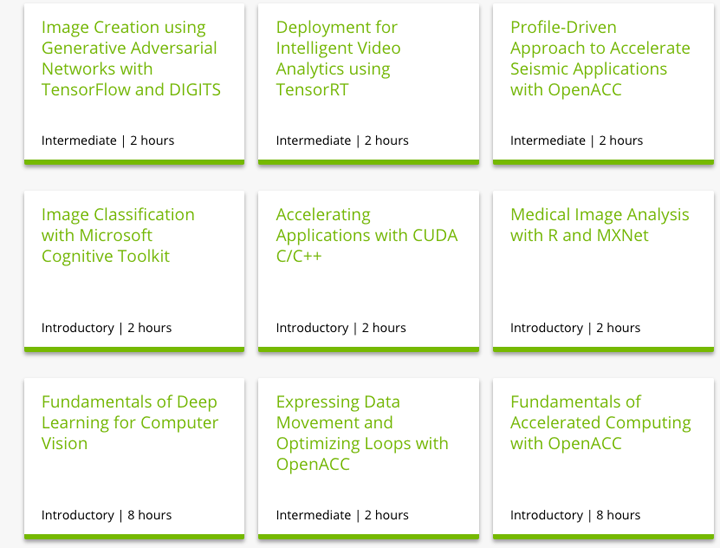
    NVIDIA, Silicon Valley’s powerhouse on GPU computing and artificial intelligence, has launched a new version of its online training platform “to deliver an enhanced hands-on learning experience”, according to this company.

    The NVIDIA Deep Learning Institute added these new features:

    • Skill-based certifications which can be shared online and added to students’ resumes
    • Continued access to fully-configured, GPU-accelerated workstations in the cloud
    • Single sign-on (SSO) integration with the NVIDIA free Developer Program (if you’re not a member, you can sign up for free today)

    Additionally, NVIDIA has recently added several self-paced classes and instructor-led content to its course platform, built on an Open edX – based ecosystem.

    In terms of number of learners, NVIDIA is on its way to reach the first 100K students by the end of this year.


  • Op-Ed: Freshman Year Can Be Free Online For Anyone

    Op-Ed: Freshman Year Can Be Free Online For Anyone

    [Originally published in The Baltimore Sun]

    By James M. Murphy

    The American system of higher education is unparalleled. Our public and private institutions — including many right here in Baltimore— offer world-class opportunities in the sciences, humanities and arts, and prepare students for vibrant intellectual and professional lives. However, the benefits of this system are unequally distributed. A college education is unaffordable for many Americans, and its traditionally residential nature creates barriers for adult and non-traditional students. In fact, students previously considered non-traditional are now the norm.

    Celebrating its one-year anniversary this August, the philanthropy Modern States Education Alliance harnesses online education to shatter these economic and geographic obstacles. [Disclosure: IBL Education developed the Modern States Open edX platform and the courses]

    Students of any age or economic background can utilize Modern States’ catalog of free online freshman-level college classes taught with state-of-the-art technology by professors from some of America’s most renowned universities including Johns Hopkins where I am a member of the math faculty. I teach four Modern States courses, each designed to help students pass a CLEP (College-Level Examination Program) exam offered through the College Board. A passing score on a CLEP exam translates to college credit at thousands of colleges and universities, including University of Maryland, Morgan State University, Coppin State University, Towson University, Community College of Baltimore County, Loyola University of Maryland, Mount Saint Mary’s University and many others in the Mid-Atlantic.

    CLEP exams cost $87, substantially less than the thousands of dollars it costs to take an on-campus math class. Moreover, Modern States is paying the exam fee for the first 10,000 students to take a course and corresponding CLEP. These courses are compact, self-contained versions of typical introductory college math classes, and they allow students to refine and develop their skills in mathematics at no cost.

    As with my on-campus classes, my Modern States classes begin with fundamentals, then follow the natural progression of the material as it would be taught in the classroom. I take the time to provide detail when working out problems, explaining the crucial steps that are imperative for learning. Providing clear insights is critical in the online format and ensures my contribution as the lecturer and architect for this course is far more valuable than a textbook alone.

    My online students are diverse. Some are typical college-age and testing out of introductory courses as a means to make college more affordable. Many are working adults who need an online platform instead of the traditional residential experience. Others are returning veterans, looking to bring themselves up to speed in college mathematics before returning to campus. My Modern States courses democratize education by allowing any student to learn and grow as a student of mathematics, regardless of age, geography or financial means.

    The Modern States online courses are not designed to replace the traditional American college experience but to complement it and increase its accessibility. By helping students move past remedial courses through online study and earn credit through the CLEP exam, my Modern States courses provide an on-ramp to college. I believe that online content can never replace the real, human interaction between teacher and pupil, especially in advanced courses and in mentorship. However, I also believe online courses can open the door to higher education for the millions of Americans who believe it is out of reach.

    Education changes lives, and the educational opportunities in America are second to none. It is for this reason that new opportunities to democratize education should be seized with both hands.

    Of course, you don’t have to take my word for it. Go to www.modernstates.org. All you need is an internet connection and the desire to learn.

    James M. Murphy (jmurphy@math.jhu.edu) is a postdoctoral fellow within the Department of Mathematics at Johns Hopkins University.

  • Learning Innovation | August 2018: UPenn, Moodle, Udacity, Blackboard, Skillshare…

    Learning Innovation | August 2018: UPenn, Moodle, Udacity, Blackboard, Skillshare…

    Newsletter format  |  Click here to subscribe ]

    AUGUST 2018  –  NEWSLETTER #14 ON LEARNING INNOVATION


    The University of Pennsylvania will launch its first fully online degree in engineering. It will be offered in Coursera for $26,300, one-third of the on-campus version’s price tag.

    Private colleges or universities closures will rise to a rate of 11 per year, according to Moody’s.

    • Higher-ed is facing worrying financial signs, The Washington Post concluded.

    Amazon is not providing schools with good deals despite its reputation for cheaper prices.

    Moodle ended its partnership with Blackboard, and it won’t allow to use the “Moodlerooms” name.

    Blackboard continued its market decline to 28 percent while its debt took a hit of $1.3 billion.

    Four megatrends shaping global education, according to the Chief Product Officer at Trilogy Education.

    Udacity’s COO explains how it decides what subjects to offer and who it wants to partner with.

    Skillshare raised $28 million to accelerate its model of being a Netflix-like subscription model for online education.

    A Georgia State University professor was awarded the McGraw Prize in education (video talk).

    Columbia University opened a research center devoted to blockchain technology.

    Blackboard updated CourseSites, its free MOOC platform

    • Education Events Calendar by IBL News


    This newsletter about learning innovation is a monthly report compiled by the IBL News journalist staff, in collaboration with IBL Education, a New York City-based company that builds data-driven learning ecosystems and courses with Open edX. If you enjoy what you read please consider forwarding it to spread the word. Click here to subscribe. 

    Archive:
    IBL Newsletter #13 – July 2018
    IBL Newsletter #12 – June 2018
    IBL Newsletter #11 – May 2018
    IBL Newsletter #10 – April 2018
    IBL Newsletter #9 – March 15, 2018
    IBL Newsletter #8 – March 1, 2018
    IBL Newsletter #7 – February 2018
    IBL Newsletter #6 – January 31, 2018

    IBL Newsletter #5 – January 15, 2018
    IBL Newsletter #4 – December 2017
    IBL Newsletter #3 – November 2017
    IBL Newsletter #2 – October 2017
    IBL Newsletter #1 – September 2017


  • Georgia Tech Launches a Master’s Degree for $10K on edX.org

    Georgia Tech Launches a Master’s Degree for $10K on edX.org

    Georgia Tech, a nationally ranked top 10 university, announced this week a new online master’s degree in Cybersecurity for less than $10,000 on edX.org.

    This OMS Cybersecurity (Online Master of Science in Cybersecurity) will launch January 7, 2019, with 250 students and will scale over time. Applications for Spring 2019 are open now until October 1, 2018.

    The program offers the same curriculum as the on-campus program at Georgia Tech, which has been offered since 2002 at a cost of $20,000 for in-state students and $40,000 for those out-of-state.  It is designed to serve working professionals who can study part-time and earn the degree within two to three years. It is richly technical and offers the same three interdisciplinary tracks available on campus beginning with information security and followed by policy and energy systems.

    “We are excited to strengthen our partnership with Georgia Tech by now offering two top-ranked online master’s degrees in high-demand fields to learners all over the world,” said Anant Agarwal, CEO at edX.

    OMS Cybersecurity is Georgia Tech’s third at-scale online degree program. It will follow the same model as the groundbreaking online Master of Science in Computer Science (OMSCS) program, which launched in 2014 on Udacity with support from AT&T and has enrolled approximately 10,000 students overall for the $6,800 degree.

    Also, it will follow the success of the Online Master of Science in Analytics (OMS Analytics) launched in 2017 on edX with support from AT&T and Accenture. This OMS Analytics currently has 706 students in its second semester and costs less than $10,000.


  • IBM’s CognitiveClass.ai Launches Two Professional Programs on edX.org

    IBM’s CognitiveClass.ai Launches Two Professional Programs on edX.org

    After launching its own Open edX installation (Cognitive Class.ai), with seventy courses on data science and cognitive computing, IBM Skills Network will release two Professional Certificate programs on the edX.org portal this year: Building Chatbots Powered by AI and Deep Learning.

    “Accelerating the pace of technology especially in the areas of AI, Machine Learning, Deep Learning and Blockchain is proving particularly challenging for traditional educational institutions,” said Leon Katsnelson, CTO and Director of IBM Skills Network, headquartered in Toronto, Canada.

    For hosting these courses on edX.org, IBM has joined the paid edX Consortium, today formed of 113 members. The edX official blog made this announcement.

    One of the IBM courses, How to Build Chatbots and Make Money, was available on May 30. It comes with a marketing promotion based on signing up for powering 10 chatbots on IBM Cloud. The other two courses of the program, Smarter Chatbots with Node-RED and Watson AI, and Programming Chatbots with Watson Services, will be released in the following weeks. Most of them are currently available, without certification, on CognitiveClass.ai.

    The five courses of the Deep Learning program will be released during September, October, and November, and the others will be mostly repackaged classes of the Cognitive Class Open edX platform.

    “The courses are virtually identical but in some instances there are some changes and additions,” explained Antonio Cangiano, an IBM instructor.


  • Hawthorn.1 Is Finally Here – edX Launches Its Eighth Version of the Platform

    Hawthorn.1 Is Finally Here – edX Launches Its Eighth Version of the Platform

    After months of delays, edX finally launched today the official Hawthorn version of the Open edX platform, Hawthorn.1. This release is based on the edX code of July 3.

    This launch means that the Ginkgo version will automatically be unsupported.

    Devstack is now based on Docker rather than Virtualbox.

    “I’m sorry that we had a year-long gap between Ginkgo and Hawthorn. We’re aiming to get the next release (Ironwood!) out in less time,” explained Ned Batchelder, edX architect.

    Hawthorn release notes have already been posted here, along with an article describing the main features.

    Hawthorn, Open edX’s eighth release, includes enhancements to the learner profiles, ORA component, files & uploads page, and a user deletion feature, following the new GDPR European data privacy law.

    LMS and Learner new features

    • Learner profile now includes the date the user joined the platform, as well as course credentials they have received. This links to social media accounts, helping learners share information with one another.
    • Learners now have the ability to purchase all the courses in a program in just one transaction. This avoids the hassle of having to enter payment information multiple times.
    • New discussion notifications now send an email message the first time a learner’s post receives a comment. The message contains the comment and a link back to the course discussions for easy access.
    • Inline discussions are expanded by default. This change has led to a threefold increase in discussion participation.

    Studio and Course Author Tools

    • Course teams now have the ability to override learner scores for individual problems. This can be done through a setting on both the instructor dashboard and the Staff Debug Viewer.
    • Course Reviews can now be viewed and added by learners from within the course experience. Open edX system administrators can configure a reviews provider such as CourseTalk to allows learners to leave reviews for a particular course.
    • Proctored exams have been improved, enabling course teams to add specific exam instructions in the Studio proctored exam settings.
    • The Files & Uploads page has been updated to significantly simplify the experience of adding all types of files to a course. This includes the ability to search and a Hide File Preview option.
    • The ORA problem editor has now been improved. A new interface offers the same formatting options for the prompt that is available for HTML components. You no longer have to create a separate HTML component above the ORA assignment.
    • Weekly course highlight messages can now be sent to encourage learners to remain engaged with self-paced courses. Specify a few highlights for each course section, and the platform sends out a weekly email message that lists these highlights. Courses on edx.org that enabled weekly highlights had higher verification rates than ones without.
    • The HTML components have been updated to give you even more easy formatting options such as aligning your text the way you want: aligned to the left or right, centered, or fully justified. Images to HTML components can be added right inside the HTML component itself, without having to upload files beforehand.
    • The Video Uploads page is enabled by default, course teams who partner with 3Play Media and cielo24, transcripts—including translations of transcripts—are added to Studio automatically.


    Resources


  • Open edX Hawthorn’s New Features

    Open edX Hawthorn’s New Features

    The edX organization will release this week the final version of its Open edX platform, Hawthorn, after the final tests have been successfully completed. “Testing went very smoothly, and your feedback was invaluable,” said Ned Batchelder, edX architect.

    Hawthorn release notes have already been posted, along with an article describing the main features.

    Currently, the version available to download is the release candidate 3, open-release/hawthorn.1rc3.

    Hawthorn, Open edX’s eighth release, includes enhancements to the learner profiles, ORA component, files & uploads page, and a user deletion feature, following the new GDPR European data privacy law.

    LMS and Learner new features

    • Learner profile now includes the date the user joined the platform, as well as course credentials they have received. This links to social media accounts, helping learners share information with one another.
    • Learners now have the ability to purchase all the courses in a program in just one transaction. This avoids the hassle of having to enter payment information multiple times.
    • New discussion notifications now send an email message the first time a learner’s post receives a comment. The message contains the comment and a link back to the course discussions for easy access.
    • Inline discussions are expanded by default. This change has led to a threefold increase in discussion participation.

    Studio and Course Author Tools

    • Course teams now have the ability to override learner scores for individual problems. This can be done through a setting on both the instructor dashboard and the Staff Debug Viewer.
    • Course Reviews can now be viewed and added by learners from within the course experience. Open edX system administrators can configure a reviews provider such as CourseTalk to allows learners to leave reviews for a particular course.
    • Proctored exams have been improved, enabling course teams to add specific exam instructions in the Studio proctored exam settings.
    • The Files & Uploads page has been updated to significantly simplify the experience of adding all types of files to a course. This includes the ability to search and a Hide File Preview option.
    • The ORA problem editor has now been improved. A new interface offers the same formatting options for the prompt that is available for HTML components. You no longer have to create a separate HTML component above the ORA assignment.
    • Weekly course highlight messages can now be sent to encourage learners to remain engaged with self-paced courses. Specify a few highlights for each course section, and the platform sends out a weekly email message that lists these highlights. Courses on edx.org that enabled weekly highlights had higher verification rates than ones without.
    • The HTML components have been updated to give you even more easy formatting options such as aligning your text the way you want: aligned to the left or right, centered, or fully justified. Images to HTML components can be added right inside the HTML component itself, without having to upload files beforehand.
    • The Video Uploads page is enabled by default, course teams who partner with 3Play Media and cielo24, transcripts—including translations of transcripts—are added to Studio automatically.


    Resources


  • Stanford Reaches 10M Students With Its Online Courses

    Stanford Reaches 10M Students With Its Online Courses