Category: Platforms | Tech

  • edX Posts the Release Notes of the Open edX Juniper Platform

    edX Posts the Release Notes of the Open edX Juniper Platform

    IBL News | New York

    edX officially announced Juniper, the latest release of the Open edX platform, and posted their release notes. “Overall, Juniper represents a huge step forward for the Open edX platform,” wrote Ned Batchelder, Architect at edX.

    Juniper, the tenth release of Open edX, is the version that took the longest time to develop: 17 months.

    It comes with new features related to the learner experience, instructor management and developer functioning.

    Learners will find new front-end pages regarding Profile, Account Settings, Order History, Checkout Page, and Course Experience.

    Improvements extend to areas like e-commerce, schedule personalization, team assignment submission, and mobile video app.

    The app now presents the ability to render YouTube videos within the application experience (previously learners would be redirected out of the application).

    Educators will find updates on Studio–the platform authoring tool– on component naming, unit creation, problem markdown editing, learning sequence navigation, and grading tools.

    For instances using programs, there is now a new registrar service to set enrollments.

    Developers will see major core upgrades to support Python 3 and Django 2, along with many areas deprecated.

  • JupyterCon 2020 Conference Will Introduce an Innovative Learning Format with Credentials

    JupyterCon 2020 Conference Will Introduce an Innovative Learning Format with Credentials

    IBL News | New York

    The annual reunion of Jupyter developers and practitioners–scheduled, prior to the pandemic, to happen in-person this summer in Germany–will be finally held online on October 5-17, 2020, featuring an innovative format in which online learning will converge with credentialing.

    “We developed a vision in which a “conference” is now a learning platform, unconstrained by synchronous schedules or geographical location, coalescing a multitude of mini-events and rad new content, learning experiences, and online social interactions,” explained Dr. Lorena A. Barba, General Chair at the conference and Professor of Engineering at GW.

    According to the announcement issued yesterday by the organizers, the JupyterCon 2020 event will comprise of:

    1. An online learning platform to create courses and organize content, providing user profiles to track learning and earn micro-credentials.
    2. Integrations with third-party tools for web conferencing and text-based threaded discussion.
    3. Online labs with access to JupyterHub/Binder attached to the content.
    4. Beyond just “talks,” content organized as mini-courses with permanent resources attached, and ensuing conversation.


    “This is our vision for the conference of the future,”
    stated Professor Lorena A. Barba. “We conceived a long-term strategy with the key vision of magnifying career-advancement opportunities for all members of our community, and assembling a permanent library of learning resources.”

    The conference program will mix on-demand with live content, resulting as follows:

    1. Tutorials: consist of prepared written materials and exercises in Jupyter notebooks, pre-recorded video by the instructor, live office hours with participants each day, and text-based discussion. The conference team will create a MOOC-style mini-course from the author-prepared materials. Participants completing the tutorials will receive certificates.
    2. Keynotes: streamed live to YouTube each day, with private backchannel discussions in the JupyterCon Mattermost server, public backchannel on Twitter, and also live, moderated Q&A after the talk.
    3. Regular presentations: pre-recorded, with timed-release on YouTube Premiere, backchannel discussions in the private text-based forum, and in public on YouTube and organically on Twitter.
    4. Panels of Speakers: since the regular presentations are pre-recorded, these are an opportunity for the audience to interact live with the speakers. We’ll cluster speakers by topic, for a live broadcast discussion with a moderator, after their pre-recorded presentations aired. Audience can submit questions ahead of time for moderators to choose, and can also ask live.
    5. Posters: these are digital artifacts that can be static or interactive (e.g., Voilà dashboards), plus a pre-recorded 2-min pitch on video.
    6. Live lightning talks: 5-min moderated live presentations, with a text-based backchannel discussion, but no Q&A with speakers.
    7. Birds-of-a-feather: open-forum video chats organized organically among attendees.
    8. Interviews with influencers in the community as an additional draw of activity and discussion. Other live panels not connected to pre-recorded talks (e.g., Q&A with JupyterHub developers).

    The JupyterCon 2020 conference will be part of a larger educational initiative named NumFOCUS Academy, which will include a scalable ecosystem consisting of an online learning platform, a JupyterHub server, front-end websites for JupyterCon, PyData and NumFOCUS Academy, and services like e-commerce, single-sign-on, and analytics.

    The Sloan Foundation approved a grant to back the project in May, while OVH decided to participate as a Platinum sponsor. IBL Education will deploy and support the learning ecosystem, with Open edX as the centerpiece technology.

  • Courses, Strategies, and Resources to Get The Most From Learning with edX and Coursera

    Courses, Strategies, and Resources to Get The Most From Learning with edX and Coursera

    IBL News | New York

    edX’s How to Learn Online course reached over 85,000 enrollments. This 4 to 6-hour course, taught by edX’s learning design team, includes a curation of effective science-backed techniques.

    Related to digital learning, edX offers five more courses under a Professional Certificate program, Course Creator Plus.

    Coursera’s Learning to Teach Online attracted a similar number of users. This 17-hour course is based upon award-winning educational resources developed by Dr. Simon McIntyre and Dr. Negrin Mirriahi, from UNSW Sidney.

    Both the Coursera and edX organizations have been releasing materials lately, with tips and inspirational resources about online learning for the COVID times.

    Regarding learning strategies, edX suggests making sure educators develop new knowledge and skills in a way that can be retained, applied repeatedly, and adapted to new contexts.

    The main advice is to make learning stick by taking advantage of established learning principles of practice, application, and reflection.

    “A well-designed learning experience will provide you with opportunities to practice, apply, and reflect, but you can reinforce your learning outside of a class by connecting it to your everyday life and work,” explained Nina Huntemann, Senior Director of Academics and Research at edX, and one of the instructors of the “How to Learn Online” course. [In the picture above].

    Nina Huntemann provided three top tips to getting the most from online learning and achieving those learning goals.

    1. Set aside time for learning. Plan and dedicate time to learn as you would to exercise or see friends or spend time with loved ones.
    2. Virtually meet and interact with your learning peers. You are not alone.
    3. Make your learning stick with the practice, application, and reflection.

    Coursera said that live synchronous sessions are optimal for creating a space for collaborative problem solving, peer-to-peer interaction and personalized step-by-step guidance.

    Linlin Xia and Alexandra Urban, from the Teaching & Learning Team at Coursera, described in seven points the best practices regarding live sessions:


    1. Enhance course community

    – Start with ice-breaker questions (e.g. what’s your favorite dessert) or virtual polls to get all students participating from the very beginning.

    – Invite alumni or previous students from the course to share their learning tips.

    – Encourage real-time community by asking students to submit messages, raise a hand, or use other tools within the virtual classroom.


    2. Dive into key concepts

    – Share your screen or use a virtual whiteboard functionality when the problem involves calculations, concept mapping, or images.

    – Show step-by-step problem solving to guide students in your thought process.

    – Make sure to pause and ask students questions throughout the session to ensure understanding.


    3. Preview or debrief an assessment

    – Collect questions from students about the specific project before the session.

    – Walkthrough the purpose and benefits of completing this assignment.

    – If it’s an open-ended project, allow students to share ideas with instructors or their peers and collect feedback.

    – Address common pitfalls, as well as how mistakes can be avoided.


    4. Conduct a live demonstration

    – Make sure the code, software, or interface is large and clear enough for students to read.

    – Zoom in on important elements to focus students’ attention.

    – Talk through the process for conducting this type of simulation or problem solving, so students can recreate needed steps later on their own.


    5. Initiate a team project

    – Encourage peer-to-peer learning through specific prompts and clear deliverables desired.

    – Use virtual breakout rooms with separate video conference links for each student-group to discuss.


    6. Highlight a guest speaker

    – Send a summary of the guest’s background and expertise before the session, so students can prepare.

    – Collect questions from students ahead of time to add structure to the meeting.

    – Add interactive and reflective elements to help students apply what they’re hearing and encourage the guest to brainstorm alongside the students. when possible


    7. Create virtual office hours

    – Let each student or team sign up for 10 to 15-minute slots of time at least one week ahead.

    – Ask students to submit their questions before the event so you can use the time most efficiently and center on the most frequently asked questions.

    – Send out beforehand which topics will be covered to pique students’ interest to attend.
  • Harvard University’s LabXChange Platform Wins the 2020 Open edX Prize

    Harvard University’s LabXChange Platform Wins the 2020 Open edX Prize

    IBL News | New York

    Harvard University’s LabXChange.org project won the 2020 Open edX Prize for the technical category, while a French training program called Les Copros Vertes was recognized as the most important project in instructional design.

    The announcement was made by the edX team organizing the prize through a blog post on its website.

    The edX organization –a nonprofit created by Harvard University and MIT– congratulated the following people at LabXChange: Robert Lue, Professor of the Practice of Molecular and Cellular Biology at Harvard University and UNESCO Chair on Life Sciences and Social Innovation, Gaurav Vazirani, Managing Director of LabXchange, Braden MacDonald, CTO of OpenCraft, Usman Khalid, Product Designer and Developer at OpenCraft, and David Ormsbee, Staff Software Engineer at edX.

    As a platform that is powered by the Open edX software, LabXchange.org allows users to freely establish an online community for personalized learning, sharing, and collaboration.  LabXchange has contributed to Open edX with features such as Blockstore, XBlock Runtime, along with a new visual assessment editor.

    Regarding the learning design award, edX specifically congratulated Yvain Demollière, CEO of MOOCit, Maxime Granata, Video Producer, and Leslie Huin, Instructional Designer, of MOOCit. Les Copros Vertes created a training program for over 50 thousand French citizens, about house-building projects and eco-friendly renovation models.

    • New stories about LabXchange on IBL News

  • Research: Platforms At Scale Will Radically Transform Learning and Teaching

    Research: Platforms At Scale Will Radically Transform Learning and Teaching

    IBL News | New York

    Researchers from Harvard, MIT, Stanford, and Cornell have conducted an extensive study that shows the power and potential of at-scale educational platforms – edX, among others – to accelerate learning and radically transform the way we learn and teach around the world.

    The research investigated at ways to help learners to complete online courses. Helpful tools for completion include the following:

    • Plan-making, creating detailed approaches to how coursework will be completed and when it will happen
    • Social accountability, choosing a ‘buddy’ to hold you accountable for completion
    • Value-relevance, reflecting on the value you hold in completing the course

    “Our present study confirms a principle that is central to social psychology and the learning sciences: Context matters,” researchers say.

    As Anant Agarwal, CEO at edX, wrote in a blog post, the researches advocate for continued experimentation, especially regarding the role of AI and Machine Learning on completion at scale.

    All analysis code, output, and study materials are available on this website.

  • edX MicroBachelors Will Include Consultants to Help Learners Complete Their Programs

    edX MicroBachelors Will Include Consultants to Help Learners Complete Their Programs

    IBL News | New York

    Learners enrolled in edX MicroBachelors Programs will receive professional coaching through InsideTrack, an educational non-profit organization based in Portland, Oregon, specialized in the student-success segment. No further details regarding the pricing and functioning were provided by the two organizations.

    According to a blog post from edX, InsideTrack’s coaches will work with learners via email, text messaging, and other digital formats. In addition, these consultants will help students to develop time management and self-reflection skills, along with improving resumes and job site profiles.

    edX currently offers five MicroBachelors programs: Professional Writing from Arizona State University, Marketing Essentials from Doane University, Elements of Data Science from Rice University, IT Career Framework from Western Governors University (WGU), and Computer Science Fundamentals from New York University (NYU). All programs are approved, or pending approval, for credit by Thomas Edison State University (TESU). They are priced between $500 and $1,500 (roughly $166 per credit) and can be completed fully online.

    InsideTrack claims that it has directly coached more than two million students while supporting online programs in the Penn State World Campus, BYU-Pathway Worldwide, and the University of Washington Continuum College.

    “By working with InsideTrack, we can provide the robust support that adults need to advance their education during uncertain times and help them stay on track to earn a valuable MicroBachelors program credential,” said Anant Agarwal, CEO and founder of edX.

  • Open edX Juniper Platform: Changes on LMS Instructor Dashboard and Studio Tool

    Open edX Juniper Platform: Changes on LMS Instructor Dashboard and Studio Tool

    IBL News | New York

    After a week of the Open edX Juniper platform release, initial features have started to emerge.

    Technically speaking, the main change is the upgrade into Python 3, after Python 2.7 became unsupported and unmaintained on January 1, 2020.

    Other upgrades affect Django, MongoDB, and Ruby, as explained on the official Confluence forum of Open edX.

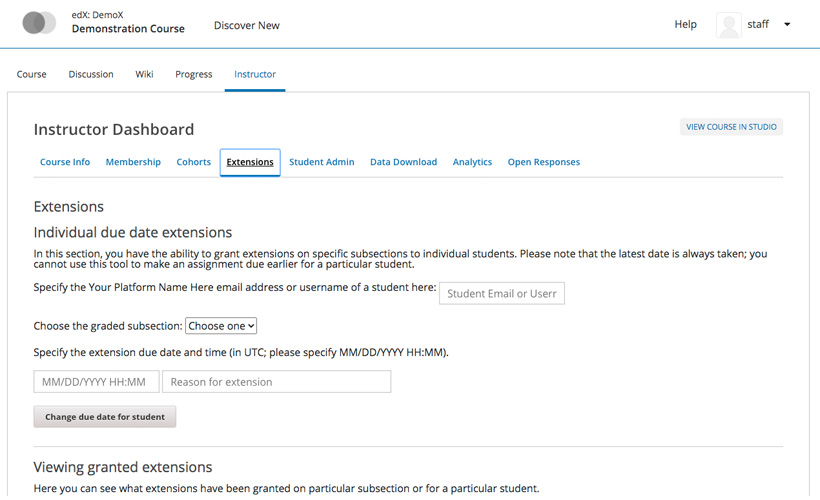
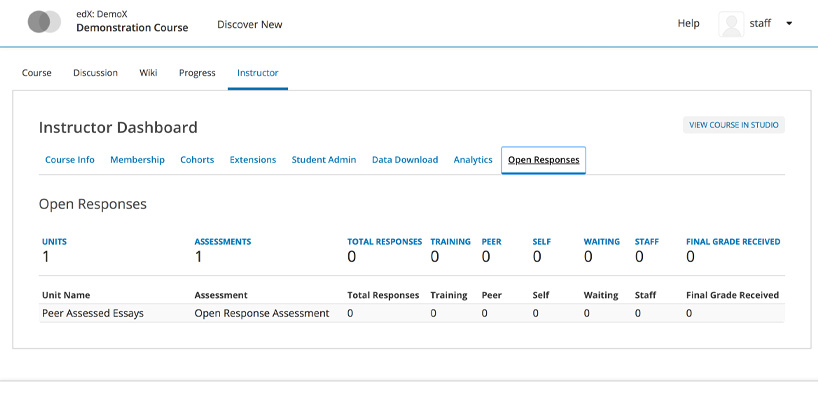
    Regarding features related to usability, the LMS’ Instructor Dashboard now includes Extensions and Open Responses data, as shown below.

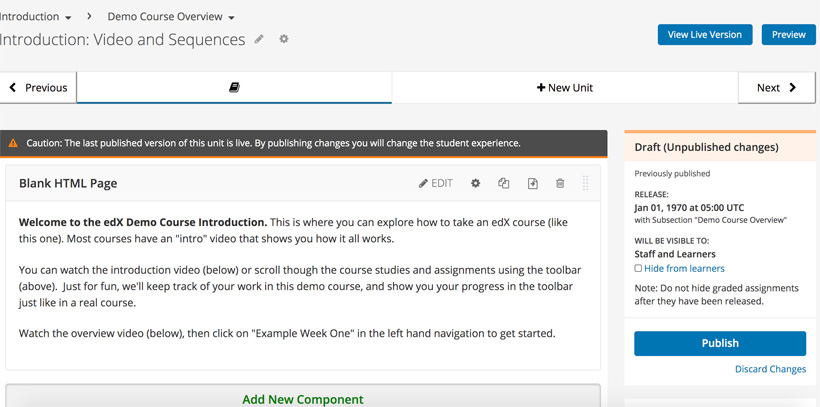
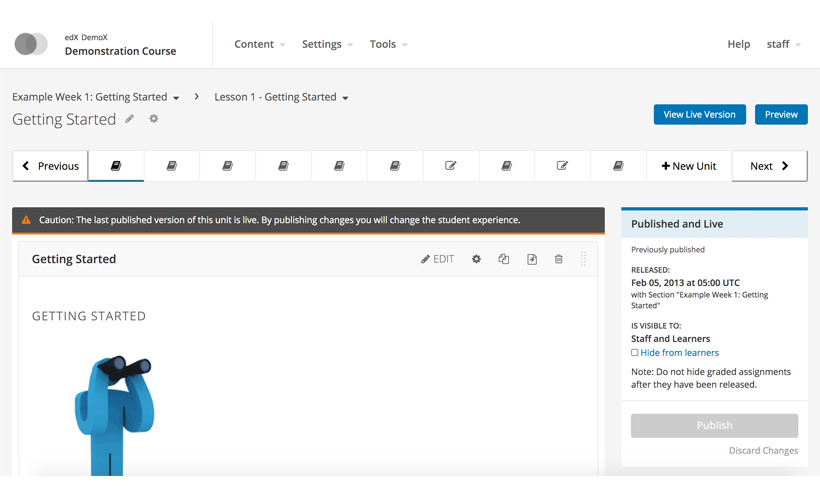
    On Studio – Open edX’s authoring tool – the main visible change points to the possibility of adding a Unit through the new prominent toolbar on top.

    The 10th Open edX release Juniper –now on its version Juniper.1– was based on the code of the master software from May 27th, 2020.

    edX hasn’t yet announced the new platform, nor released notes.

    IBL News (June 11)edX Releases Juniper, Its Tenth Version of the Open edX Platform

  • Coursera Users Complain About Cheating and Plagiarism on Peer Assignments

    Coursera Users Complain About Cheating and Plagiarism on Peer Assignments

    IBL News | New York

    Cheating and plagiarism on peer assignments prompted complaints among Coursera’s students, who blamed the learning company for not addressing the problem.

    “People either copy from their classmates or from the Internet. Submitting blanks give them the ability to see other assignments. Flagging has no effect,” said a user named “Moocer” at the Coursera Community forum.

    A learner called “Chee Yang Ng” wondered why Coursera is not taking any action. “ They know academic misconduct is the major obstacle to the credibility of their courses, but why aren’t they doing anything about it,” he said.

    The same frustration was shared by Luke Lau, who asked Coursera to handle “this case of academic dishonesty.”

    The discussion at Coursera started a week ago when a user opened a thread titled “How do we make certificate more creditable when there is a serious violation of intellectual property on Coursera?” claiming that his work was plagiarized. Chee Yang Ng said: “I cannot express how disappointed I am, not only on the violation of my intellectual property but also on the system failure of the platform that makes me question the quality of the education provided by the platform.”

    “Keep in mind that Coursera is a for-profit business, not an educational institution,” concluded Moocer.

    No one from Coursera answered, including the community manager of the forum.

    The discussion generated twelve replies.

    Plagiarism and cheating have been constant on MOOC platforms, although the problem has been kept inside doors.

  • An edX Survey Finds that a Majority Is Interested in Pursuing Additional Education

    An edX Survey Finds that a Majority Is Interested in Pursuing Additional Education

    IBL News | New York

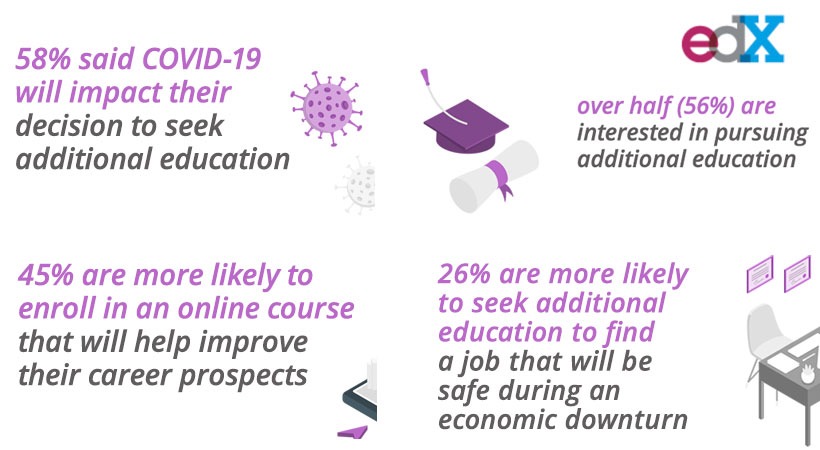
    As a result of the impact of the COVID-19 pandemic, 56% of Americans are interested in pursuing additional education but are unable to due to the cost (29%) or other factors such as limited time (23%). In contrast, just over a quarter (26%) of Americans are more likely to pursue additional education because they are in search of a recession-proof job.

    These are the main conclusions of a survey conducted by edX in determining the impact of the pandemic on education.

    “Education has always been linked to improved job and earning potential, and with the pandemic leading us into a likely economic downturn, the cost is clearly top of mind,” concluded Adam Medros, Co-CEO at edX.

    The survey shows that 45% are looking for a course that will help advance their career, while another 30% who are interested in taking a course to explore a new interest.

    edX.org offers stackable, modular credentials, such as MicroMasters Programs, Professional Certificate Programs, and MicroBachelors Programs.

  • Udacity Develops an Introductory Course and Nanodegree on Machine Learning for Microsoft Azure

    Udacity Develops an Introductory Course and Nanodegree on Machine Learning for Microsoft Azure

    IBL News | New York

    Udacity announced this week a new Machine Learning Scholarship Program for Microsoft Azure.

    The scholarship begins with a two-month-long course, focused on completing prerequisites for the full Nanodegree program.

    A distinctive feature of this course, titled Introduction to machine learning on Azure with a Low-code Experience, is Azure Labs, in which students work with live Azure environments directly within the Udacity classroom.

    Learners aiming to earn one of up to 10,000 free spots are able to apply until June 30.

    The 300 top performers who successfully complete the introductory course will be selected for a scholarship to earn a four-month Nanodegree credential.

    The amount invested by Microsoft on this Udacity program to help train developers on its cloud infrastructure was not disclosed.