Category: Platforms | Tech

  • edX Releases Juniper, Its Tenth Version of the Open edX Platform

    edX Releases Juniper, Its Tenth Version of the Open edX Platform

    IBL News | New York

    The edX organization quietly released yesterday its new Open edX version named Juniper.1. There have been no announcements nor release notes.

    This release was based on the code of the master software from May 27th, 2020.

    “Juniper” is the tenth Open edX version of the platform.

    Its name follows the adopted practice of picking botanical tree words and classifying them alphabetically.

    The next version will be named Koa. The past versions were:

    • Juniper
    • Ironwood
    • Hawthorn
    • Ginkgo
    • Ficus
    • Eucalyptus
    • Dogwood
    • Cypress
    • Birch
    • Aspen
  • UT Austin Launches an Online Master’s in Data Science for $10,000 on edX.org

    UT Austin Launches an Online Master’s in Data Science for $10,000 on edX.org

    IBL News | New York

    edX.org announced this week another online Master’s degree at $10,000 on a high-demand subject.

    The Master of Science in Data Science, from the University of Texas at Austin (UT Austin), is designed to prepare graduates to step into jobs within industries like bioinformatics, academia, government, and others.

    In this program, leaders from both the Department of Statistics and Data Sciences and the Department of Computer Science at UT Austin deliver a foundational curriculum in statistical theory that is built upon computer science.

    “We have made it a point from day one to ensure that the academic rigor of this program is held to the historic standards that everyone has come to expect from The University of Texas at Austin,” said Kate Calder, chair of UT Austin’s Department of Statistics and Data Sciences. “In many cases, these are the same faculty teaching comparable degree material to our on-campus courses, but tailored to the needs of this group of online students,” she added.

    The program will start on January 19, 2021, and the application deadline is September 15, 2020.

    Tuition is 30 credits at $333 each; $10,000 in total.

    This Master’s degree joins two additional online degree programs from UT Austin – a Master of Science in Computer Science and a Master of Science in Nutritional Sciences.

    UT Austin, one of the best U.S. public colleges, was a founding partner of edX in 2012.


  • College Students Will Have Free Access to the Coursera Course Catalog this Summer

    College Students Will Have Free Access to the Coursera Course Catalog this Summer

    IBL News | New York

    Coursera announced yesterday a collection of courses that help broaden an understanding of racism, bias, and social justice while pledging to provide financial support to create and host new classes about racial discrimination and social justice.

    On the other hand, in its latest response to the pandemic, also this week, the learning company announced, that college and university students will have temporary free access to the Coursera course catalog–including credentials– of 3,800 courses, 150 Guided Projects, 400 Specializations, and 11 Professional Certificates.

    All that’s required to enroll is that students–current undergraduate, graduate, or recently graduated–have a verified school email. They can sign up in programs for free until July 31. Once enrolled, they will have until Sept. 30, 2020, to complete the programs.

  • Coursera Introduces ‘Guided Projects’, a Hands-On Feature

    Coursera Introduces ‘Guided Projects’, a Hands-On Feature

    IBL News | New York

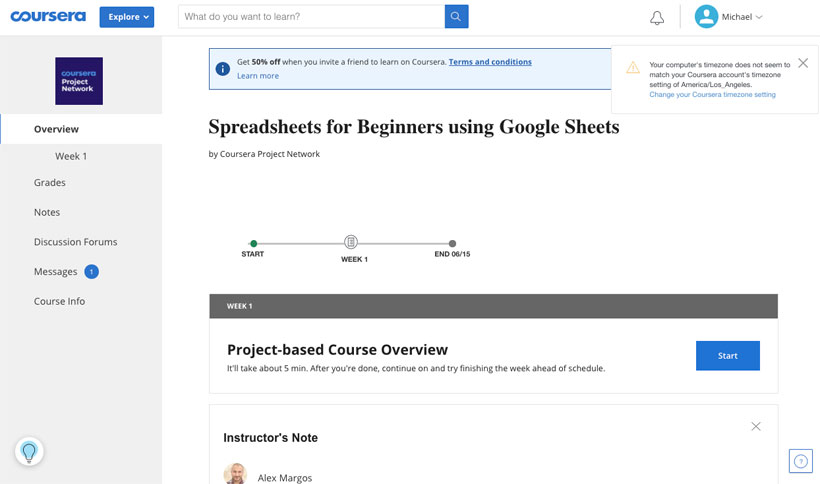
    Coursera announced the launch of Guided Projects, a feature to gain job-relevant skills in less than two hours, with step-by-step guidance from an instructor.

    The educational portal now has over 150 Guides Projects, and it will release “hundreds more” by the end of the year.

    Examples include curated collections that focus on learning specific data science, business, or computer science skills, such as:


    Coursera described the learning experience of Guided Project this way:

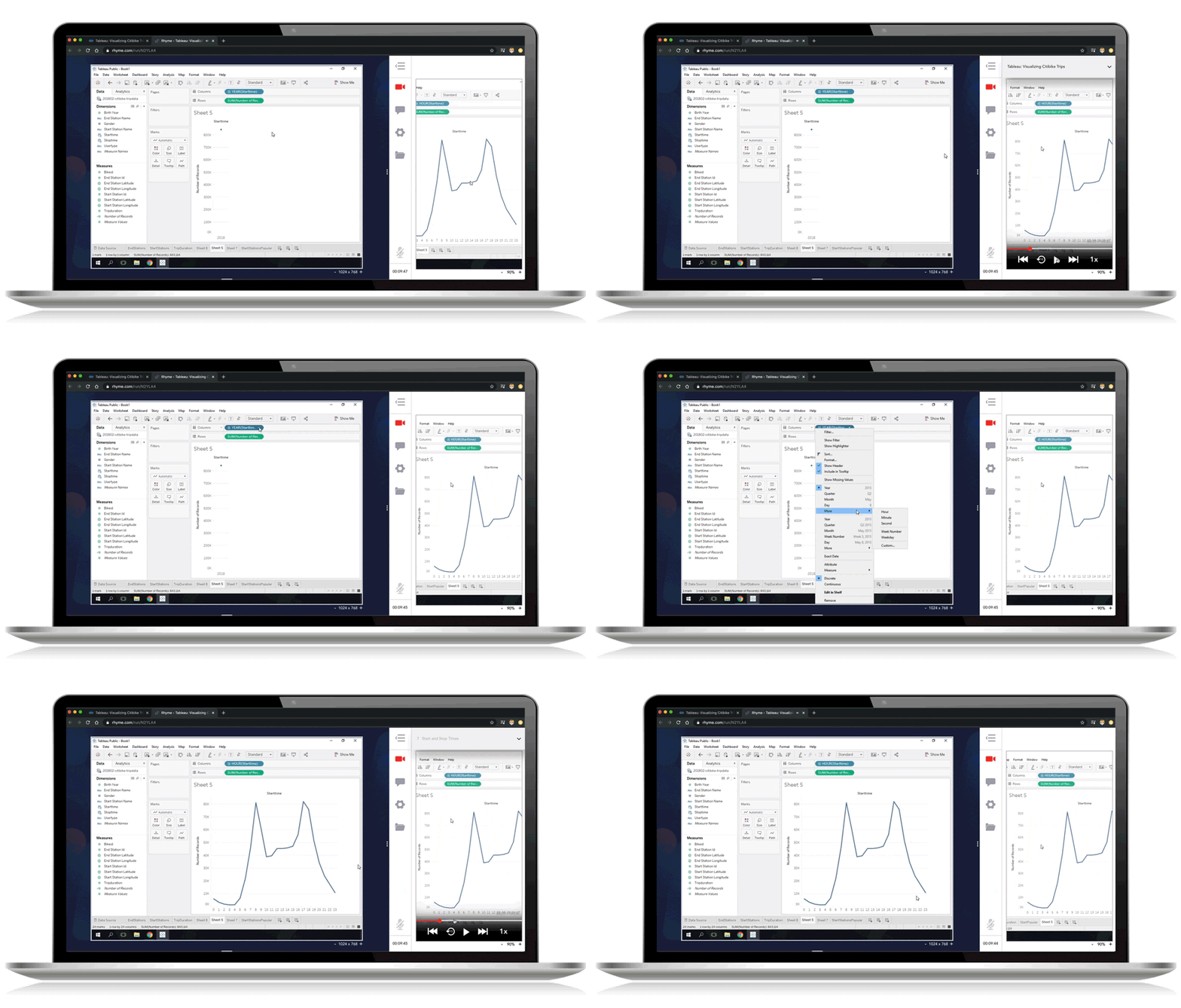
    “First, you’ll read an overview of the project structure, get introduced to your instructor, and see your learning objectives. You’ll then be prompted to open a tool called Rhyme to work on the project. Rhyme is a hands-on learning platform that provides a unique, side-by-side learning interface where you complete each step in a virtual workspace as you watch video instructions from your instructor on the other side of the screen. After you complete the project, you’ll return to your course homepage and take a quiz to check what you’ve learned. When you pass the quiz, you complete the Guided Project and earn a shareable certificate that showcases what you’ve learned.”

    Namit Yadav, General Manager at Rhyme Softworks–an online platform for hands-on projects acquired by Coursera last summer–wrote in a blog-post: “We’ll continue to add opportunities like these—both within courses and as standalone offerings—as well as explore new ways for you to learn skills through interactive formats.”

    From now until June 12, 2020, Coursera offers a free trial of a Guided Project.


  • edX Adds Three New Credit-Backed MicroBachelors Programs to its Portfolio

    edX Adds Three New Credit-Backed MicroBachelors Programs to its Portfolio

    IBL News | New York

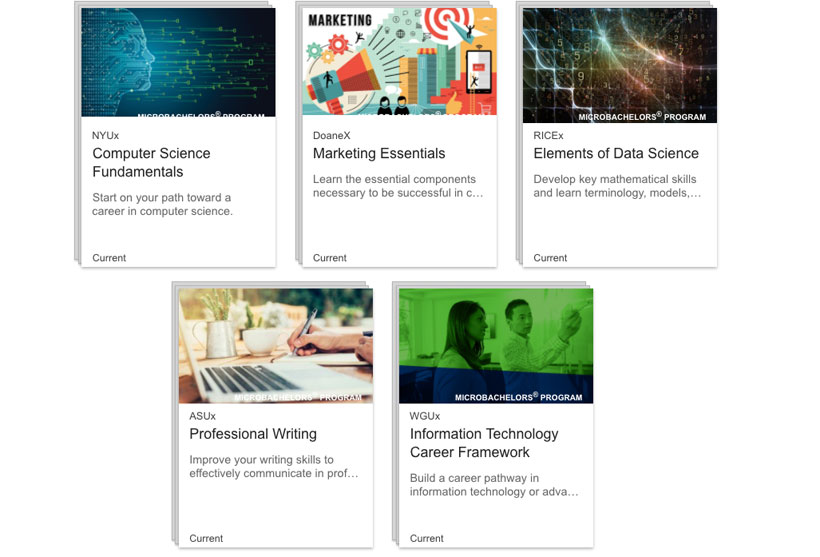
    edX.org announced yesterday three new credit-backed MicroBachelors programs, with an average cost per credit of $166.

    These programs join the currently available programs in IT Career Framework from Western Governors University (WGU) and Computer Science Fundamentals from New York University (NYU). All programs are approved, or pending approval, for credit by Thomas Edison State University (TESU).

    “As the global economy deals with the impact of the COVID-19 pandemic, MicroBachelors programs are more relevant than ever; they offer immediately transferable skills for people looking for new or more secure jobs and academic credit for people with college plans left up in the air,” wrote Anant Agarwal, CEO at edX, in a blog-post.

    The coronavirus pandemic is causing many young adults to delay or reexamine their college plans, according to edX. An Arts and Science Group survey found roughly one in six high school seniors say they definitely or most likely will change their plans to attend college in the fall because of the coronavirus.

    “For this group, MicroBachelors programs offer the opportunity to become better prepared for college, or explore in-demand fields like computer science and IT while earning college credit,” said Anant Agarwal. “For example, a student could take the Professional Writing and IT Career Framework MicroBachelors programs and earn 15 academic credits, which is a typical semester credit load.”

    Organizations such as Boeing, Lumina Foundation, Truist Foundation, Walmart, Jeremy M. and Joyce E. Wertheimer Foundation and Yidan Prize Foundation have financially contributed to the development of these programs from the beginning.

  • MOOCs Were Dead, but Now They Are Booming, According to The New York Times

    MOOCs Were Dead, but Now They Are Booming, According to The New York Times

    IBL News | New York

    Five years ago, The New York Times, in an extensively quoted report among academics keynoting on higher-ed conferences, had determined that MOOCs were dead. Low completion rates being below 5%, no business model behind them, and no impact on skyrocketing tuitions were the main reasons. In other words, disruption never occurred, and education wasn’t democratized.

    Yesterday, however, the Gray Lay of the journalism–the New York Times–certified a new reality. “Remember the MOOCs? After Near-Death, They’re Booming,” was the headline. The confinement at home and the online move due to the pandemic has mostly caused “a jolt that could signal a renaissance for big online learning networks that had struggled for years,” wrote the veteran reporter Steve Lohr.

    After millions of adults have signed up for online classes in the last two months, Coursera added 10 million new users from mid-March to mid-May–that is seven times the pace of new sign-ups in the previous year, according to the Times. Enrollments at edX and Udacity have jumped by similar multiples.

    “Crises lead to accelerations, and this is the best chance ever for online learning,” said Sebastian Thrun, Founder of Udacity.

    “Active learning works, and social learning works,” said Anant Agarwal, CEO at edX.


  • UC Davis’ Professional Ed Courses Soar to 4,000 Enrollments Per Day

    UC Davis’ Professional Ed Courses Soar to 4,000 Enrollments Per Day

    IBL News | New York

    The UC Davis’ Continuing and Professional Education (CPE) division announced that it has reached one million enrollments on its development programs on Coursera. In addition, CPE also offers training to the employees of nearly 2,000 organizations through the same platform.

    The institution is registering about 4,000 new individual enrollments per day, according to its data, while before the pandemic, the growth was 4,000 per week.

    “The [one million enrollments] milestone reflects the essential role that CPE and its faculty partners play in creating access to workforce development programs globally,” said Susan Catron, Dean of UC Davis Continuing and Professional Education.

    UC Davis offers 60 courses, nine specializations, and one “MasterTrack” on Coursera.

    The most popular specializations offered are SQL for Data ScienceIntroduction to SEOFundamentals of GIS, and Coaching Skills for Managers.

    UC Davis announced that it is adding new offerings of courses, such as Javascript, Spatial Analytics, Emotional Intelligence, Growth Mindset “and other high-demand topics aimed at closing the skills gap and supporting career advancement.”


  • Rancher.com Creates a Free Online Certification Program for Developers

    Rancher.com Creates a Free Online Certification Program for Developers

    IBL News | New York

    Rancher Labs, creators of a widely adopted Kubernetes management platform, announced today the launch of an online certification program through the newly created Rancher Academy.

    “It’s a professional, no-cost, zero obligation education platform centered on empowering commercial customers and the open-source community to be successful with Kubernetes and Rancher,” explained Peter Smails, CMO at Rancher Labs.

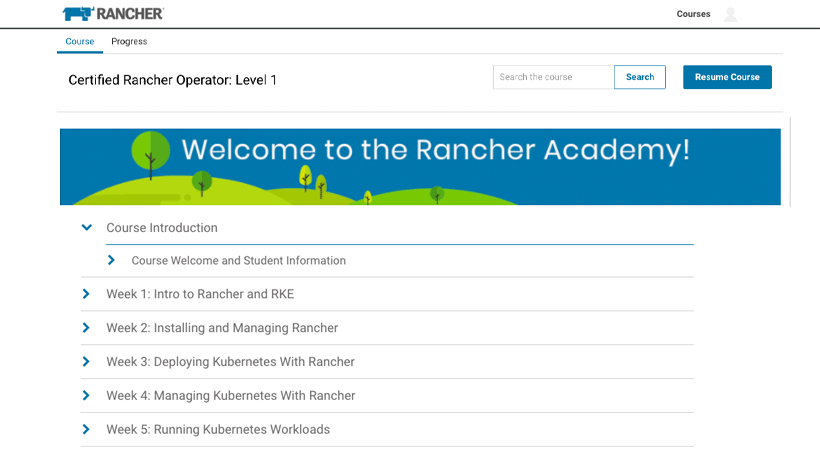
    The first available course is a free, self-paced, 5-week class, “Certified Rancher Operator: Level 1”.  The class is designed to teach developers with a basic understanding of Docker and Kubernetes how to deploy and use Rancher, RKE, along with how to work with downstream clusters.

    The course includes a mix of passive and active learning, with increasing detail and difficulty over the five weeks. Components of the learning experience include video introductions, theory work, demonstrations, hands-on labs, quizzes, and a final exam.

    Learners will be able to earn a certificate upon demonstrating their knowledge and competence with Kubernetes and Rancher.

    “The training is ideal for open source practitioners, partners supporting their customers and end-user customers looking to maximize their investment in Kubernetes, as well as any individual looking to increase their Rancher and Kubernetes competency in order to advance their careers,” stated the company.

    New classes are scheduled to be announced later this year.

    “Rancher Academy addresses the strong demand for a professional, certification-led program, while further cementing Rancher’s commitment to education,” said the Cupertino, California-based startup, in a press release.

    According to the company, Rancher Labs experienced a 250% increase in its Rodeo and Master Classes registrations over the past year.  As an extension of Rancher’s education strategy, the next step has been a training initiative to formalize skills and competencies with a professional, enterprise certification program.

    The launch of Rancher Academy has been led by Adrian Goins, Director of Community and Evangelism at Rancher Labs.

    The learning ecosystem is powered by IBL Education.

    Rancher.com reports having over 30,000 active users and 100 million downloads.

    •  Cloud Pro: Rancher Labs unveils new Kubernetes certification programme

  • edX Reports 100 Million Unique Enrollments After a Growth of 20 Million

    edX Reports 100 Million Unique Enrollments After a Growth of 20 Million

    IBL News | New York

    edX.org, the non-profit venture created by MIT and Harvard University in 2012, has reached a milestone of 100 million unique enrollments, after an increase of 20 million during the pandemic time. Anant Agarwal, CEO at edX, announced this achievement in a video message yesterday.

    “Eight years ago, we started a movement when we launched our first course and since then have grown to 100 million enrollments and counting,” said Agarwal.

    At the beginning of the year, edX reported 80 million unique enrollments and 24 million unique users, along with over 3,000 courses and 1.6 million certificates issued.

    This data was included in a document titled the “2020 Impact Report.”

  • Over 35,000 Enrolled in an Online Course to Become a Contact Tracer for the Pandemic

    Over 35,000 Enrolled in an Online Course to Become a Contact Tracer for the Pandemic

    IBL News | New York

    The state of New York will be hiring thousands of contact tracers to fight the pandemic. Across the nation, an estimated workforce of 100,000 could be required.

    These tracers in New York who will work in identifying infected persons’ contacts in order to break the chain of transmission, will be required to take and pass a free six-hours online course.

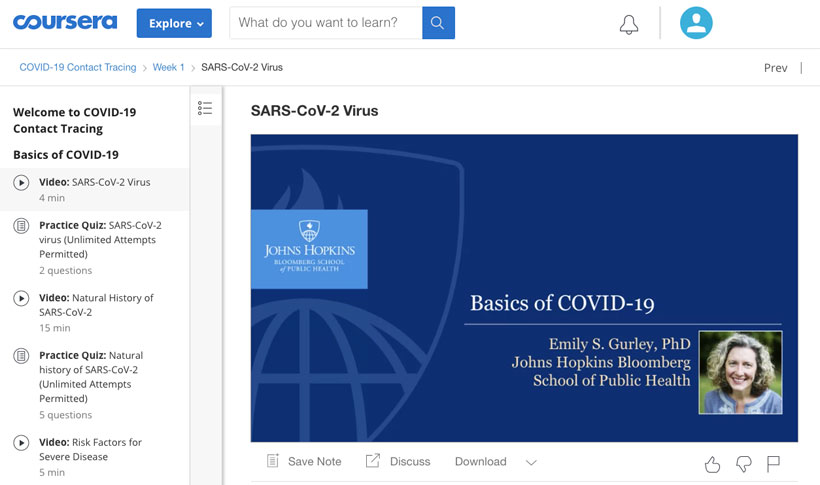
    The course COVID-19 Contact Tracing, is now available on Coursera, and has been developed by the Johns Hopkins Bloomberg School of Public Health with Bloomberg Philanthropies. Within days of its release on Monday, over 35,000 had enrolled.

    The certificate class taught by Emily Gurley, an infectious disease epidemiologist and an associate scientist of Johns Hopkins, teaches the basics of interviewing people diagnosed with the virus, identifying their close contacts who might have been exposed, and providing them guidance for self-quarantine for two weeks.
    “Even if you stop one or two new infections, you’re preventing many new cases down the line,” explained Emily Gurley.

    The course is part of an ambitious push for contact tracing backed by New York Governor Andrew Cuomo and tycoon Michael Bloomberg, who recently announced plans to develop a large-scale statewide program in New York.

    The program will include a baseline of 30 contact tracers for every 100,000 residents in the state and is expected to have 6,400 to 17,000 tracers statewide depending on the projected number of cases.

    “This new training course, which we’re making available online for free, will teach contact tracers how to do this work effectively—and help cities and states across the nation undertake these critical efforts,” Bloomberg said in a release.

    Across the nation, an estimated workforce of 100,000 could be required to help limit the spread of COVID-19 and safely reopen the economy, according to a recent report by the Johns Hopkins Center for Health Security.

    “Other communities may similarly adopt this particular course, or maybe they’ll give students a few options,” Joshua Sharfstein, Vice Dean at the Bloomberg School, said during the briefing. “Anyone in the country can now take this course and get a certificate to demonstrate that they … understand these key aspects of contact tracing.”

    The contact tracing course is divided into five sections or “modules,” covering:

    1. Basic information on the virus and COVID-19, including symptoms of infection and how the virus is transmitted
    2. Fundamentals of contact tracing, such as how to define a case, identify their contacts, and calculate how long a contact should isolate;
    3. Steps involved in investigating cases and tracing their contacts, including simulated scenes performed by professional actors who illustrate potential interactions that tracers may experience with infected individuals and their contacts
    4. Ethics of contact tracing, including balancing privacy and public health considerations, and examples of basic technology tools that can facilitate contact tracings, such as using text messaging for check-ins and reminders;
    5. Skills for effective communications in the tracing process, such as what it means to be an “active listener” and how to deal with common challenges that arise when investigating cases.

    The class includes simulations of contact tracing calls to give trainees a sense of the complex personal dynamics at play with the strategy, including in some cases a reluctance to self-quarantine for two weeks.