Category: Platforms | Tech

  • LMS Market Won’t Grow, Continuing To Be Dominated By The Big Four

    LMS Market Won’t Grow, Continuing To Be Dominated By The Big Four

    IBL News | New York

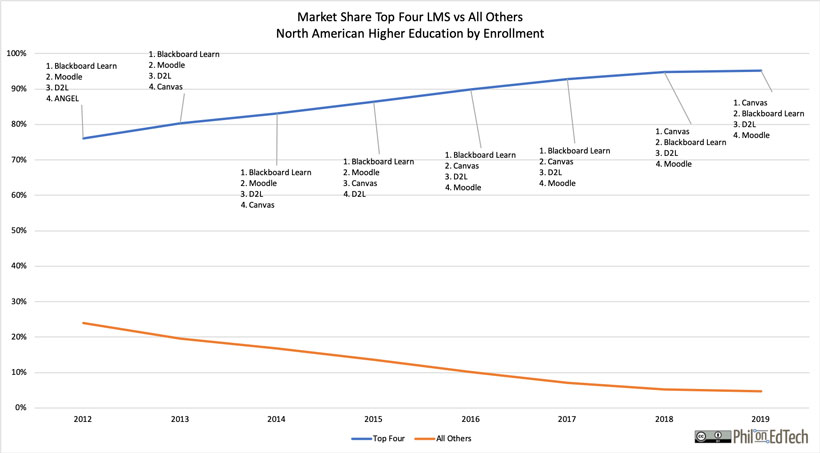
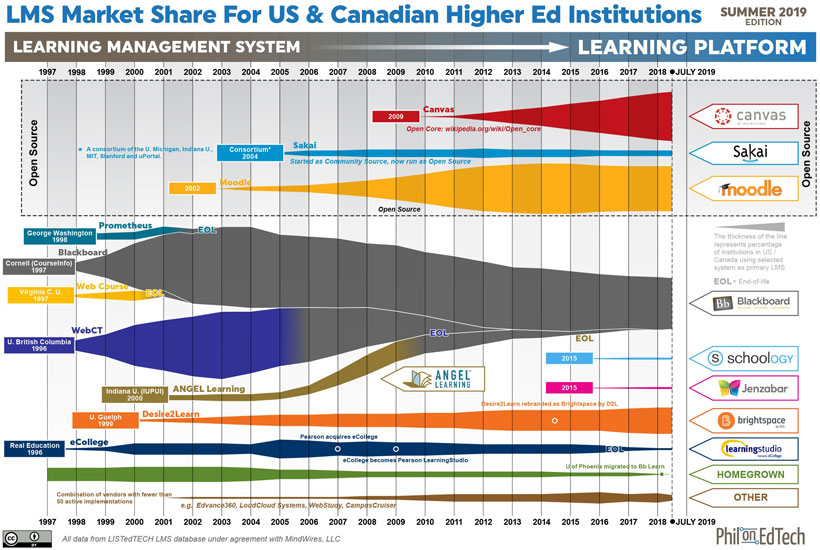
    Phil Hill, edtech consultant, released its mid-year 2019 report on the business of LMS (Learning Management System) in the United States and Canada’s higher education.

    This market continues to be dominated worldwide at a 95% rate by “the Big Four” (Instructure Canvas, Blackboard Learn, D2L Brightspace, and Moodle).

    Since mid-2018, the overall market activity showed fewer LMS formal evaluations, with data pointing to a 20%– 25% drop from 2017. “This slowdown seems to be a type of plateau rather than a continuing trend,” explains Phil Hill.

    Canvas LMS has extended its lead in North America over Blackboard: 28% vs. 27% based on several institutions, and 35% vs. 31%, in terms of student enrollments at those schools. Meanwhile, D2L/Brightspace’s market share decreased slightly – largely due to the closure of for-profit clients – despite recent wins including Purdue University, the University of the Sciences, University of Rhode Island, and nearly a dozen others.

    The report also indicates Moodle’s slight decline of less than 1% in terms of institutions over the past year.

  • Coursera Acquires an Online Platform for Hands-On Projects In Order to Enhance Its New R&D Unit

    Coursera Acquires an Online Platform for Hands-On Projects In Order to Enhance Its New R&D Unit

    IBL News | New York

    Coursera.org announced on August 28 its first-ever acquisition of the startup Rhyme Softworks, creator of a platform that allows developers to build hands-on, virtual e-learning projects.

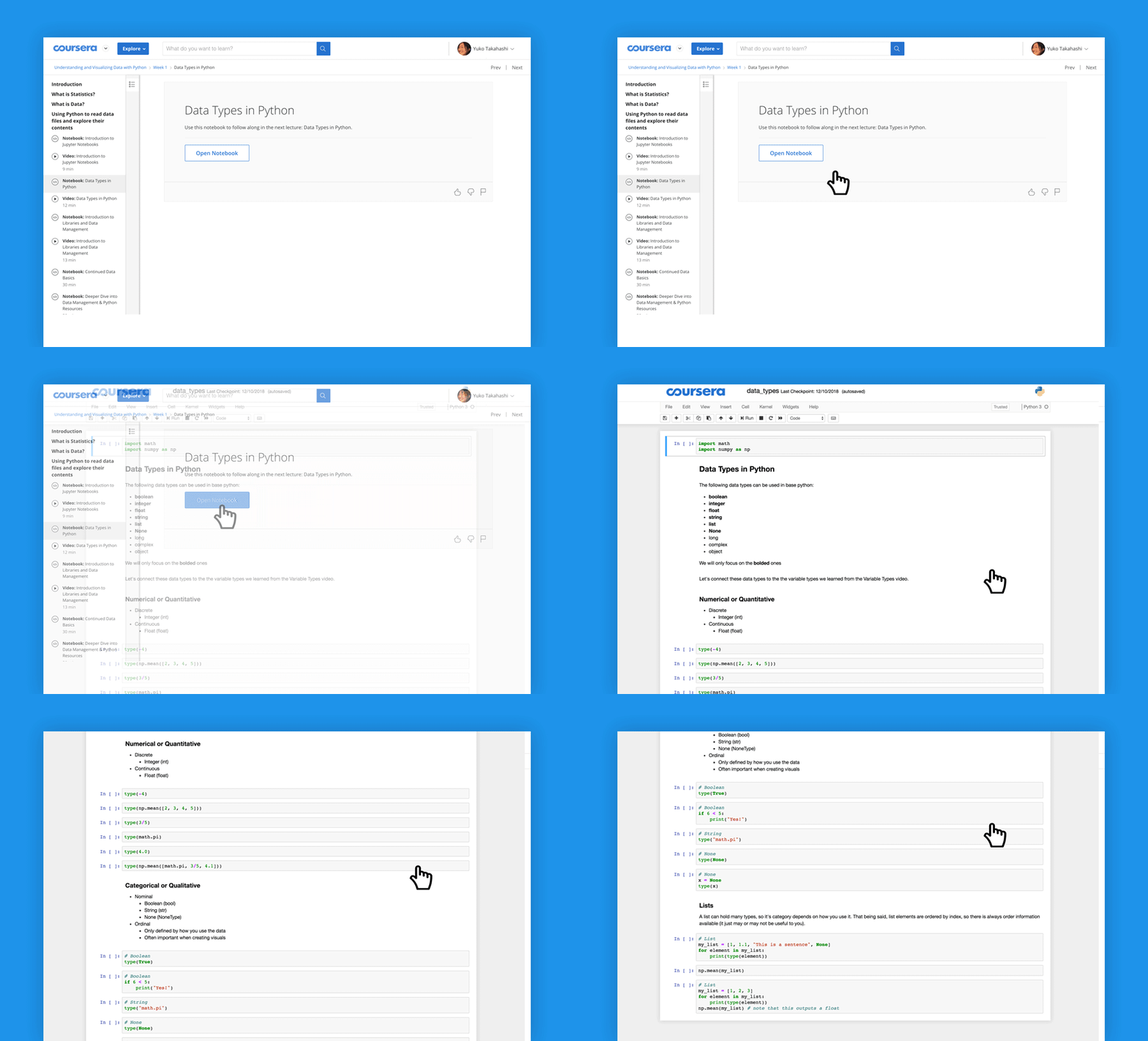
    Along with the transaction, Coursera unveiled Coursera Labs. This new offering lets educational institutions and industry partners to work on projects and assignments in a browser without any environment setup or software downloads using tools like Jupyter Notebook, RStudio, VS Code, and cloud software consoles.

    The terms of the acquisition of Rhyme Softworks – a San Mateo, Calif-based company with a team of only six – were not disclosed.

    “With Rhyme’s virtual machines, beginner to intermediate-level learners can follow along with self-paced or live guided sessions while simultaneously completing a project or assignment — all from one browser using pre-configured Windows or Linux cloud desktops,” explained Jeff Maggioncalda, CEO at Coursera, in a blog post.

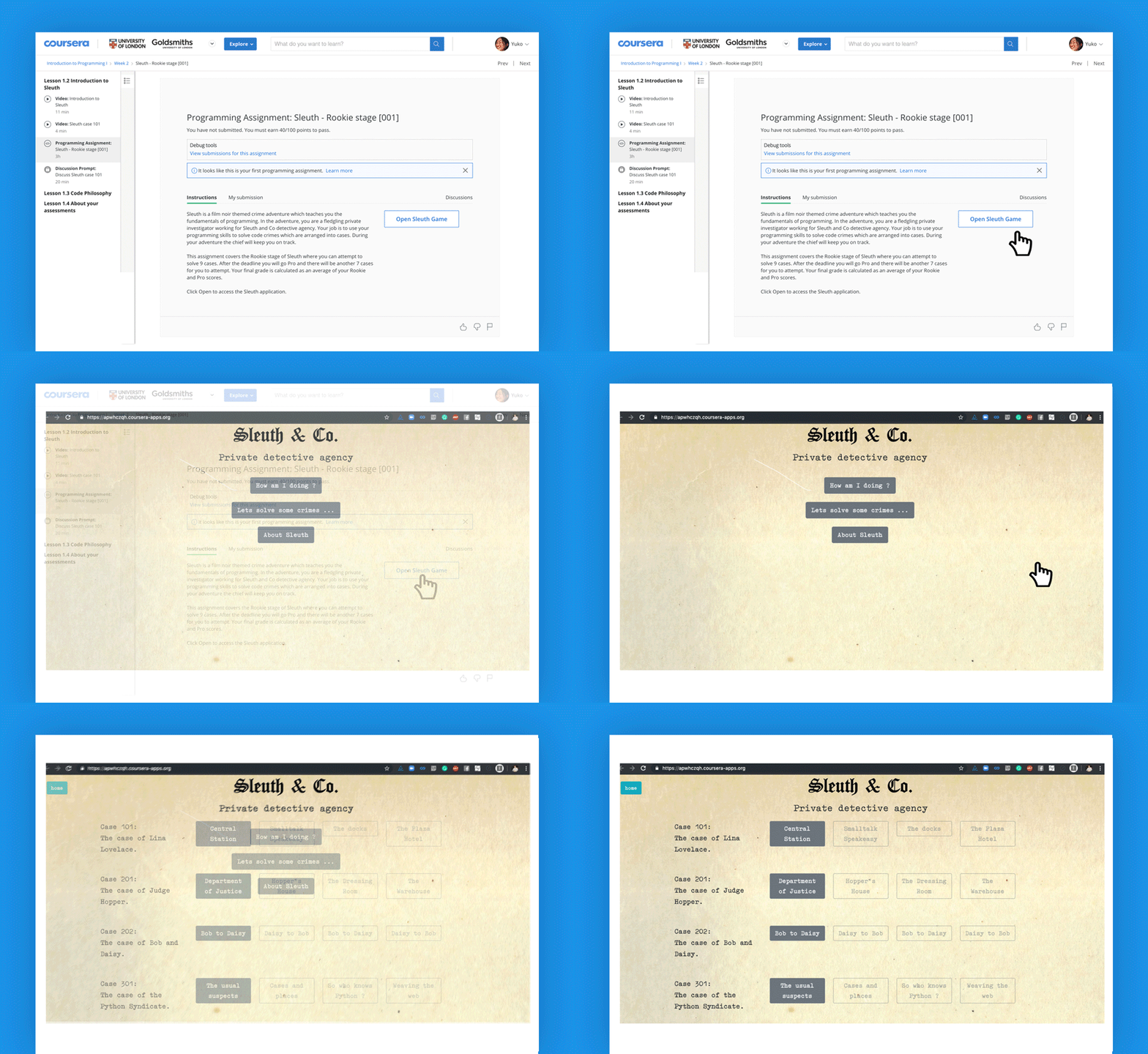
    Jeff Maggioncalda also disclosed that the University of London was a pilot partner for Coursera Labs, creating an innovative way for learners of their Introduction to Computer Programming course.

    For instance, with a custom application called Sleuth, students are able to write code to solve a series of interactive detective puzzles.

    The University of Michigan and the University of Illinois also plan to use this functionality for their upcoming content on the Coursera platform by the end of the year.

    “As online learning continues to support workforce training on the job and at home, it’s important to provide engaging, hands-on experiences that enable learners to test their mastery of new skills with the tools used in the workplace,” concluded Maggioncalda.

    Mountain View, Calif-based Coursera currently hosts 3,600 courses and 14 degrees, from 190 top university and industry partners, attracting 43 million learners and 2,000 corporate customers.

    The organization recently raised $103 million at a valuation of $1 billion. It competes with well-funded rivals like Udemy and Udacity, as well as the nonprofit edX.org.

  • GitHub Classroom Builds an Extensible Ecosystem to Integrate Popular LMSes

    GitHub Classroom Builds an Extensible Ecosystem to Integrate Popular LMSes

    IBL News | New York

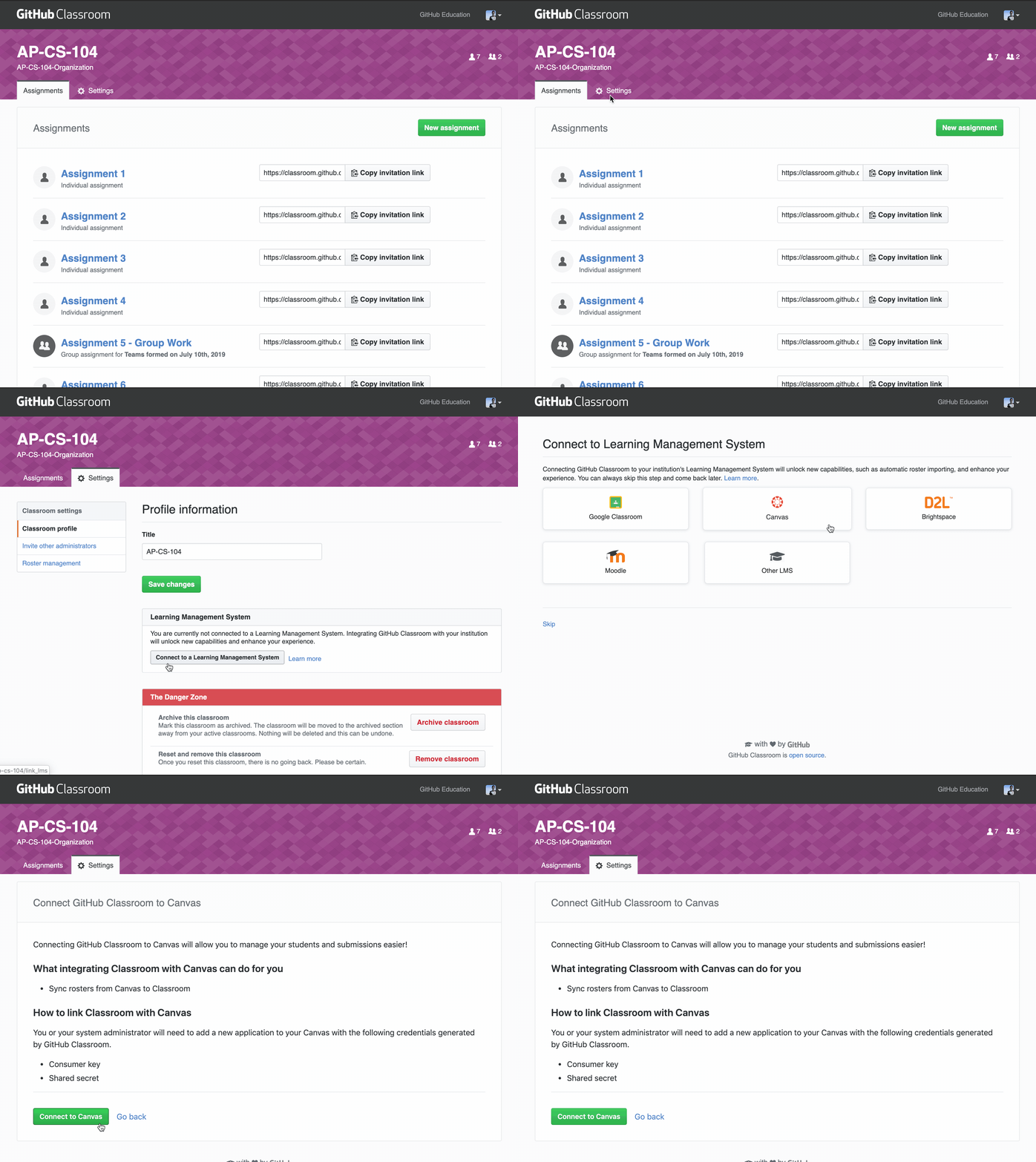
    GitHub Classroom, the LMS of the leading repository, is building an extensible ecosystem to integrate popular learning systems.

    Recently, GitHub announced integrations with Google Classroom, Canvas, Brightspace, and Moodle. Blackboard is expected to be added soon to the list of LMSes supported, according to its blog.

    GitHub, which is an open source, is used by almost 20,000 teachers to hand out assignments, monitor student progress, and give feedback.

    “We’re excited to announce the new integration with the learning management systems (LMS) you already use,” wrote Nathaniel Woodthorpe, program manager at GitHub. “This integration allows you to sync your list of students from your LMS with GitHub Classroom—all without the need for manual copying. Even better, you can make changes to this list throughout the semester,” he added.


  • Sebastian Thrun Picks an Executive of LendingTree as a New CEO at Udacity

    Sebastian Thrun Picks an Executive of LendingTree as a New CEO at Udacity

    IBL News | New York

    Udacity announced yesterday the appointment of Gabriel Dalporto as a new CEO, after nearly ten months searching for a top executive. Dalporto fills a vacant position since Vishal Makhijani stepped down in October 2018.

    “With Gabe’s dynamic leadership style and outcome-driven approach, I know he is the right person to lead Udacity into our next phase of growth,” wrote Sebastian Thrun, co-founder and currently in charge of day-to-day operations at Udacity in a blog post . “And I will continue to support him as Executive Chairman of Udacity,” he added.

    Gabriel Daporto’s last managing position was CFO at LendingTree. He was also a member of the Board of Directors at LendingTree and Guitar Center.

    “Gabe takes over Udacity at an opportune moment in time,” explained Thrun while issuing an array of bullish statements:

    • “Since June 2019, the company has been cash-flow positive, and it is growing aggressively”.

    • “The consumer business has grown by more than 60%.”

    • “Our enterprise and government businesses are also booming, with bookings each increasing by over 100% year over year.”

    • “Our corporate clients now consistently report over 80% course completion rates, a far cry from MOOCs and other content-only offerings.”

    • “Staying truthful to our social mission, we launched more than 50,000 new scholarships with AT&T, Google, Bertelsmann, Facebook, and AWS.”

    [Gabriel Dalporto and Sebastian Thrun, in the picture above]

    [Official Press Release: Udacity Names Gabriel Dalporto as Chief Executive Officer]

  • Arizona State University Develops the First Adaptive-Learning Degree in Science

    Arizona State University Develops the First Adaptive-Learning Degree in Science

    IBL News | New York

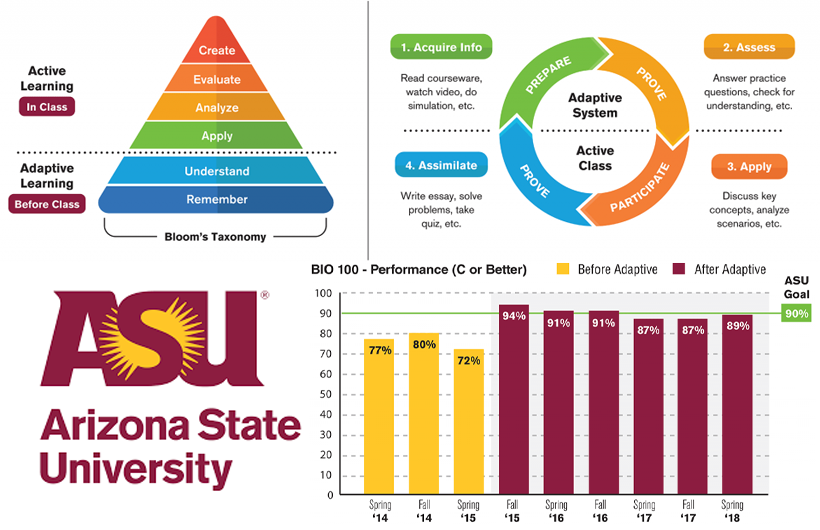
    Arizona State University (ASU) announced last week that it has developed the world’s first adaptive-learning biology degree, adjusting to its students’ needs in real-time.

    “We are moving away from mass production to mass personalization,” said Dale Johnson, director of adaptive-learning initiatives with EdPlus at ASU. “We used to teach everyone the same thing at the same time. Now, we’re connecting the right student to the right lesson. We are changing the structure of higher education from static to dynamic,” he added.

    The four-year degree in Biological Sciences is built in a new adaptive-learning platform called BioSpine. The technology was co-created between ASU and a Scottish company called CogBooks.

    “With the support, we are creating through adaptive learning, as well as true assessments that measure the range of student learning, students will receive support and direction when course material is especially challenging,” said Joshua Caulkins, assistant director of undergraduate programs with ASU.

    The degree program uses the BioSpine adaptive-learning courseware rather than textbooks.

    Faculty members link learning activities to the platform, which then allows students to progress through more challenging coursework when they are ready, or step back and get support in relearning material from a previous course or chapter.

    ASU believes a large lecture hall doesn’t engage students in science classrooms, nor is it effective in producing an exceptional performance in exams.

    “Key BioSpine features include aligning the curriculum, integrating content, shifting faculty roles from lecturers to leaders and empowering faculty to see when a student needs intervention,” said ASU.

    Students have responded enthusiastically to the change, and even some faculty members have received an ovation from learners at the end of courses.

  • The University of Glasgow Will Deliver Its First Online Degree in Late 2020

    The University of Glasgow Will Deliver Its First Online Degree in Late 2020

    IBL News | New York

    The 550-year-old University of Glasgow, one of the top world 100 universities, will deliver its first online degree via FutureLearn at the end of 2020.

    The degree will be offered through the FutureLearn platform. It will be on End of Life Studies and will be accompanied by a free “taster course” in late 2019, so prospective students can learn what the program might entail.

    The degree will be available as a master’s, postgraduate diploma, and postgraduate certificate, with 180, 120 and 60 credits awarded respectively.

    Terms of the arrangement, announced early this month, were not disclosed.

    The University of Glasgow has been a FutureLearn partner since this platform launched in 2012, with the institution hosting online courses such as A History of Royal FashionUnderstanding Suicide and Suicide Prevention Strategies in a Global Context, and Antiquities Trafficking and Art Crime.

    Regarding the subject of the degree, the Scottish university explains, “as the global population ages and grows, there will be a huge increase in the number of people who die in the world every year, from around 56 million currently to 90 million, or even more, by the second half of the century.”

    “This degree will explore the many contested issues concerning where, how, when and where we die.”

    “The course will draw on the social sciences, humanities and clinical disciplines to examine new theories, empirical studies and innovative methods that are shedding light on the issues of death, dying and bereavement across cultures and geographies.”

  • LearnX.UQ, The University of Queensland’s New Open edX Ecosystem

    LearnX.UQ, The University of Queensland’s New Open edX Ecosystem

    IBL News | New York

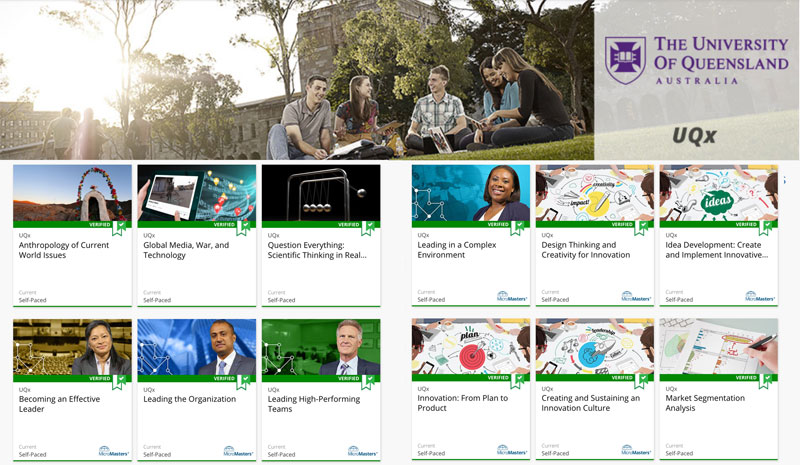
    The University of Queensland (UQ), in Australia, has started its own Open edX ecosystem, called LearnX.UQ. The university has over 50 MOOCs and programs on edx.org and dozens of SPOCs on edge.edx.org.

    This deployment will join UQ’s Blackboard LMS, known as Learn.UQ, becoming a key component of its virtual learning environment.

    “Our initial focus for LearnX.UQ is blended learning for UQ students, but phase 2 will encompass our fully-online programs and alternative credentials,” wrote John Zornig, Director of UQx at University of Queensland (UQ) on the Open edX forum.

    “We are excited to be working with IBL Education as our technical partner for the development and operations of LearnX.UQ,” he added. “We look forward to contributing where we can to the future of Open edX”.

    The University of Queensland (UQ), in Australia, is one of the world’s premier teaching and research institutions and has been an edX partner since 2013.


  • Pluralsight.com Faces Class-Action Lawsuits From Investors Who Suffered Losses

    Pluralsight.com Faces Class-Action Lawsuits From Investors Who Suffered Losses

    IBL News | New York

    2U (NASDAQ: TWOU) is not the only public EdTech facing class-action lawsuits for alleged securities fraud. Pluralsight (NASDAQ: PS) is now being targeted by several law firms on behalf of investors who have suffered significant losses exceeding $50,000 between August 2018 and July 2019.

    For example, San Francisco-based law firm, Hagens Berman Sobol Shapiro LLP, argues in a recent press release:

    “Defendants [Pluralsight] misled investors about its business outlook, particularly related to its salesforce and ability to generate strong growth in billings.”

    “Pluralsight and senior management concealed the Company’s substantial delays in hiring and properly training the salesforce necessary to meet its lofty billing projections.”

    “On July 31, 2019, Pluralsight announced (1) disappointing financial results for 2Q 2019, (2) blamed Pluralsight’s declining growth in billings on sales execution problems with its salesforce, and (3) the departure of the Company’s Chief Revenue Officer.”

    In result, several analysts lowered their price targets for Pluralsight shares.

    “We’re focused on investors’ losses, the extent to which management may have misled investors about reasonable growth prospects, internal controls, and reasons for the recently-announced auditor change,” said Hagens Berman partner Reed Kathrein.

    New York-based Rosen Law Firm is also filing a class-action lawsuit, announcing on August 20, it seeks to recover damages for Pluralsight investors under the federal securities laws.

    On August 20, six more firms announced their legal actions including Faruqi & Faruqi, Robbins Arroyo, The Schall Law Firm, Bronstein, Gewirtz & Grossman, Levi & Korsinsky and The Gross Law Firm.

    Other firms filing are Bronstein, Gewirtz & Grossman, Levi & Korsinsky, and The Gross Law Firm,

    On July 31, Pluralsight stock plunged over than 20 % issuing third-quarter guidance that was below Wall Street estimates.

    The education software company reported second-quarter net losses of $35.6 million, or 30 cents a share, compared with losses of $43.8 million, or 19 cents a share, during its 2018 second quarter.

    On August 27-29, Pluralsight.com will be celebrating its annual conference in its hometown Salt Lake City, Utah.

  • Startup Partners With University of Pittsburgh to Offer Transfer Credit for Online Classes

    Startup Partners With University of Pittsburgh to Offer Transfer Credit for Online Classes

    IBL News | New York

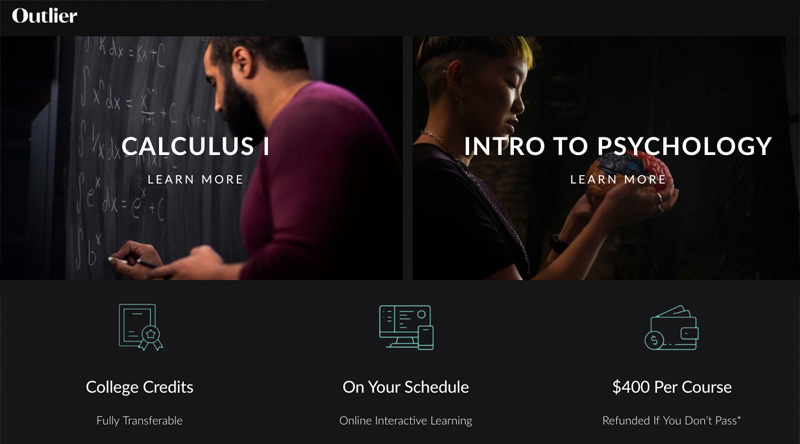
    Outlier.org, a new educational provider created by MasterClass co-founder, Aaron Rasmussen, will offer introductory credit for online college courses at $400 per course.

    Outlier.org will launch on September 9 with two, three-credit, 14-week courses: Calculus I and Introduction to Psychology. They will be offered through the University of Pittsburgh, which will facilitate the transfer of credits.

    The company has promised to offer refunds to any student who doesn’t pass.

    Despite the .org name and address, Aaron Rasmussen, co-founder and former creative director of MasterClass, addressed Outlier is a for-profit company. “Our goal is a social impact. Coming up with a market solution to education, rather just relying on people’s charity, is far more durable.”

    Rasmussen explained that each year, one million students take a college-level Calculus I course in the United States, at an average cost of $2,500, and 40% of them fail, explained Rasmussen. “That means we’re wasting $1 billion per year, and that’s just on a single class,” he explained.

    The main question is whether the existing university system will accept the transfer of these credits.

    Students will need to check and verify which institutions will accept these credits.

    Rasmussen’s experience in education is mostly based on MasterClass.com, a provider known for light-hearted, online classes from celebrities in disciplines like photography, guitar-shredding or home cooking.

    Other companies such as StraighterLine or Study.com tried to bring general education courses at scale in the past.

    “While Outlier.org has taken the lead in many of these areas, Pitt faculty members have closely reviewed the syllabi and assessments to ensure that they meet our high standards,” said the University of Pittsburgh Provost Ann Cudd at Education Dive.

    The courses, developed on a proprietary LMS, will combine video lectures with open-access materials and. The platform will implement proctoring through Examity for assessments.

    Students will be able to choose from different instructors or even switch between them mid-semester. The teachers for Calculus I, for example, include Hannah Fry of University College London, Tim Chartier of Davidson College and John Urschel of MIT.

    Outlier expects less than 100 students in each class for the fall term. Classes will be broken up into smaller study groups of four to five students who can connect over video chat.

    The startup said that it will remain focused on the first 25 college-level courses, rather than recreating an entire college curriculum.


    https://www.youtube.com/watch?v=BkElzZfQhS0

    https://www.youtube.com/watch?v=6hrgCkRA-0k
  • Google Introduces a Plagiarism Checker for Classroom and Assignments

    Google Introduces a Plagiarism Checker for Classroom and Assignments

    IBL News | New York

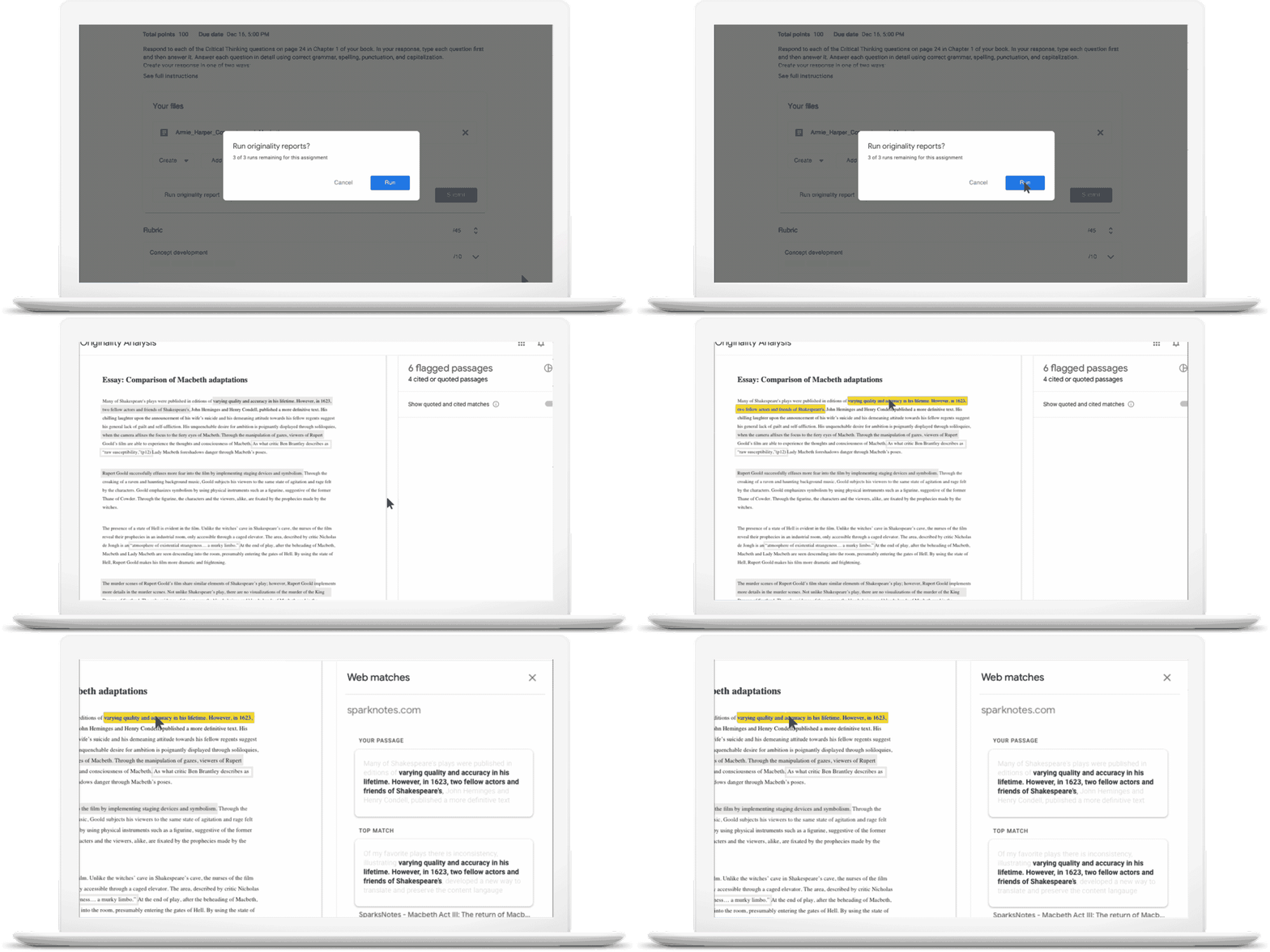
    Google unveiled a new functionality on its educational platform, Google Classroom and Assignments, enabling educators to detect plagiarism in students’ work.

    The tool, called “Originality reports,” will be publicly available later in 2019, but until then it remains in beta mode.

    “Originality reports compare student work against hundreds of billions of web pages and tens of millions of books,” explained Google. “The reports highlight missing citations, ineffective paraphrasing, or unintended plagiarism due to high similarity and link to the external source.”

    Students will be able to run Originality reports up to three times before submitting, allowing them to identify and address citation errors.

    Google promised that scanned work won’t be retained by its organization. It announced that it plans to add an option for schools to have a private repository of student submissions, so instructors can see peer-to-peer matches.

    Google’s Turnitin-style plagiarism detection tool has been in high demand by G Suite for clients in the educational field.

    Originality reports will be free for up to three assignments in each course using Google’s tools. Beyond that, an upgrade is needed for a G Suite Enterprise for Education account, which currently starts at $4 per month per instructor.