Category: Platforms | Tech

  • Dan Goldsmith (Instructure): “My Job Is Resisting Short Cuts In Our Educational Business”

    Dan Goldsmith (Instructure): “My Job Is Resisting Short Cuts In Our Educational Business”

    Mikel Amigot | IBL News

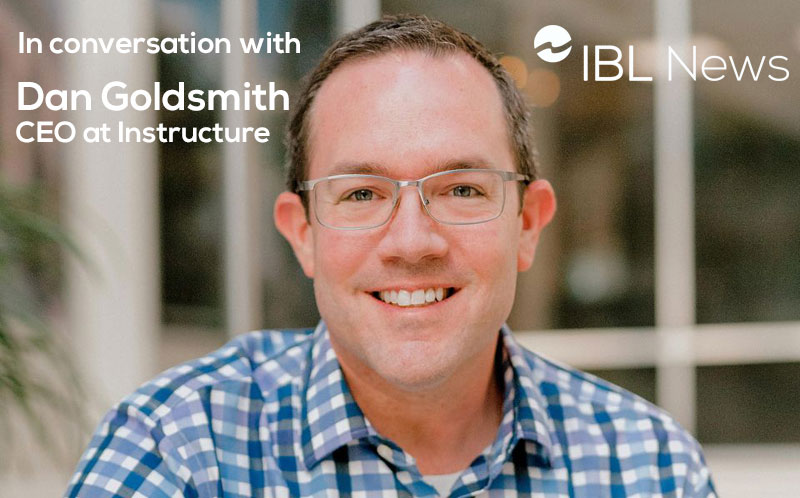
    No one would believe that Dan Goldsmith, who runs Instructure, the maker of Canvas LMS and Bridge, is a Wall Street CEO.

    His lack of arrogance, along with an understanding of the nuances of the educational industry, makes him unusual. “I know it sounds odd to have a good conversation with the CEOs of a competing business but at the end, we have a common mission and we all serve a similar space,” Goldsmith said in a conversation with IBL News.

    He translates the same philosophy to his management style. “We want to be a mission-minded company”. “There is always pressure to take short cuts in business. A part of my job is resisting those practices. Following the right path takes 20 % more effort, but that is all right,” he explains.

    Another temptation he avoided during our conversation was talking about the preeminence of Canvas in the LMS market space. “We just want to make sure we inspire innovation and change.”

    Given Blackboard, D2L and Moodle’s stagnant numbers regarding users and financials, as journalists, we pushed Goldsmith to reveal if he would take advantage of the situation and turn the calm path of Instructure into more aggressive behavior. While he did not disclose this information, he made clear that he is absolutely in charge. “We have strength and conviction in our mission and business plan.”

    “I’m not afraid to take the direction and ask for patience with the investment community.” “I exhibited this in my last company, Veeva Systems, a cloud-based SaaS company.”

    Goldsmith was one of the first 50 employees at Veeva. He helped lead the company through a successful IPO and a growth path to a $10 billion market cap. Prior to Veeva, he worked in various executive positions at companies such as Accenture, PwC and IBM.

    At Instructure, Goldsmith took the lead on January 2019 after 10 years of Josh Coates’ role as CEO. His initial focus is on market growth, with the sales leaders reporting directly to him. Currently, Instructure has over 4,000 corporations and educational institutions in higher ed and K12 as customers and serves 30 million learners.

    Opening a new phase of growth and achieving the company’s profitability is the most impending challenge today.

    Watch the full interview of Dan Goldsmith in the video below.


  • CanvasLMS’ CEO on the Learning Data Controversy: “Information Will Be Owned by Institutions”

    CanvasLMS’ CEO on the Learning Data Controversy: “Information Will Be Owned by Institutions”

    Mikel Amigot | IBL News (Long Beach, CA)

    Instructure’s CEO Dan Goldsmith said that learning data accumulated on its Canvas platform, with 30 million learners, “is owned by the student and institutions, and it should always stay that way”.

    Mr. Goldsmith made this claim at a conversation with a selected group of journalists and analysts (IBL News, among them) yesterday in Long Beach, CA, during the Canvas LMS annual conference.

    The controversy around the usage of data started when Instructure disclosed the existence of DIG, a data analytics, predictive and AI-based internally developed project. “There is a lot of potential to use data and information to benefit education. It is important to open this conversation”.

    Instructure, however, doesn’t have a launch date. “We don’t want to make mistakes with DIG, and we don’t want to be constrained with a timeline,” he added.

    On the adaptive and personalized topic, Dan Goldsmith claimed that “it is inevitable as an educational community to figure out ways to use personalized learning.”

    Asked about its strategy now that Canvas LMS is recognized in the industry as the market leader in North America, he said: “Our benchmark is the 1.5 billion students there are in the world”. “If we are constantly looking at our competitors we will lose many opportunities for innovation”.

    Regarding competitors, “I have a good conversation with them. I talk to CEOs, and have a good relation. At the end of the day, we have a common mission.”

    Based in Salt Lake City, Utah, and with a staff of 1,200 employees, this publicly traded company is not profitable yet, although “we are a financially stable organization”. “We are in a good position to make an impact”.

    Regarding its software developments, Mr. Goldsmith highlighted that “there are 250 applications built on top on Canvas by our customers”. “We are not the only channel for innovation”.

    He also stressed that “we will continue to maintain our commitment toward open source. We have a very thriving community that we support”.

    See the video below exclusively shot by IBL News.


  • Canvas LMS Increases Its Lead to 30 Million Users, According to Its CEO’s Data

    Canvas LMS Increases Its Lead to 30 Million Users, According to Its CEO’s Data

    Mikel Amigot | IBL News (Long Beach, CA)

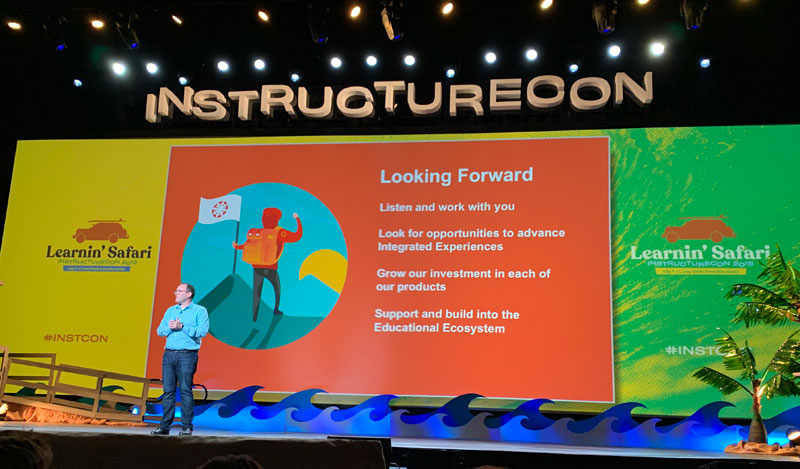
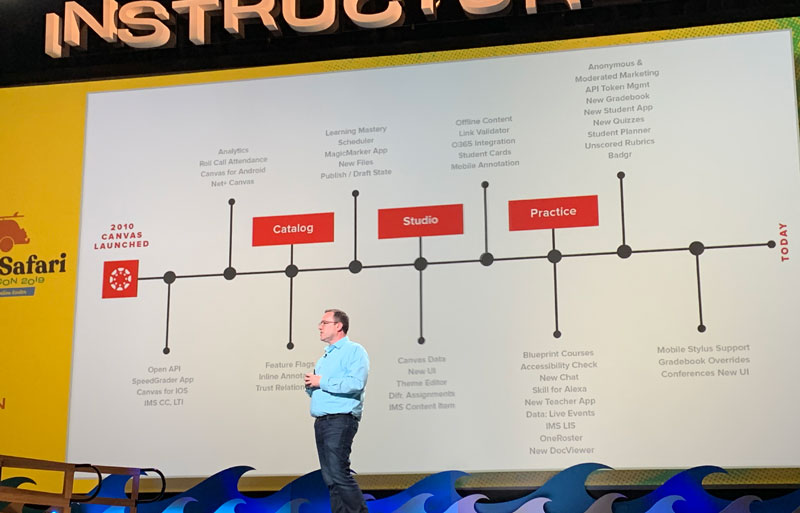
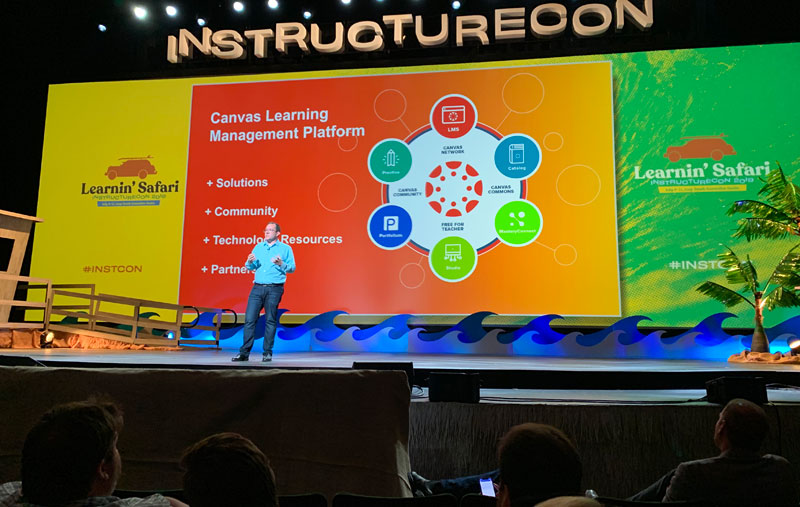
    Canvas continued to expand its lead as the most adopted LMS in North America until reaching 30 million users, according to the data provided by its CEO Dan Goldsmith yesterday during its opening keynote at the annual Instructure partners’ conference, which is taking place this week in Long Beach, CA.

    In the last years, Canvas reported the “more than 20 million users” number, but this year it changed into “more than 30 million users”.

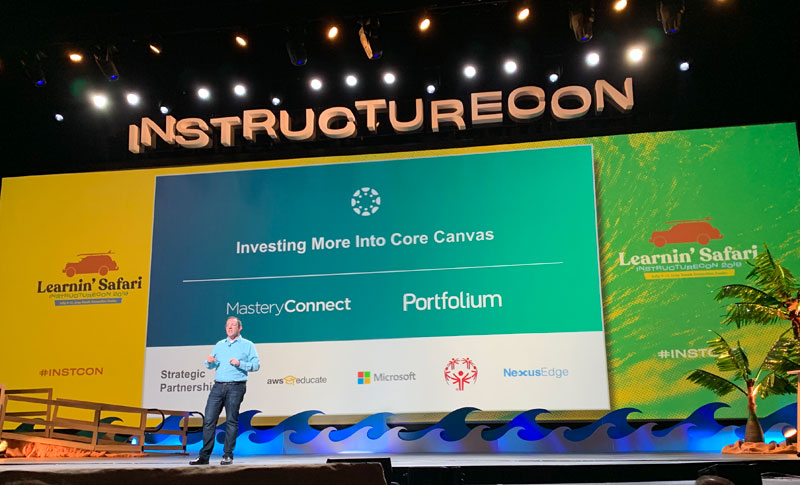
    Dan Goldsmith talked about Instructure’s future plans and elaborated about its new three partners, AWS Educate, Microsoft and Nexus Edge. “Our mission is to help people grow from the first of school and last day of work”, he said.

    Another interesting piece from Instructure’s CEO’s statement referred to the fact that “institutions are under increased pressure to prove their effectiveness with students”.

    This year’s conference has attracted a record number of 3,000 attendees and 72 vendors.

    Selected slides of the keynote:


  • Open edX | July 2019: HarvardX’s Blockstore, Boeing, MITx, Coursera, Google…

    Open edX | July 2019: HarvardX’s Blockstore, Boeing, MITx, Coursera, Google…

    Newsletter format  |  Click here to subscribe ]

    JULY 2019 – NEWSLETTER #18  |  More breaking news at IBL News 


    Open edX

    • The Next Evolutionary Step in MOOCs Will Be ‘Blockstore’, Says Robert Lue, from Harvard

    • Open edX Posts Videos of All Talks from Their Recent Conference


    edX

    • A Detailed Study of Boeing Shows Learners’ Engagement and Performance on an edX MOOC

    • An Innovative, Stackable Online Master’s in Supply Chain Management from ASU On edX

    • MITx Prepares 30 New MOOCs and Builds with Other Universities a Blockchain System for Credentials

    • Half of the Employees That Need to Re-Skill Don’t Ask for Help, an edX Survey Finds


    COURSERA

    • “Coursera’s Business Challenge Is Getting Predictably High Revenue Growth,” Says Its CEO

    • A Billionaire Will Cover the Cost of Coursera’s Illinois Data Science Master’s Degree for His Employees

    • Coursera’s Google IT Support Certificate Program Gets a Good Response

    • Coursera Matches Its Global Skills Index Research With Courses and Specialists

    • An English Course to Teach Foreigners on Career Development Reaches 320K Learners


    INDUSTRY

    • Udacity Launches a Program On AI to Train Non-Engineers

    • View: A MOOC Platform Catalog is No-Marketing. Leveraging Institutional Networks Is Key


    2019 UPCOMING EVENTS

    Education Calendar  –  JULY  |  AUGUSTSEPTEMBER |  OCT–DEC 2019


    This newsletter about Open edX is a monthly report compiled by the IBL News staff, in collaboration with IBL Education, a New York City-based company that builds AI analytics-driven, revenue-oriented learning ecosystems, and courses with Open edX and other educational software. 

    Read the latest IBL Newsletter on Online Education at Scale  |  Archive of Open edX Newsletters

  • The Next Evolutionary Step in MOOCs Will Be ‘Blockstore’, Says Robert Lue, from Harvard

    The Next Evolutionary Step in MOOCs Will Be ‘Blockstore’, Says Robert Lue, from Harvard

    It Takes a Network to Teach a Learner: Robert Lue Believes Blockstore Will Bring About the Next Step for Open edX


    Henry Kronk | IBL News

    When massive open online courses (MOOCs) (re)emerged in 2012 as a popular educational phenomenon, they took the ‘course’ as their base unit. To this day, learning material on edX, Coursera, and FutureLearn is organized, tagged, and searched via course.

    Professor Robert Lue, the Richard L. Menschel Faculty Director of the Derek Bok Center for Teaching and Learning at Harvard University, was involved in the creation of edX. He now believes that, for the full potential of MOOCs and open educational resources (OER) to be realized, the reign of the ‘course’ in open education needs to come to an end. The next step, he believes, will be the Blockstore.

    “We have been thinking about what the next evolutionary step in online learning platform would look like; that’s open-source and that’s at scale,” Lue says to IBL News.

    “What is so often talked about over and over again is: some large number of students will enroll in an online course, but only a tiny percentage will actually complete it. There is much carrying on about how terrible that is and how MOOCs are a failure. In my view, that is a complete misunderstanding of how people are actually using the materials.”

    “Quite often, someone has a particular question. There is some aspect they want to know about chemistry, or about some Shakespeare play, they go into the course, they get what they need, and they come back out. So unless you’re looking for a credential of some kind, you go in to get exactly what you want.”


    Blockstore Will Break Up edX Courses Into Discrete Assets

    Currently on Open edX, courses are housed in a framework known as the Modulestore. Its successor, the Blockstore, will break up courses into smaller, discrete pieces of learning content. Lue likes to refer to these as ‘assets.’ 

    Once fully implemented, learners will be able to search the edX platform for specific videos and texts (each of which will be meta-tagged in a detailed manner), instead of needing to progress through the entire course to get what they’re looking for. All of this material will only be available if those who created it give their permission to share it. 

    “Better yet, a teacher will be able to pull those out, maybe assemble them with other things, and use them as they see fit,” Lue said. 

    Teachers will also be able to access the open quizzes, homework, and other course supplements on edX.

    “I think learning is one of the fundamental rising tides that will lift all boats in terms of progress, in terms of people being able to lead a better life, in terms of society actually improving,” Lue said.

    “But if we don’t focus on what online learning can do, we’ll never get to scale. Even if we had all the money in the universe, we can’t build enough universities, we can’t build enough schools, we can’t train enough teachers, etc. to reach the many hundreds of millions who need it.”


    The Potential of the Blockstore

    Lue sees a huge amount of potential with Blockstore. He believes it will significantly increase teachers’ ability to employ flipped learning and OER resources. He also believes Blockstore will pave the way for open AI-delivered personalized learning at scale. 

    “There are a whole bunch of companies out there making claims about personalized learning,” Lue said. “They’re all proprietary. It’s all a black box. You don’t get to see the algorithms, and you have to pay for it.” 

    “I have nothing against folks who have revenue-generating business plans, but ultimately what I’m focused on is what’s going to help the most people in the world. For me, having access to a potentially personalized learning experience that’s free is absolutely of critical importance.”

    Another application of the Blockstore will be realized this year. LabXchange will bring together the science ‘assets’ available on edX and elsewhere on the internet and repackage them into various learning ‘pathways,’ as Lue calls them. It will essentially form a consolidated corner of the Blockstore that focuses on science education. It will also double as a lightweight learning management system (LMS) that will allow teachers to author their own modules or entire courses.

    This library of content and tools, furthermore, will be hosted remotely and require only a sufficient Wi-Fi signal to use. LabXchange is set to launch in September of this year and, according to Lue, everything is on schedule.


    A Commitment to Open-ness in Education

    At a time when the barriers of entry to MOOCs are, in many cases, growing higher, Lue remains committed to free and open educational resources. As a part of the Open edX architecture, Blockstore will be open-source. According to Lue, LabXchange will be free and there are no plans to monetize it, even in the name of sustainability. 

    “A lot of people have asked me, ‘Oh, so edX is turning into a completely paid platform?’,” Lue said. “You have to realize that edX is the only MOOC provider where the entire software code is open-source. There are roughly 130 named institution partners on the edX site. But there are 1300 organizations that use Open edX for free for whatever they want.”

    “Do I have objections to other organizations using LabXchange and charging for certification or credentialing or something? That’s up to other folks to figure out. But LabXchange content, the learning experience, all of those things, will remain free and open.”


    Though Inspiring, Many Issues with OER Remain

    This is, of course, not the first time a brilliant Ivy League professor has laid plans to make the world a better place with free and open educational initiatives. When MOOCs first deployed en masse, many focused on the poor completion rates as their failings. But many education stakeholders also realized that successful North American courses don’t always work so well in an international context. 

    What’s more, OER requires sufficient devices and data infrastructures to access. And takes work to maintain. Open learning content needs to be vetted, moderated, and updated on a consistent basis. Lue, however, is optimistic that these problems can be overcome.

    “I think those arguments are perfectly reasonable,” he said. “What they underscore is a lack of systemic, networked coordination in the OER universe. My feeling is that one of the reasons we run into those issues is because, quite often, big OER efforts tend to operate in silos. Many efforts miss opportunities to work with institutions, with governments, with other NGOs and partners—all around this common mission of what open education can do for society. In my view, if you connect all the dots in a network, the network will support and flourish.”

    In that regard, Lue and LabXchange have begun to put their money where their mouth is. As he revealed during a speech he gave at the 2019 Open edX Conference, the Harvard Global Institute of Health has already volunteered to moderate all of the public health content on LabXchange.

    “Am I saying that OER will replace everything? No, I don’t think so,” Lue said. “Because there will always be different kinds of experiences that will require the level of updating, the level of services, etc. that need to be paid for. I always talk about the rising tide. We need to think about what will make that rising tide lift the baseline level of education and learning materials available to hundreds of millions of people a significant distance up from where it is now.”

    “I think that OER is absolutely the way to go for that. This idea that OER will die a quiet death—that’s a grave risk. But it’s only a grave risk if we keep siloing our efforts. That’s why LabXchange is very interested in partnerships. We’re partnering with organizations that have similar interests and trying to make sure that we create more of a network that allows overall effort to succeed. I do believe there is an issue, but I don’t think it’s an inherent issue. OER needs to get its act together.”

    Lue, furthermore, that there are other areas where OER can be put to use.

    “I’ve always had a longstanding interest in lifelong learning,” he said. “Quite often, lifelong learning is sort of piggybacked on top of the materials that are developed for colleges, for undergraduate education, as well as perhaps for high school education. And then, separate from that is the executive education universe, which is nearly always closed and paid. I think that in the lifelong learning realm, there are certainly some huge opportunities for OER, on a free basis, to allow individuals to think about the evolution of their careers, changes in their careers that they might be thinking about making, so on and so forth. I think there’s a lot of possibilities there as well.”

     

  • An English Course to Teach Foreigners on Career Development Reaches 320K Learners

    An English Course to Teach Foreigners on Career Development Reaches 320K Learners

    IBL News | New York

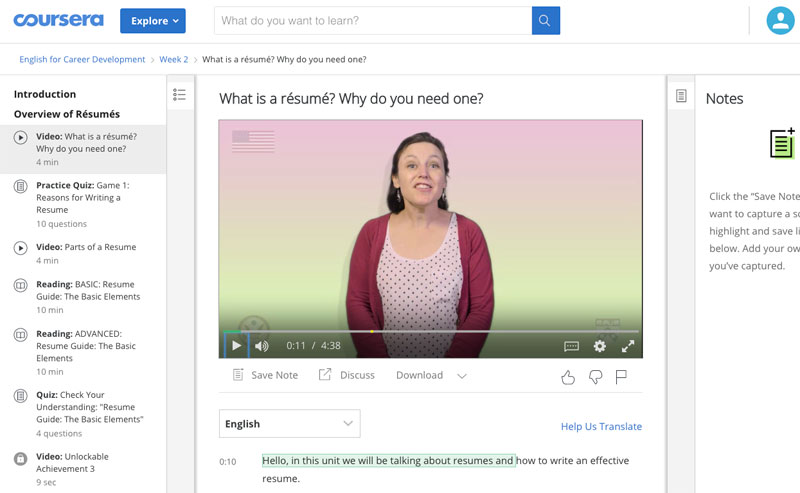
    The “English for Career Development” course has become a remarkable success after reaching 320,000 learners on Coursera.org.

    This free, two-week online class, created by the University of Pennsylvania, and funded by the U.S. Department of State Bureau of Educational and Cultural Affairs, Office of English Language Programs, is designed for non-native English speakers. It is distributed under a Creative Commons 4.0 Attribution license, meaning that all course materials are available for re-use, repurpose and free distribution.

    Two English language specialists, Brian McManus, and Robyn Turner, teach about the job search, application, and interview process in the United States.

    “This course will also give you the opportunity to explore your global career path while building your vocabulary and improving your language skills to achieve your professional goals. The first unit in this course will introduce the U.S. job application process and provide strategies for identifying the jobs that match your interests and skills. Unit 2 will take you through the steps necessary to produce a professional-looking resume. In unit 3, you will work to develop a clear and concise cover letter. The final unit of the course focuses on networking and interview skills,” the instructors explain.

    The estimated effort required to complete the course is 21 hours, after 10 hours/week study time.


  • Ideas to Boost Your Course Completion Rate

    Ideas to Boost Your Course Completion Rate

    Mikel Amigot | IBL News

    Completion rates of free massive online courses have traditionally been low, at an average of 5%. This is mostly because these online classes are not offering an appealing benefit in career advancement and do not include tutoring to follow up with learners.

    In addition, requiring students to make an upfront payment, often with a minimal fee, show their commitment to the class. It is like in brick-and-mortar colleges: those who pay their own tuition are more likely to continue.

    As an instructional designer, a good technique to increase engagement is to place a survey at the beginning of the course asking students how they will apply their new knowledge and what their expectations are.

    It is also very helpful to feature the materials available for certain course intervals and include synchronous sessions and live office hours. Whatsapp, Slack, Twitter, Facebook or even Google Hangouts are efficient tools for a face-to-face conference.

    This can be combined with group projects and peer assessments ––Open edX includes those two functionalities.

    Naturally, discussion forums and problem submissions must be managed. Having at least one teaching assistant who interacts with students via forums, Piazza-style boards or email will end up motivating learners.

    Chatbot agents and AI-Teaching AssistantsGeorgia Tech-style, which are able to personalize experiences are also an option.

    Economic incentives, such as AWS’ or IBM’s cloud free-credit for young entrepreneurs, are smart approaches.

    Imposing deadlines for course completion tends to work well but it could also discourage enrollment. A solution can be to keep parts of the course open without registration. (This possibility –available on Open edX, too– is beneficial for SEO purposes, since Google and other search crawlers can index your public courses.)

    Finally, consider adaptive learning. AI-driven adaptive or personalized courses are becoming a reality. Behavioral Sciences and predictive analytics help learners succeed. New learning ecosystems are being designed with this requirement.


  • Open edX Posts Videos of All Talks from Their Recent Conference

    Open edX Posts Videos of All Talks from Their Recent Conference

    IBL News | New York

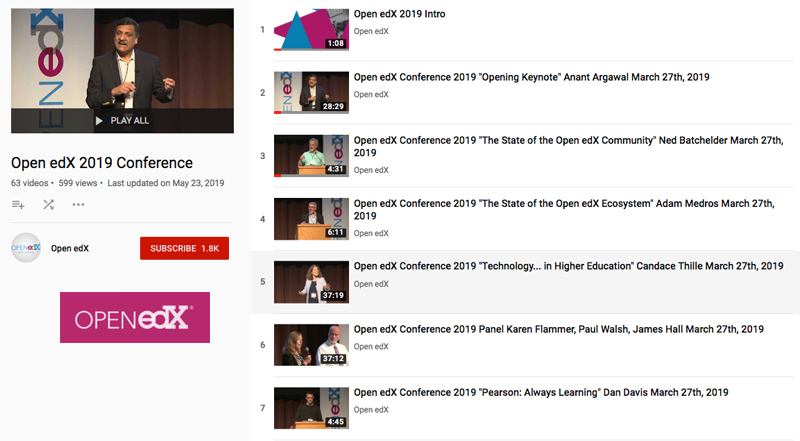
    The edX team has posted videos of all talks pertaining to the 2019 Open edX Conference in San Diego on its YouTube channel. [Watch the playlist below].

    There are 63 total videos discussing software engineering, instructional design, learning initiatives, and discoveries. Most of the scheduled speakers are featured in these videos.

    The theme of the conference revolved around collaborative learning, and how Open edX enables technologists, educators and learners to collaborate, innovate, and move the state of teaching and learning forward.  

    Today there are over 2,400 instances using this software, with more than 25,000 courses and 45 million learners in 70 countries.

  • Coursera Matches Its Global Skills Index Research With Courses and Specialists

    Coursera Matches Its Global Skills Index Research With Courses and Specialists

    IBL News | New York

    A report from Coursera has found that two-thirds of the world’s population is falling behind in critical skills, including 90% of developing economies.  Meanwhile, the World Economic Forum has pointed to a “growing skills instability” and estimates that the core skills required to perform most roles will change by 42% by 2022.

    One of the main conclusions of both organizations is that due to the rapid advance of automation and AI, the skills required to do most jobs are evolving quickly, and therefore businesses and governments must upskill their workforces and populations.

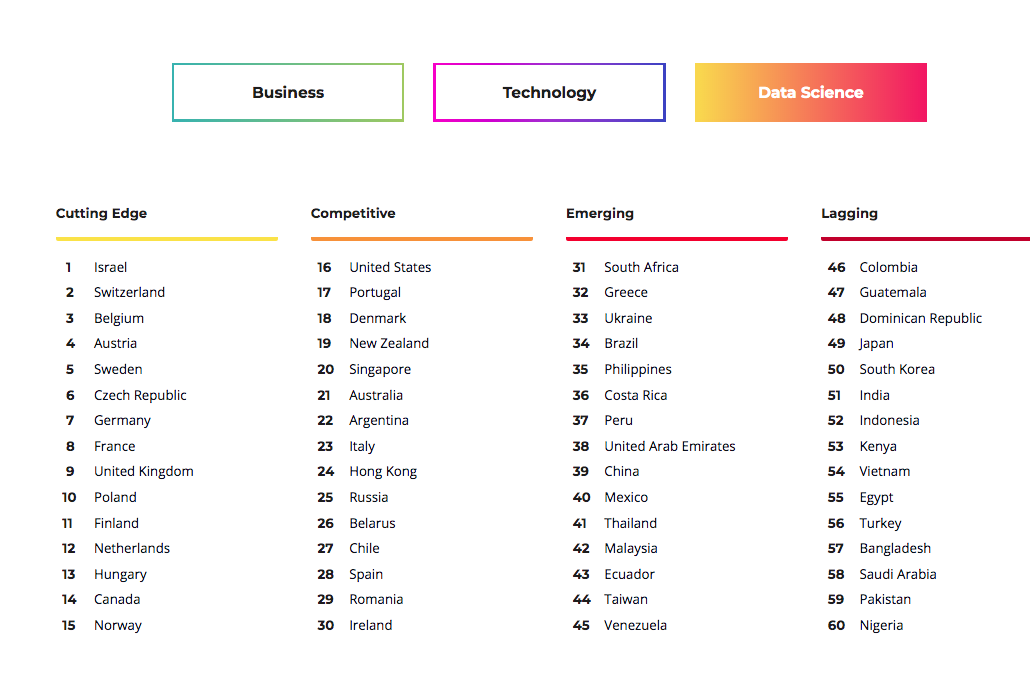
    With 38 million learners, over 3,000 courses, and one of the largest skill databases, Coursera has come up with a Global Skills Index. Its first edition ranks 60 countries and 10 industries across Business, Technology, and Data Science.

    Developing a commercial application, Coursera has matched its index with courses on its catalog and specialized skills experts.

    “For example, the top skills for Engineering include Leadership, Agile Management, and Machine Learning, so we recommend the following courses: Foundations of Everyday LeadershipDigital Product Management: Modern Fundamentals, and Neural Networks and Deep Learning,” writes a content strategists in the company blog.

    Global Skills Index


  • “Coursera’s Business Challenge Is Getting Predictably High Revenue Growth,” Says Its CEO

    “Coursera’s Business Challenge Is Getting Predictably High Revenue Growth,” Says Its CEO

    John G. Paul | IBL News, New York

    Coursera has $180 million in the bank after the last round of funding of $103 million in April, company’s CEO Jeff Maggioncalda revealed during a candid interview with a manager from the European start-up accelerator The Family in Paris. [Watch the video below].

    However, this pile of cash is not giving Jeff Maggioncalda much tranquility, given his admitted challenge based on making sure that Coursera’s existing profitable business and financial model works by generating increasingly high margins. “I’m perpetually thinking about how do we get predictably high revenue growth for the next three or five years,” disclosed Coursera’s CEO, who has been in this position for the past year.

    “You want to demonstrate that, as you become bigger, you will become more profitable. If you don’t generate predictably high revenue growth, it is going to be difficult to attract a lot of investment,” he said. (Coursera’s IPO is currently one of the most expected operations in the edtech industry).

    Another interesting revelation from that interview (watch it below) is that designing educational programs for governments is providing “one of the biggest growth rates of Coursera for Business”. “We work with Singapore, Egypt, India, Abu Dhabi. Our biggest deal is with Abu Dhabi; they hired us to train and skill up 60,000 government officials,” Jeff Maggioncalda explained. “Country after country, governments realize that education is the only hope.”

    Regarding the controversial issue of completion rates, Jeff Maggioncalda provided interesting data. Completion is 10% for people who don’t pay for courses, and 40% or 50% for learners who pay. For online degrees it’s 90%. “The completion rates are much higher depending on the value of the credential you get when you finish your learning”. 

    • Class Central: Coursera’s Monetization Journey: From 0 to $100+ Million in Revenue