Category: Views

  • TCRIL Changes Its Name Into Axim Collaborative and Names a CEO

    TCRIL Changes Its Name Into Axim Collaborative and Names a CEO

    IBL News | Cambridge, Massachusetts

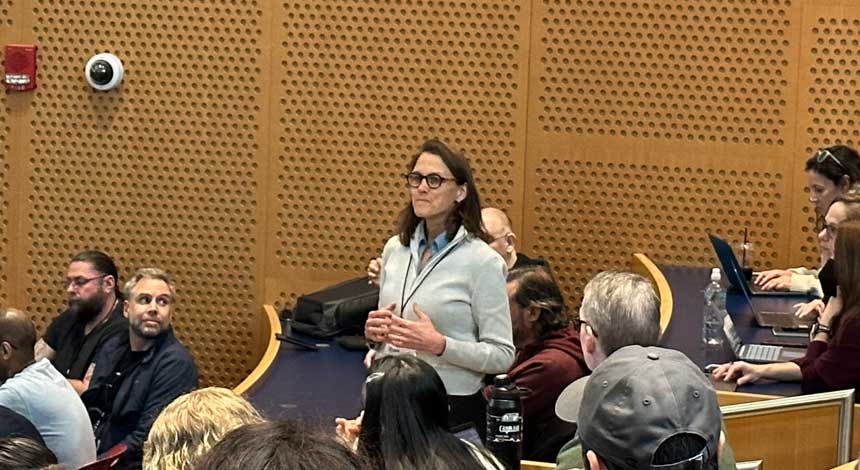
    The MIT and Harvard non-profit organization — Center for Reimagining Learning (or “tCRIL”) — that handles the Open edX platform named its first CEO: Stephanie Khurana [in the picture]. She assumed her role on April 3.

    In parallel, this organization which started by the two universities with the $800 million of proceed from the sale of edX Inc to 2U, changed its name into Axim Collaborative.

    Axim Collaborative’s mission is to make learning more accessible, more relevant, and more effective.

    The name Axim (a hybrid of the two ideas) was selected to underscore the centrality of access and impact,

    Khurana brings two decades of experience in social venture philanthropy and in technology innovation space. Most recently she served as managing partner and chief operating officer of Draper Richards Kaplan Foundation, a global venture philanthropy that identifies and supports innovative social ventures tackling complex societal problems.

    Earlier in her career, Khurana was on the founding teams of two technology start-ups: Cambridge Technology Partners (CTP) and Surebridge, both of which went on to be sold.

    Khurana also served in numerous roles at Harvard University, working on initiatives to support academic progress and build communities of belonging with undergraduates.

    Stephanie Khurana introduced herself to the Open edX community members in a town hall style which took place last Friday, March 31st, at the end of the annual developers conference.

    The gathering, celebrated at MIT’s Stata Center in Cambridge, Massachusetts, last week, attracted over 250 attendants, a similar number to past editions.

    One of the stories of the event was the acquisition of French-based company Overhang.IO, creator of the distribution tool Tutor. Pakistani American Edly purchased it for an undisclosed amount.

    Régis Behmo, the Founder and only developer in of Overhang, assumed the role of VP of Engineering at Edly.

    “Edly understands how contributing to open source creates value both for the company and for the whole edTech community. This partnership will help us drive this movement forward to serve learners and educators worldwide,” Behmo said.

    “Régis’s experience and leadership will be invaluable as we increase our impact on educational technology. In coming weeks and months, we’ll be making further announcements around our expanded roadmap for open source contributions to Open edX,” said Yasser Bashir, the founder and CEO of Arbisoft LLC, that operates with Edly its edTech brand.
    .

  • Italy Bans ChatGPT While Elon Musk and 1,100 Signatories Call to a Pause on AI [Open Letter]

    Italy Bans ChatGPT While Elon Musk and 1,100 Signatories Call to a Pause on AI [Open Letter]

    IBL News | New York

    Italy’s data protection authority said on Friday it will immediately block and investigate OpenAI from processing data of Italian users. The order is temporary until the company respects the European Union’s landmark privacy law, the General Data Protection Regulation (GDPR).

    Italy’s ban to ChatGPT come amid calls to block OpenAI’s releases over a range of risks for privacy, cybersecurity and disinformation on both Europe and the U.S.

    The Italian authority said reminded that ChatGPT also suffered a data breach and exposed users conversations and payment information last week.

    Moreover, ChatGPT has been shown producing completely false information about named individuals, apparently making up details its training data lacks.

    Consumer advocacy groups are saying that OpenAI is getting a “mass collection and storage of personal data to train the algorithms of ChatGPT” and is “processing data inaccurately.”

    This week, Elon Musk and dozens of AI experts this week called for a six-month pause on training systems more powerful than GPT-4. 

    Over 1,100 signatories — including Steve Wozniak, Tristan Harris of the Center for Humane Technology, some engineers from Meta and Google, Stability AI CEO Emad Mostaque signed an open letter, that was posted online, calling on “all AI labs to immediately pause for at least 6 months the training of AI systems more powerful than GPT-4.”

    • “Contemporary AI systems are now becoming human-competitive at general tasks, and we must ask ourselves: Should we let machines flood our information channels with propaganda and untruth? Should we automate away all the jobs, including the fulfilling ones? Should we develop nonhuman minds that might eventually outnumber, outsmart, obsolete and replace us? Should we risk loss of control of our civilization? Such decisions must not be delegated to unelected tech leaders. Powerful AI systems should be developed only once we are confident that their effects will be positive and their risks will be manageable.”

    • “AI labs have been locked in an out-of-control race to develop and deploy ever more powerful digital minds that no one – not even their creators – can understand, predict, or reliably control.”

    • “The pause should be public and verifiable, and include all key actors. If it cannot be enacted quickly, governments should step in and institute a moratorium.”

    • “AI labs and independent experts should use this pause to jointly develop and implement a set of shared safety protocols for advanced AI design and development that are rigorously audited and overseen by independent outside experts.”

    • “This does not mean a pause on AI development in general, merely a stepping back from the dangerous race to ever-larger unpredictable black-box models with emergent capabilities.”

    No one from OpenAI nor anyone from Anthropic signed this letter.

    Wednesday, OpenAI CEO Sam Altman spoke with the WSJ, saying OpenAI has not started training GPT-5.

    Pause Giant AI Experiments: An Open Letter:

    AI systems with human-competitive intelligence can pose profound risks to society and humanity, as shown by extensive research and acknowledged by top AI labs. As stated in the widely-endorsed Asilomar AI Principles, Advanced AI could represent a profound change in the history of life on Earth, and should be planned for and managed with commensurate care and resources. Unfortunately, this level of planning and management is not happening, even though recent months have seen AI labs locked in an out-of-control race to develop and deploy ever more powerful digital minds that no one – not even their creators – can understand, predict, or reliably control.

    Contemporary AI systems are now becoming human-competitive at general tasks, and we must ask ourselves: Should we let machines flood our information channels with propaganda and untruth? Should we automate away all the jobs, including the fulfilling ones? Should we develop nonhuman minds that might eventually outnumber, outsmart, obsolete and replace us? Should we risk loss of control of our civilization? Such decisions must not be delegated to unelected tech leaders. Powerful AI systems should be developed only once we are confident that their effects will be positive and their risks will be manageable. This confidence must be well justified and increase with the magnitude of a system’s potential effects. OpenAI’s recent statement regarding artificial general intelligence, states that “At some point, it may be important to get independent review before starting to train future systems, and for the most advanced efforts to agree to limit the rate of growth of compute used for creating new models.” We agree. That point is now.

    Therefore, we call on all AI labs to immediately pause for at least 6 months the training of AI systems more powerful than GPT-4. This pause should be public and verifiable, and include all key actors. If such a pause cannot be enacted quickly, governments should step in and institute a moratorium.

    AI labs and independent experts should use this pause to jointly develop and implement a set of shared safety protocols for advanced AI design and development that are rigorously audited and overseen by independent outside experts. These protocols should ensure that systems adhering to them are safe beyond a reasonable doubt. This does not mean a pause on AI development in general, merely a stepping back from the dangerous race to ever-larger unpredictable black-box models with emergent capabilities.

    AI research and development should be refocused on making today’s powerful, state-of-the-art systems more accurate, safe, interpretable, transparent, robust, aligned, trustworthy, and loyal.

    In parallel, AI developers must work with policymakers to dramatically accelerate development of robust AI governance systems. These should at a minimum include: new and capable regulatory authorities dedicated to AI; oversight and tracking of highly capable AI systems and large pools of computational capability; provenance and watermarking systems to help distinguish real from synthetic and to track model leaks; a robust auditing and certification ecosystem; liability for AI-caused harm; robust public funding for technical AI safety research; and well-resourced institutions for coping with the dramatic economic and political disruptions (especially to democracy) that AI will cause.

    Humanity can enjoy a flourishing future with AI. Having succeeded in creating powerful AI systems, we can now enjoy an “AI summer” in which we reap the rewards, engineer these systems for the clear benefit of all, and give society a chance to adapt. Society has hit pause on other technologies with potentially catastrophic effects on society. We can do so here. Let’s enjoy a long AI summer, not rush unprepared into a fall.
     

  • Google Shows What AI-Embedded Writing Will Look Like in Gmail and Google Docs

    Google Shows What AI-Embedded Writing Will Look Like in Gmail and Google Docs

    IBL News | New York

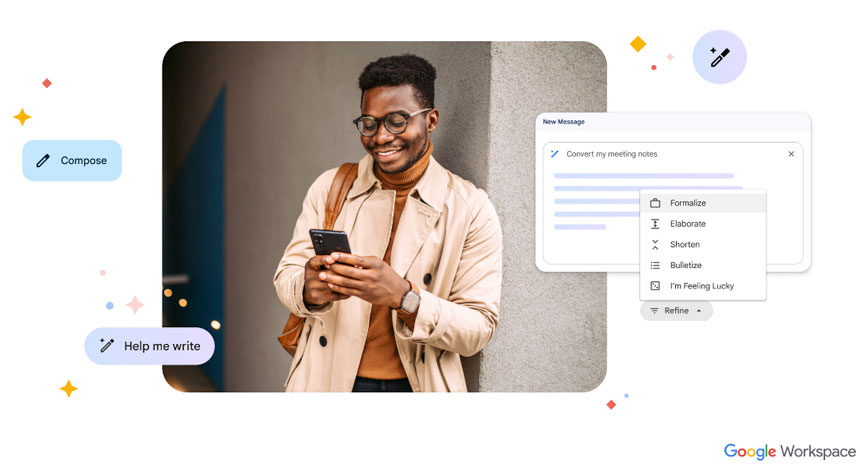
    Google announced that it plans to embed generative AI in Gmail and Google Docs yesterday, as shown in the video below.

    These features of this “collaborative AI partner” are not out yet. They will be launched via Google’s tester program, starting with English in the U.S., this month.

    “From there, we’ll iterate and refine the experiences before making them available more broadly to consumers, small businesses, enterprises, and educational institutions in more countries and languages,” wrote Johanna Voolich Wright Vice President, of Product at Google Workspace.

    For now, Google says it is only “sharing our broader vision” across Gmail, Docs, Slides, Sheets, Meet, and Chat.

    A “help me write” box in Gmail and Google Docs will let users type what they want
    and AI will spit out a block of text based on that prompt. In addition, Google’s “collaborative AI partner” into Workspace will result in these features:

    • draft, reply, summarize, and prioritize your Gmail
    • brainstorm, proofread, write, and rewrite in Docs
    • bring your creative vision to life with auto-generated images, audio, and video in Slides
    • go from raw data to insights and analysis via auto completion, formula generation, and contextual categorization in Sheets
    • generate new backgrounds and capture notes in Meet
    • enable workflows for getting things done in Chat

    Google Cloud also announced generative AI support in Vertex AI and Generative AI App Builder, helping businesses and governments build gen apps.

    So far, the company has opened up API access to a language model, but it hasn’t been any real consumer product launch.

    Analysts interpret that Google is in total panic over the rise of ChatGPT and AI-powered text. Just like how Google put social features into every product back in the G+ days, the plan going forward is to build ChatGPT-style generative text into every Google product.


  • DuckDuckGo Unveils a Feature that Summarizes Information Using Generative AI

    DuckDuckGo Unveils a Feature that Summarizes Information Using Generative AI

    IBL News | New York

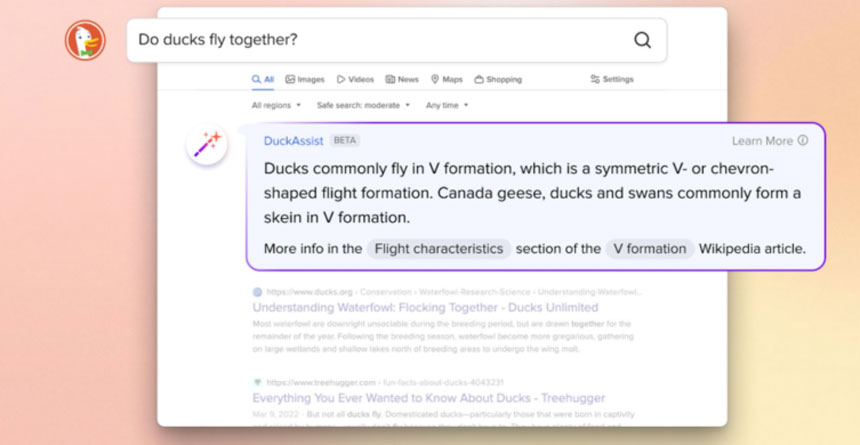
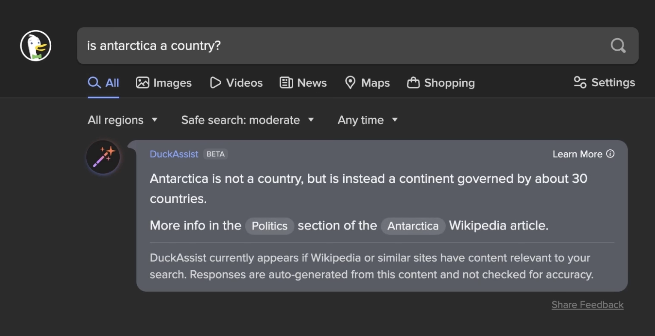
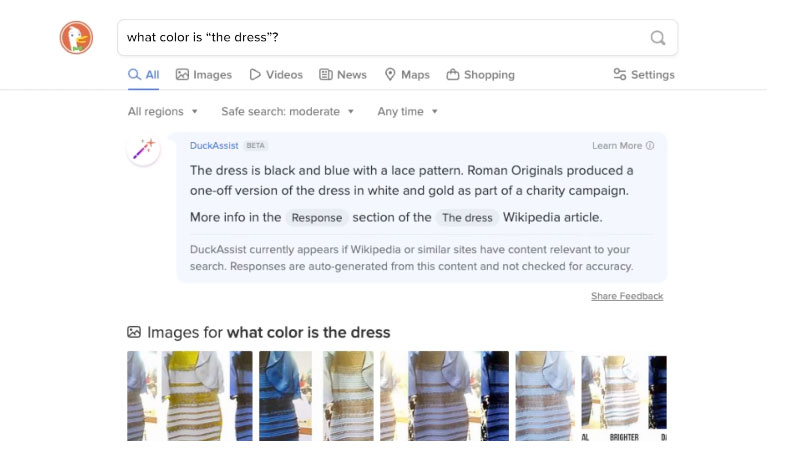
    The privacy-focused search engine DuckDuckGo entered the generative technology race by announcing a free AI-powered summarization feature, an instant answer but not a chatbot, called DuckAssist this week.

    DuckAssist — in beta now and only available via apps and browser extensions — suggests natural language answers in English when it recognizes a search engine it can answer. And when an AI-powered response is available, the user sees a magic wand icon with an “ask me” button in their search results.

    “If this DuckAssist trial goes well, we will roll it out to all DuckDuckGo search users in the coming weeks,” said Gabriel Weinberg, CEO of DuckDuckGo, in a blog post.

    DuckDuckGo says it’s drawing on natural language technology from Davinci model from OpenAI and Claude model from Anthropic, combined with its own indexing of Wikipedia — “99%+ is Wikipedia” — and occasionally related sites like the Encyclopedia Britannica, among other sources. The company also notes DDG is “experimenting” with the new Turbo model OpenAI recently announced.

    Although it’s imperfect, DuckDuckGo considers Wikipedia a relatively reliable source.

    DuckDuckGo Enters The AI Race With DuckAssist

    Moreover, Gabriel Weinberg, CEO of DuckDuckGo, said:

    “Generative AI technology is designed to generate text in response to any prompt, regardless of whether it “knows” the answer or not. By asking DuckAssist to only summarize information from Wikipedia and related sources, the probability that it will “hallucinate” — that is, just make something up — is greatly diminished.”

    “In all cases though, a source link, usually a Wikipedia article, will be linked below the summary, often pointing you to a specific section within that article so you can learn more.”

    “Nonetheless, DuckAssist won’t generate accurate answers all of the time.”

    “DuckAssist may also make mistakes when answering especially complex questions, simply because it would be difficult for any tool to summarize answers in those instances.”


  • Snapchat Introduces My AI, a ChatGPT-Powered Artificial Intelligence Bot Into Its App

    Snapchat Introduces My AI, a ChatGPT-Powered Artificial Intelligence Bot Into Its App

    IBL News | New York

    Snap Inc. announced yesterday that it was introducing My AI, a ChatGPT-powered artificial intelligence bot, into its Snapchat app. The goal is to allow users to talk with the chatbot as they would with their human friends.

    The Chief Executive of Snap Inc, Evan Spiegel, said that My AI will first roll out to subscribers of the Snapchat+ service — which costs $3.99 a month — but he hopes it will ultimately become available to all Snapchat users.

    The chatbot has been trained to avoid swear words and sexually explicit content and to decline requests to write academic essays. Other than that, at launch, My AI is essentially just a fast mobile-friendly version of ChatGPT inside Snapchat.

    The company, with 2.5 million subscribers, has been aiming to diversify its revenue base beyond advertising.

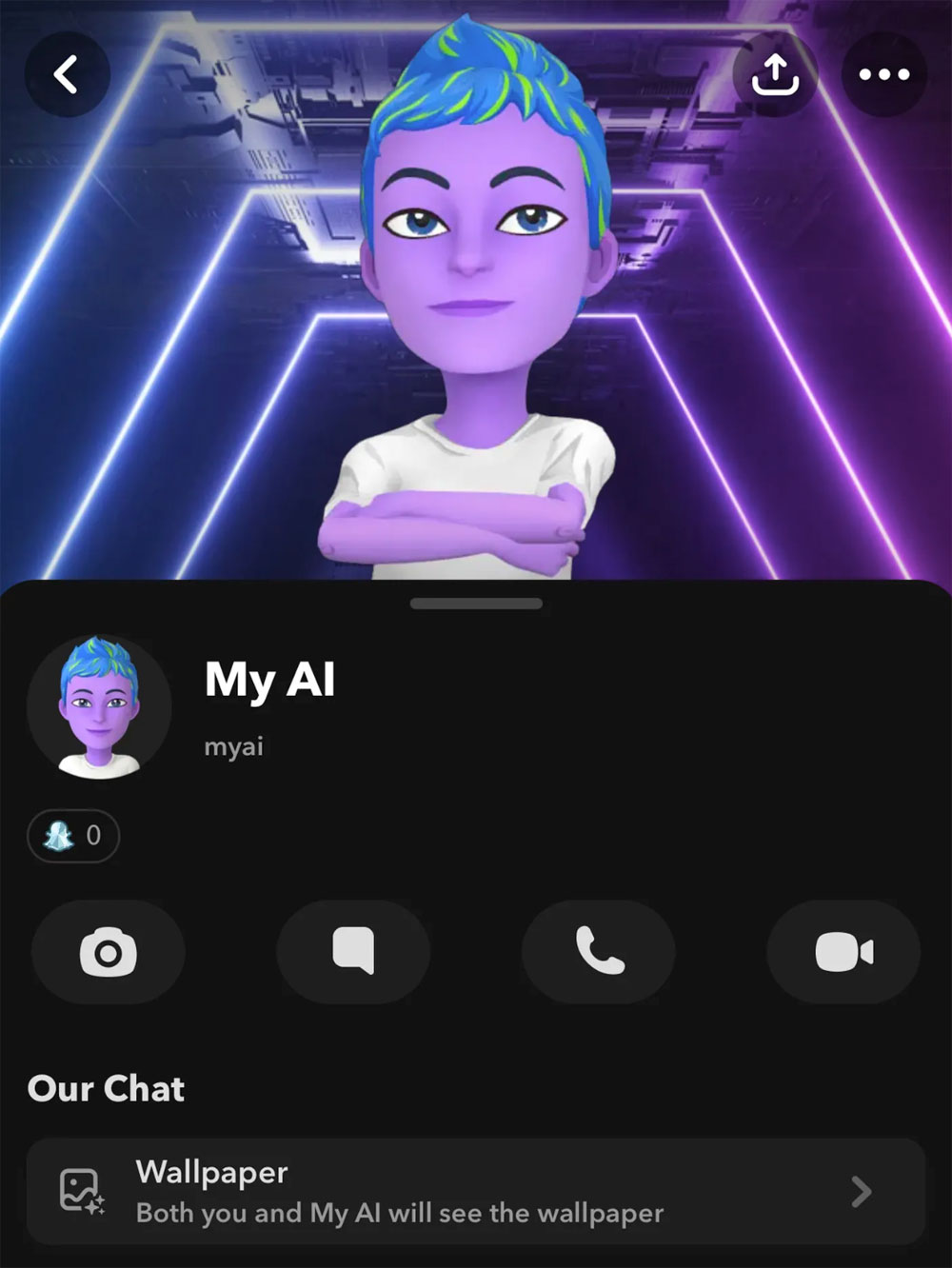
    While ChatGPT — the fastest-growing consumer software product in history — has become a productivity tool, Snap’s implementation treats it like a persona, as shown in the picture below.

    The design suggests that My AI is another friend inside of Snapchat to hang out with, not a search engine.

    Snap is one of the first clients of OpenAI’s new enterprise tier called Foundry, which lets companies run its latest GPT-3.5 model with dedicated computing designed for large workloads.

  • GitHub Copilot, Which Suggests Code in Real-Time through Generative AI, Launches Its Business Offer

    GitHub Copilot, Which Suggests Code in Real-Time through Generative AI, Launches Its Business Offer

    IBL News | New York

    GitHub has made its AI developer tool Copilot for Business publicly available.

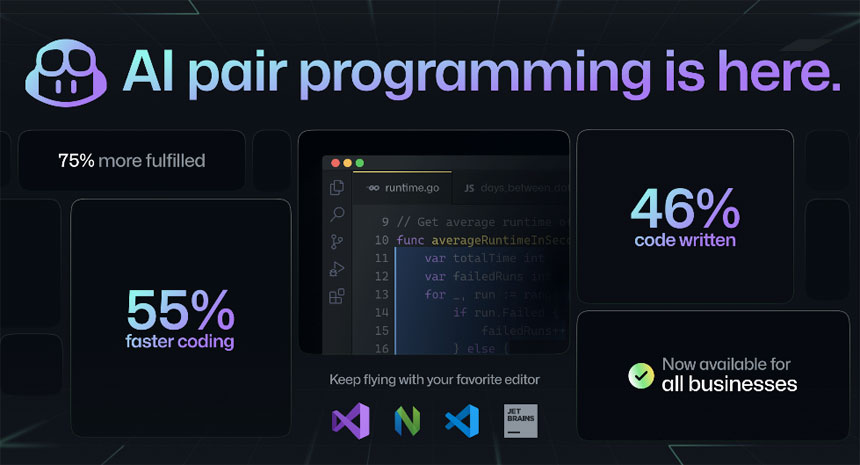
    First previewed in partnership with OpenAI in 2021, GitHub Copilot suggests in real-time new lines of code, entire functions, tests, complex algorithms, and even blocks common insecure code suggestions.

    GitHub Copilot, built on generative AI, works as an editor extension and it learns alongside developers to adapt to individual coding styles and conventions.

    With GitHub Copilot, developers can use the editor of their choice from Visual Studio to Neovim, VS Code, or JetBrains IDEs.

    However, despite its success, GitHub Copilot is not always accurate, similar to the OpenAI-owned language model ChatGPT.

    “Like any other code, code suggested by GitHub Copilot should be carefully tested, reviewed, and vetted,” GitHub said in its FAQs. “As the developer, you are always in charge.”

    “Back i​n June 2022, we reported that GitHub Copilot was already generating 27% of developers’ code. Today, we’re seeing this happen more and more with an average of 46% of code being built using GitHub Copilot across all programming languages, and 61% among developers using Java,” says GitHub. “In the coming years, we will integrate AI into every aspect of the developer experience —from coding to the pull request to code deployments.”

  • Opera Will Release a New Browser with Built-In Access to ChatGPT and Other AI Services

    Opera Will Release a New Browser with Built-In Access to ChatGPT and Other AI Services

    IBL News | New York

    Opera announced the upcoming integration of AI-generated content services into the sidebar of its desktop and mobile browsers.

    One of the first features that will be available is a new “Shorten” button in the right of address bar that will be able to use AI to filter through all the content and generate short summaries of articles and webpages.

    When tapped, it opens a sidebar where ChatGPT will provide a bulleted summary of the webpage, as shown in the video below.

    No specific date of the public launching was provided by Opera.

    Opera’s AI integration is in line with the browser’s previous addition of direct access to platforms such as TikTok, Telegram, and WhatsApp.

    “Following the mass interest in generative AI tools, we believe it’s now time for browsers to step up and become the gateway to an AI-powered web,” said Song Lin, Co-CEO of Opera.

    We see the rise of Generative Intelligence as the beginning of a new future in which consumer app developers like Opera will be able to build experiences on top of AI-based platforms,” he added.

    Opera is a twenty-five years-old browser.

  • Over 1 Million People Signed Up for the Bing Waitlist; Microsoft Shows Viva Sales Emails

    Over 1 Million People Signed Up for the Bing Waitlist; Microsoft Shows Viva Sales Emails

    IBL News | New York

    Microsoft will demonstrate in March how new ChatGPT-like AI will transform its Office productivity apps — Word, PowerPoint, and Outlook, among others. This announcement comes after the software giant showed its Prometheus Model on its new Bing search engine earlier this week.

    Over a 1 million people have signed up for the Bing waitlist in 48 hours, and Bing was the third most popular app in the App Store in the US as of Thursday.

    Microsoft is already using OpenAI’s ChatGPT for its Viva Sales emails, as shown below. The company announced a new generative AI experience in Microsoft Viva Sales a week ago.

    Microsoft is already using OpenAI tech for its Viva Sales emails.


    It is expected that Outlook will include features for suggesting replies to emails and Word document integration to improve a users’ writing.

    The new Bing AI sidebar in Microsoft Edge can already be used with web-based Office apps.

    The sidebar includes a compose tab that gives an early preview of some of the work Microsoft has been testing for Word and Outlook.

    Microsoft is also working on ways to generate graphs and graphics for PowerPoint. Bing can already generate tables and charts for basic data, but transforming those into visual graphics for presentations or even for use in Excel is a logical next step.

    On the other hand, as Google battles to compete with ChatGPT, the manager in charge of Google’s search engine warned against the pitfalls of AI in chatbots.

    “This kind of artificial intelligence we’re talking about right now can sometimes lead to something we call hallucination,” Prabhakar Raghavan, Senior Vice President at Google and Head of Google Search, told a German newspaper.

    “This then expresses itself in such a way that a machine provides a convincing but completely made-up answer,” he added.

    This week, Google’s parent company Alphabet Inc announced Bard, its own chatbot. This AI robot shared inaccurate information in a promotional video, costing the company $100 billion in market value on Wednesday, according to several analysts.

    Alphabet, which is still conducting user testing on Bard, has not yet indicated when the app could go public.

  • “ChatGPT is High Tech Plagiarism; It Undermines Education,” Says Noam Chomsky

    “ChatGPT is High Tech Plagiarism; It Undermines Education,” Says Noam Chomsky

    IBL News | New York

    “ChatGPT is high-tech plagiarism; it undermines education,” said Noam Chomsky, American linguist, philosopher, and public intellectual.

    In an interview with the host of YouTube channel EduKitchen, Chomsky explained:

    “For years there have been programs that have helped professors detect plagiarized essays,” Chomsky says. “Now it’s going to be more difficult, because it’s easier to plagiarize. But that’s about the only contribution to education that I can think of.”

    Chomsky sees the use of ChatGPT as “just a way of avoiding learning.” (…) “Students learn absolutely nothing from this.” (…) “The way to deal with it is to make education programs interesting enough.”

    Chomsky, 94, author the theory of language acquisition — which argues that human brain structures naturally to learn and use languages — stated that students instinctively employ high technology to avoid learning, “a sign that the educational system is failing.”

    “If it has no appeal to students, doesn’t interest them, doesn’t challenge them, doesn’t make them want to learn, they’ll find ways out,” just as he himself did when he borrowed a friend’s notes to pass a dull college chemistry class without attending it back in 1945.

    After spending most of his career teaching at MIT, Chomsky retired in 2002 to become a full-time public intellectual.

  • Microsoft Presented Its New Bing Search, Powered by ChatGPT

    Microsoft Presented Its New Bing Search, Powered by ChatGPT

    IBL News | New York

    Microsoft announced in a press conference yesterday new AI-powered features on its Bing searches engine and Edge browser.

    The new version of Bing is available to try in a limited preview mode.

    Microsoft said it’s using conversational AI to create a new way to browse the web.

    The search engine is powered by ChatGPT and GPT-3.5, according to OpenAI CEO Sam Altman (as shown in the picture below). He took the stage momentarily during the presentation event, as shown on the video of the announcement, which was not live-streamed.

    This means that the new Bing can answer questions with lots of context, similar to the way ChatGPT does. It allows users to chat to Bing like ChatGPT, asking questions and receiving answers in natural language.

    The company said a waitlist will be available for the full version of Bing in the coming weeks. It also plans a mobile version of Bing.

    “It’s a new day in search,” said Microsoft CEO Satya Nadella. He argued that the paradigm for web search hasn’t changed in decades, but AI can deliver information more fluidly and quickly than traditional methods.

    “The race starts today, and we’re going to move and move fast,” Nadella said. “Most importantly, we want to have a lot of fun innovating again in search, because it’s high time.”

    The company showed various configurations. One of these displays traditional search results side-by-side with AI annotations, while another mode lets users talk directly to the Bing chatbot, asking it questions in a chat interface like ChatGPT.

    Unlike ChatGPT, the new Bing can also retrieve news about recent events.

    Microsoft says these features are all powered by an upgraded, more powerful version of GPT 3.5, which it calls the “Prometheus Model.”

    Later, Microsoft will bring its AI-powered chat features to all browsers, starting with Microsoft Edge.

    Edge browser will embed within its sidebar “chat” and “compose.” “Chat” will let users ask questions about the document or webpage they’re looking at, while “compose” acts as a writing assistant, helping to generate text, from emails to social media posts, based on a few starting prompts.