Category: Views

  • Google Announces ‘Bard’, a Testing, ChatGPT-Style AI Service

    Google Announces ‘Bard’, a Testing, ChatGPT-Style AI Service

    IBL News | New York

    Google CEO Sundar Pichai has announced in a blog post yesterday the launch of its experimental conversational AI service, Bard, powered by LaMDA Language Model for Dialogue Applications.

    Bard will be available to “trusted testers” before being made more widely available to the public in the coming weeks and will compete directly with OpenAI’s ChatGPT.

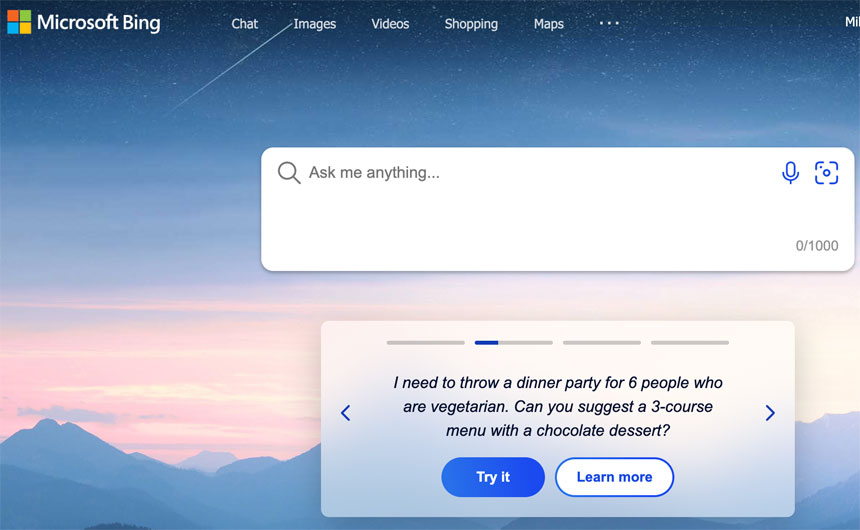
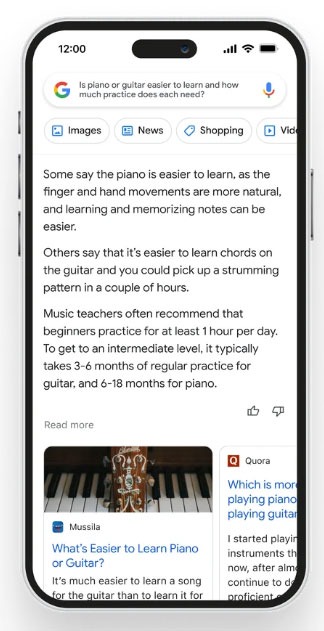
    Bard will have a search desktop design that can be used in a question-and-answer format.

    In the last months, Google has accelerated its developments as part of a “code red” plan to respond to ChatGPT. Features of the chatbot Bard will include a search desktop design that could be used in a question-and-answer format, as shown in the image below released by Google’s CEO.

    “Bard seeks to combine the breadth of the world’s knowledge with the power, intelligence, and creativity of our large language models. It draws on information from the web to provide fresh, high-quality responses,” Sundar Pichai wrote.

    “We’ll combine external feedback with our own internal testing to make sure Bard’s responses meet a high bar for quality, safety, and groundedness in real-world information,” he added.

    Sundar Pichai said that this rival of ChatGPT is a “lightweight model version of LaMDA,” and “enables us to scale to more users, allowing for more feedback.”

    “Our newest AI technologies — like LaMDA, PaLM, Imagen, and MusicLM — are creating entirely new ways to engage with information, from language and images to video and audio. We’re working to bring these latest AI advancements into our products, starting with Search.”

    In addition, Google is scaling its AI efforts through Google Cloud partnerships with CohereC3.ai, and Anthropic, which was just announced last week.

    Google’s AI chief, Jeff Dean, told recently that the company has much more “reputational risk” in providing wrong information and thus was moving “more conservatively than a small startup.”


  • ChatGPT and Upcoming AI Bots Will Make Jobs Obsolete in Several Industries

    ChatGPT and Upcoming AI Bots Will Make Jobs Obsolete in Several Industries

    IBL News | New York

    The surprisingly intelligent bot ChatGPT — released to the public as a free tool by a Microsoft-backed research laboratory in November 2021 — and other upcoming AI systems can leave many well-paid workers vulnerable, making many jobs obsolete in industries such as finance, health care, higher-ed, graphic design, software, and publishing.

    These are some sectors at risk of being supplemented by AI, according to several experts quoted by The New York Post.

    Education
    ChatGPT — currently banned in NYC schools — would work well at the middle or high school level. In higher education, AI could teach without oversight. At the Ph.D. level, AI would struggle, for now, to create an independent thesis on an area not studied yet.

    Finance
    Wall Street could see many jobs axed in coming years, especially in the trading and investment bank sides. Currently, many people are hired out of college and spend two, or three years to work doing Excel modeling, a job that AI does much faster.

    Software Engineering
    Website designers and engineers responsible for simple coding are at risk of being made obsolete within a few years since AI can draft the software hand-tailored to a user’s requests and parameters.

    Journalism
    AI technology is already highly qualified for copy editing, including summarizing, making an article concise, and composing headlines. For now, the tool is showing a complete inability to fact-check efficiently and write a story with proper citations.

    Graphic Design
    OpenAI‘s DALL-E, which can generate tailored images from user-generated prompts, along with Craiyon, Stable Diffusion, and Midjourney, pose a threat to many in the graphic and creative design industries.

    Copyright issues are also being generated by image-based AI. Getty Images recently announced legal action against Stability AI — Stable Diffusion’s parent company — claiming that the program “unlawfully copied and processed millions of images protected by copyright.”

    Update:

    A recent article in Forbes, said, “Professions that will be disrupted by generative AI include marketing, copywriting, illustration and design, sales, customer support, software coding, video editing, film-making, 3D modeling, architecture, engineering, gaming, music production, legal contracts, and even scientific research.”

    “Software applications will soon emerge that will make it easy and intuitive for anyone to use generative AI for those fields and more.”

    “Other industries ripe for disruption by generative AI may not immediately seem obvious. It may be used in the finance sector to make recommendations and manage risk. It can help the healthcare sector with diagnoses and predictive medicine. The advertising industry can use generative AI not only for creative work, but also in customer targeting. Biopharma can use generative AI to search medical literature, finding novel ways of using existing medicines off-label, and discovering new compounds to treat disease.”

    “Without hyperbole, this may be a technology inflection point like the world has never seen before.”

    “Tectonic as these changes are, you should expect to see massive disruption in 2023, 2024, and 2025. This is happening now.”


    • Insider
    : From financial planning to dealmaking, here’s how ChatGPT could impact jobs across Wall Street

  • Top Contenders Challenge ChatGPT. Google Invests $300M In Anthropic

    Top Contenders Challenge ChatGPT. Google Invests $300M In Anthropic

    IBL News | New York

    Nine weeks after ChatGPT was launched, the company behind it, OpenAI, released this week a brief technical note stating, “we’ve upgraded the ChatGPT model with improved factuality and mathematical capabilities.”

    On November 30, 2022, San Francisco-based research lab, now heavily supported by Microsoft, OpenAI described what it released as an “early demo” of a part of the GPT 3.5 series — an interactive, human-like, conversational model. Its dialogue format “makes it possible for ChatGPT to answer follow-up questions, admit its own mistakes, challenge incorrect information, and reject inappropriate requests.”

    ChatGPT took the world by storm and made AI the next big thing, according to experts. Since then, tech giants like Google are in “red code,” and every day seems to bring new contenders.

    At least four top players are working on “generative” A.I., technologies making moves to challenge ChatGPT:

    Google: LaMDA. Launched in 2021, Google said in a launch blog post that LaMDA’s conversational skills “have been years in the making.”

    Like ChatGPT, LaMDA is trained in dialogue. It’s built on Transformer, the neural network architecture that Google Research invented and open-sourced in 2017.

    The Transformer architecture “produces a model that can be trained to read many words (a sentence or paragraph, for example), pay attention to how those words relate to one another, and then predict what words it thinks will come next.”

    Anthropic: Claude.
    Founded in 2021 by a group of people that included several researchers who left OpenAI, this San Francisco AI start-up has raised $300 million in new funding, in exchange of taking a stake of 10%.

    The deal values Anthropic at $3 billion.

    According to a report posted at The Financial Times today, Google has already made that investment.

    The British paper said that Google confirmed it had made that investment and that it had a large cloud contract with Anthropic to use the Google Cloud infrastructure, but did not provide further details. This deal would echo OpenAI’s agreement with Microsoft’s Azure.

    Anthropic developed an AI chatbot, Claude — available in closed beta through a Slack integration — that reports say is similar to ChatGPT and has even demonstrated improvements.

    Character AI. This news AI chatbot technology allows users to chat and role-play with anyone, living or dead — as it can impersonate historical figures like Queen Elizabeth and William Shakespeare.

    It was launched by two engineers that left Google in October 2022, Noam Shazeer, one of the authors of the original Transformer paper, and Daniel De Freitas.

    Now they are trying to raise $250 million in new funding, a striking price for a startup with a product still in beta. 

    DeepMind: Sparrow. DeepMind, the British-owned subsidiary of Google parent company Alphabet, introduced Sparrow in a paper in September.

    For now, Sparrow is a research-based, proof-of-concept model that is not ready to be deployed, according to Geoffrey Irving, a safety researcher at DeepMind and lead author of the paper introducing Sparrow.

    DeepMind’s CEO and cofounder Demis Hassabis said in a TIME article two weeks ago that its company is considering releasing its chatbot Sparrow in a “private beta” sometime in 2023.

    DeepMind says “Sparrow is a dialogue agent that’s useful and reduces the risk of unsafe and inappropriate answers.” The agent is designed to “talk with a user, answer questions and search the internet using Google when it’s helpful to look up evidence to inform its responses.”

    It was hailed as an important step toward creating safer, less-biased machine learning (ML) systems, thanks to its application of reinforcement learning based on input from human research participants for training.

    Axios: How ChatGPT became the next big thing
  • ChatGPT Surpasses 100 Million Users in January, with 13 Million Daily Visitors

    ChatGPT Surpasses 100 Million Users in January, with 13 Million Daily Visitors

    IBL News | New York

    ChatGPT is on track to exceed 100 million monthly active users, increasing from 57 million in December, according to UBS analyst Lloyd Walmsley. Currently, the natural language chatbot ChatGPT receives 13 million daily visitors, more than double the figure from December 2022, the analyst notes.

    The New York Times quotes other sources stating that ChatGPT has more than 30 million users and gets roughly five million visits a day.

    In a research note, Walmsley points out that it took TikTok nine months from its launch to reach 100 million users, while it took Instagram 2.5 years. “We have not seen an app grow at this rate before,” the analyst adds.

    Developed by start-up OpenAI and backed by Microsoft, ChatGPT has experienced explosive growth.

    Venture capital investors speculate that the market for generative AI applications could be worth up to $1 trillion.

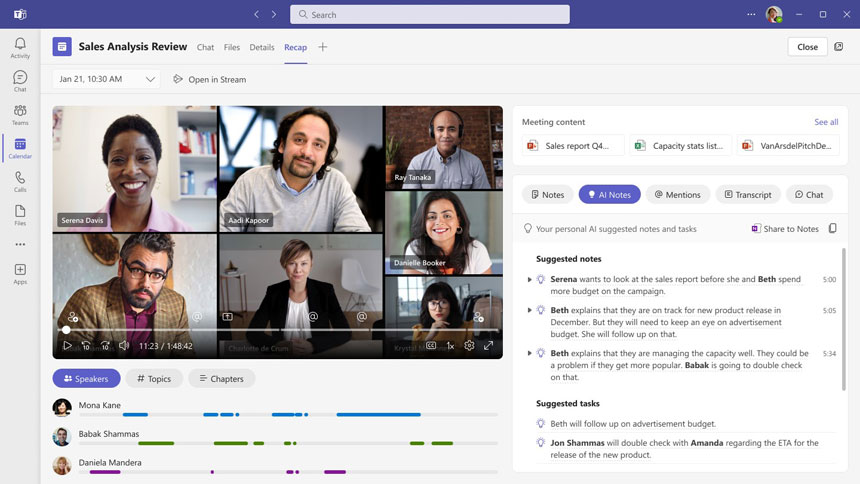
    On the other hand, Microsoft continues to integrate ChatGPT capabilities into its Office products. Microsoft Team is the latest one, as shown below.


  • Microsoft Launches Teams Premium with Features Powered by ChatGPT

    Microsoft Launches Teams Premium with Features Powered by ChatGPT

    IBL News | New York

    Microsoft Corp rolled out a premium Teams version with features powered by Large Language Models powered by OpenAI’s GPT-3.5 yesterday.

    This way, Microsoft, which announced a multi-billion dollar investment in OpenAI in January, is setting the stage for more competition with rival Alphabet Inc’s Google.

    Microsoft Teams Premium, which costs $7 per user/month, is “infusing AI throughout the meeting experience,” by “generating meeting notes, recommended tasks, and personalized highlights, even if you miss the meeting.”

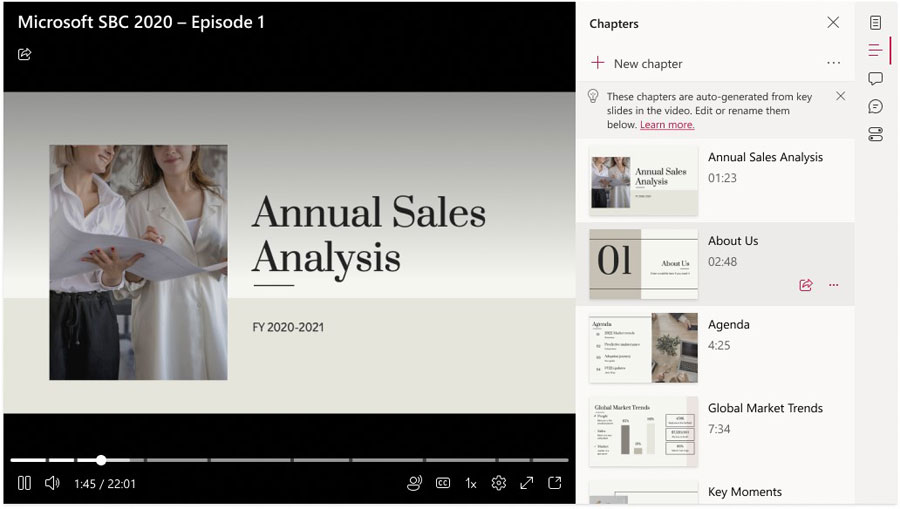
    • “AI-generated chapters divide the meeting into sections to choose relevant content to save time spent reviewing meeting recordings. This is available today for PowerPoint Live meeting recordings. Intelligent recap will automatically generate meeting chapters based on the meeting transcript as well.”


    “Microsoft Teams Premium also includes live translations for captions, with AI-powered real-time translations from 40 spoken languages.”

    “Branded meetings to see the logo and colors of each company on calls will be available in mid-February 2023.”

    “Advanced meeting protection permits watermarking to deter leaks and limit who can record.”

    VoiceBot.AI: New Microsoft Teams Premium Uses ChatGPT to Take Meeting Notes

  • OpenAI Announces ChatGPT Plus, a $20/Month Premium Service

    OpenAI Announces ChatGPT Plus, a $20/Month Premium Service

    IBL News | New York

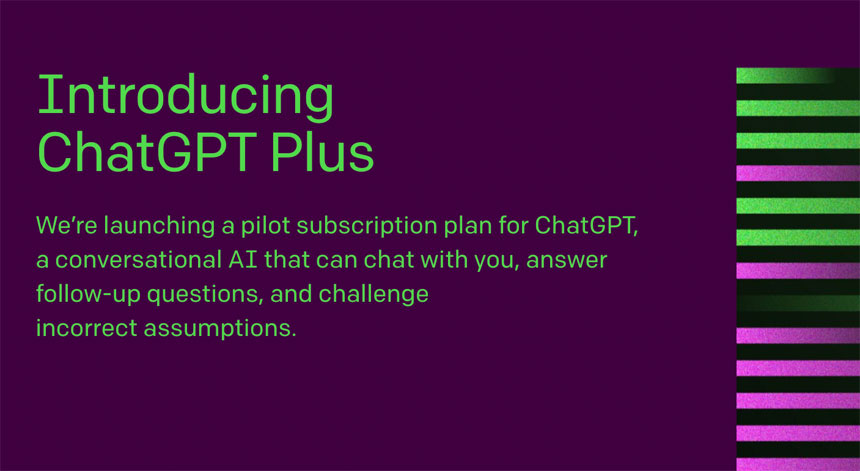
    OpenAI announced yesterday the launch of its premium service, ChatGPT Plus, which is available in the United States for $20 a month.

    This new subscription plan will grant users access to ChatGPT during peak times with “faster response times and priority access to new features and improvements,” according to the company.

    The premium service is currently in a pilot phase and will be available in the coming weeks. There is a waitlist. in place for now.

    Previously, OpenAI was considering introducing a plus or pro version of the service at $42 a month, but the price has been lowered to $20 a month to make it more accessible to a wider range of users, including students and businesses that require reliable access to AI-generated text.

    OpenAI also stated that it will continue to offer free access to ChatGPT “to support free access availability for as many people as possible.”

  • OpenAI Issues a Free Tool to Help Determine If Any Text Is Written by ChatGPT

    OpenAI Issues a Free Tool to Help Determine If Any Text Is Written by ChatGPT

    IBL News | New York

    OpenAI, the creator of ChatGPT, released yesterday a free web tool, called AI Text Classifier, that detects if a text has been written by AI or not.

    This solution tries to address concerns, especially in higher education over plagiarism.  ChatGPT. New York schools, for example, have banned this technology on their networks.

    “The tool is a fine-tuned GPT model that predicts how likely it is that a piece of text was generated by AI from a variety of sources, such as ChatGPT,” explained OpenAI. “This classifier is available as a tool to spark discussions on AI literacy.”

    AI Text Classifier requires approximately 150 – 250 words (or a minimum of 1,000 characters) and it isn’t always accurate. The text can even be edited easily to evade the classifier and is likely to get things wrong in text written by children.

    The user simply has to paste the text that he or she would like to check in this URL after logging in. The system will determine if the text was written by a machine, offering a five-point scale of results: Very unlikely to have been AI-generated, unlikely, unclear, possible, or likely.

    OpenAI’s View on Academic Dishonesty, Plagiarism Detection, and Education


  • China’s Baidu Will Soon Launch an AI Platform Similar to ChatGPT

    China’s Baidu Will Soon Launch an AI Platform Similar to ChatGPT

    IBL News | New York

    China’s biggest search engine Baidu said yesterday it will launch a ChatGPT-like AI bot in March, according to sources quoted by Reuters and Bloomberg.

    It will be based on a large-scale machine-learning model developed by the company and trained over several years called Ernie. It will also allow users to get conversation-style search results, similar to OpenAI’s platform.

    Beijing-based Baidu sees ChatGPT-like apps as a potential way to leapfrog rivals, according to analysts.

    It seems that Baidu — China’s Google — plans to launch the AI service as a standalone application and gradually merge it into its search engine, said a person to Reuters.

    The idea of Baidu seems to point out incorporating chatbot-generated results when users make search requests, instead of only links.

    Chatbots in China currently focus on social interaction, whereas ChatGPT performs better at more professional tasks, such as programming and essay writing.

    Baidu has been investing heavily in AI technology, including in cloud services, chips, and autonomous driving, as it looks to diversify its revenue sources.

    The news of Baidu’s plans sent shares up by 5.8%, the largest intraday gain in almost four weeks.

  • MusicML, a Research Project by Google, Generates Songs From Text Descriptions

    MusicML, a Research Project by Google, Generates Songs From Text Descriptions

    IBL News | New York

    Google researchers have created an AI system called MusicLM that can generate songs in any genre from any text. This AI was trained on a dataset of 280,000 hours of music to learn to generate coherent songs. TechCrunch reported the story first.

    However, Google, fearing the risks of copyright laws along with ethical challenges, said that it has no immediate plans to release it.

    The project was detailed in an academic paper. Creators gave MusicML instructions, such as “a calming violin melody backed by a distorted guitar riff”,  “create an enchanting jazz song with a memorable saxophone solo and a solo singer”, or “Berlin ’90s techno with a low bass and strong kick.”

    Researchers said that songs sound something like a human artist might compose, albeit not necessarily as inventive or musically cohesive. However, MusicLM managed to capture instrumental riffs, melodies, and moods.

    Google researchers showed that the system could create melodic stories fit for a movie soundtrack or generate audio played by a specific type of instrument in a certain genre.

    This AI “musician” can be set to compose music inspired by places, epochs or requirements (e.g. motivational music for workouts).

    A concern of Google is the tendency of MusicML to incorporate copyrighted material from training data into the generated songs. During an experiment, they found that about 1% of the music the system generated was directly replicated from the songs on which it trained. Deepfake music stands on murky legal ground.

    Music Publishers Association argued that AI music generators violate music copyright. Legal copyright experts say that an AI system music would be considered a derivative work, in which case only the original elements would be protected by copyright.

    Several lawsuits likely would be filed pertaining to the rights of artists whose work is used to train AI systems without their knowledge or consent.

    Before MusicML, there have been other attempts at generative music, such as Riffusion, Dance Diffusion, Google’s own AudioML, and OpenAI’s Jukebox.

  • An AI Application Allows to Ask Questions and Gain Insights About Documents

    An AI Application Allows to Ask Questions and Gain Insights About Documents

    IBL News | New York

    Businesses around large language models (LLMs) and ChatGPT continue popping up.

    One of the latest is Usemeru.com, which allows people to ask questions about Documents, HTML Files, and JSON files in natural language. Large volumes of text can include recruiting call transcripts, request tickets from customers, and medical records.

    Users upload and index those documents and files and ask questions about the document. The app parses input and delivers natural language responses.

    Essentially, when a client submits a document to Usermeru’s API, the system indexes the document and stores the index on the company servers. Clients can then query the index via an LLM, such as GPT-3, and obtain a response.

    This approach is more robust than passing the document as a part of the prompt.

    In addition, because the user is querying the index, he/she doesn’t waste tokens as prompts, and can therefore build much larger and more complex queries. Documents larger than 4096 tokens can also be queried effectively.

    Usermeru.com also allows you to embed Stable Diffusion image generation into your applications with low latency, variable sizing, and automatic resolution upscaling.

    The application is available as an API for dense data retrieval at a starting price of $2.75 per concept.

    People in finance/investing, law, humanities/social science research might find this useful in order to search for documents.