IBL News | New York
Nearly 200 top economists, researchers, and tech leaders warned in a letter to policymakers about the threats of AI, including large-scale job displacement, while asking them to do more to understand and respond to potential disruptions by building policies, institutions, guardrails, and incentives that steer AI in a direction that complements human labor rather than replacing it.
The letter, titled “We Must Act Now,” included 15 Nobel laureates and the chief economists of OpenAI and Anthropic, along with Jack Clark, a co-founder of Anthropic; Eric Schmidt, the former CEO of Google; Reid Hoffman (LinkedIn co-founder); Jeff Dean (Google AI Lead); and the VC investor Vinod Khosla.
Other notable signatories were the economist Daron Acemoglu (MIT), Erik Brynjolfsson (Stanford), Anton Korinek (UVA), Nobel laureates Joseph Stiglitz and Simon Johnson.
In their statement, they said that Artificial intelligence can drive an economic transformation faster than the Industrial Revolution. They emphasize that, unlike steam or electricity, which gave societies decades to adapt, AI may only give society a few years to put the necessary protections in place.
Their concern is that unmanaged AI adoption could automate millions of jobs, potentially bifurcating the workforce into a small group of tech elites and a “permanent underclass” of displaced workers.
In addition, the massive wealth generated by AI could concentrate in the hands of a few tech giants.
However, many economists, including Mr. Brynjolfsson, say they believe that A.I. will ultimately be beneficial, making workers more productive and raising living standards. They point to historical examples of technologies — including steam power and the personal computer — that wiped out some categories of jobs but ultimately created far more new ones.
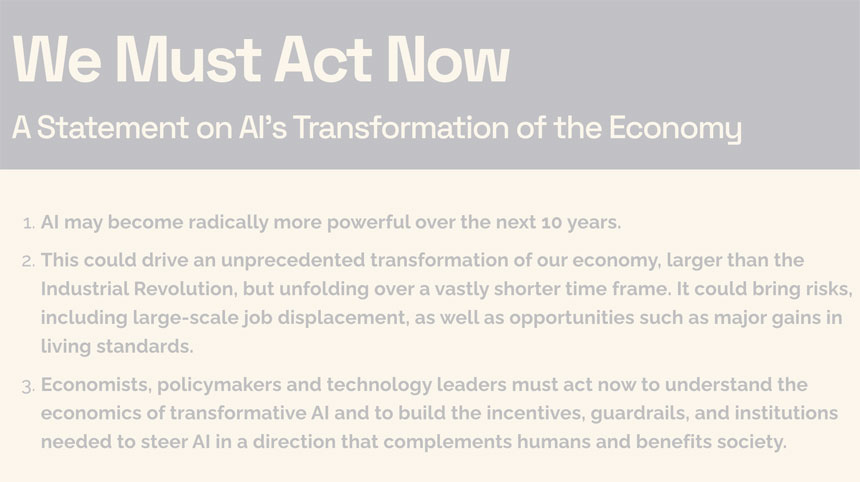
Literally, their main triple statement is this:
-
AI may become radically more powerful over the next 10 years.
-
This could drive an unprecedented transformation of our economy, larger than the Industrial Revolution, but unfolding over a vastly shorter time frame. It could bring risks, including large-scale job displacement, as well as opportunities such as major gains in living standards.
-
Economists, policymakers, and technology leaders must act now to understand the economics of transformative AI and to build the incentives, guardrails, and institutions needed to steer AI in a direction that complements humans and benefits society.
This is the list of all signatories to date:
Anne Trefethen, University of Oxford
Pierre Larouche, Université de Montréal
Nikola Jurkovic, METR
Joshua Saxe, Abundant Security
Ben Hyman, University of California, Los Angeles
Michael Douglas, Harvard University
Marshall Van Alstyne, Boston University
Hidenori Tanaka, Harvard University and NTT Research, Inc.
Amin Karbasi, CISCO, Stanford
Carl Sommers, Retired
Kweku Opoku-Agyemang, Machine Learning X Doing
George Georgopoulos, York University, Toronto, Canada
Annaas Asshidiiq, Prasetiya Mulya
Hatim Rahman, Northwestern University
Joshua Mask, Temple University
Logan Graham, Anthropic
Probal Lala, Maple Leaf Angels
Joseph Steinberg, University of Toronto
Philipp von Randow, Obligate AG
Mobina Mobaraki, University of British Columbia
Pawan Kumar BK, Tribhuvan University, Nepal
Mario Brcic, University of Zagreb, FER
Dirk Bergemann, Yale University
Piotr Zoch, University of Warsaw
Patrick Shafto, Rutgers University
Andrei Potlogea, University of Edinburgh
Viet Dang
Jason Wolfe, OpenAI
Craig Vander Galien, DrillerDB
Bernardo Recamán, Universidad de los Andes, Bogotá
Reese Pathak, University of California, Berkeley and Cornell University
Isaac Baley, Universitat Pompeu Fabra
Dashun Wang, Northwestern University
Kevin Nicholas, North Highland
Alan Raul, Harvard Law School
Carringtone Kinyanjui, Haki AI Africa
Luke Drago, Thinking Machines
Christopher Altman, Continuation Observatory
Peter Henderson, Princeton University
Daniel Gross, Duke University
Saif Khan, Institute for Progress
Tyler Xiao, UCLA
Swapna Iyer, The LAB (Let All Build) Company
David Crozier, Artificial Intelligence Collaboration Centre (AICC)
Emad Mostaque, Intelligent Internet
Adam Traweek, University of Louisiana Monroe
John Bailey, American Enterprise Institute
Gabor Bekes, Central European University
Cem Say, Boğaziçi University
Ravi Gupta, Tambourine Innovation Ventures
Xiang Hui, Washington University in St Louis
Jens Groth, University College London
Jan Kulveit, Charles University
Hillary Vipond, Complexity Science Hub / LSE
Eric Dolores, Yonsei University
Dominik Gutt, RWTH Aachen University
Pranav Modi, Possible Minds
Michael Reich, University of California, Berkeley
Muskan Achhpilia, Radboud University Nijmegen
Will DePue, OpenAI
JOAN Paredes, National Bank of Slovakia and European Central Bank
Roman Yampolskiy, University of Louisville
Risto Uuk, KU Leuven
Olli Laitinen, Macon Oy, CTO
Jason Liu, Stanford Digital Economy Lab
Nicholas Brown, Institute for Progress
Shrutya Bhalla, CEO, Co-founder
Brian Hayashi, Debabelize AI
Bhaskar Nandy, Destiny Energy
Dmitry Nedovis
Matias Scaglione, Motio Research
John Tidwell, YoungWilliams
Paul Gaggl, UNC Charlotte
Jacob Schaal, King’s College London
Rod Fontecilla, Chief Innovation and AI Officer
Matt Abrams, $1B for Trust
Tiffany Kuhlmann, Citizen
Krishna Sharma, Stanford University
Davud Rostam-Afschar, University of Mannheim
Michelangelo Rossi, HEC Paris
Filip Jolevski, World Bank
David Gelvez, Fedesarrollo
Vijay Gurbaxani, UC Irvine
Benjamin Funk, USU
Andreas Kostøl, BI Norwegian Business School
Anirudh Bajaj, Microsoft
Meg Bear, The Meg & Amy show
Alessandra Bonfiglioli, University of Bergamo
Tomasz Kostrząb, Tutore Group
Semih Uslu, Johns Hopkins University
Jorge DeFlon, México
Sinead Bovell, Futurist, WAYE
Enrico Forti, Seton Hall University
Florian Mai, University of Bonn
Joshua New, SeedAI
Saimir Baci, Augmentifai
Harris Mylonas, George Washington University
ahmed tritah, University of Poitiers
Roberto Musso, DIGEVO
Francis Su, Harvey Mudd College
Jacob Conway, University of Chicago
Ali Merali, Scaling Laws for Economic Impacts
Felix M. Simon, University of Oxford
Daniel Liebau, Erasmus University
Aditya Naryana, Mirror Security
Karan Girotra, Cornell Tech
Kate Odziemkowska, University of Toronto
Karla Sayegh, University of Cambridge
Benjamin Roth, Harvard Business School
Joel Christoph, Harvard Kennedy School
Mauricio Rodríguez, CESA
Leo Sokolow Romin, PhD Student in Economics at Uppsala University
Nidhal Selmi, Independent AI Researcher
Chiranjit Kundu
Ian Salas, Johns Hopkins University
Trina Gorman, Gorman Consulting
Mehrdad Mahdavi, Penn State University
Andreas Park, University of Toronto
Raymond Douglas, ACS Research
Tarek AlKady, Saudi Pension Fund
Willem Scheepers, Damies Future Intelligence
Krishnendu J, J-PAL
Rusty McMurray, soulshine labs
Steven Strauss, Harvard
Adrien Ecoffet, OpenAI
Christopher Barrington-Leigh, McGill University
Hakan Özalp, University of Amsterdam
Joe Rayner, Ruđer Bošković Institute
Sven koster, Siemens Healthineers
David Drodge, FHNW.CH
Lior Rokach, Ben-Gurion University of the Negev
Janot Mendler de Suarez, Boston University
Daniel Parshall, Canary Institute
Le Lee, Independent
Vaibhavi Desai, Student
Nathalie Gazzaneo, OpenAI
Santhosh R, Panimalar Engineering College
James LeVere, Independent/
Bofu Chen, Numbers Protocol
Robert Bjarnason, Citizens Foundation Iceland
Zameer Arora, Capula Global
Kurt Huebner, University of British Columbia
Mikel Albizu, Orkestra IVC
Sascha Becker, University of Warwick
Adit Mehta, London School of Economics
Emin Koksal, Bahçeşehir University
Richard Corey, University of Maine
Daniel Björkegren, Columbia University
Md Soaib Hossain, NORDIK Institute
Tobi Akinyemi, AGI.space
Mahsa Keikha, Researcher
Robb Bush, INDUSTRY 5, Inc.
Khalid Ali, METR
Brad Browning, Tech Safe Solutions
Lucia Velasco, Maastricht University
Jason Abaluck, Yale University
Vivienne Hesha, Columbia University
Nell Watson, University of Gloucestershire
Anshul Khandelwal
stelian balta, Hyperchain Capital
Alex Palcuie, Anthropic
Tonio Romero, Osom.biz
Angel Grimalt, Andrés Bello University
Christophe BENAVENT, Université Dauphine PSL
Caitlin McKinnon, Talamore Mining
Fabian Gaessler, Universitat Pompeu Fabra
David Timis, Global Governance Institute
Ricardo Silva, Webaround.ai
Tim G. J. Rudner, University of Toronto
Randy Kawka, Student
Ewan Simpson, Narxoz Business School
Owen Carroll, CloudZero (Employment), University of Rochester (Education)
Luís Barreto Xavier, Universidade Católica Portuguesa
Bernard Bontemps, hyperscale.net
Alejandro Wills, Universidad de La Sabana
Luca Picariello, University of Naples Federico II
Alexander Farach, Microsoft
Morad Nagib Alsahybi, Founder, Ouamarkom | Exploring the Command Economy of AI
Rikdev Bhattacharya, University of Connecticut
Harry Esau, Moorpark College
Karen Jeffrey, University of Glasgow
Chris Stahl, Entrepreneur
David Rein, METR
Torben Klarl, University of Bremen
Matti Liski, Aalto University
Thomas Mustier, Nexcade AI
Swabhiman Chhotray, HSBC
Lionel Levine, Cornell University
Tobias Hütner-Reisch, ETH Zürich
Tom Fehring, Artificial Intelligence Underwriting Company
Roberto Benedetti, Studio Associato Revisori Commercialisti
Michael Majster, Université Libre de Bruxelles
Shyamgopal Karthik, University of Tübingen
Ramiro Gil-Serrate, Universidad Nebrija
Larry Panozzo, Ethicist & Engineer
Christian Hendriksen, Copenhagen Business School
Kevin Bauer, Goethe University Frankfurt
Felix J Vigneault, The Citizen Architect
Alex Nomberto, Moddula
Ahmed Banafa, San Jose State University
Debora Loccisano, WorkWhile and Carleton University
Satish Viswanathan, Author of “The Weight of Intelligence”
Stephen Zelnick, Temple University (Emeritus Professor)
Alvaro Sanchez, AI safety researcher
Daniel García, University of Vienna
Andreas Madestam, Stockholm University
Wesley Holliday, University of California, Berkeley
David Orban, Al Liwan Labs
Yves Lermusiaux, Corporate AI Responsibility
Juan JACKSON, U.S. Government
Aariffa Hajamaideen, Teckollab
Rachelle Sampson, University of Maryland
Mark Mullikin, Value Creation Partners
Elvin Aghammadzada, Nvidia
Karl Meilke, University of Guelph
Jermaine Malcolm, Skills Gap Advocate
Govind Kamtamneni, Microsoft
Andrew Chaney, Futurist
Jean-Félix Brouillette, HEC Montréal
Tobias Salz, MIT
João Monteiro, CRON STUDIO
Ignacio Gonzalez, American University
Barbara Zanger Zuniga, California State University Monterey Bay
Clarisse Molad, Golden Gate University
Eleanor Bloxham, The Value Alliance
Harm Bandholz, Kiel University of Applied Sciences
Sergey Yablonskiy, UJA
Ulrich Glogowsky, Johannes Kepler University Linz
Gerard de Melo, University of Potsdam
Marcello Vena, IE Business School
Till Stange, University of Cologne
Seyed M. Hosseini Maasoum, Harvard University
Zeb Anderson, TriVista
Johannes Haushofer, Cornell University
Guy Lichtinger, Harvard University
Wei Chen, University of Connecticut
John Ahlquist, UC San Diego
Jarah Euston, WorkWhile
Abhinav Sarma, KV khanapara
Angelica Parente, Civilization Ventures
Lucas Pollock Muguruza, PUBLIC.io
John Painter, Independent AI researcher in HUD service coordination
Johan Fourie, Stellenbosch University
Walter Robinson, @AI_4_Healthcare on X
Claudio Ribeiro de Lucinda, University of São Paulo
Gaurab Aryal, Boston University
Arne Janssens, Factory22
William Hynes, University College London
Yelena Mammadova, Microsoft
Pankaj Nagpal, CWRU
Alfredo Menacho, Entrepeneur
Julia M. Schmidt, Université Paris Dauphine – PSL
Ainhoa Zamora, Stanford University
Daniela Muhaj, Georgetown University
Daniela Andren, Örebro University
Edward Tsoi, AI Safety Asia
Haresh Gurnani, Stony Brook University
Nicolas Beecroft, Workhelix
Ian Davidson, Signol Labs
Shayan Abbasi, McMaster University
Romel Mostafa, Ivey Business School
Przemek Gawryluk, Sotapoc
Claudine Gartenberg, University of Pennsylvania, Wharton School
Clara Shih, New Work Foundation
Jaakko Meriläinen, Stockholm School of Economics
Nikos Karampekios, National Documentation Centre, Greece
Raghav Kumar, Student
Matthias Samwald, MedUni Vienna
Ekkehard Ernst, International Labour Organisation
Hadi Hendrawan, NATARAJA
Carol Aziz, Achieve Sustainability Inc.
Sharthok Rayan Pal, SwiftAPI
Sander Volten, Seismic Foundation
Scott Rallya, Hearth & Code
Gregory Conti, Princeton University
Jonas Kjellstrand, kjellstrand.se
Christopher Mills, University of Notre Dame
Jason Kapcar, Foundation AI Advisory
Dennis Hedegreen, Hedegreen Research
Salman Arif, University of Minnesota
Hyunjin Kim, Insead
Spencer Bastani, IFAU and Uppsala University
João Furtado, Universidade de São Paulo
Eric Rhodes, LISSAI Group
Berkay Saygin, University of Chicago
Rahul Singh, Anant
Theodore Koutmeridis, University of Glasgow
Gerry Tsoukalas, Boston University and University of Oxford
Reggie Padin, AILCN
Charles Downing, University of Chicago
Mads Rosendahl Thomsen, Aarhus University
Manas Ray, Biotech Consultant, Modal Therapeutics Inc.
Gualter Agrochâo, Aposentado
Luis Enrique Urtubey De Césaris, Centro de Estudos em Governança de Inteligencia Artificial
Philipp Schirmer, University of Bonn
Nat Sothanaphan, Independent
Andrew Freedman, Fathom
Benjamin Wittenbrink, MIT
Isabel Mota
Ernest Gnan, SUERF -The European Money and Finance Forum
John Sorrentino, Temple University
Sebastian Gallegos, UAI Business School, Chile
Zubin Wadia, Every Second Counts, Inc.
Workineh Kassie, University of Gondar
Olivier Simard-Casanova, University of Lorraine
Ardeep Chakroborty, Capgemini
Alan Mackworth, University of British Columbia, Former President AAAI
Ben Corpron, Author at Life with AI
Eduardo César Garrido Merchán, Universidad Pontificia Comillas
Philip Tomei, AI Objectives Institute
Tomasz Zgliczyński-Cuber, aiethos
Rena Conti, Boston University
Andrej Srakar, Jozef Stefan Institute and University of Ljubljana
Hasan Cavusoglu, University of British Columbia
Giorgio Ricchiuti, University of Florence
Eric Hubacheck, CanXP AI
Victor Lyonnet, University of Michigan
James Mickens, Harvard University
Hans Galland, BeyondTrucks
Santa Ono, EIT Oxford and University of Oxford
Alex Field, Santa Clara University
Joshua Achiam, OpenAI
Juan M Lavista Ferres, Microsoft AI For Good Lab
Kastuv Ray, Founder – Raynari Circle
Alan Finkelstein Shapiro, Tufts University
Jarrod Humphrey, Xavier University
Alessio Moro, University of Cagliari
Alessandro Sellitto, University of Milan and University of Pavia
Mohamad Fahmi, Universitas Padjadjaran
Claudio Argentini, Istituto superiore di sanità
Ricardo Forcano Garcia, Creditas
Victor Gomes, University of Brasilia
Paul Triolo, DGA Albright Stonebridge
JM Arseneau, Winnia
Theepakorn Jithitikulchai, Thammasat University
Martial Simonard, IApprentissage
Peter Jensen, SAFE AI Forever Institute
Paolo Campioni, USB Pubblico Impiego Italy
Benjamin Schwartz, OpenAI
David Wuepper, University of Bonn
Mumtaz Ahmed, COMSATS University Islamabad
Alexandre Rispal, HEKZE
Mireya Rodriguez, CEO Vortex AI Solutions
Vahagn Jerbashian, University of Barcelona
Kevin Planovsky, Entrepreneur, Investor & Advisor
Dimitrios Diamantaras, Temple University
Daniel Mulet, Radical ventures
Jayasimha Gunda, Luzia
Erik Hornung, University of Cologne
Diego Villamizar, Xavier University of Louisiana
Dora Moscato, Banca d’Italia
William Spat, IOTO International Inc.
Luis Lamb, Stony Brook University
Matthew Wemyss, Cambridge School of Bucharest
Steven Stawarz, Self
Param Singh, Carnegie Mellon University
Kurt Lavetti, Ohio State University
Hernan Salas, Director, Hernán Salas Management Consulting
Yidi Wang, Eternal Terra Ear ÉTÈ Institute
Haotian Zong, Johns Hopkins University
Zvi Mowshowitz, Don’t Worry About the Vase
Nouriel Roubini, NYU
Daniel Weld, Allen Institute for Artificial Intelligence
Ehsan Mousavi, University of Bergamo
Madhu Gopinathan, Amazon
Joan Torrent-Sellens, Universitat Oberta de Catalunya
Rami Kiwan, Economist and policy advisor – Independent
Florin Rotar, Atos Group
Elizabeth Strickler, Georgia State University
Michael Hanegan, Center for the Future of Learning and Work
Manuel Couto, Agrupamento de Escolas da Corga de Lobão
Tom Haas, STATEC
Ceren Baysan, University of Toronto
Felecia Webb, Partnership on AI
Rahul Anand, Aarhus University
Volkan Gurses, California Institute of Technology
Mit Gandhi, Havas
Alex Chan, Harvard University
Robert Greer, Texas A&M University
Sigbjørn Landazuri Tveteraas, University of Stavanger
Rob Dolci, 42N
Larry Chao, Agency Studio
Travis Malott, Riskonnect
Andrew Wang, Founder and President of the Ottawa AI Safety Initiative
Rudolph Lohmeyer, A.T. Kearney
Christopher Cormack, Quant Foundry Limited
Fidelis Hove, Genesis Analytics
Chad Neutek, NEUTEK
Boris ARCINIEGAS, Business It
Neel Somani
Alexander Brust, DNV
Sharon Gai, Culture Fluid
Luc NANGA, Intelligence Qubit
Rohinton Medhora, McGill University
Aaron Wood, The University of Tampa
Guru Chadha, Value CoCreators LLC
Owen Zidar, Princeton University
Howard Brown, Revenue.io
Cloda Jenkins, Imperial College London
Kendon Bell, Scarlatti, New Zealand
Edward Tsang, University of Texas at Dallas
Anthony Finbow, Agential Biology Institute
Gunnar Grass, Chef Jasper
Geoffrey Leonardelli, University of Toronto
Ali Ozkes, Vienna University of Economics and Business
Christina Gathmann, LISER and IZA@LISER
Pasquale D Apice, European Commission
Benjamin Sprecher, Delft University of Technology
Gina Neff, University of Cambridge
Ludovic Subran, Allianz SE
Climent Quintana-Domeque, University of Exeter
Jeremy Huang, Harvard University
Oguz A. Acar, King’s College London
Stephan Ganter, Digital Health SolutionSales Manager
William Everitt, Princeton Wood Preservers Ltd
Amy Fane Hervey, University of Stellenbosch
Tan Zhi-Xuan, National University of Singapore
Gianluca Caruso, Private
Ali Hasanain, Lahore University of Management Sciences
Karl Schmedders, IMD
Ravinder Bommu, Wiley
Val Samonis, Vilnius University
Chris Varvares, Economist Intelligence Unit
Gad Levanon, Burning Glass Institute
Cristiana Firullo, Cornell University
Sondre Solli Halvorsen, NTNU – Norway
Sondre Solli Halvorsen, Student
Ivan Ortenzi, BIP
Olivia Zamis, University of Chicago (Student)
Halsey Roberts, Indiana University
Nadia Zakir, University of Leicester
Ada Pirolo, Intesa Sanpaolo
Joseph Chan, Columbia University
Sebastian Kranz, Ulm University
Michael Scheessele, Indiana University South Bend
Patricio Dominguez, Pontificia Universidad Católica Chile
Johannes Wachs, Corvinus University of Budapest
Petros Dimas, National Technical University of Athens, Greece
Raja RAJENDRA Timilsina, Asian Development Bank institute
Sebastian Buhai, Stockholm University and UC Chile
Tauã Magalhães Vital, Mercado Libre
Ángel Valarezo-Unda, Universidad Complutense de Madrid
Rakesh Verma, Nokia
Alejandro Guerrero, OECD
Christelle Luchsinger
Ahmet aysan, HBKU
Zachary Schlosser, Prosperity of the Commons International
Nicole Martinez, Let’s Jetty
Tom Hashimoto, Vilnius University
Vihar Georgiev, Sofia University “St. Kliment Ohridski”
Maik Huettinger, ESSCA
Teemu Pekkarinen, University of Vaasa
Edoardo Ciscato, KU Leuven
Mahdiyeh Entezarkheir, Huron at Western University
Victor Gonzales
Jory Pestorious, Workhelix
Paul Röttger, University of Oxford
David Gustavo Soriano, LATAMiA
Sundar Bharadwaj, University of Georgia
KEITH MG, Graduate Northwestern
Thomas Smith, Tony Blair Institute for Global Change
Ningning Wu, Cornell University
Andy Neely, University of Cambridge
Francis DiTraglia, University of Oxford
Gabor Melli, LegalOn Technologies
Jon de Quidt, Queen Mary University of London
Francesco Pigliaru, CRENoS, Università di Cagliari, Italy
Mark Esposito, Northeastern University & Harvard University
Kenneth Church, Northeastern University
Greg Schuckman, Western Governors University
Scott Witt, Coalition for Smarter Buildings (Linux Foundation)
Kivanc Altintas, Research Assistant (PhD)
Faizan Chundrigar, Georgia Institute of Texhnolo
Mark Ruppert, Northern Arizona University
Justin Buell, Scout Lunar Inc.
Guido Baldi, Swiss Inclusive Productivity Monitor
James Norris, Center for Existential Safety
Nirav Patel, University of New Hampshire
Ashley Craig, Australian National University
Uchenna Offorjebe, University of Chicago
Codie Petersen, Asteres Technologies
Berkant Kacar, AI Consultant, Darmstadt / Germany
Peter Henderson, Princeton University
Thomas Renault, Paris-Saclay University
Aurélie ‘Lily’ Jean, Infra
Stanislav Ivanov, Zangador Research Institute
Joseph Brusuelas, Chief Economist RSM
Diego Malatesta, Private
Silverio Zebral Filho, OAS School of Governance
Heather Flannery, AI MINDSystems Impact
Richard Wellen, York University
Manuel J. Molano, Universidad de las Américas Puebla
Julian Lopez-Milla, University of Alicante
Daragh Meehan
Hyun Cheol Kim, Korea Artificial intelligence Association
Alberto Bisin, NYU
Łukasz Müldner-Nieckowski, Mental Path (Luxmed / Bupa Group), PL; Polish National Consultant in Psychotherapy
Prerna Dewan, Indian Statistical Institute (PhD Student)
Enrique De la Rosa-Ramos, King’s. College London
Olaf Groth, UC Berkeley Haas School of Business & Cambrian.ai
Isa Mutlib, Cotalent AI
Andrew Peterson
Soulé DIKO, Dssi
Henning Vöpel, Centre for European Policy
Margaret Wallace, Boston University
Madhu Shashanka, Concentric AI
Susan Guest, humanU+AI
Gonzalo Gárate Sierra, HELIX inteligencia
Dian Diallo, RD Digital
Gökhan Karabulut, Istanbul University
Sumit Sanghai, Google
Francisco Molinero, Stamford Capital
Benjamin Hansen, University of Oregon
Julian Sommer, Harmoniq Coordination Institute
Ezequiel Nascimento, AI Researcher | Machine Learning | AI Ethics
Ernesto Ugolini, Oldenburg University
Xavier Briggs, The Brookings Institution
George Gui, Columbia University
Ezequiel Nascimento, Researcher in Artificial Intelligence, Machine Learning and AI Ethics
Suphanit Piyapromdee, University College London
Andres Drenik, The University of Texas at Austin
Ravi Pothapragada
David Ticoll, University of Toronto
Engy Ziedan, Indiana University
Philip Metzger, University of Central Florida
German Petersen, Polydata
David Wroe, The Australian Strategic Policy Institute
Adam Seth Litwin, Cornell University
Tess Fagan, MIT FutureTech
Jonathon Hazell, London School of Economics
Hitanshu Pandit, Bates College
Werner Aumayr, digIT-Circle Austria
Alexander Jung, Aalto University
Jesse Matheson, University of Sheffield
Victor Barone, Asuncion, Paraguay
Beth Porter, Boston University, Stanford University
Hassan Mujtaba, UMass Amherst
Alex Zanon, Digital Attitude
Aleksandr Kondratenko, Chalmers University of Technology
Erick Gonzalez Aguilar, Avant.Dev / ITU P2C Pledge #7528
Francisco Gabriel Rodríguez González, Universidad de las Américas Puebla
Alex Duffy, Good Start Labs
Ross Matican, Halcyon Futures
Stijn Decneut, KU Leuven
Salvatore Loguercio, Scripps Research
Bastián Olea Herrera, Subsecretaría de Desarrollo Regional y Administrativo
Matthew Bone, University of Oxford
Igor Asanov, University of Kassel
Steven Ollek, Elessar Strategy
Paul Gertler, University of California Berkeley
Seongkyu Gilbert Park, Willamette University
Jim Hornthal, UC Berkeley Haas School of Business
Tomás Aguirre, GovAI
J.Santos Pires, Retired Executive
Willian Adamczyk, Universidade do Vale do Itajaí
Hiroo Teraichi, The Open University of Japan
Alok Gupta, University of Minnesota
Hector Pollitt, University of Cambridge
J. Jobu Babin, University of Northern Iowa
Shaolong Lorry Wu, Harvard University
Martijn Burger, Erasmus University Rotterdam
Stephan Meier, Columbia University
Augustin Breda, Cgil Italy
Frederick Goff, The Excelsior Group
Colin Henny, CPA Society
Ali Shourideh, Carnegie Mellon University
Gary Lai, Independent
Dimitri Ognibene, University of Milano-Bicocca
Bradley Canham, University of St Thomas
Diego Restrepo-Tobon, Universidad EAFIT
Takao Shigeta, SBI Graduate School
Bulent Guler, Indiana University
Pallavi Chitta, Curie Quantum
Sudhir Tiku, Author, World Scientific
Adam Khoja, Center for AI Safety
Brent Goldfarb, University of Maryland
Mogens Fosgerau, University of Copenhagen
Juan Camilo Villar Otálora, Externado University of Colombia
Hermann Tribukait, Atinary Technologies
Rey Rosales, Macewan University
Phanish Puranam, INSEAD
Alexander Cutler, University of Washington
John Daniel, Christian
Steven Keith Platt, Loyola University Chicago
Audrey Tang, University of Oxford and Taiwan’s Cyber Ambassador
Elijio Martinez, Martine Musings
Tianle Ma, Oakland University
Charlie Nave, Monash University
Fabio Motoki, University of Texas Rio Grande Valley
Frank So, Private
Travis Taylor, Christopher Newport University
Konstantinos Stouras, UCD
Kwadwo Asamoah, University Of Ghana
J. Xavier Prochaska, University of California, Santa Cruz
Alan Bester, Georgetown University
Alfonso Pretto, Paullier & Cia International
Peter Norvig, Stanford Univerrsity
Teddy Lee, Anthropic
Jay Bennett, Humanity
Barsat Khadka, The University of Southern mississippi
Timothy McAllister, University of Central Florida
Kaitlin Cort, What We Will / Tech Workers Coalition
Thomas Stone, University College London
Gustav Alexandrie, University of Zurich
Anushya Chandran, Boston University
Cesario Nakamura, Accendo Advisory
Hiroaki Miyamoto, Hitotsubashi University
Max Nathan, UCL
Saining Xie, Advanced Machine Intelligence
Brian Martin, AbbVie
Shubh Pachchigar, Dell Technologies
Lior Zalmanson, Tel Aviv University
Nasir Hossein Dad, Boise State University
Leonardo Grapeia, Accenture
Andrew Williams, Mila, University of Montreal
Maria Valencia
Nathanael Fast, University of Southern California
Julio Cesar Garcia, UNIVEL
Carlos Coronel, Jones College of Business, MTSU
Sylvie Leduc, UQAM & CIRANO
Paul M, SafeEarthSolutions Pty Ltd
Kazuhiko Shibuya, University of the Ryukyus, Japan
Bernard Miller, Killam Trusts
Angel Feijoo, Acadexia Peru
Stephen Barnham, University of Birmingham
Von Leong, Purpose Venture Capital
Elmekdad Shehab, Qatar University
Harry de Gorter, Cornell University
Joe Golden, Paper2Audio
Yupeng Liu, University of Colorado Boulder
Annie Hardy, Split Futures
Nayat Sanchez Pi, INRIA
Philip Kyeyune Kazibwe, Centre for Infrastructure Consulting
Luis Carlos Reyes, Pontificia Universidad Javeriana
Mai Mavinkurve, Prosperity Global Services
David Kuo Chuen Lee, Global Fintech Institute
Derek Chong, Stanford University
Steph Sharma, EuroMed Academy
Alberto Serdan Rosales, Public Servant
Anjana Susarla, Michigan State University
Jonathan Chew, Brandrev.ai
David McGaw, The UX Humanist
Rubhesh Jha, AIFirstAdvisor
James Jen, Shotgun Ventures
Manuel Hoffmann, University of California, Irvine
Samil Oh, Bank of Korea
Piyushimita Thakuriah, Rutgers University, New Brunswick, NJ
Jean-Claude Maswana, School of Economics, Ritsumeikan University, Japan
James Parrott, New School
Glen Y, Meridian Cambridge
Antônio Rodrigues da Silva Neto, Neo Code Instituto de Tecnologia e Educação Ltda
Ananjan Nandi, NowPilot
Cody Avant, Insurance
Weiyan Shi, Northeastern University
Claudio Alejandro Valdivia Martínez, Researcher
Carlos Calderón, UTEC
Vamsi Kodam, FLYR
Toby Walsh, UNSW Sydney
Jun Hyung Kim, KAIST
Hanseok Suh, Gachon University
Jong-Sung Hwang, National Information Society Agency
Peter Morgan, Deep Learning Partnership
Sandeep Das, Tata Institute of Social Science
Sunita Vaidyanathan, Founder
Jilly Gabriela Rivera Vargas Machuca, Independiente
Ercan Ekmekcioglu, AZi
Carolina Alves de Lima Salge, University of Georgia
Kosuke Uetake, Yale University
Aviv Ovadya, AI & Democracy Foundation
Naresh Kumar, World Bank
Colin Mang, McMaster University
Wilber Armel Cortez Gomez, Egresado Universidad de los Andes Colombia
Trang Pham, UEL VNU HCMC
Abhay Gupta, Indian Institute of Technology, Kanpur
Petr Lebedev, SciencePetr
Kaibalyapati Mishra, NIT ROURKELA
Shruti Rajagopalan, George Mason University
Akshey Singhal, AI Engineer/ Professor
Daniel Wigdor, University of Toronto
Akshey Singhal, Lambton College
Christina Jie Tscai, ALLIN_AILIN@X.com
Monica Morlacco, University of Southern California
Jonathan Black, Ditchley Foundation and Sherpa to U.K. Bletchley Park AI Safety Summit
LaVada English, The National Association of Women in AI
Darius Atmar, Brown University
David Broggy, Microsoft MVP, Cybersecurity
Stephen Rubb, Sacred Heart University
Chandu Parimi, BITS Pilani Hyderabad Campus , India
Khader Mohammed, Falconrock, Inc
Rangamannar Veeravalli, Great Lakes Institute of Management, Chennai, India
Dean Gilbert, Former Google and YouTube Executive
Valentin Martinez Biasi, Universidad de Buenos Aires
Kenji Utagawa, University of Tokyo
Pablo Egana-delSol, Adolfo Ibanez University
Giuseppe Torre, Pontificia Università Antonianum
Byung Chul Lee, RISCON AI
Colin Lewis, Navatir
Jason Kerwin, University of Washington
Mehmet Kocaman, Employee
Muhammad Nadim Hanif, Institute of Business Management
Adrien Joly, London School of Economics
Eric van Heck, Erasmus University Rotterdam
Jaehyuk Park, KDI School
Richard Smith, Simon Fraser University
Joel Luís Carbonera, Federal University of Rio Grande do Sul (UFRGS)
Michael Murphy, Loyola University Chicago
Chiaki Moriguchi, Hitotsubashi University
H.K Pradhan, XLRI- Xavier School of Management, Jamshedpur (India)
Bobby Babbrah, Flipp.ED Ventures
Barbara Boggiano, Universidad Alberto Hurtado
Miguel Angel Saravia-Rojas, UPCH
Vaibhav Jha, Editor and Co-founder, AI FrontPage
Pablo Astudillo-Estévez, Universidad San Francisco de Quito
Ben Fall, EPFL
Michael Niemira-Dowjat, Concerned Citizen
Shamod Lacoul, Jobsflow.ai
Iti Bhargava, Signal Studio
Yannis Ioannides, Tufts University
Ioannis Petrakis, Northumbria University
Robert Trager, University of Oxford
Mario Campuzano, BS
YiMing Lin, MIRDC
Stefano Mizio, Politecnico of Milan
Georg Schlomka, Independent AI safety researcher
Erika Taranto, Universidad Casa Grande, Guayaquil – Ecuador
De Kai, HKUST (HK) / ICSI (Berkeley)
Marcel Jaun, Bern University of Applied Sciences
Myriam Blin, Charles Telfair Centre
Roberto Mosquera, Universidad de las Americas
Michael ARBEL, Inria
Ashok Goel, Georgia Tech
Leon Wieseltier, Liberties
David Fleming-Muñoz, La Trobe University
Oscar Zapata, University of Saskatchewan
Bob Bastian, Politecnico di Milano
Carl-Henry Cadet, Education is Wealth Foundation
Daniele Agate, Unipa
John Ayers, Disruptor Confessions
Roue Yecpot, AIScale.pro
Sasha Ivanov, AXL
Fan Zhang, ULVAC
Marcus A. Link, Manupool
Michael Eddy, Stanford University
Adomas Klimantas, ISM University of Management and Economics
Hyundam Je, University of Seoul
Amna Usman Chaudhry, Autonomous Finance
Michele Lenza, European Central Bank
Azita Esmaili, Atos
Herby Olschewski, ZaGenie MSP
Manuel Land, Startup Factory Mexico
Jean-François Carrasco, University of Nice
Piyush Mishra, Independent Researcher AI Policy
Vincenzo Dentamaro, Univeristy of Bari | Geodesia.ai
Kaushik Basu, Cornell University
Naruko Kodama, I&W Partners, Inc.
Christian Schumacher, Vienna University of Economics and Business
Tom Mitchell, Carnegie Mellon University
Tommaso Nannicini, European University Institute
Christian Peukert, University of Lausanne
Peng Wang, Bytedance
Yatima Kagurazaka, The University of Tokyo
Berken Arslan, University of Nottingham (MSc Economics & Data Science)
Will Fithian, UC Berkeley
Praveen N, Center of Policy Research and Governance
Bouke Klein Teeselink, King’s College London
Marc Porat, Millennial Advisors
Jungpil Hahn, National University of Singapore
Samuel Nocito, Sapienza University of Rome
Giuseppe Attardi, Università di Pisa
Nona Mamulashvili, Former Member of Parliament of Georgia
Jesse Weltevreden, RankmyAI and Amsterdam University of Applied Sciences
Noah Zahnd, Greater Zurich Area AG
Joshua Blumenstock, University of California, Berkeley
Tarje Nissen-Meyer, University of Exeter
Christian Fichter, Kalaidos University of Applied Sciences
Stanislav Bonislavskyi
Gustavo Valente, Abbiamo
Daniel Ziekenoppasser-Powell, Independent Researcher
Caner Giray, İstanbul Okan University
Miquel Banchs-Piqué, Fraunhofer ISI
Fabrizio Silvestri, Sapienza University of Rome, Italy
Ugo Y, Geneva Graduate Institute
Ismael Rodríguez-Lara, Universidad de Málaga
Marco Fernandes, ANACOM
Radouane Monhem, Ministry of Education and Higher Education, Qatar
Paul Shenouda, Polytechnique Montréal
Halmi Silviu, ISPRO
Rohan KG, Indian Statistical Institute
Jan Marco Leimeister, University of St.Gallen
Halmi Silviu, ISPRO
Simeon Schudy, Ulm University
Sabine Döring, Tübingen University
Marcus Pivato, Université Paris 1 Panthéon-Sorbonne
Martin Aubel, AI and Data Professional
Alastair Moore, University College London
Harris Neeliah
Danny Bluestone, CobaltLions
Alfonso Rosa García, University of Murcia
Bram Timmermans, NHH Norwegian School of Economics
Nurlan Rahimli, PhD in Economics at Kozminski University, Warsaw, Poland
UMIT OZAYDIN, Dragoman Language Solutions
Peter Chatwell, Ambertrace Labs
Dr. Rajendra Pratap Gupta, Chairman – Dynamic Coalition on Digital Economy, Internet Governance Forum
Tamsin Deasey-Weinstein, CTI
Efrat Behar-Netanel, MOSAIC AI Policy Institute
Kehinde Ademolu, Redoubt Labs
Giuseppe Piero Grillo, beppegrillo.it – movimento5telle.it
Ross Medcalf, Concerned Citizen
Mika Takayanagi, Professor Emeritus, Nagoya University of Foreign Studies
Matthew Norman, Insight Health Analytics
Manoj Maharaj, University of KwaZulu-Natal;u-Natal, South Africa
Don Tocher, Donline Computer Consultancy Ltd
João Abrantes, Polytechnic University of Viana do Castelo
Oliver Tian, APARA, IARA, GRC, Oliver Tian Associates
Monika Schnitzer, Ludwig Maximilians University of Munich
Franca Garzotto, University of Milano-Bicocca
Shimon Waldfogel, Moonshot Press
Tom Millinchip, AI Ready
Miguel Trigo, Universidade Fernando Pessoa
Noreena Hertz, University College London
Benjamin Patrick Evans, JP Morgan AI Research
David Martinez de Lecea, DnA Holding
James Clare, Saïd Business School, Oxford
Ashutosh Tiwari, SAFAL Partners
Arthur Wetzel, Media University, Berlin
Raahel Baig, Experian
Sarah Parlane, University College Dublin
Apostolos Vetsikas, University of Thessaly
Erwin van Sas, Associate Professor Economics
Fabrice Rousseau, Maynooth University
Euncheol Shin, Korea Advanced Institute of Science and Technology
Raffaele Coriglione, Black Box Host (Chora Media)
Martin Vanek, ACS Research
Duke Dukespan, ohrenkino.com
Wilson Lau, Educator
Bert Hofman, East Asian Institute NUS
nicolas blanc, GPAI
Spiros Konstantopoulos, Microsoft
Tim Xu, Accenture
George Kourousias, Elettra Sincrotrone Trieste
Frank Trierweiler, EducDesign
Gupteswar Patel, IIM Bodh Gaya
Thierry Burger-Helmchen, Faculty of Economics and Management, University of Strasbourg
Filippo di Mauro, IWH-CompNet
André Hinkenjann, Bonn-Rhein-Sieg University of Applied Sciences
Alexandra Pinto, Hoursec
Robert Butscher, Technical University of Applied Sciences Würzburg-Schweinfurt
Stefano Grancini, Nova SBE
Axel Richter, IEEE
James Ong, Artificial Intelligence International Institute (AIII)
Mohammed Sharukh, IISER Pune
Nathaniel Cornoiu-Jitaraşu, Romanian Competition Council
Timothy Barnes, Centre for Entrepreneurs
Rasmus Helt, Historian and Content-Manager Ecommerce
Tom Jones, Leomayn
Pratima Pareek, Editor and Co-founder, AI FrontPage
Georgios Koimisis, Manhattan University
Fernando Ramos-Palencia, Universidad Pablo de Olavide (Seville-Spain)
Fabricio Frontera, Independent Researcher
Johannes Dahlke, University of Twente
Helena Skyt Nielsen, Aarhus University
Johannes Angeldorff, Chalmers University of Technology, Gothenburg, Sweden
Gene Moo Lee, University of British Columbia
Sivaram Kurpati, SnehaHasthaalu Foundation
Connor Atkins, Swansea University
Toby Ord, University of Oxford
Flavio Bazzana, University of Trento
Mahmoud Mohieldin, Cairo University
Dean Thake, Liverpool University
David Caswell, Signals at Scale Ltd.
Andreas Rükgauer, THWS Business School, Würzburg, Germany
Isaia Gisler, ETH Zurich
issachar lev, cs student
Patrick Honohan, Trinity College Dublin
J. Paul Wright, ALLIANCE 4 CHILDREN
Volker Holz, Cyan IT GmbH
PV Boccasam, Jörn Capital
Ali ihsan Balcı, Zonguldak Bülent Ecevit university
Spenta Wadia, ICTS-Tata Institute of Fundamental Research, India
Till Wenke, ETH Zürich
Patri Pérez, DoubleYou
Shuwei Fang, Harvard University
Sarah Gillard, Blueprint for Better Business
Hendrik Müller, University of Applied Sciences Fresenius
Jesse Lastunen, UNU-WIDER
Horatiu Rus, University of Waterloo
Sarah Kuhn, ETH Zurich
Simone Quercia, University of Verona
Eamonn Caffrey, Trinity College Dublin
Patricia Prüfer, Centerdata & Tilburg University
Hendrik Leitner, Argument House
Prabhat Barnwal, Michigan State University
Thomas Livelli, EQT Partners
Jose M. Carabias, London school of Economics
Paolo Coppola, University of Udine
Sabrina Barcaroli, Cityzen
Oscar González Peralta, IESE Business School
Niko Schwarz, Google
Hande Gürsoy, ET Zurich
Meike Altmann, Umicore AG & Co KG
Ike Malmros Nilsson, Citizen
David Bray, Stimson Center
T Venkatesh, University of Hyderabad
Gustavo Munoz, Instituto Tecnológico Autónomo de México (ITAM)
Carsten Köhler, unaffiliated
Yadvinder Rana, NegoAI
Katie Ford, Microsoft
David Zalewski, Providence College
Felix Zhang, Refond optoelectronics CO. LTD.
Chibuzor Nwachukwu, Mission To Scale
Matthew Grimes, University of Cambridge
Nafees Ahmad, Graduate stuy
Giovanni Cicuttin, Lenovo
Timothy McClellan, Republican
Roxana Diaconiuc, CFO
Jeff Bouganim, Independent Advisor, AI and Financial transformation
Helen Margetts, LSE
Patrick Tisalona-Nakoa, ✊
Smaragda Vlachou
Mario Santiago, root
Cosmina Dorobantu, London School of Economics and Political Science
Chandrashekar DP, Fractal analytics
Carsten Hennig, Digital Evangelists
Daniel Hembling, nonagon AI
Carlo De Matteo, Wonderful.ai
Marcelo Vieira da Silva, Euroban Brasil
Aman Minhas, IT Corporate
Bernhard Friess, Managing Director of Agentic ERP Broker
Silvana Denicolò, International Market Researcher
Oyvind Aasbrenn, private
Brianna Newkirk, Business Owner
Koshi Matsushita, Wakayama Prefecture Data Utilization Promotion Center, Japan
Kabir Bhatt, As citizen of post abundance era
Dwi Agustian, Universitas Padjadjaran
Bruna Silveira, Student
Nikolay Sudarikov, Hypothesis3
David Taboada Garza, Consejo de Seguridad de la Información y Ciberseguridad, A.C. (CONSEJOSI)
Mohammad Rahman, Purdue University
Leo Bartu Hong, Student
Llewellyn Ellardus van Zyl, North-West University and Psynalytics
Naresh Taneja, HR Professional
Marton Balazs, University of Bristol
Florian Ostmann, London School of Economics and Political Science
Alexandre Samy De Castro, ipea – instittute of applied economic research, Brazil
Jose Camero, TRIDITIVE
Leon De Beer, Norwegian University of Science and Technology
William Sewell, Janney Montgomery Scott
Stuart Mountjoy, Student
Carlos Lopes, University of Cape Town
Alexis Delavaquerie, NET6TM
Shinnosuke Kikuchi, UC San Diego
Ghim Ping Tan, Software Engineer
Zibo Zhao, Arizona State University
Paul Roosenstein, SWP Publishing
Santhoshkumar P, IT professional
Robert Otty, Ex-Wits University
Kam Kothia, Star Academies Trust
Biljana Sipka
Ruud Muffels, Tilburg University
James Sherwood-Rogers, Ontologica
Dhiren Chatlani, Actyus
Sanaz Ahmadi, Payatech Consulting
Jorge Toro, Universidad Carlos III
Natalie Koeppe, HR Executive, PhD
Mickie De Wet, Católica Lisbon School of Business and Economics
Magnus Lodefalk, Örebro University and Ratio
Georg Stjernswärd, Philosopher
Zeno Heilmann, CRS4
Sergio Prada, Fundación Valle del Lili
Paige Babor, Independent
Michele Sandrolini, Bologna University
Andrea Venturini, Poste italiane
Pedro Hollanda, ISE Business School
Guido Bongioanni, European University Institute
Bugge Holm Hansen, Copenhagen Institute for Futures Studies, CIFS H3 AI Lab
Brent Smith, Creative director
Neelakandan NC, Agentronics
Bonnie Factor, Leading With Success
Wilfred Rubens, WilfredRubens.com
Sung-Kook Han, Won Kwang University, Korea
Johannes Winkelhage, Frankfurter Allgemeine Zeitung
Edson Augusto, PMI
Valentina Gonzalez-Rostani, University of Southern California
Luciano Tavares, Morais & Tavares Advogados Associados | MTAA
J. Timothy Lefever, Greystone Foundation Inc.
Giuseppe Cinque, Cisco
Daniele Pini, Università degli Studi di Milano-Bicocca
Theofanis Tasis, Ionian University
Alejo Sison, University of Navarre
Herlon Oliveira, Amazonia Tech Partners
ROMAINE FOSTER, CICBD
Jacopo Piana, Scops.ai
Luis Reis, Porto Business School
Mattia Laudi, LISER
Teun SCHMIDT, Erasmus University Rotterdam [retired]
Larry Shapiro, Copper Ocean
Jan Pacan, Match-Maker Ventures
Tafadzwa Macdonald Sigauke, Vantara Group
Paulo Paiva, Fundação Dom Cabral (FDC)
Adam Dorr, RethinkX
Patrick Degenaar, Newcastle University
Alexander Trauth-Goik, University of Vienna
Louis Rosenberg, Unanimous AI
Meghan Graham, Crux Consult
Bekah Selby-Leach, Wichita State University
Moustapha Diack, Southern University A&M College
Calum Chace, Author, The Economic Singularity
Gina Palladino, Volunteer with the Aging
Marco Tulio Daza Ramirez, Universidad de Guadalajara / Universidad de Navarra
Philippe Soupault, Systems architect
David Niño, MIT
Sabine Dubedat, Lawyer
Mads Petersen, A simple Nobody
Gabriele Bortolotti, Student
kelley arthur, Purdue (Doctoral Student)
Intae Yoon, North Carolina State University
Martin Bell, Concerned Public
Bojan Bjelic, CTO hateBlocker
Paola Sapienza, Stanford University
Wolfram Conen, Westfälische Hochschule
AJ Barea, Rochester Institute of Technology
Artur de Arruda Campos, Associate at Targa Capital
Shashwat Ghosh, XLRI Institute
Kurt Barth, Scholar, Human race
Brenda Bertol, The AI n I
Louis Macias, University Professor
Mats Johansson, Chairman Gridly
Wannaphong Durongkaveroj, Ramkhamhaeng University
James Ruggieri, CEO General Machine Corp. PC
Jacopo Macrì, CGIL
Huzaifa Shaikh, Mumbai University
Christopher Taylor
Felix Rusche, Max Planck Institute for Behavioral Economics
Nico Voigtländer, University and University of California, Los Angeles
Henri ISAAC, Université Paris-Dauphine PSL
Jörg Poersch, crossgo GmbH
Aubrie Pagano, Alpaca VC
Jaś Fasola, AI Privatee University
Markus Dicks, Former Head of the German AI-Observatory
Min Ding, Pennsylvania State University
Hubert Oesterle, University of St. Gallen
Axel Dittmann, Microsoft
Christopher Medina, BlastPoint
shailendra nema, Industrial IoT
Sanjyot Dunung, Atma Global Knowledge Media Inc
Lisandro Bril, Lisandro Bril Technology Ventures (Argentina)
David Folkerts-Landau, Deutsche Bank
Claudine Curran, Curran Design
Shafi Ahmed, Barts Health NHS Trust
Walter Palmetshofer, TU Wien
Blanc Nicolas, GPAI
Linda Canlan, Meta
Joachim Wagner, Leuphana University Lüneburg
Raphael Araujo, Accenture
Luke Stein, Babson College
Edgar Rodríguez Ríos, Pontificia Universidad Católica de Puerto Rico
Marie-Christine Fregin, Maastricht University (ROA)
Luz Maria Rivas, Universidad Eafit
Nishan Mills, La Trobe University
Paulo Carrijo, UFG
Christine Valente, University of Bristol
Isabel Oliveira, Federal University of Rio de Janeiro
Rachel Bui, Aires
Nina Bajon, Independant
Angel Gavieiro Besteiro, AG Strategy & Partners
Swapnil Hase, EPAM Systems Limited
Anik Bose, Ethical AI Governance Group
Johanna Fajardo
Adrian Cocolos, Founder
Brian Gassman, Coherent AI Systems
Michael Mallett, Experience Futurist
Danique Eijkenboom, Maastricht University
Sian Tsuei, University of British Columbia
Grant Sawyer, Brandeis University
Adam Grant, The Wharton School, University of Pennsylvania
Cecilia Seri, UNU-MERIT
Scott Nowack, First Presbyterian Church of Marysville, Ohio
Serkan Tezcan, Stanford Business School of Administration
Sherveen Mashayekhi, Free Agency
Monica Kowal, BoardView AI
Bas Engelblik, AI Tool Product Owner
Werner Pisar, Citizen
Stefan Brennecke, Athanor Akademie
bakka br, BakkaLabs
Juan Zufiria, Bankinter Innovation Foundation
Mary Gribbin, Pratt Institute
B. David Lennert, Citizen
Vishal Patel, Stanford
Raja Vanga, we the people. A Citizen
Terence Tse, AI Native Foundation
Prateek Kathuria, We the people
Rowan Clarke, Harvard Business School
Miki Guillamón, Just For Fun
John Schmitz, TOK4ALL
Ramesh Manian, Stanford University
Stefan Schleicher, Professor
James Harper, Inanimate Alice
Tara Traeder, Point Taken Consulting
William Hope, Wilfrid Laurier University / Independent
Joshua Ross, University of Denver
Alex He, University of Maryland
Thomas Hoeche, Fraunhofer IMWS
Amber Exton
Tony Curzon Price, NESTA
Lenny Mendonca, State of California, Former Chief Economic and Business Advisor
Wallace Judd, Authentic Testing Corporation
Heloise Delfosse, Asset management
Petros Papadakis, Hypersystems
Lisa Iannucci, Monmouth University
Alexandra Iliopoulou
Lan’Tiqua Burks, Private
Roxana Del Valle, Pontificia Universidad Católica del Perú
Saad Asiri, KFUPM
Áine Myler, Charities Institute Ireland
Mikael Westerlund, CEO of AI-utbildarna Sverige AB
Sarah Soisson, ClaraPrice
Marco Schaa, Allpax GmbH & Co. KG
Scott Quill, Unprompted Media
Ferran Maylinch
Sebastian Krawczyk, TU Wien
Risham Garg, National Law University Delhi
David Kyler, Center for a Sustainable Coast
Jimmy Martínez, naska digital
Hugo Ramallo García, Globalcobots.com
Moses Charikar, Stanford University
Thomas Hartkens, NursIT Institute GmbH
William Massy, Stanford University (emeritus)
Claire Holcombe, Wheaton College
David Sten
José González, Artist
Fabio Miani, University of Udine, Italy
Russell Sabella, Sabella & Associates, LLC
Brian Wood, Independent Analyst
Mark Cliffe, University of Exeter and London Institute of Banking & Finance
Andrea Kehoe, Austin Community College District
Roberto De La Pava Abad, Empresario
Paula Grzybowski, Advocate Aurora
Paolo Giudici, University of Pavia
John McLachlan, Independent
Marcin Wolski, European Investment Bank
Lukas Freund, Boston College
Richard Teed, LBi Software
Klaus Radunsky, ASI
Giles Carden, University of Southampton
Joshua Greene, Harvard University
Deanna Kilburn, Citizen
Phillip McKeown, Madison College
Christian Bailey, LightSett
Mikalai Karelin, EPAM Systems
Norbert Wohlgemuth, University of Klagenfurt
Matthew Jackson, Stanford University
Mordecai Kurz, Stanford University
Lauren Milan, CohabHaven LLC
Aharon Acosta, Challenge University
Sebastien Jacquinot, Nest Commerce
Amrit Raj, EY
Bradford Cornell, UCLA
Leonardo Oliveira de Meira, Bank of America
Ralf Elsner, Elsner working in Administration of Duisburg
Rachael Fowler, Cayman Women In Tech
Nina Hirota, Global Synergy Partner Solutions
Silvio Gerlach, Alexano
Yao Xie, ContextWell Lab
Marco Letta, Sapienza University of Rome
Angel Chacon Patiño, Universidad de los Andes Merida Venezuela
Kathleen McGinn, inq strategies
James McCullough, Human Being
Jacy Anthis, University of Chicago
Kathy McNea
Ben Grime, Stable Future
Christopher Hanson, thedatabank, inc
Shanthini Mathavan, SDPP Lab
Wolfgang Hoehnel, University of Applied Science Bonn-Rhein-Sieg
Richard St-Pierre, Levio
Miraz Manji, University of Toronto
Serge Rouleau, Retired
François Raffin, Auki
Simon Eggeraat, Henry Ford Health System
Andrew Dooley, Tech Industry
Alejandro Retegui, Lawyer
Guillaume Raffin, Bull
Maya Okawa, Harvard University
Chang Ma, Fudan University
Elisa Bernardini
Piotr Drozd, Leaders for Climate Action
Kelsey Berteaux, Private US Citizen
Cole Wethington, University of Kentucky
Tania Treibich, Maastricht University
Lev Reyzin, University of Illinois Chicago
Goldy Dharmawan, Indonesian Ministry of Primary and Secondary Education
Scott Taylor
Sasha Senechal, Université Laval
Benjamin Xie, University of Denver
George Mathanool, COVE LLC
Didier Bonnet, IMD Business School
Sukwoong Choi, University at Albany, SUNY
Susan Aaronson, The George Washington University
John Grigsby, Princeton University
Ian Bassin, Protect Democracy
Filippo Scafi, Global Center for Advanced Studies
Rodrigo Assael, Pinion Education
Edison Clase, Teacher
Paige Donner, Frontier Registry
Diane Zipper, Keeping the next generation safe.
Serge Znu, Universal Business Income via X3EM Autonomous Unicorn Factory for Humanity
Rick Wesslund, BDC Advisors. LLC
Mark Kammerer, CEO Transparent Path
Steven Dooley, Professor Molecular Hepatology, Heidelberg University
Catia Montagna, University of Aberdeen
Luis Ragno, Centro de Estudios Prospectivos de Cuyo
Henri Kramer, User
Carlos Nigro, Independent scholar
Ricardo Shiroma, Contextual Intel
Eric Moore, Case Western Reserve University
Yadunath Bhargavan, We have been working AI & economics at Solvendo.ai for nearly a decade (it was access to justice technologies earlier)
Gabriela Cabello, University of Notre Dame
Pablo Carmona, Infinity AI Solutions
Gary Graham, Human
Elias Mokrane, Technical University of Munich
Daniel Falcone, University of Pennsylvania
Richard Berry, Business research and development for manufacturing
Terry Parkman, Next Generation Leader
Harminder Singh, Auckland University of Technology
Mary Boone, Boone Associates
Will Hong, SUNY New Paltz
Ricardo Carvalho, Zendesk
Bill Shier, Democrat
Rob Waiser, University of Kansas
Simon Neugebauer, Maastricht University
Rishabh Atray, Indian Institute of Management Trichy, India
Karen Murphy, Tango
Per Strömberg, Stockholm School of Economics
Haley Daniels
John and Karen Persico, Education
Walter Berger, Berger UTB
Dilip Chetan, Founder, Defensible Zone
Selim Kurt, Giresun University
Mario Galindo, Universidad Mayor de San Andres La Paz Bolivia
Nathalie Sanon, Université de Montréal, Collectif NRS
Jean Marc Rejaud, Fashion Institute of Technology
Donald O’Hara, Harrisburg University of Science and Technology
Donald Norbeck, Dark AI Defense LLC
Paolo Bevilacqua, Commercial aviation
Gene Leonard, University of Limerick
Francesc Rodriguez-Tous, Bayes Business School
Alessandra Cogoli, Bank of Italy
Sangkeun Kim, Yonsei University, South Korea
Krishna Pendakur, Simon Fraser University
Jeffrey Mensch, Hebrew University of Jerusalem
Marvin Deversi, AWO Germany
Nico F. Brandl, IMM Consulting interim management & more
Christopher Roth, University of Cologne
Hari Raman Pokhrel, Sanford Health
Matt Chevis, Stoke Poly
Andrea Neyra-Nazarrett, Harvard University
Karnika E Yashwant, KEY Difference
Seung Yong Lee, Korean Maryland Presbyterian Church
Rahul Bhatt, Cybersecurity Director
Iris. S. De Lis, Portland State University
Carlos E. Paz-Soldan, Techmien Corp.
Zachary Johnson, UC San Diego
Glenn Hubbard, Columbia University
Mardou Strikker, Student AI
Marguerite Hillman, National University
Marco Bentivogli, Graduate School of Management Politecnico of Milan
Jose Perez, UMU
Cheranellore Vasudevan, kartha.ai
Rosario Punzo, Beppe Grillo
Marcelo Gerpe, Poder Judicial de la Ciudad Autónoma de Buenos Aires (CABA) – Judiciary
Edgar Salvador Villazon Salem, Universidad Motolinia Del Pedregal
Felipe Valencia Caicedo, Brown University
Maty Bohacek, Stanford University
Gianfranco Mauro, Emissium
Shakti Tripathy, Shakti Business Ltd
Giorgio Motta, Lancaster University
Gabrielle Drouin, Ax.c
Chase Deso, Artist
Juliana Londoño Vélez, UCLA
Franz Schäfer, IT Sysadmin
Maja Strasser, Neurologische Praxis Solothurn
Stephen Froelich, HPQ – retired
Rochelle Woolen, Shadow AI Dangers
Erin Alexander, None
John Rubino, Bank of New York
Stephen Godfrey, Retired geologist
Ramiro Tovar, Instituto Tecnologico Autonomo de Mexico
Javier Aragón, AffectiveAI Research
Monica Gabay, National University of San Martin
Joel Thoresson, Volvo Group
Michał Marcinkowski, Wrocław University
Ashishkumar Vishwakarma, Pune University
Paulo Santos Monteiro, University of York
Matthias Firgo, Munich University of Applied Sciences
Exar Ahau, Tlacuilo
JP Pieterse, New Charter
David Sze, Greylock
Steven Rafter, Deptartment of Education Queensland
Giordana Maldonado, Universidade de Varzea Grande
Danilo Morais, Co-founder Radaradar
Leonardo Abreu, Economist
Giordana Maldonado, University of Varzea Grande
Rocio Fernández-Rubíes Aguirre, Wiselook
Steve Marder Marder, Independent Scholar
Jory Des Jardins, Candor Partners
Sunuk Park, Fenix Research
Janice De Los Reyes, Create Tomorrow
Rocio Perales Valdes, AISI @ Georgia Tech
Kiseok Lee, KSL Energy Institute
Denis Royer, Ostfalia University of Applied Sciences
Rohith Jyothish, O.P. Jindal Global University, Sonipat, India
Nolwenn Godard, Carbon 2C
Mugabe Rucyahana, Nsubiza
Patrick Upmann, AIGN.global
Kimball Wilkins, Hourglass Health, PhD/alumna UC Berkeley
Tommaso De Santis, Optimizm Solutions Inc.
Anu Järvinen, Fashion Retail
Harri Juntunen, Liberal Party Finland
Ricardo Zermeño-González, CEO Select (México)
James Traina, New York University
Ezio Viola, The Innovation Group
Eddan Katz, UC Law SF
Ramrao Wagh, Goa University India
Cenk Acar, Prodex
Muhsina Kamal
Jason Krech, Humanity
Mona Nikhanj, UofA
Harshul Basava, Georgia Institute of Technology
Matthew Rascoff, Stanford University and Anthropic
Alexandru Burghelea, Alibox italia
Vilson Simon, Àgora Learning & Consulting
Isabel Günther, ETH Zürich
Jon Down, University of Portland
Ayub M. Omar, Maayaa.com
Cynthia Bailey, Stanford
Pamela Gonzalez, Concerned US citizen in Texas
Christian Gruber, CEO, Innophore
Marc Cobb, Woodinville Montessori School or American Montessori Society
Dominic Martin, Université du Québec à Montréal
Johan Varno, IBM
Michele Mantovani, private italian citizen
Lon Peters, Retired
Marin Komadina, Head of Data & AI
Evan Lopez, Creative Professional
jean macedo, PowerWorks AI
Sean Dacat, U3A
İrem Öztürk, Child And Media Lab
Stephen Spear, Carnegie Mellon University
Zeynep Kumkale, Child and Media Lab
Toshko Kirov, University of Toronto
Swaeny Nina Kersaan, Universitat Oberta de Catalunya
Daniel D. Cote, Retired lawyer province of Quebec i
Gordon Taylor, University of Houston
Kaustubh Kislay, Wisconsin AI Safety Initiative
Chris Frazier, CSF Technologies Inc.
Gloria Jacobs, Bellevue Literary Press
Jesse Anttila-Hughes, University of San Francisco, Department of Economics
Jan Borda, Cybernetic learning Solutions
Chris Moschovitis, CEO, Technology Management Group
Colin Thompson
Andrew Malviev, Fellow, AI, HUMAIN
Luke Bradshaw, Industrial Designer, Luke Bradshaw Design
Ruth Starkman, Stanford University
Michael S. Dahl, Aalborg University
Alexander Regler, WBS Training SE
Alison Lands, New Collar Skills
Federica Giardini, University of Padua
Amy Keller, North Dakota State College of Science, Wahpeton, ND
Scott Cunningham, Baylor University
Johnny í Grótinum, University of the Faroe Islands
John Zysman, University of California, Berkeley
John Rzasa, Retired
Steve Cochran, Retired
John Sorrentino, Temple University
Florian Goppel, Foundation myclimate
Angelo Manassero, AP
Zain Harper, Project Telos
Mehmet Selman Sezgin, Pttem
Ketal Amin, Purdue West Lafayette
Vinayak Pathak, CORAL
Nicola Marcacci Rossi, smartive
James Brown, FM
Matthew Stebelsky, University of Waterloo
Jeff Vockrodt, Fair Labor Association
David Patterson, UC Berkeley and Google
Pierpaolo Peretti Griva, MIDA SB spa
Jennifer Baunsgard, Retired
Meem Arafat Manab, Universidad Politécnica de Madrid
Brian Farkas, BLET NRL GCA
Laura Coroneo, University of York
Jose Luis Silva, Collab
Mayu Takeuchi, Breakwater Initiative
Adrian Boioglu, Journalist – CityDigital Media Network
James Griffin, Sustainable Business Network
Ralf Kauther, WHU Otto Beisheim School of Management
Sakib Mahmud, Southern Methodist University
Krzysztof Adamczyk, AI enthusiast
Ayush Chopra, Project Iceberg and MIT
Thomas Scheurer, ETH Zurich
Nawas Adam, National Agency For Science And Engineering Infrastructure
Emily Fletcher, Challenge Seattle & Cascadia Innovation Corridor
Seth Dobrin, ARYA Labs
Rob Garlick, University of Surrey
John Hogle, De Anza College Library
Paul Meyrat, City of Zürich
Bram Grooten, TU Eindhoven
Kwanho Shin, Korea University
Gerd Leonhard, Royal Society of the Arts
James Hemsath, University of Alaska Anchorage
Sergio Neiva, Fundação Getúlio Vargar

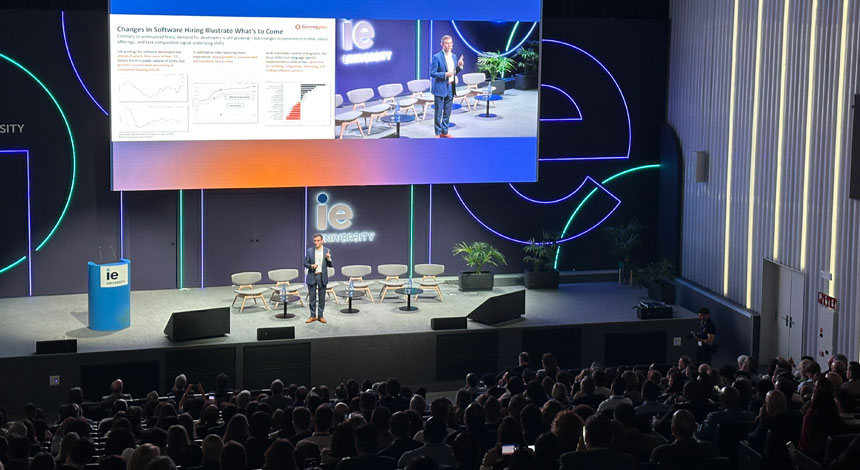
 The Building Skills for Tomorrow’s Jobs” conference landed on a forceful message: the challenge of the AI era is skills, not jobs. The data show little evidence of mass employment displacement, but dramatic changes in what happens inside jobs.