IBL News

    • About IBL News
    • Contact Us
    • cronicas-iframe-ibl
    • Do you want to advertise, write for IBLNews.org or share a story?
    • Events: IBL Picks
    • footer – teme footer
    • Home
    • RSS Feeds
    • Terms of Use

Category: Views

  • Coursera Offers Free Certificates on 50+ Courses, While It Announces New Programs and Tools

    Coursera Offers Free Certificates on 50+ Courses, While It Announces New Programs and Tools

    IBL News | New York

    Coursera.org announced yesterday at its virtual Partner’s Conference, that it is offering 50+ free courses, which include access to lectures and quizzes, along with earning certificates at no cost.  The offer will be available through May 31, 2020.

    The courses cover the following areas:

    • Eight courses for high school students: from calculus to guitar for beginners.
    • Four courses for college students: from preparing for an interview to learning data science.
    • Six career development-related courses: from creative problem solving to personal branding.
    • Nine courses for building a cloud-technology career: from machine learning to cloud computing, with six courses from Google Cloud, two from AWS
    • Twelve courses about public health and safety in the age of Covid-19: from the science behind COVID-19 to communicating during global emergencies.
    • Eight courses Mental health and well-being.
    • Six courses in Spanish: from wellness to professional development.


    Also, yesterday, Jeff Maggioncalda, CEO at Coursera, announced the addition of two new degrees to its list of 19 programs, which are the Master of Science in Population and Health Sciences—from the University of Michigan—and Master of Data Analytics Intelligence from the Universidad de los Andes (Uniandes).

    In addition, Maggioncalda unveiled eight MasterTrack Certificates (in topics such as Blockchain Applications, Cybersecurity, AI and Machine Learning, Social Work, Sustainability and Development), along with 100 guided projects to gain job-relevant skills in less than two hours, such as TensorFlow, scikit-learn, and Plotly.


    Regarding technology tools, the educational company issued new product features. These are some of the most relevant:

    • Goal Setting. These goals will be seamlessly synced with Google Calendar and other calendar apps, integrating learning into a daily routine.
    • Smart-Review Material. A machine learning tool that serves targeted review material recommendations based on the specific questions learners miss, providing learners with a structured path to succeed on the next quiz attempt, according to Coursera.
    • Skill Tracking, This data-driven tool tracks learner skill development, sharing updated competency scores as learners takes more assessments. Through a centralized dashboard, learners can monitor their progress toward career-specific skills and see how their competency scores compare to other professionals on the Coursera platform.
    • Live2Coursera. This feature, “scheduled later in 2020”, will enable instructors to integrate Zoom live lectures into a course. Zoom recordings will be added automatically to an instructor’s course as they teach, so they can build a library of content to reuse in future private or open courses.
    • Personalized Homepage. When logged in, learners can resume a course in one click, see personalized recommendations on courses to pursue next, and view the certificates they’ve earned so far.
    • Machine-Assisted Peer Review. This tool enables grading at scale. Learners struggling to get an assignment peer-graded can have their work automatically assessed by a machine learning model trained on previously peer-graded submissions from the course.


    April 22, 2020
  • Google and Apple Will Release in Mid-May a Controversial Tool to Track Down Infected People

    Google and Apple Will Release in Mid-May a Controversial Tool to Track Down Infected People

    Mikel Amigot | IBL News, New York

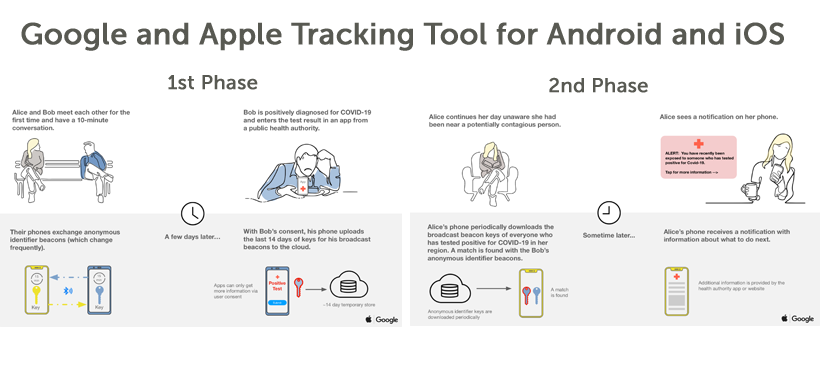
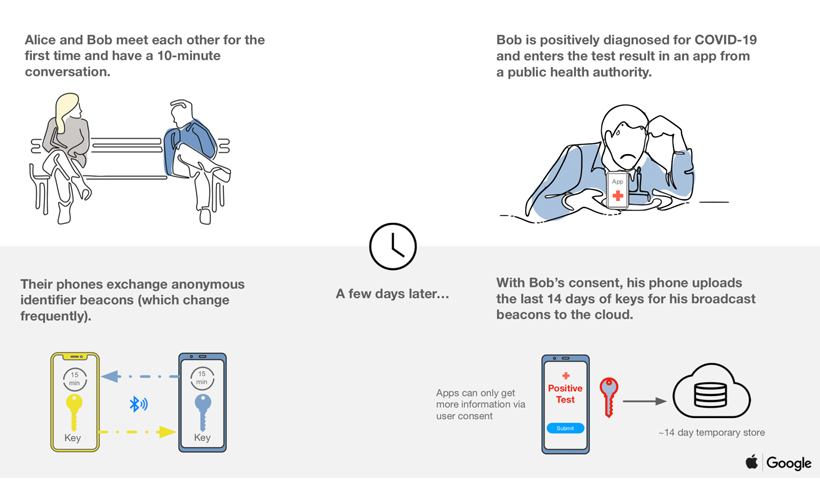
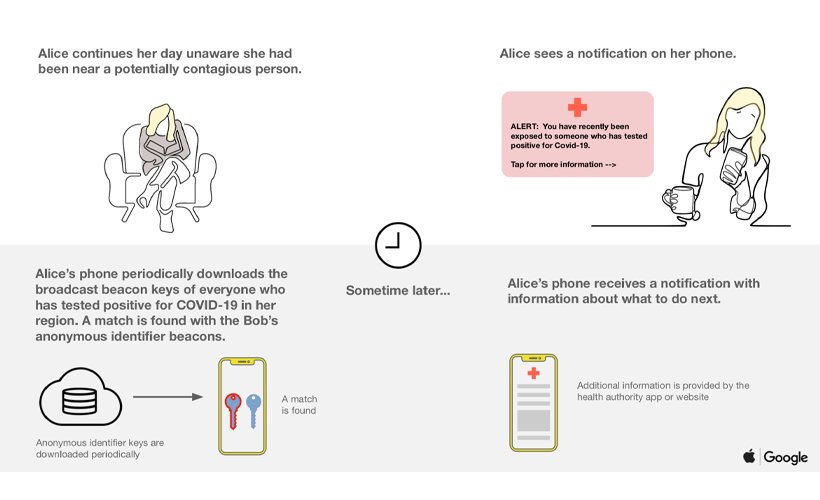
    Google and Apple teamed up to develop a system for tracking the spread of the COVID-19, which will encourage users to share data through Bluetooth and approved apps from public health organizations.

    These apps would exchange anonymous identified data with other participating phones.

    If the user voluntarily reports having tested positive for the virus, the app then alerts those phones’ owners that they may have been exposed.

    Experts explain that tracking is key to testing and self-quarantining yourself to avoid infecting others. But in the U.S. and the Western world, there isn’t a widely-used tracking tool, mostly due to privacy concerns. South Korea and Singapore have used similar COVID-19 tracking apps, although way more privacy-invading. These apps have been key to their success in containing the disease within these two countries.

    Apple’s and Google’s system was announced on Friday and was laid out in a series of documents and white papers.

    To be successful, the system will need to be widely adopted. The user would need to give explicit consent. In addition, tests will need to be available for all potentially infected people –although today there is still a shortage.

    Privacy and civil liberties activists have warned that the apps need to be designed so governments cannot abuse them to track their citizens.

    President Donald Trump called the technology “very interesting,” but expressed concern that “a lot of people worry about it in terms of a person’s freedom. We’re going to take a look at that.”

    Apple and Google said that user privacy and security are baked into the design of their plan.

    This is how the system works, according to Google:

    To help public health officials slow the spread of #COVID19, Google & @Apple are working on a contact tracing approach designed with strong controls and protections for user privacy. @tim_cook and I are committed to working together on these efforts.https://t.co/T0j88YBcFu

    — Sundar Pichai (@sundarpichai) April 10, 2020

    Contact tracing can help slow the spread of COVID-19 and can be done without compromising user privacy. We’re working with @sundarpichai & @Google to help health officials harness Bluetooth technology in a way that also respects transparency & consent. https://t.co/94XlbmaGZV

    — Tim Cook (@tim_cook) April 10, 2020

    • The Verge: Apple and Google are building a coronavirus tracking system into iOS and Android

    • AP: Apple, Google to harness phones for virus infection tracking

    April 13, 2020
  • LabXchange, Harvard’s Science Platform, Provides a Free Tool to Create Online Classes and Pathways

    LabXchange, Harvard’s Science Platform, Provides a Free Tool to Create Online Classes and Pathways

    IBL News | New York

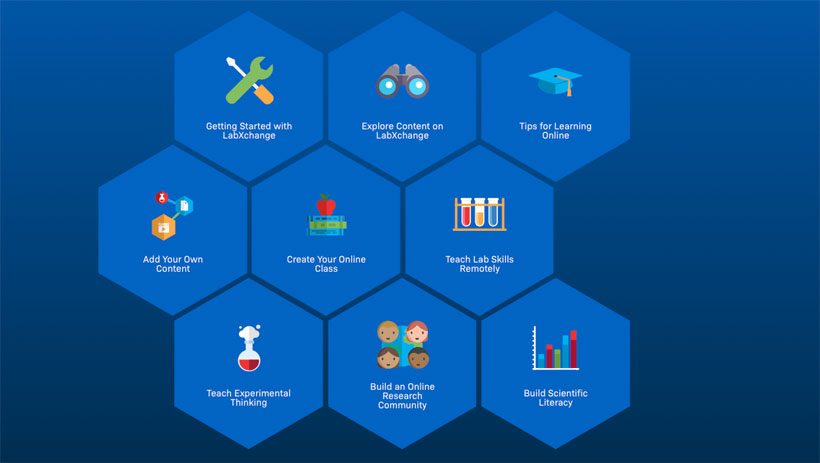
    LabXchange.org, the Open edX-based platform created by Harvard University and Amgen Foundation, is providing a free tool for educators to create online and hybrid classes and pathways with science content.

    The platform lets instructors select vetted content from Harvard, OpenStax, Khan Academy and other sources, remix it with private materials, build collaboration and share ideas with a small group of learners –with a maximum of 100 users.

    “Due to economic and geographic limitations, millions of students worldwide lack opportunities to engage meaningfully in the scientific process, which has led to significant gaps in scientific literacy and in diversity across scientific fields,” explained Robert Lue, Director at the platform.

    LabXchange is essentially designed to support educators in creating customized learning experiences. The content-type offered on the LabXchange library includes video, text, image, simulation, assignment, pathway, narrative, assessment, and cluster. Some animations allow learners to learn by doing in the digital space.

    Subject areas include Biological Sciences, Chemistry, Science & Society, Physics, Health Science, Global Health, Prepare For Careers, Prepare For College, Scientific Process, Online Learning, Professional Development, and Prepare for Graduate School.

    An interesting pathway content available at the LabXchange platform is “Coronavirus: From Bats to Humans to Pandemic”.

    Soon, teachers will be able to track students’ progress and individually contact learners.

    LabXchange is here to support you with moving your science classes online. Our newest resource, Remote Learning with LabXchange, is a collection of guides, tutorials, and demos for a variety of teaching and learning needs. Always open, and always free. https://t.co/ifYRoBXhR7 pic.twitter.com/ARUZ9oUyXf

    — LabXchange (@LabXchange) March 14, 2020

    This video below explains the main features:


    These two tutorials recently posted, shows how to create a class and a pathway at LabXchange.


    • More stories about LabXchange at IBL News

    April 6, 2020
  • Princeton, Berkeley, and Rice Switch to Remote Classes to Head Off the Spread of the Virus

    Princeton, Berkeley, and Rice Switch to Remote Classes to Head Off the Spread of the Virus

    Mikel Amigot, IBL News | New York

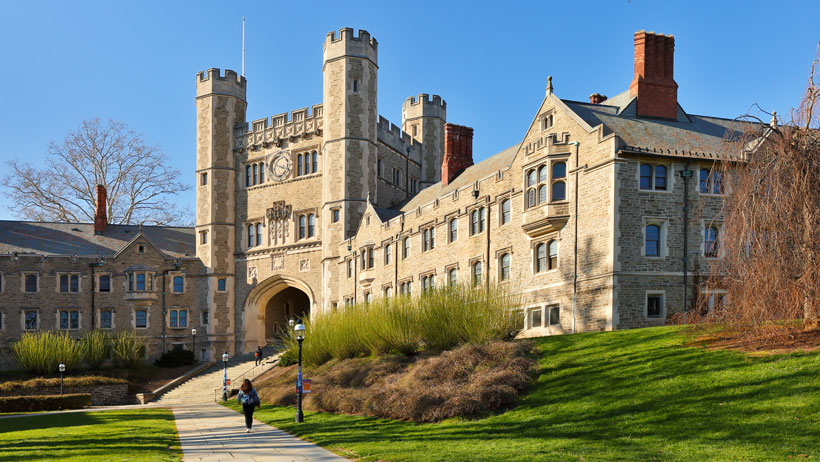
    Princeton, Berkeley, Rice, Fordham, Yeshiva, Hofstra, and Sacred Heart universities joined Columbia and Barnard College this Monday on the announcement that they were suspending in-person classes and teaching remotely, in order to head off the spread of the coronavirus.

    The city of Scarsdale in New York also announced it was closing its public schools for the week after a teacher tested positive for the virus.

    Last week, the universities of Washington, Seattle, and Stanford shifted entirely to virtual courses.

    With New York under a declared state of emergency and with over 100 people testing positive, Yeshiva University in Manhattan and Hofstra University in Long Island communicated that classes were canceled for the week.

    A student and two faculty members at Yeshiva tested positive for the virus last week, and Hofstra said that a student had started showing symptoms after attending a conference; that test result is pending. Columbia said a university community member was quarantined for exposure to the new coronavirus.

    Meanwhile, Princeton University said in a statement that new policies would be in place through Sunday, April 5.

    “While much remains unknown about COVID-19’s epidemiology and impact, our medical advisers tell us that we should proceed on the assumption that the virus will spread more broadly and eventually reach our campus,” wrote Chris Eisgruber, President of Princeton University.

    In Houston, Rice University canceled in-person classes for the rest of the week after staff member tested positive for the virus. It also banned meetings of more than 100 people until May.

    The University of California, Berkeley, became the fourth major U.S. university to suspend classes for an extended period of time due to concerns over COVID-19.

    Chancellor Carol Christ said in a message that the school will move all lecture courses and seminars to Zoom and other online tools starting today Tuesday and through spring break, which ends March 29. Courses that have to meet in person—such as labs, performing arts and physical education classes—will continue to meet as scheduled.

    Also yesterday, the American Council on Education called off its annual conference, originally scheduled for March 14 to 16 in San Diego, Calif0rnia.

    The coronavirus outbreak that originated in Wuhan, Chine, has killed so far over 4,000 people and infected more than 114,000. At least 875 people have died outside mainland China. The United States has reported over 700 cases and 26 deaths: 22 in Washington state, two in Florida, and two in California.

    The World Health Organization considers the outbreak an international public health emergency.


    • Johns Hopkins University’s dashboard tracking the disease in real-time

     

    March 10, 2020
  • Columbia University Cancels Classes After a School Member Is Put Under Quarantine

    Columbia University Cancels Classes After a School Member Is Put Under Quarantine

    IBL News | New York

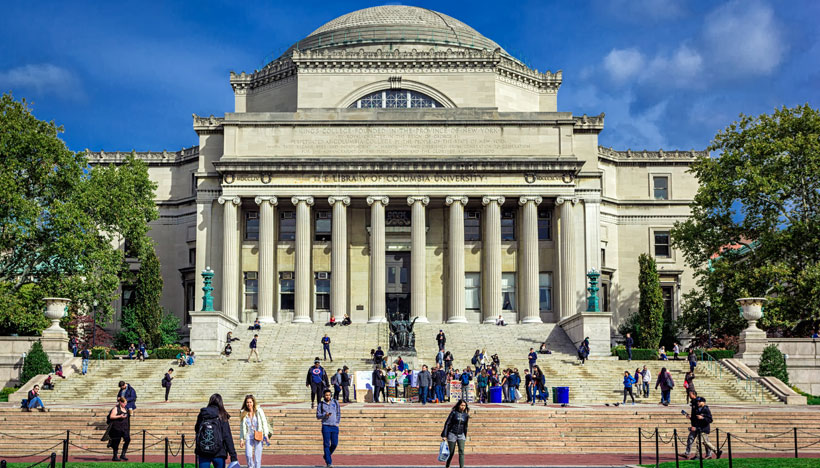
    Columbia University in New York announced yesterday all classes had been canceled Monday 9 and Tuesday 10 after a school member was exposed to the Coronavirus and is now under quarantine.

    “From Wednesday until the start of Spring Break on Friday, classes will be taught remotely,” said president Lee C. Bollinger in a message sent to the university community.

    “We do not have a confirmed case of the virus on campus. This action is intended to prevent the virus from spreading,” Bollinger explained.

    The closure came as the city’s mayor Bill de Blasio announced the 13th confirmed case in NYC and more than 105 people tested positive statewide.

    Governor Andrew Cuomo declared a state of emergency on Saturday.

    Columbia University’s decision followed a similar decision made by a number of schools—most notably Stanford, University of Washington and Seattle University—to cancel in-person classes.

    Resource:
    • Columbia Spectator: Columbia temporarily cancels class, quarantines affiliate after exposure to COVID-19

    Universities Adopt Emergency Plans

    In this context, universities have activated serious measures against the Coronavirus at their campuses. Many of them created specific planning teams to fight the spread of the disease, following the CDC’s and local health agencies’ recommendations.

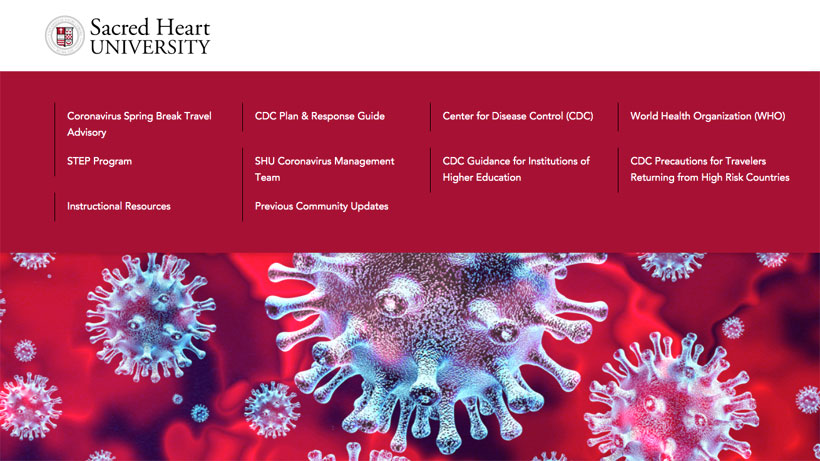
    School officials sent emails and messages to their communities this weekend. For example, Sacred Heart University (SHU) in Connecticut set a pattern of precautions, along with a thematic website, that could inspire other institutions.

    This message was sent to the SHU community this Sunday:

    “Dear students, faculty, and staff,

    Welcome back from break. In today’s update, we want to tell you about the precautions we have taken—and will continue to take—to protect the University community from the coronavirus. These are precautions recommended by the CDC and local health agencies:

    • Bathrooms in all University housing have been disinfected in anticipation of students’ return
    • Touchpoints (doorknobs, faucets, flushers, etc.) will be disinfected daily with more frequent cleaning and sanitizing of public/common restrooms
    • Extra attention is also being paid to athletic areas because of the high traffic flow
      • Gym equipment is disinfected daily and wiped down with Clorox wipes
      • Hand soap is available in all restrooms and hand sanitizer can be found throughout the gym area
      • Clorox disinfecting wipes are also available throughout the gym area. These kill 99.9% of all bacteria in 10 seconds
    • In addition, extra protocols will be in place in dining halls
      • Food services personnel will go above and beyond in following CDC hygiene guidelines Hand sanitizers will be available to workers at all food preparation sites
      • Touchpoints (doorknobs, horizontal services, tables & chairs, condiment dispensers, drink dispensers, etc.) will be cleaned often
      • In addition to other locations on campus, portable sanitizer stations will available for students, faculty, and staff in the dining halls
      • We ask that you practice good food hygiene—don’t touch food with your hands (a piece of fruit, for example) and then put it back
    • The cleaning staff is available 24/7 to respond to any emergencies anywhere. Monday through Friday from 7 a.m. to 4 p.m., call 203-371-7870. Nights and weekend, students should report issues to their RHD to submit an off-hours MOP request

    We are also asking that all students and employees do their part by following the hygiene guidelines set forth by the CDC:

    • Avoid close contact with people who are sick
    • Avoid touching your eyes, nose, and mouth
    • Stay home when you are sick
    • Cover your cough or sneeze with a tissue, then throw the tissue in the trash
    • Clean and disinfect frequently touched objects and surfaces using a regular household cleaning spray or wipes

    We are in regular contact with our cleaning contractors and food services staff to ensure that CDC guidelines are being followed in all areas of the University.

    More information can be found on the coronavirus page on the SHU website. In particular, you may want to check out the Frequently Asked Questions (FAQs) on that page.

    We want you all to have a great finish to the spring semester, while at the same time taking the necessary precautions to keep us all healthy and safe.”


    Beyond these measures, several media outlets paid attention to the pressing questions around the virus. This New York Times’ article was one of the most remarkable.


    March 9, 2020
  • Time to Cancel Your Ed Conference? Facebook Pulls Out of Its Biggest Event; Microsoft Follows

    Time to Cancel Your Ed Conference? Facebook Pulls Out of Its Biggest Event; Microsoft Follows

    IBL News | New York

    The Covid-19 coronavirus is prompting major tech conferences around the world to pull out of their events.

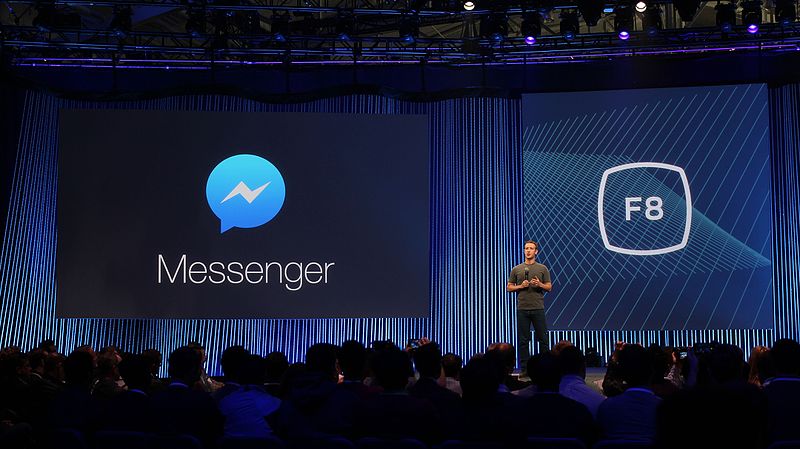
    Yesterday, Facebook announced the cancelation of its biggest event of the year, the F8 conference, over coronavirus-outbreak concerns and “in order to prioritize the health and safety of our developer partners, employees and everyone who helps put the event on,”  said the company in a statement.

    The conference, scheduled to be held in San Jose, California, on May 5th to 6th with an attendance of 5,000 people, will be replaced by “a combo of locally hosted events, videos, and live-streamed content,” Facebook said without providing further details.

    The cancellation highlights how the Covid-19 or coronavirus –which has infected so far over 81,000 people and killed more than 2,700, mostly in China– is causing widespread disruption.

    In the case of Facebook, the company recently pulled out of the March 9 Global Marketing Summit on March 9th, a 5,000-person marketing conference held in San Francisco. In addition, the company said its supply chain for hardware has been disrupted and its employees have been told not to travel to China. Meanwhile, employees who have visited China are being asked to work from home, according to Bloomberg.

    Facebook’s announcement followed other high-profile cancellations, including Microsoft and Unity, which pulled out of the Game Developers Conference scheduled for March 16th to 17th in San Francisco.

    In addition, Workday on Wednesday announced the cancellation of its March 2 sales conference. Two weeks ago, the Mobile World Congress, the largest trade show for mobile phones, was canceled in Barcelona, as well.

    San Francisco in State of Emergency

    The San Francisco Bay Area has some of the highest travel rates to and from China when compared to other regions in the US. On Tuesday, the mayor of San Francisco declared the city to be in a state of emergency, although there are still zero confirmed cases of the novel coronavirus in the city.

    The question now is whether other major conferences on tech and education as well will do the same. Google and Apple are also scheduled to have major conferences in the San Francisco Bay Area in May and June, respectively. For now, Google has confirmed that it is currently planning to host its I/O conference on May 12 to 14 in Mountain View.

    SXSWEdu

    South by Southwest  (SXSWEdu), the largest upcoming edtech conference, that attracts over 30,000 people, said it plans to continue with the event on March 13 to 22, although it recognizes having “a handful of cancellations.”

    February 28, 2020
  • Instructure’s CEO Steps Down and the Board Approves a Tender Offer to Acquire All Outstanding Shares

    Instructure’s CEO Steps Down and the Board Approves a Tender Offer to Acquire All Outstanding Shares

    Mikel Amigot | IBL News, New York

    Instructure (NYSE: INST) announced yesterday that Dan Goldsmith will be stepping down as CEO and as a member of the Board of Directors within two weeks. Goldsmith will remain with the company until March 6 “to help with the transition”, while a new replacement is sought through an executive search firm.

    Dan Goldsmith will receive a “golden parachute compensation” of over $12 million, sources exclusively told IBL News.

    This manager [in the picture, above] joined Instructure as president in June 2018 and became CEO in January 2019.

    The reason why he abruptly resigned or was removed was not officially disclosed, although investment banks speculated that the move increased the likelihood of the transaction getting completed. Apparently, Thoma Bravo’s offer of $49 per share was not sufficient to convince opposing investors.

    Also, yesterday, Instructure’s Board approved Thoma Bravo’s revised proposal based on buying the company at $49 per share in cash through a “tender offer” designed to acquire all outstanding shares of common stock directly from stockholders.

    “We encourage all stockholders to tender their shares in support of the transaction,” said Josh Coates, Executive Chairman of the Instructure Board of Directors.

    Pursuant to the revised agreement, Instructure finally announced that it will no longer hold the vote on the special meeting with stockholders, scheduled for February 25, 2020.


    • IBL News’ Coverage of the Instructure Sale to Equity Firm Thoma Bravo


    February 19, 2020
  • Coursera Introduces an Annual Subscription Plan for Learners Similar to Its Business and Campus Offering

    Coursera Introduces an Annual Subscription Plan for Learners Similar to Its Business and Campus Offering

    IBL News | New York

    This week, Coursera started to pilot a new annual subscription program for individual learners at $399 per year. This offering, called Coursera Plus, resembles the existing subscription plans of Coursera for Business and Coursera for Campus – although these ones include analytics and other integration services.

    Coursera’s plan follows the trend towards the subscription pricing model, increasingly executed among MOOC platforms and initiatives at scale such as Pluralsight or A Cloud Guru.

    Essentially, Coursera Plus allows to access 90% of the courses, Specializations and Professional Certificates on its catalog – over 3,000 classes. There is no limit to the courses that the learner can enroll in or the certificates that can be earned, as long as those petitions fall into that program.

    However, some popular courses, such as those of co-founder and AI-guru Andrew Ng e.g. “Machine Learning”, or professional certificate courses from IBM, AWS, and Stanford University, are not available.

    The Coursera organization lets its partners decide whether or not to make their content part of the Plus initiative.

    In addition, existing subscriptions to Coursera specializations will not be automatically canceled. Users must cancel their existing subscriptions to avoid being charged for both Coursera Plus and single Specialization subscriptions.

    Anubhav Chopra, Lead Product Manager at the educational company, explained in a promotional blog post: “Coursera Plus is one of many enrollment options available on Coursera including the ability to audit a course, take a course for free, apply for financial aid, or pay for a course, Specialization, or Professional Certificate individually.”

    Coursera encouraged students to explore the following examples:

    • Programming for Everybody (Getting Started with Python) (University of Michigan)
    • The Science of Well-Being (Yale)
    • Learning How to Learn (McMaster University, UC San Diego)
    • Algorithms, Part I (Princeton)
    • Data Science Specialization (Johns Hopkins University)
    • Improve Your English Communication Skills Specialization (Georgia Institute of Technology)
    • Google IT Support Professional Certificate (Google)
    February 16, 2020
  • The World’s Largest Smartphone Conference Canceled Due to Coronavirus Concerns

    The World’s Largest Smartphone Conference Canceled Due to Coronavirus Concerns

    IBL News | Barcelona, Spain

    The world’s largest smartphone technology annual conference, the Mobile World Congress in Barcelona, Spain, was canceled yesterday over worries about the Coronavirus outbreak from China. It was another demonstration of the ripple effect the virus is having on businesses globally.

    GSMA, the conference organizer announced that was pulling the plug. The decision was taken after almost all of the big-name corporate participants – from Nvidia and Intel to Amazon and Facebook – backed out amid fear about the safety of their employees.

    “The global concern regarding the coronavirus outbreak, travel concern and other circumstances make it impossible for the GSMA to hold the event,” the group’s CEO, John Hoffman, said in a statement.

    The event, scheduled to kick off on Feb. 24, typically attracts more than 100,000 attendees each year, generating over $600 million in revenues. Since the first edition in Barcelona in 2006, the GSMA convened the industry, governments, ministers, policymakers, operators and industry leaders who attend the show to check out the latest in smartphone technology.

    According to local media reports, the GSMA was heavily pressuring Catalonian officials to declare a health emergency. That would have allowed the GSMA to cancel the event and collect on insurance to cover its losses. However, the government declined, saying there was no reason to make such a declaration. The GSMA still decided to cancel, so it’s probably taking a serious financial hit.

    Trade Shows, Events, and Flights Affected by the Outbreak

    Other trade fairs and business events have also been affected by the spread of the Coronavirus. More than two dozen large industry conferences in Asia have been postponed, shuttering events where billions of dollars worth of deals have been signed-in the past.

    Coronavirus’ death toll surpassed 1,100 on Wednesday, and more than 45,000 cases have been reported globally, most of them contained to mainland China.

    Companies continue to watch and wait to see how long the outbreak lasts and affects China’s economy, with thousands of factories and shops closed.

    The United States Parcel Service suspended shipments to China and Hong Kong, as major airlines have suspended flights to the region.

    The outbreak also raised fears for the global economy overall, with Boeing saying yesterday that the virus was a drag on its first-quarter deliveries.

    “The immediate and most significant economic impact is in China but will reverberate globally, given the importance of China in global growth as well as in global company revenue,” said Jessica Gladstone, an associate director at Moody’s.


    February 13, 2020
  • Has 2U Turned the Corner? Quarterly Reports Show Improved Revenue and the Stock Surges 11%

    Has 2U Turned the Corner? Quarterly Reports Show Improved Revenue and the Stock Surges 11%

    IBL News | New York

    The 2U (NASDAQ: TWOU) stock saw this Friday a surge of 11.39% to $25.33 per share, as the investors were surprised with the educational company quarterly reports, which registered a loss of $0.18 per share versus the Zacks Consensus Estimate of a loss of $0.22.

    2U posted revenues of $163.18 million for the quarter ended December 2019, surpassing the year-ago revenues of $115.10 million. The company expects to generate sales between $170 million and $180 million in the current quarter and between $725 million and $750 million for the full year 2020; consensus expectations are for $172.45 million and $729 million, respectively.

    So far, 2U has underperformed the market, with the shares losing 8.8% since the beginning of the year versus the S&P 500’s gain of 3.2%.

    In the last year, shares have lost more than half their value. They were hit by an August announcement that the company was lowering its near-term growth expectations prompted investors to question whether 2U was a long-term growth stock.

    Ahead of this earnings release, the estimate revisions trend for the 2U stock price is mixed. In its forecast for 2020, the education company said it expects full-year adjusted EBITDA to range from a loss of $5 million to a gain of $10 million.

    During the Q4 Earnings Call [Transcript here], Christopher “Chip” Paucek, Co-Founder and CEO at 2U, was bullish.

    “2U is starting 2020 with tremendous momentum. We had a strong finish in 2019 and we are excited to see what’s happening. Universities are launching more with us. Our degree business is turning the corner. Our short course business is sliding new courses and enrolling students in record numbers and our boot camp business is starting to deliver on the strategic value of our acquisition. As we move through 2020, we will improve our operational efficiency with continued realignment and short corporate hygiene.”

    “Looking to the future, university demand for our full investment revenue share model is strong and we are managing our launch cadence to optimize growth, cash flow and profitability. Add all this up and we are expecting double-digit revenue growth and increasing segment profitability in 2020,” added the CEO.

    2U launched 15 new degree programs in the quarter, claiming that it achieved an 82% student retention rate in the segment.

    “In conclusion, 2019 was challenging. But last year we took actions to deliver long-term value for all of our stakeholders. Our grad business is turning for the better. We added a product line that opens a significant new segment of the market. We more than doubled our client base and currently have a portfolio of over 400 product offering. We delivered strong second half results and we believe we turned the corner going into 2020. 2U expects to maintain industry-leading growth, while delivering margin improvement over the course of 2020 and driving toward positive free cash flow, all with a relentless focus on quality and outcomes,” said Christopher “Chip” Paucek.

    Regarding the sale rumors spread by activist investors, 2U’s management declined to comment.


    February 8, 2020
←Previous Page
1 … 21 22 23 24 25 … 31
Next Page→

IBL News

Global Education, Innovation and Technology: Insights + Breaking News

  • Blog
  • About
  • FAQs
  • Authors
  • Events
  • Shop
  • Patterns
  • Themes

Twenty Twenty-Five

Designed with WordPress