Category: Views

  • Coursera for Campus Is Not an Alternative LMS to Blackboard, Canvas and Moodle, Says Maggioncalda

    Coursera for Campus Is Not an Alternative LMS to Blackboard, Canvas and Moodle, Says Maggioncalda

    Mikel Amigot | IBL News


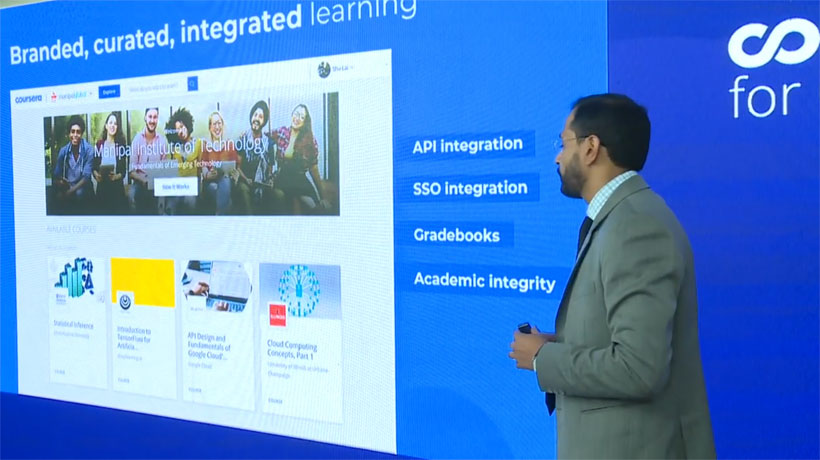
    “Coursera for Campus is not a full-featured LMS,”
    said Jeff Maggioncalda, CEO of Coursera, during the announcement event in India, on October 3rd. “We expect many universities to stay on their LMSs.”  

    According to the company, Coursera for Campus’ LMS is designed to supplement the existing Canvas, Blackboard and Moodle systems.

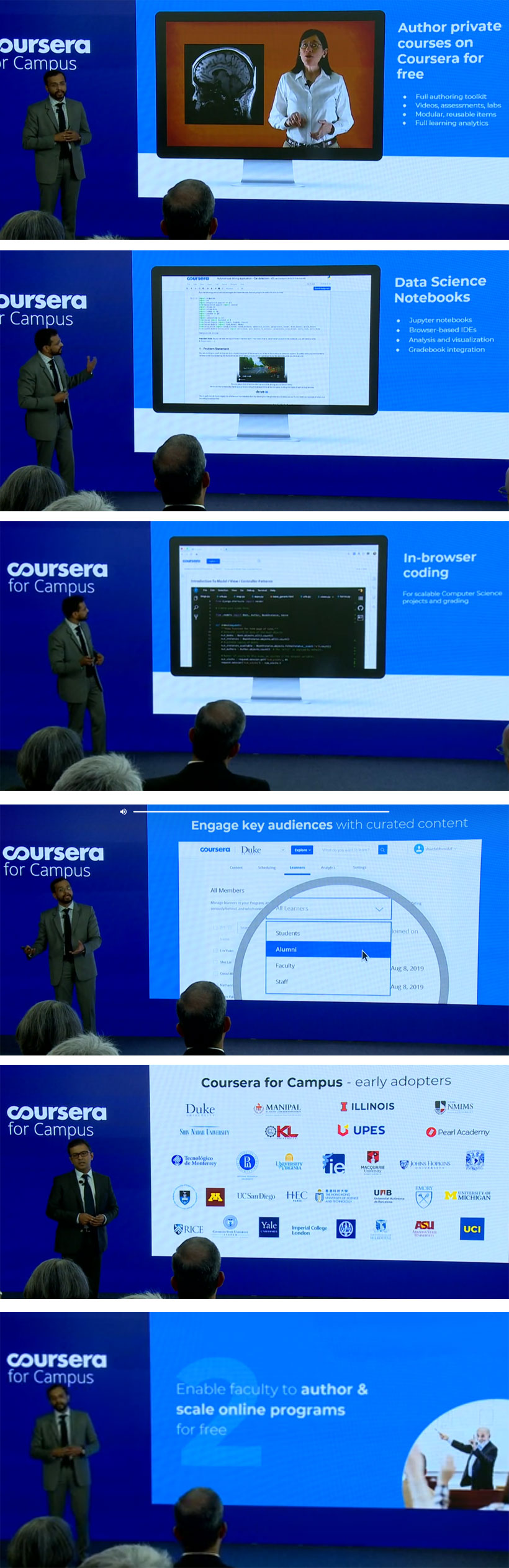
    Its main utility refers to authoring content for private audiences such as residential students, alumni, faculty members, and staff.

    The SSO (Single Sign-On) and APIs are apparently intended to facilitate further integrations. The collection of distinctive features include analytics, live-hands on labs, in-browser coding, plagiarism detection, Jupyter Notebooks and gradebook integration.

    Jeff Maggioncalda insisted on the message of collaboration and not being an alternative LMS.

    So far 20 partner universities, including Duke and Illinois, have piloted Coursera for Campus, and 10 additional universities are using an early version of it.

    Last week, when Coursera for Business was advertised, representatives of the company highlighted that this new LMS was designed to deliver online courses and interactive lessons better than most LMSs.

    “We’re talking about a potential major disruption to the LMS market,” Leah Belsky, Coursera’s Vice President of Enterprise said on EdSurge. “We don’t have all the features of an LMS but what we do have is all the tools to create cutting-edge interactive learning experiences.”

    Michael Feldstein, a known consultant and author at the eLiterate blog, doubted that universities will replace their learning management systems with Coursera’s. “MOOC platforms are interesting and have some innovative features, but they are neither mature for their original purpose nor tuned for the broad range of usage that a campus LMS must serve,” Michael Feldstein wrote.

    The edX Consortium had always offered to its affiliated members a private, yet unbranded, authoring platform called Edge.

    Michael Feldstein’s Blog Post: The MOOC-Courseware Convergence


  • The Power of Data and Analytics Can Save Higher Education, Says Educause, AIR and NACUBO

    The Power of Data and Analytics Can Save Higher Education, Says Educause, AIR and NACUBO

    IBL News | New York

    Analytics can solve some of higher education’s biggest problems.

    To reaffirm this idea, and given that progress has faltered, three important associations joined forces and made a collective call-to-action for colleges and universities.

    Data and analytics are institutional strategic asset; using analytics to make better decisions will result in improved student recruiting, student outcomes and completion rates, cost management and campus operations, according to these organizations.

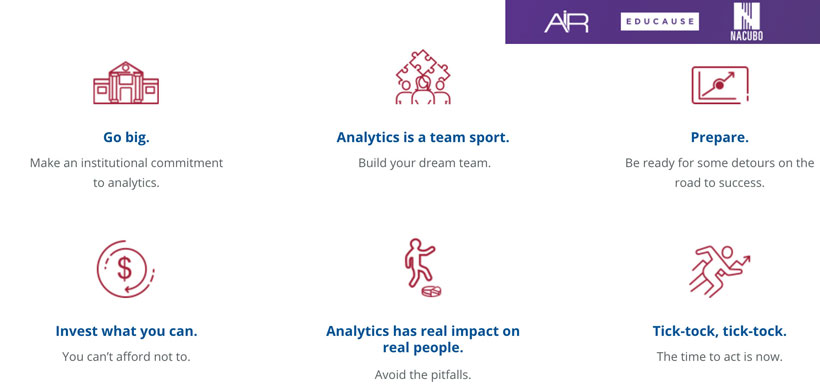
    Educause, the Association for Institutional Research (AIR), and the National Association of College and University Business Officers (NACUBO) – who collectively serve 2,500 institutions and represent over 80% of post-secondary students in the U.S. – released a statement last month recommending six guiding principles:

    • Go big—make an institutional commitment to analytics.
    • Analytics is a team sport—build your dream team.
    • Prepare for some detours on the road to success.
    • Invest what you can—you can’t afford not to.
    • Analytics has a real impact on real people—avoid the pitfalls.
    • Tick-tock, tick-tock—the time to act is now.

    “For a while now, our progress on institution-wide analytics initiatives has not hit its stride,” said John O’Brien, President and CEO of EDUCAUSE. “We hope this statement encourages a sense of urgency and fosters a deeper understanding of the benefits of data analytics for institutions of all kinds.”

    The associations created a website to further support colleges and universities in their implementation processes.


  • A Conference to Find Viable Business Models to Commercialize Open Source Software

    A Conference to Find Viable Business Models to Commercialize Open Source Software

    Mikel Amigot  | San Francisco


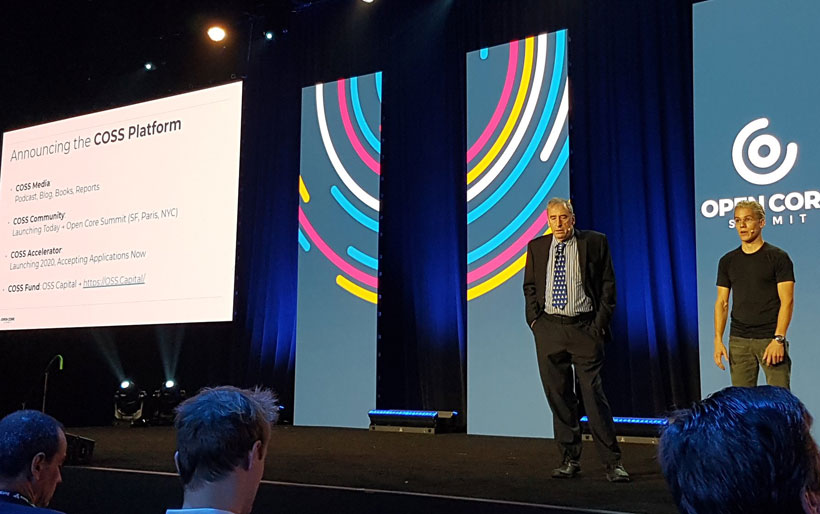
    Organizers of the Open Core Summit – which took part this month at the Palace of Fine Arts in San Francisco – announced the COSS (Commercial Open-Source Software) Platform.

    The goal of this initiative is to help commercial open-source organizations develop viable business models. “We want to educate, grow, fund and connect leaders of COSS companies,” as explained to IBL News by Joseph Jacks, founder of OSS Capital, a venture-capital firm who put together the Open Core Summit.

    Today open-source licenses like Apache 2.0 have no requirements to compensate those who craft software. Consequently, many software companies have been struggling for years.

    To solve it, open-source code cobblers such as Elastic, Confluent, InfluxData, MongoDB, Neo4J, and Redis Labs, among many others, are experimenting with improved business models and alternative software licenses.

    Commercial open-source software is often developed as a substitute for costly proprietary software.

    “In addition, COSS companies are fundamentally more capital efficient at running on and innovating with far less capital,” OSS Capital Founding Portfolio Partner Heather Meeker recently wrote.

    Despite the ups and downs, open-source has become a standard for software development and fast-paced innovation. Its collaboration and knowledge sharing model has transformed software’s development and delivery over the last two decades.

    Open-source is getting increasingly popular, with 30 million developers exchanging code and ideas and collaborating on GitHub.

    From the business perspective, companies like Red Hat and Canonical are proof that an open-source model can turn a profit. Other examples of companies which follow the model of “commercial support” include Docker, GitLab, and Databricks.

    In this new environment, the open-source services industry is set to exceed $17B in 2019, and expected to reach $33B by 2011, according to CB Insights.

    An indication of the growth can be found on Canonical/Ubuntu‘s plans to march into an IPO and recent acquisitions (Red Hat by IBM for $34B, and GitHub by Microsoft for $7.5B), alongside large public market valuations like those of MongoDB ($7.9B) and Elastic ($7.3B).

  • Learners at Coursera, Canvas and Blackboard Will Be Able to Ask Alexa for Course Updates

    Learners at Coursera, Canvas and Blackboard Will Be Able to Ask Alexa for Course Updates

    IBL News | New York

    “Alexa, when is my next assignment due?”

    Coursera will introduce a new tool for Alexa in October, taking advantage of the new API, Alexa Education Skills, created by Amazon for any edtech company.

    Along with the MOOC portal, CanvasLMS, Blackboard, Kickboard and ParentSquare plan to activate this feature soon.

    By simply asking Alexa, learners will get updates based on the latest information on their student account.

    Voice assistants, like Alexa and Siri, are being rapidly adopted.

    Available to all learners with a Coursera account and Amazon Alexa-enabled device, this tool will help learners access course assignment and quiz scores, due dates, and progress updates, among other pieces of information.

    “Recognizing this trend, we introduced a new tool that helps learners fit education into their daily lives, we’ve taken another exciting step toward our mission of providing transformational learning experiences to anyone, anywhere,” Alex Sanchez, Product Management, Mobile Experiences, and Emerging Technology at Coursera, wrote in a blog post.

    The Alexa Education Skill API integrates with Learning Management Systems (LMS), Student Information Systems (SIS), Classroom Management providers, and massively open online course (MOOC) platforms.

    The new API will be available in preview by invitation only for the following interfaces:

    • Alexa.Education.Profile.Student
    • Alexa.Education.Course
    • Alexa.Education.Coursework
    • Alexa.Education.School.Communication
    • Alexa.Education.Grade.Course (coming soon)
    • Alexa.Education.Grade.Coursework (coming soon)


  • Automattic, the Company Behind WordPress, Valued at $3 Billion After Its Last Funding

    Automattic, the Company Behind WordPress, Valued at $3 Billion After Its Last Funding

    Mikel Amigot | IBL News

    Automattic, the company behind WordPress.com, WooCommerce, the Jetpack plugin and soon Tumblr, announced on Thursday that it closed a 
    $300 million funding round in Series D from Salesforce Ventures. The investment puts Automattic’s valuation at $3 billion post-funding.

    Today WordPress powers more than 34% of all sites on the web, claims Automattic CEO and WordPress co-founder Matt Mullenweg [in the picture].

    The company will have close to 1,200 employees when the Tumblr acquisition closes. In August, Automattic purchased Tumblr from Verizon for $3 million, a fraction of what it was worth when Yahoo bought it for $1.1 billion in 2013. Tumblr is seen as complementary to WordPress.com; therefore, no major changes are planned.

    The freemium business model with an open-source philosophy at its core has been working very well for Automattic Inc.

    WordPress, as a free open-source software platform, is owned by a non-profit group called The WordPress Foundation, while the popular domain WordPress.com is privately held.

    Automattic makes most of its money by selling subscriptions to software services related to the WordPress platform, like WooCommerce, an open-source e-commerce plugin for WordPress; Jetpack, a customization and security plugin for WordPress; and enterprise WordPress for businesses, such as WordPress.com VIP. It also gets revenues by selling advertising against some of the free blogs that users create on WordPress.com.

  • 2U Will Release More Data As The OPM Industry Will Face Growing Scrutiny

    2U Will Release More Data As The OPM Industry Will Face Growing Scrutiny

    Mikel Amigot | New York

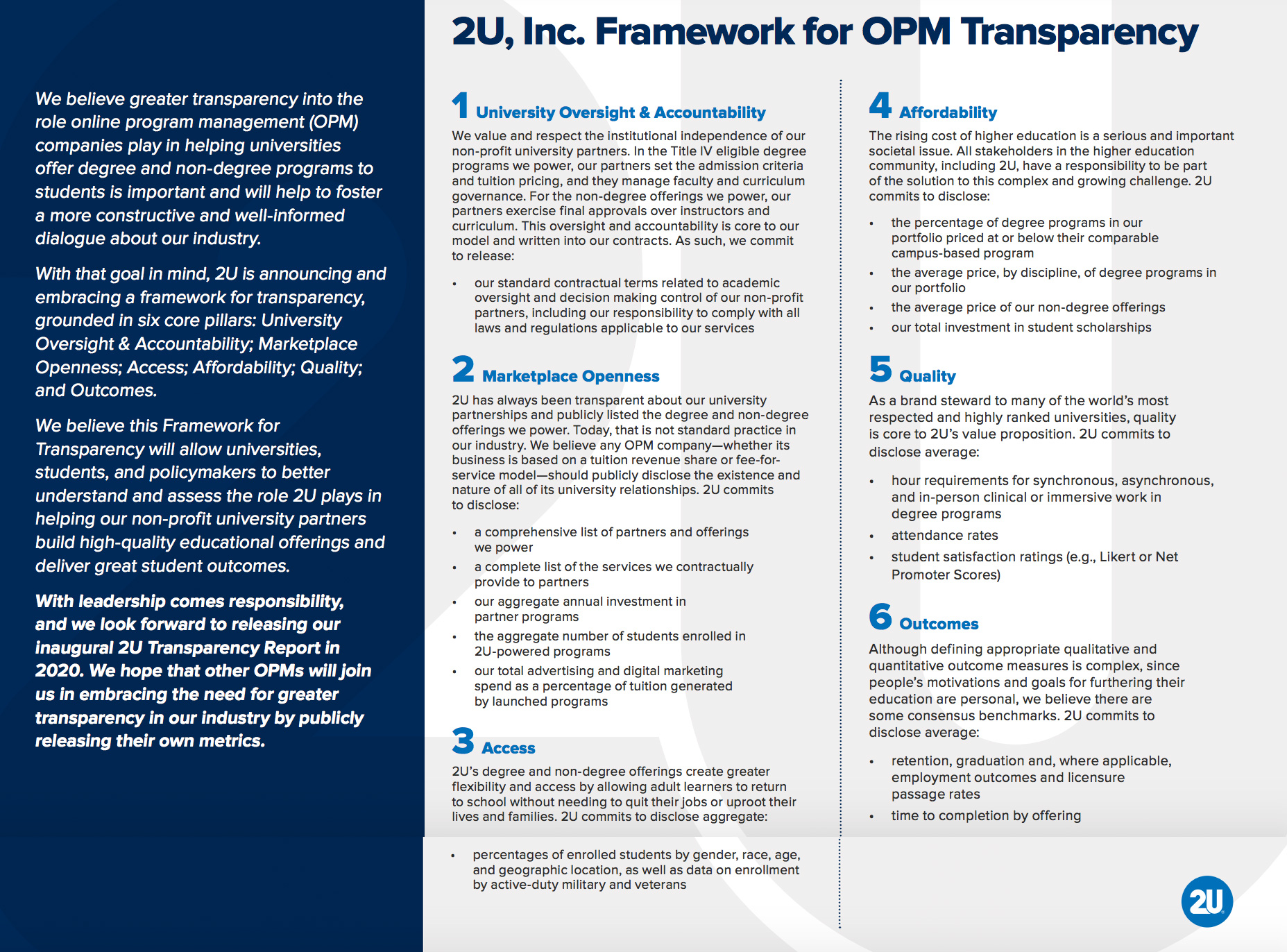
    2U, the most visible company in the OPM (Online Program Management) industry, announced on September 11 what it called “an unprecedented new Framework for Transparency”, which “will offer students, universities, and policymakers data on outcomes, quality, institutional independence, and more for the degree and non-degree offerings.”

    “2U becomes the first OPM to openly call for, and embrace, greater transparency,” the Lanham, Maryland-based company said in a statement.

    “We call upon other OPMs across the industry to join us in committing to greater transparency,” 2U Co-Founder and CEO Christopher “Chip” Paucek added.

    The new framework is grounded in six pillars: University Oversight & Accountability; Marketplace Openness; Access; Affordability; Quality; and Outcomes.

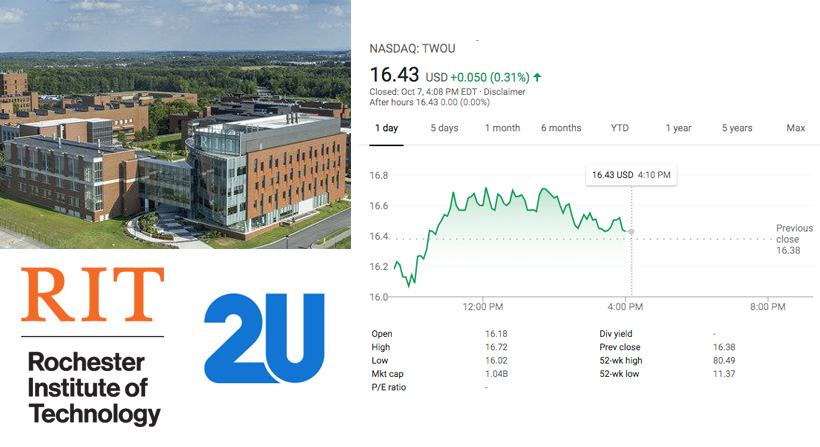
    Facing growing scrutiny, 2U’s move isn’t as big as it looks, given that the company is publicly traded (NASDAQ: TWOU) and needs to recover investors’ confidence after losing over half of its market value in the last seven weeks.

    Secondly, the controversial company needs to self-regulate, getting ahead of potential regulatory changes.

    In addition, it would be an attempt to put pressure on competitors such as Pearson, Wiley, Academic Partnerships, Noodle and Bisk to do the same.

    “Paucek believes that releasing more information about the company and its operations will help prove just how ‘excellent’ it is,” wrote Doug Lederman in Inside Higher Ed.

    A Public Database of Online Program Contracts

    In relation to the OPM industry, the Century Foundation published a report yesterday titled “Dear Colleges: Take Control of Your Online Courses.” It elaborated on the relationships between 79 public colleges and OPM companies and included a database of scores of contracts outlining the terms of the arrangements.

    “Our hope is that this action-focused report will assist schools and those who care about them to jumpstart a paradigm shift in how online education in the United States is done,” the Foundation said.

    EdSurge: Layoffs, Deferred Tuition and More Transparency Among 2U Changes Since Stock Fall
    Education Dive: A look inside public universities’ OPM contracts


  • MIT Top Officials Were Aware of Epstein’s Ties to the Media Lab and Accepted Those Donations, Says Peter Cohen

    MIT Top Officials Were Aware of Epstein’s Ties to the Media Lab and Accepted Those Donations, Says Peter Cohen

    IBL News | New York

    Peter Cohen, a former MIT Media Lab fund-raiser and currently a central figure in the MIT/Epstein unfolding scandal, said on Tuesday that he was following university’s practices on accepting donations.

    Through a written statement to The Boston Globe, Peter Cohen, former MIT Media Lab director of development and strategy and now director of development for computer science at Brown University, said that when he joined the Media Lab in 2014, it already had established procedures for handling Epstein’s contributions (despite the disgraced financier was convicted in 2008 to a 13-month jail term for soliciting sex from a minor.)

    Those policies regarding donations were “authorized by and implemented with the full knowledge of MIT central administration.”

    According to e-mails released by a whistleblower on The New Yorker and The New York Times, Cohen acted as an intermediary between the Media Lab and its former director Joi Ito and MIT’s central administration on donor issues. Cohen also worked with Ito on Epstein-related matters, such as developing a written proposal for funding from Microsoft founder Bill Gates, that Epstein said he could arrange.

    “Notwithstanding my personal discomfort regarding Mr. Epstein and his involvement with MIT, I did not believe I was in a position to change MIT’s policies and practices,” Cohen said in an e-mailed statement. “I did not witness anything I understood to be illegal, and I never solicited gifts from Mr. Epstein.”

    MIT president L. Rafael Reif said on Monday that the university had retained a law firm [Goodwin Procter] to investigate Epstein’s interactions with MIT.  Despite that criminal history, Ito said he wooed Epstein as a donor for the lab when he met him in 2013.

    MIT’s funding practices have attracted media attention in the last months.

    In July The New York Times Magazine published a thorough article about it.

    On Friday, The New Yorker mentioned that corporate donors—called “members”—who pay at least $250,000 a year make up the majority of the Media Lab’s annual budget.

    Yesterday, two columnists wrote on Fortune, “while these institutions project the appearance of being focused on academic pursuits—finding the truth, asking tough questions, pursuing independent lines of exploration, and so on—in reality, they are corporate lap dogs fetching the balls their masters throw.”


  • An MIT Professor Will Temporarily Lead the Media Lab In the Midst of the Crisis

    An MIT Professor Will Temporarily Lead the Media Lab In the Midst of the Crisis

    IBL News | New York

    MIT announced on September 10 that it appointed a transitional executive committee of faculty and senior staff to lead the MIT Media Lab, after the resignation of its director Joi Ito over his financial ties to sex trafficker Jeffrey Epstein.

    Meanwhile, an independent investigation by law firm Goodwin Procter, announced by MIT’s President Rafael Reif on Saturday, is still ongoing. [Update: Email from President Reif to the MIT Community]

    Pattie Maes, professor of media arts and sciences at MIT, will serve as chair of the committee, managing the future lab governance model and search for new director.

    Four more members, along with their areas of responsibility, will be:

    • Deb Roy, professor of media arts and sciences: executive director of operations and communications;
    • Tod Machover, professor and head of the Program in Media Arts and Sciences: community engagement and culture change;
    • Maria Zuber, MIT’s vice president for research: policies, practices, and culture of research; and
    • Ramona Allen, the School of Architecture and Planning’s assistant dean for human resources and, as of Oct. 1, MIT’s vice president of human resources: administrative organization.

    “These have been exceptionally difficult times for the Media Lab, and I want to thank the members of the community for their dedication to the lab and for their commitment to real change,” said Hashim Sarkis, dean of the School of Architecture and Planning.

    A Whistleblower Revealed the Ties of MIT to Epstein

    In an internal meeting at the lab, on September 4, Ito admitted to having taken $525,000 from Epstein for the Media Lab and an additional $1.2 million for his private ventures.

    According to an article at MIT Technology Review, emails provided to the New Yorker and the New York Times by whistleblower Signe Swenson, a former development associate at the Media Lab, showed Ito, along along with Peter Cohen, a former development official at the lab, acknowledging that Epstein’s money needed to remain anonymous.

    The hidden ties with Epstein –who died in jail on August 10– were so widely known at the Media Lab that staff in Ito’s office began to call him “he who must not be named” or “Voldemort,” according to the New Yorker. Questions also remain about how the donations evaded detection by MIT.

    The lack of transparency around the close relationships between academic institutions and an elite network of donors is a constant in the higher education industry, according to observers.

    MIT and Harvard Professors and Thinkers Supported Joi Ito

    Epstein had a reputation for cultivating relationships with scientists. He also funded many scientific projects, including some at MIT and Harvard University. He was linked to deceased MIT professor and AI pioneer Marvin Minsky, who was recently accused of having sex with one of Epstein’s underage victims.

    Now Epstein’s support has become a source of public shame for the Media Lab. Mainly, because documents showed that the MIT Media Lab – an elite group within MIT –, was aware of Epstein’s status as a convicted sex offender. Additionally, Epstein’s directed contributions to the lab far exceeded the amounts M.I.T. has publicly admitted.

    Another angle of the controversy refers to the group of prominent professors and thinkers involved with MIT and Harvard who signed a letter in support of MIT Media Lab director Joi Ito in mid-August. The letter sought to gather support for Ito, who apologized for accepting funds from the now-deceased sexual criminal.

    This list includes as signers Harvard Law professor and Creative Commons founder Lawrence Lessig, Whole Earth Catalog founder Stewart Brand, Media Lab co-founder Nicholas Negroponte, Harvard law professor and EFF board member Jonathan Zittrain, and synthetic biology pioneer George Church. 


  • The MIT Media Lab’s Scandal: Its Director Resigns After Lying Over His Ties to Epstein

    The MIT Media Lab’s Scandal: Its Director Resigns After Lying Over His Ties to Epstein

    IBL News | New York 

    Joi Ito, the director of Media Lab and professor at MIT, resigned Saturday over his ties to convicted pedophile and accused sex trafficker Jeffrey Epstein.

    “After giving the matter a great deal of thought over the past several days and weeks, I think that it is best that I resign as director of the media lab and as a professor and employee of the Institute, effective immediately,” Ito wrote in an internal e-mail.

    In a message to the M.I.T. community, Rafael Reif, the president of M.I.T., wrote, “Because the accusations in the story are extremely serious, they demand an immediate, thorough and independent investigation.” Rafael Reif announced that M.I.T.’s general counsel would engage an outside law firm to oversee that investigation.

    “The acceptance of the Epstein gifts involved a mistake of judgment,” stated Reif.

    According to a New Yorker investigation, the prestigious MIT Media Lab received at least $7.5 million from Jeffrey Epstein and Ito would allegedly ask that the donations were counted as anonymous. “New documents show that the M.I.T. Media Lab was aware of Epstein’s status as a convicted sex offender and that Epstein directed contributions to the lab far exceeding the amounts M.I.T. has publicly admitted,” explained The New Yorker.

    Emails reveal donations cover-up

    Joi Ito [in the picture below] resigned just hours after The New Yorker published emails showing how he had attempted to conceal donations from Epstein.

    The embattled director of the Massachusetts Institute of Technology’s Media Lab had previously apologized for accepting money from Epstein for the lab and for his own personal ventures.

    The newly disclosed emails show he didn’t just make the wrong call in accepting the money, as he explained to lab members as recently as Wednesday: he also ordered that Epstein’s donations be listed as “anonymous” going back years, as Epstein had been disqualified as a donor following his 2008 conviction for soliciting sex from a minor. Epstein was facing additional charges before his death on a prison cell this summer.

    “Top MIT officials knew of Epstein’s ties to Media Lab, e-mails show,” titled yesterday The Boston Globe.

    Professor at Harvard, too

    The New York Times reported that Ito also left the boards of the MacArthur Foundation, the John S. and James L. Knight Foundation and The New York Times Company, as well as a visiting professorship at Harvard University.

    One of Ito’s emails reportedly says that Epstein directed a $2 million gift to the lab from the Bill Gates, but the Gates Foundation has denied any business connection to Epstein.

    Brown University announced that it has placed its director of development for computer science and former MIT Media Lab director of development and strategy, Peter Cohen on administrative leave, The Providence Journal reported.

    Peter Cohen forwarded a request from Epstein to another colleague at MIT with the note: “Jeffrey money needs to be anonymous. Thanks.”

    “Like its parent university, the famed research center became far too comfortable selling its prestige. Even to Jeffrey Epstein,” writes Justin Peters in an article on Slate titled The Moral Rot the MIT Media Lab”.

    “Jeffrey Epstein used MIT to launder his image. It’s a lesson for the #MeToo era,” writes Vox. “Revelations about the sex offender’s connections to the MIT Media Lab are a reminder of the power of enablers.”


  • 2U’s New $24K Online Undergrad Degree: Trend of Publicity Stunt?

    2U’s New $24K Online Undergrad Degree: Trend of Publicity Stunt?

    Mikel Amigot | IBL News

    While investors wonder if 2U (NASDAQ: TWOU), the digital higher ed firm, is still a valuable opportunity, especially after it faces an array of class action lawsuits, Academia dissects the new 2U powered $24K online undergraduate 3-year degree program in data science and business analytics, developed by the University of London.

    The program will be executed in partnership and under a 10-year contractual revenue share model with the University of London and one of its member institutions, the London School of Economics and Political Science (LSE).

    The low price is feasible because almost two-thirds of curriculum is based on asynchronous content and boards.

    It follows a facilitator model of instruction where expensive faculty and subject matter expert professors create the course content for multiple runs of the course, and they later oversee less expensive instructors who focus on mentoring users and providing student support.

    For example, the live online synchronous classes on Zoom – for 90 minutes biweekly – are conducted by non-faculty, adjunct educators, who lead roughly 40 students each session.

    With this approach, scaling the program to host a growing number of enrolled students would require hiring more facilitators, not professors.

    Besides, 2U might use its GetSmarter subsidiary – located in South Africa – for more affordable labor on tutoring, instructional design, project and media management.

    “This online undergraduate degree will work best for only a specific type of learner. How many 18-year-olds are highly organized and self-motivated enough to navigate an education at a distance? The $24K price tag of this degree demonstrates one model of undergraduate instruction, but I’m not sure that it is a model for undergraduate education,” writes Joshua Kim, director of digital learning initiatives at the Dartmouth Center for the Advancement of Learning.

    In general, scholars consider this innovative, alternative program as an experiment, not a trend.

    It also could be just a publicity stunt from 2U.

    For now, it seems that the world’s top universities prefer to keep their status, exclusivity and tradition on undergraduate programs, rather than lowering the price and expanding access.


    IBL News, August 6: 2U Announces Its First Online Undergraduate Program