Category: Views

  • Analysis: The Software is Now Open Source or It Is Not

    Analysis: The Software is Now Open Source or It Is Not

    Mikel Amigot | New York

    Proprietary software providers like IBM, Microsoft, Oracle, SAP, and Blackboard have dominated the technology scene for years. Not anymore.

    Publicly accessible open-source has transformed how software is developed and delivered in the last two decades. It is getting increasingly popular, with 30 million developers exchanging code and ideas and collaborating at GitHub.

    In this new environment, the open-source services industry is set to exceed $17B in 2019, and expected to reach $33B by 2011, according to CB Insights.

    An indication of the growth can be found on recent acquisitions (Red Hat by IBM for $34B, and GitHub by Microsoft for $7.5B), alongside large public market valuations like those of MongoDB ($7.9B) and Elastic ($7.3B).

    An Alternative Which Started in the 1960s

    Open-source began to offer alternatives to proprietary solutions in the 1960s when modifying and redistributing the source code became an established practice. Many manufacturers of proprietary software with proprietary hardware encouraged users to troubleshot and modify source code themselves, in order to limit the need for frequent, onsite visits. Universities began sharing bug fixes and even software enhancements with other universities and soon thereafter with the public.

    Some of the most notable projects since the dot-com bubble include Mozilla’s Firefox in 2002 as well as Git (a source code version-control system created by Linus Torvalds) in 2005.

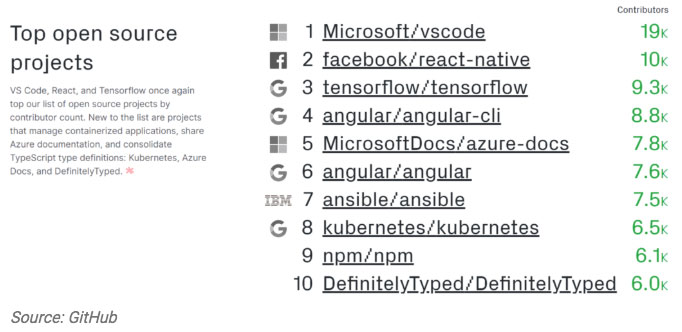
    More recently, we’ve witnessed the growth of open-source databases like Redis, open-source infrastructure-as-a-service like OpenStack, and even open-source machine learning libraries like TensorFlow, Docker, Kubernetes, and Swift.

    The Business Behind

    In terms of monetization, the model of “commercial support” is one of the most established methods. Enterprises are willing to pay for software that is otherwise free because they want assurances. They want security flaws fixed, dedicated assistance, and software longevity. They don’t want to implement open-source software that has persistent vulnerabilities, complicates development, or may become obsolete.

    An increasingly popular revenue model is referred to as “open-core,” which offers a blend of open-source and proprietary software. The core platform remains free and open-source by being feature limited. Companies can then choose to pay for add-on services or to unlock a proprietary, feature-rich platform.

    Examples of open-core companies include Docker, Elastics, GitLab, MongoDB, and Redis.

    The Case of Google and Tech Giants

    The second type of monetization strategy is that of the corporate-sponsored project. For example, Google is the primary developer of Kubernetes, and while Google doesn’t monetize Kubernetes directly, the wide adoption of the service has brought awareness to the company’s cloud service, Google Cloud Platform (GCP).

    Another one of Google’s most successful open-source projects in recent years is machine learning (ML) library TensorFlow. Its widespread use has created a large, engaged community, resulting in contributions from many independent developers.

    With thousands of developers contributing, Google and other tech giants such as Microsoft, IBM, Intel and Facebook — none of which are open-source companies — benefit from the free developer input and direct user feedback. This allows organizations to build better software faster.

    In addition, these projects also act as an ongoing lead generation for the sponsoring organization.

    • Research ReportOpen-Source Software Has Changed The Way Software Is Developed. Here’s Where The $33B Industry Is Headed


  • Ten Top Ways Learners Hack Learning According to edX

    Ten Top Ways Learners Hack Learning According to edX

    IBL News | New York

    As instructional designers, do we really engineer massive courses with the users’ interests in mind?

    An edX instructional team took to social media to ask learners how we can make the most of their learning and studying experience.

    Responses suggested ten learning hacks:

    1. Break large concepts down into smaller, more digestible pieces. Bite-size learning improves comprehension and retention.

    2. Feature podcasts
    , audiobooks, and ebooks relevant to the area of study. This will enhance the learning experience and provide a well-rounded perspective.

    3.
    Enhance interactions and discussion forum participation among students. This is a great way to solidify concepts and gain different perspectives on the topics.


    4. Simplify course topics
    so students will be able to teach them to others.

    5. Regularity and repetition is key to keeping learning consistent and more effective. Students advance when they add time to study in their schedule on a regular basis.

    6. Learners operate on a different clock, which means that it’s important to find the right time of the day to study. Some students work better in the morning. Others will do some of their best work in the later hours of the day.

    7. Ask for help. Find peers or fellow learners who are knowledgeable on the topic or ask your instructors. This is a great way to clarify concepts that may be difficult to grasp.

    8. Real-world practice. Putting learning into practice through projects, case studies or real-world scenarios is a proven way to advance their comprehension, rather than just theorizing and memorizing.

    9. Making mistakes and learning from them along the way is a natural part of the process. Don’t shy away from mistakes.

    10. Taking notes and revising them are two essential components of learning. Color-code, bullet lists, or draw maps and graphs to make learning stick.

  • 2U Logs a Small Gain But Uncertainty Over Its Business Model Persists

    2U Logs a Small Gain But Uncertainty Over Its Business Model Persists

    Uncertainty Over 2U’s Business Model After Two-Thirds of Its Value Disappears – Shares Closed at $13.92


    Mikel Amigot | IBL News

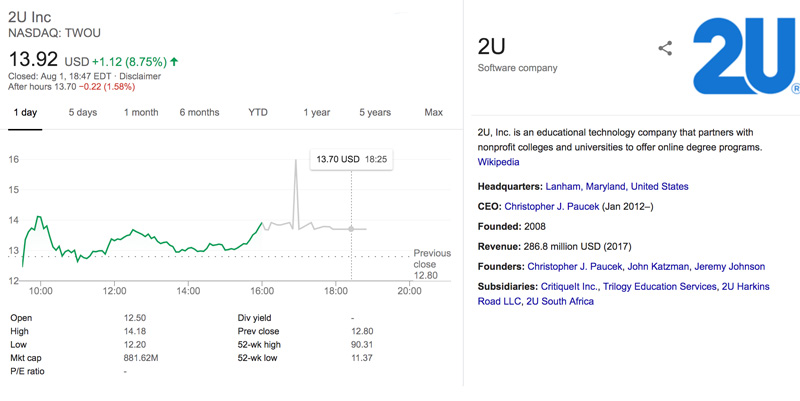
    Uncertainty over 2U’s business model didn’t disappear on its third day of trading after the collapse of the stock price on Tuesday and Wednesday when the company lost two-thirds of its value. And a look at the 2U (NASDAQ: TWOU) stock shows that over the past year it has lost -83.03% of its value.

    Shares of 2U Inc. closed yesterday Thursday 1 at $13.92 after an increase of 8.75% or $1.12.

    Investors were still wary after the educational organization lowered growth expectations yet again during an earnings call on Tuesday.

    The company posted a 43-cent loss per share for its latest quarter, whereas analysts expected a loss of 35 cents per share.

    This was the third time that 2U reset its growth expectations. CEO Chip Paucek and CFO Cathy Graham’s commentaries prompted a rush of analyst downgrades alongside a massive sell-off.

    Thursday’s session consolidated the idea that 2U’s business model is broken and that the company needs to adjust to a more competitive landscape.

    Last quarter’s results showed that problems that dogged the company core business have not only persisted but worsened, according to a majority of analysts.

    What is unclear now is how a stock that seems “uninvestable”, according to Oppenheimer’s Brian Schwartz, will affect the day-to-day operations and level of service offered to colleges and universities, including enrollments.

    2U’s high cash-burn rates along with an unclear path to profitability (with 77% losses recorded over the past six months) send a grim message to the higher education industry.

    For-profit educational institutions aren’t generally well regarded. It is worse if they are Wall Street players. And it is catastrophic when there is the suspicion that debt-burdened students not only feed Wall Street profits but even risk the education they pay for.

    2U’s plunge might be the beginning of the end of the commercial OPM market, and its ripple effect might impact more vendors and players.


    Yahoo Finance: 2U Inc (TWOU) Q2 2019 Earnings Call Transcript
    2U: 2Q’19 Earnings Deck
    Joshua Kim, Inside of Higher Ed: 3 Takeaways from this Week’s 2U / OPM News

  • Analysis: Pearson’s Bold Move Into Digital Will Allow Them to Re-Establish Control of the Market

    Analysis: Pearson’s Bold Move Into Digital Will Allow Them to Re-Establish Control of the Market

    Mikel Amigot | IBL News

    Moving into a “digital-first” publishing house is, certainly, a bold move.

    Pearson –the biggest education company in the world, with 24,000 employees operating in 70 countries– announced this week that all of its 1,500 U.S. titles will become digital, going further than any other textbook company.

    Some analysts say that this shift can entirely change the textbook market, mostly because it is an attempt to control the distribution channels.

    Pearson justified its big move away from print calling the new approach a “product as a service model and a generational business shift to be much more like apps, professional software or the gaming industry.”

    This new development format will allow Pearson to update textbooks on an ongoing basis, taking into account new developments in the field of study, new technologies, data analytics, and efficacy research, the company said in a news announcement.

    The switch to digital —which will go into effect next year— will also lower the cost for students:

    “We will effectively have three price points. They will vary by discipline, but broadly speaking, the average ebook will be $40. You can still rent a physical textbook for $60. And a fully integrated digital product, like Revel, MyLab or Mastering, will be $65 to $80,” said John Fallon, CEO of Pearson, in a statement.

    Many of their print textbooks are priced at $200 or $300 today. College students on average spend more than $1,200 on books and materials, according to The College Board.

    “We’ve changed our business model to deliver affordable, convenient and personalized digital materials to students. Our digital-first model lowers prices for students and, over time, increases our revenues. By providing better value to students, they have less reason to turn to the secondary market. This will create a more predictable, visible revenue stream with a better quality of earnings that enables us to serve the needs of learners and customers more effectively,” added John Fallon.

    With the print versions, Pearson is trying to discourage the second-hand rental market mostly through Amazon, Chegg, and college bookstores.

    Additionally, Pearson will save on printing, packaging and other costs associated with making physical textbooks.

    Phil Hill, an expert blogger, and partner at MindWires Consulting, said that going digital-first “makes plenty of sense on paper for textbook publishers, as it enables them to “re-establish control” over the distribution of their products and cut off the secondhand rental market.”

    Pearson’s major announcement comes at a time when the textbook industry is seeing a number of deals and transactions on digital courseware. A year ago, Cengage launched a subscription with unlimited access to its digital materials. In addition, Cengage and McGraw-Hill Education announced a merger, and Wiley acquired two startups —Zyante and Knewton— to bolster its courseware offerings.

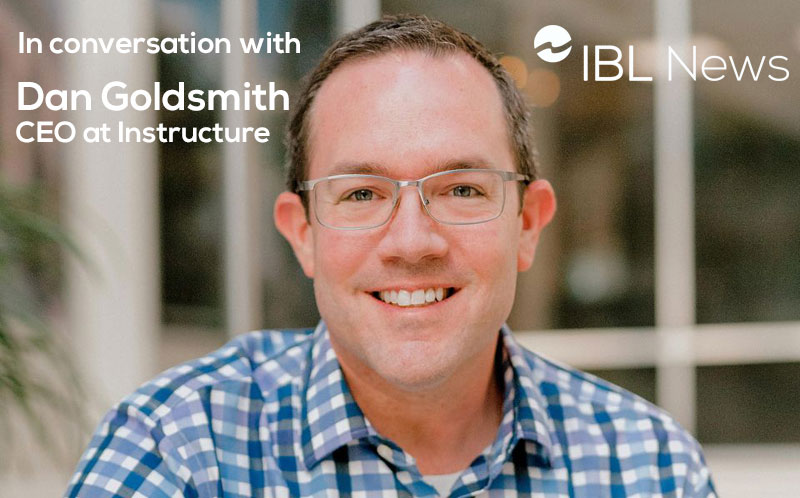
  • Dan Goldsmith (Instructure): “My Job Is Resisting Short Cuts In Our Educational Business”

    Dan Goldsmith (Instructure): “My Job Is Resisting Short Cuts In Our Educational Business”

    Mikel Amigot | IBL News

    No one would believe that Dan Goldsmith, who runs Instructure, the maker of Canvas LMS and Bridge, is a Wall Street CEO.

    His lack of arrogance, along with an understanding of the nuances of the educational industry, makes him unusual. “I know it sounds odd to have a good conversation with the CEOs of a competing business but at the end, we have a common mission and we all serve a similar space,” Goldsmith said in a conversation with IBL News.

    He translates the same philosophy to his management style. “We want to be a mission-minded company”. “There is always pressure to take short cuts in business. A part of my job is resisting those practices. Following the right path takes 20 % more effort, but that is all right,” he explains.

    Another temptation he avoided during our conversation was talking about the preeminence of Canvas in the LMS market space. “We just want to make sure we inspire innovation and change.”

    Given Blackboard, D2L and Moodle’s stagnant numbers regarding users and financials, as journalists, we pushed Goldsmith to reveal if he would take advantage of the situation and turn the calm path of Instructure into more aggressive behavior. While he did not disclose this information, he made clear that he is absolutely in charge. “We have strength and conviction in our mission and business plan.”

    “I’m not afraid to take the direction and ask for patience with the investment community.” “I exhibited this in my last company, Veeva Systems, a cloud-based SaaS company.”

    Goldsmith was one of the first 50 employees at Veeva. He helped lead the company through a successful IPO and a growth path to a $10 billion market cap. Prior to Veeva, he worked in various executive positions at companies such as Accenture, PwC and IBM.

    At Instructure, Goldsmith took the lead on January 2019 after 10 years of Josh Coates’ role as CEO. His initial focus is on market growth, with the sales leaders reporting directly to him. Currently, Instructure has over 4,000 corporations and educational institutions in higher ed and K12 as customers and serves 30 million learners.

    Opening a new phase of growth and achieving the company’s profitability is the most impending challenge today.

    Watch the full interview of Dan Goldsmith in the video below.


  • Amazon’s Gigantic Training Effort Shows How Automation Is Transforming the Job Market

    Amazon’s Gigantic Training Effort Shows How Automation Is Transforming the Job Market

    Mikel Amigot | IBL News

    Amazon –with almost 300,000 employees in the U.S. and over 630,000 worldwide– is the latest example of a large employer committing to retrain workers. It will invest $700 million over six years to upskill 100,000 of its employees across the U.S.

    Other companies that have concluded that they must coach existing staff to take on different types of work are WalmartAT&T, JPMorgan Chase, and Accenture.

    New automation and AI technologies are transforming the workplace and companies are struggling to recruit talent.

    There is a revealing statistic from the U.S. Bureau of Labor Statistics (BLS): there are now more job openings (7.4 million) than there are unemployed Americans (6 million).

    No doubt, this is one of the hottest job markets in decades.

    And in looking at job growth over the next decade, the Bureau of Labor Statistics anticipates that some of the fastest-growing jobs will increasingly be in more skilled areas. This includes medical assistants, statisticians, software developers, nurse practitioners, and wind turbine service technicians.

    Investing in their own workforces seems to be a smart approach for corporations.

    One caveat. Experts say that retraining programs boost employee morale and keep workers from leaving a company, but they are not for everybody. Not everyone has the capacity or will to prepare themselves for a new role.

    According to the Association for Talent Development (ATD), large employers with 10,000+ workers spent an average of $500 per worker on training in 2017.

    Amazon’s massive corporate retraining initiative worth $700 million breaks down into $7,000 per employee or $1,200 a year through 2025 in the U.S.

  • Creating Compelling Slides: Bullet Point the Content or Read Scripts?

    Creating Compelling Slides: Bullet Point the Content or Read Scripts?

    Marie I. Rose | IBL News

    One of the most time-consuming tasks in instructional design is creating slides.

    Slides are the backbone of any course. We usually outline the talking points, script the visuals and convey important information for the students.

    Many times slides are accompanied by texts to be teleprompted by lecturers. This mostly depends on their personality and teaching style.

    The dilemma is whether to bullet point the content or read scripts.

    However, one requirement is certain: we need to create killer visuals. Layouts, texts, pictures, icons, videos, graphics, animations, colors, and fonts need to be compelling. And flipping through slides (Keynote or PowerPoint) should result in an engaging teaching experience.

    Let us share some of our recommendations when designing slides:

    • Choose wide-screen format 16:9.
    • Use bullets or very short sentences. Do not add paragraphs of information on your slides: learners become distracted and stop listening. Use multiple slides for a topic if the content is too long.
    • Pick sans serif fonts: they are easier to read and seem more friendly. Some of the classics are Arial, Geneva, Lucida Grande, Tahoma, Trebuchet MS, and Verdana.At IBL our favorites are Roboto, Open Sans, Lato, Fira Sans, Libre Franklin, and Karla… Never Helvetica!

      Regarding size, use fonts larger than 22 points.

      The Fontsquirrel.com website includes many free fonts.
    • Choose 2-3 colors to that work well together. Use the color palette combinations or pick your brand’s color if the course is an extension of your activities. Adobe has a good color picker. Coolors.co is another good generator.
  • CanvasLMS’ CEO on the Learning Data Controversy: “Information Will Be Owned by Institutions”

    CanvasLMS’ CEO on the Learning Data Controversy: “Information Will Be Owned by Institutions”

    Mikel Amigot | IBL News (Long Beach, CA)

    Instructure’s CEO Dan Goldsmith said that learning data accumulated on its Canvas platform, with 30 million learners, “is owned by the student and institutions, and it should always stay that way”.

    Mr. Goldsmith made this claim at a conversation with a selected group of journalists and analysts (IBL News, among them) yesterday in Long Beach, CA, during the Canvas LMS annual conference.

    The controversy around the usage of data started when Instructure disclosed the existence of DIG, a data analytics, predictive and AI-based internally developed project. “There is a lot of potential to use data and information to benefit education. It is important to open this conversation”.

    Instructure, however, doesn’t have a launch date. “We don’t want to make mistakes with DIG, and we don’t want to be constrained with a timeline,” he added.

    On the adaptive and personalized topic, Dan Goldsmith claimed that “it is inevitable as an educational community to figure out ways to use personalized learning.”

    Asked about its strategy now that Canvas LMS is recognized in the industry as the market leader in North America, he said: “Our benchmark is the 1.5 billion students there are in the world”. “If we are constantly looking at our competitors we will lose many opportunities for innovation”.

    Regarding competitors, “I have a good conversation with them. I talk to CEOs, and have a good relation. At the end of the day, we have a common mission.”

    Based in Salt Lake City, Utah, and with a staff of 1,200 employees, this publicly traded company is not profitable yet, although “we are a financially stable organization”. “We are in a good position to make an impact”.

    Regarding its software developments, Mr. Goldsmith highlighted that “there are 250 applications built on top on Canvas by our customers”. “We are not the only channel for innovation”.

    He also stressed that “we will continue to maintain our commitment toward open source. We have a very thriving community that we support”.

    See the video below exclusively shot by IBL News.


  • It’s All About Increasing Learners’ Engagement in Courses and Programs

    It’s All About Increasing Learners’ Engagement in Courses and Programs

    Mikel Amigot | IBL News

    A measure to calibrate the success of a learning platform and an ongoing program is the progress of engagement. If engagement improves, then revenues go up and administrators, instructors, and students smile.

    edX, for example, has seen an 11 % increase in their engagement rate in the last two years. Now it claims a 42 % engagement rate.

    The question is what truly generates engagement in courses.  Three are three main factors, in our view:

    • Content quality along with the design of the course
    • Platform’s pedagogical technology and new features
    • Content marketing and SEO campaigns to allow learners to find their desired courses

    Please examine the graphic above, captured from Studio, the authoring tool of the Open edX platform –which is open-source and free to install.

    The third checkmark refers to a core technical and pedagogical characteristic of this platform: active learning.

    The course content is presented through learning sequences: a set of interwoven videos, readings, discussions, wikis, collaborative and social media tools, exercises and materials with automatic assessments and instant feedback.

    Students alternate between learning concepts and solving simple exercises to check their understanding.

    As a best practice, edX recommends building diverse learning sequences, following researchers’ discoveries. “We recommend that 80% or more of your learning sequences or subsection include multiple content types (such as video, discussion, or problem)”.

    Gently nudging students, tutoring them and setting and soft deadlines in the course is equally helpful.

    Would you suggest additional engagement techniques?


  • Asimov Predicted the State of Education in 2019. Was He Right?

    Asimov Predicted the State of Education in 2019. Was He Right?

    Mikel Amigot | IBL News

    “AI, Machine Learning, Augmented and Virtual Reality, Adaptive Learning, Big Data, and so on, and so.”

    This is how Jeffrey Riman, Professor at FIT and Chair of the Faculty Advisory Council on Teaching and Technology (FACT2) at SUNY, summarized the technology issues dominating the conversation in higher ed during the 2019 CIT Conference.

    “Among the many challenges for faculty and instructional support staff are increased complexity and steeper learning curves, greater time commitment, and outsourced content creation and assessment strategies. Course size will continue to grow, and the pace of change is accelerating,” said Jeffrey Riman [in the picture].

    “And one thing we know: history is not a predictor of future performance,” he added.

    Funny reference to history. Let’s go back four decades.

    On December 31, 1983, esteemed scholar and best-selling sci-fi writer Isaac Asimov predicted how the world would be in 2019.

    He wrote: “Education, which must be revolutionized in the new world, will be revolutionized by the very agency that requires the revolution – the computer…”

    “There will be an opportunity finally for every youngster, and indeed, every person, to learn, in his or her own time, at his or own speed, in his or her own way…”

    “Education will become fun because it will bubble up from within and not be forced in from without.”

    Does anyone dare to predict how education will be in 2065?

    Asimov the genius did envision the impact of the computer and the connected network, as well as the potential of on-demand learning at scale.

    For a fully universal, personalized, adapted and fun education, we might need to wait a little longer.

    But foundations are building up.