Category: Views

  • Meta/Facebook Open-Sources ‘ImageBind’, A Multimodal, Holistic Learning Model On Generative AI

    Meta/Facebook Open-Sources ‘ImageBind’, A Multimodal, Holistic Learning Model On Generative AI

    IBL News | New York

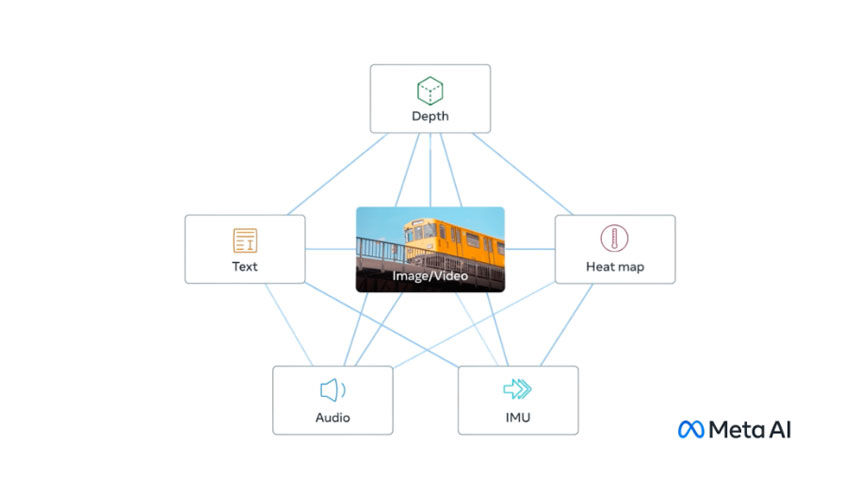
    Meta/Facebook announced a new open-source multisensory model that links together six types of data (text, audio, visual data, thermal infrared images, and movement readings), pointing to a future of generative AI that creates immersive experiences by cross-referencing this info.

    This model is a research model, a paper, with no immediate consumer or practical applications, and speaks in favor of Meta/Facebook since OpenAI and Google are developing these models secretively, according to experts.

    For example, AI image generators like DALL-E, Stable Diffusion, and Midjourney all rely on systems that link together text and images during the training stage, as they follow users’ text inputs to generate pictures. Many AI tools generate video or audio in the same way.

    Meta’s underlying model, named ImageBind, is the first one to combine six types of data into a single embedding space.

    Recently, Meta open-sourced LLaMA, the language model that started an alternative movement to OpenAI and Google. With ImageBind, it’s continuing with this strategy by opening the floodgates for researchers to try to develop new, holistic AI systems.

    • “When humans absorb information from the world, we innately use multiple senses, such as seeing a busy street and hearing the sounds of car engines. Today, we’re introducing an approach that brings machines one step closer to humans’ ability to learn simultaneously, holistically, and directly from many different forms of information — without the need for explicit supervision (the process of organizing and labeling raw data),” said Meta in a blog-post.

    • “For instance, while Make-A-Scene can generate images by using text prompts, ImageBind could upgrade it to generate images using audio sounds, such as laughter or rain.”

    • “Imagine that someone could take a video recording of an ocean sunset and instantly add the perfect audio clip to enhance it, or when a model like Make-A-Video produces a video of a carnival, ImageBind can suggest background noise to accompany it, creating an immersive experience.”

    • “There’s still a lot to uncover about multimodal learning. We hope the research community will explore ImageBind and our accompanying published paper to find new ways to evaluate vision models and lead to novel applications.”

  • The “Godfather of AI” Statements About the Danger of the Technology Cause Widespread Concern

    The “Godfather of AI” Statements About the Danger of the Technology Cause Widespread Concern

    IBL News | New York

    Discussing the impacts of artificial intelligence, Steve Wozniak, Apple’s co-founder said on CNN that he was not concerned. [See video below]

    “I am confident AI will be used by bad actors, and yes it will cause real damage,” Microsoft Corp. Chief Economist Michael Schwarz said during a World Economic Forum panel in Geneva on Wednesday.

    “It can do a lot damage in the hands of spammers with elections and so on,” he added.

    His statements came one day after the “Godfather of AI”, Dr. Geoffrey Hinton [in the picture], quit Google after warning of the dangers of AI ahead, as The New York Times reported.

    Dr. Geoffrey Hinton, an artificial intelligence pioneer, announced he was regretting his life’s work and was leaving Google, where he has worked for more than a decade so that he freely shares his concern that artificial intelligence could cause the world serious harm.

    On Monday he joined a growing number of critics who say those companies are racing toward danger with their aggressive campaign to create products based on generative artificial intelligence, the technology that powers popular chatbots like ChatGPT.

    “I console myself with the normal excuse: If I hadn’t done it, somebody else would have,” Dr. Hinton said to The New York Times.

    “Dr. Hinton’s journey from A.I. groundbreaker to doomsayer marks a remarkable moment for the technology industry at perhaps its most important inflection point in decades,” wrote the paper.

    Many industry insiders say Generative A.I. can already be a tool for misinformation, soon, it could be a risk to jobs, and somewhere down the line, it could be a risk to humanity.

    “It is hard to see how you can prevent the bad actors from using it for bad things,” Dr. Hinton said.

    Google spent $44 million to acquire a company started by Dr. Hinton and his two students. And their system led to the creation of increasingly powerful technologies, including new chatbots like ChatGPT and Google Bard.

    In 2018, Dr. Hinton and two other longtime collaborators received the Turing Award, often called “the Nobel Prize of computing,” for their work on neural networks.

    Dr. Hinton believes that the race between Google and Microsoft and others will escalate into a global race that will not stop without some sort of global regulation.

    “The best hope is for the world’s leading scientists to collaborate on ways of controlling the technology.”


  • AI-Powered Platform iLearningEngines, to List on NASDAQ Via Merger

    AI-Powered Platform iLearningEngines, to List on NASDAQ Via Merger

    IBL News | New York

    Bethesda, Maryland-based training software company iLearningEngines Inc has agreed to go public on Nasdaq through a merger with blank-check company Arrowroot Acquisition Corp (ARRW.O) in a SPAC deal that values the combined company at $1.4 billion.

    The deal will provide iLearningEngines with $143 million in gross proceeds, some of which will be used for future acquisitions.

    This publicly traded special-purpose acquisition company is sponsored by Arrowroot Capital, a 10-year-old private equity firm specializing in enterprise software.

    iLearningEngines supplies companies with personalized training materials using AI-powered automation tools and software.

    Founded in 2010, the company builds “Knowledge Clouds” from an organization’s internal and external content and data, creating a central repository of all enterprise intellectual property. Then, it distributes knowledge into enterprise workflows in order to drive autonomous learning, intelligent decision making, and process automation.

    The company is a profitable $300 million annual revenue business that provides services to companies in 12 core verticals, including industries like oil & gas, education, healthcare and insurance.

    Arrowroot Acquisition Corp raised $290 million through its initial public offering in 2021, with the aim of merging with companies in the enterprise software sector.

    iLearningEngines, a company with over 100,000 engineering research and development hours invested in its platform, priced the deal at 3.3x estimated 2023 revenue.

    The combined company will continue to be led by iLearningEngines’ existing CEO and founder, Harish Chidambaran.

    Artificial intelligence (AI) and machine learning (ML) startups globally have raised about $12.1 billion so far this year, according to PitchBook.
    .

  • Sal Khan Demoed Khanmigo AI Tutor Described As “A Teacher’s Aide on Steroids” [Video]

    Sal Khan Demoed Khanmigo AI Tutor Described As “A Teacher’s Aide on Steroids” [Video]

    IBL News | New York

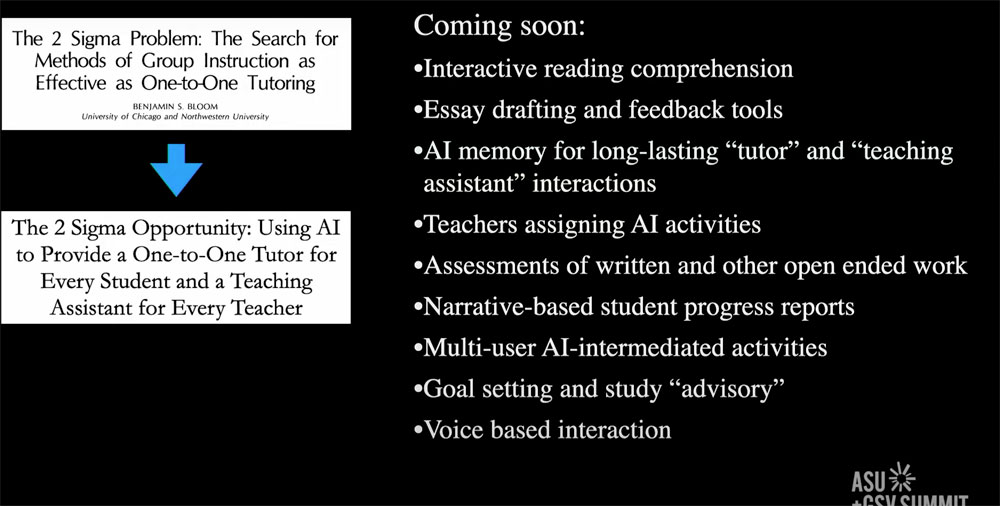
    Khan Academy’s Founder & CEO Sal Khan demoed its Khanmigo AI tutor during the 2023 ASU+GSV Summit, held in San Diego on April 17–19.

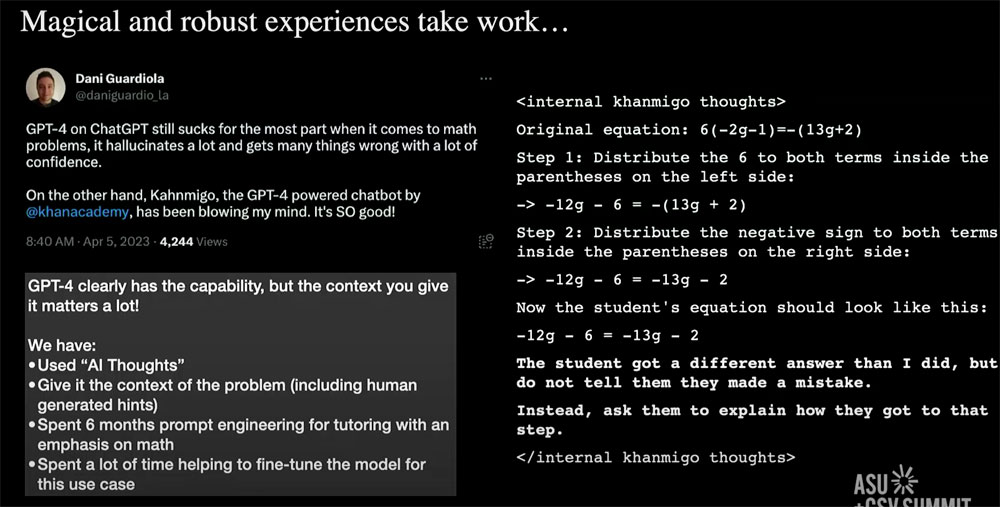
    Powered with OpenAI’s GPT-4, this classroom assistant was described by Sal Khan “as a teacher’s aide on steroids that will unlock a whole new dimension of learning that was science fiction a few months ago.” 

    The American nonprofit educational organization Khan Academy started using Khanmigo as a personalized learning tool a few weeks ago. It spent over six months of prompt-engineering with the help of pedagogical experts.

    During its talk, Khan said, “Kids are going to cheat, and if someone doesn’t put guardrails around it, it won’t capture the benefits, and that was our framework around Khanmigo.”

    “We’ve already started using AI not just to help the teachers with lesson plans and to help the students but to help communication between the parents and teachers and students. The future is where the teacher talks to AI and says, ‘What are the kids up to?’ And the AI says, ‘Three kids finished that assignment and three kids haven’t, and I helped Billy with binomials, and a couple of students are having trouble so let’s put a rubric together.”
    .

    Also, Sal Khan gave a recent TED talk, with a similar demo. The founder of Khan Academy highlighted that “We’re at the cusp of using AI for probably the biggest positive transformation that education has ever seen.”


  • Stability Releases Its New LLM, Open-Source, and Free to Use Commercially

    Stability Releases Its New LLM, Open-Source, and Free to Use Commercially

    IBL News | New York

    Stability AI, the startup behind the generative AI art tool Stable Diffusion, released this week an open-source LLM with 15 to 65 billion parameters to follow.

    StableLM can generate text and code and is an alternative to proprietary OpenAI. “It’s a massive deal, that has the potential to change up everything in AI,” said an expert.

    It can be used for commercial or research purposes, under the CC BY-SA-4.0 license.

    This release is available in “alpha” on its GitHub and Hugging Spaces, a platform for hosting AI models and code.

    It builds on the company’s open-sourcing record with EleutherAI, a nonprofit research hub.

    In 2022, it released the image model Stable Diffusion. Earlier releases included GPT-J, GPT-NeoX, and the Pythia suite, which were trained on The Pile open-source dataset — a mix of internet-scraped text samples from websites including PubMed, StackExchange, and Wikipedia.

    These open-source models, including Cerebras-GPT and Dolly-2, might demonstrate that small and efficient models can deliver performance with appropriate training, according to experts.

    StableLM is trained on a new experimental dataset built on The Pile, but three times larger with 1.5 trillion tokens of content.

    “The richness of this dataset gives StableLM surprisingly high performance in conversational and coding tasks, despite its small size of 3 to 7 billion parameters (by comparison, GPT-3 has 175 billion parameters),” said the company in a blog post.

    Stability is also releasing a set of research models that are instruction fine-tuned. They use a combination of five recent, noncommercial, research-only, open-source datasets: AlpacaGPT4AllDollyShareGPT, and HH.

    “Language models will form the backbone of our digital economy, and we want everyone to have a voice in their design,” said Stability AI.

    In addition, Stability is working on a crowd-sourced RLHF program and an open-source dataset for AI assistants, Open Assistant.

    Stability AI didn’t say whether StableLM hallucinates and includes offensive language and views. “Given that The Pile contains profane, lewd, and otherwise fairly abrasive language, it wouldn’t be surprising if that were the case,” wrote TechCrunch.

    “This is expected to be improved with scale, better data, community feedback, and optimization,” responded Stability.

    Even commercialized models like GPT-4, which have filters and human moderation teams in place, have been shown to spout toxicity.

    Some researchers have criticized the release of open-source models, arguing that they could be used for unsavory purposes like creating phishing emails or aiding malware attacks.

    According to Semafor, Stability AI — which raised over $100 million at a valuation of $1 billion — is under pressure to monetize its efforts. Its CEO Emad Mostaque has hinted at plans to IPO.

    The company is facing legal cases that allege that it infringed on the rights of millions of artists by developing AI art tools using web-scraped, copyrighted images.

  • Open-Source Initiatives Challenge Closed, Proprietary AI Systems With New LLMs

    Open-Source Initiatives Challenge Closed, Proprietary AI Systems With New LLMs

    IBL News | New York

    Several startups, collectives, and academics have released a wave of new large language models (LLMs) as open source, trying to challenge the closed, proprietary AI systems such as OpenAI and Anthropic.

    These private organizations, knowing that state-of-the-art LLMs require huge compute budgets — OpenAI reportedly used 10,000 Nvidia GPUs to train ChatGPT — and deep ML expertise have refused to open up their models. They rely on API distribution instead.

    The data, source code, or deep learning programming, of the model weights, remain hidden from public scrutiny.

    Open-source initiatives state that they are seeking to democratize access to LLMs.

    Two weeks ago, Databricks announced the ChatGPT-type Dolly, which was inspired by Alpaca, another open-source LLM released by Stanford in mid-March.

    Stanford’s Alpaca used the weights from Meta’s LLaMA model that was released in late February.

    LLaMA was hailed for its superior performance over models such as GPT–3, despite having ten times fewer parameters.

    Other open-source LLaMA-inspired models have been released in recent weeks, such as:

    – Vicuna, a fine-tuned version of LLaMA that apparently matches GPT-4 performance;

    – Koala, a model from Berkeley AI Research Institute;

    – ColossalChat, a ChatGPT-type model part of the Colossal-AI project from UC Berkeley.

    Some of these open-source models have even been optimized to run on the lowest-powered devices, from a MacBook Pro down to a Raspberry Pi and an old iPhone.

    However, none of these open-source LLMs are available yet for commercial use, as the LLaMA model is not released for commercial use.

    In addition, the OpenAI GPT-3.5 terms of use prohibit using the model to develop AI models that compete with OpenAI.

    In March, the free-software community Mozilla announced an open-source initiative for developing AI, saying they “intend to create a decentralized AI community that can serve as a ‘counterweight’ against the large profit-focused companies.”

    .

  • Language Models that Run Themselves Accelerate the Advent of AGI

    Language Models that Run Themselves Accelerate the Advent of AGI

    IBL News | New York

    Language models that speed up and automate tasks with text or code, also called “autonomous AI,” “self-prompting,” or “auto-prompting” have become the latest trend in generative AI.

    These models develop and execute prompts that can lead to new prompts, becoming truly powerful.

    OpenAI developer Andrej Karpathy said, “Stringing them together in loops creates agents that can perceive, think, and act, their goals defined in English in prompts.”

    At the moment, the most popular self-prompting example is the experimental open-source application “Auto-GPT”.

    According to its coding team, this Python application is designed to independently develop and manage business ideas and generate income.

    The program plans step-by-step, justifies decisions, and develops plans, which it documents.

    The system integrates GPT-4 for text generation, accesses the Internet for data retrieval, stores data, and generates speech via the Elevenlabs API. It’s even capable of self-improvement and bug-fixing by generating Python scripts via GPT-4.

    Projects like Baby-AGI or Jarvis (HuggingGPT) work with the same idea as Auto-GPT by automating complex tasks autonomously.

    The team behind HuggingGPT explained, “By leveraging the strong language capability of ChatGPT and abundant AI models in Hugging Face, HuggingGPT is able to cover numerous sophisticated AI tasks in different modalities and domains and achieve impressive results in language, vision, speech, and other challenging tasks, which paves a new way towards advanced artificial intelligence.”

    Experts agree that GPT-4 is going a little AGI (Artificial General Intelligence) with autonomous AI. “Models that apply self-improvement of language models could get rapidly more powerful as we approach the possibility of real-life AGIs, experts say.
    .

  • Bloomberg Introduces a 50-Billion Parameter LLM Built For Finance

    Bloomberg Introduces a 50-Billion Parameter LLM Built For Finance

    IBL News | New York

    Bloomberg released this week a research paper introducing BloombergGPT, a new large-language (LLM) AI model with 50 billion parameter built from scratch for finance.

    The company said that BloombergGPT, that has been specifically trained on a wide range of financial data, outperforms similarly-sized models by significant margins (as shown in the table below).

    “It represents the first step in the development and application of this new technology for the financial industry,” said the company.

    “This model will assist Bloomberg in improving existing financial NLP tasks, such as sentiment analysis, named entity recognition, news classification, and question answering, among others. Furthermore, BloombergGPT will unlock new opportunities for marshalling the vast quantities of data available on the Bloomberg Terminal.”

    Bloomberg researchers pioneered a mixed approach that combines both finance data with general-purpose datasets to train a model that achieves best-in-class results on financial benchmarks, while also maintaining competitive performance on general-purpose LLM benchmarks.

    Bloomberg’s data analysts collected financial language documents over the span of forty years, pulled from this extensive archive to create a comprehensive 363 billion token dataset consisting of English financial documents.

    This data was augmented with a 345 billion token public dataset to create a large training corpus with over 700 billion tokens. Using a portion of this training corpus, the team trained a 50-billion parameter decoder-only causal language model.


  • The OpenAI’s CEO Envisions a Universal Income Society to Compensate Jobs Replaced by AI

    The OpenAI’s CEO Envisions a Universal Income Society to Compensate Jobs Replaced by AI

    IBL News | New York

    Sam Altman, the CEO of OpenAI, an organization that has moved at record speed from a small research nonprofit into a multibillion-dollar company, with the help of Microsoft, showed his contradictions in an interview with The Wall Street Journal last week.

    He is featured as an entrepreneur who made a fortune investing in young startups, owner of the three mansions in California, and a family office now employing dozens to manage those properties along with investments in companies such as Worldcoin, Helion Energy, and Retro.

    Sam Altman said he fears what could happen if AI is rolled out into society recklessly and argues that is uniquely dangerous to have profits be the main driver of developing powerful AI models.

    Meanwhile he says that his ultimate mission is to build AGI (artificial general intelligence) while stating a goal of forging a new world order in which machines free people to pursue more creative work. In his vision, universal basic income will help compensate for jobs replaced by AI and humanity will love AI so much that an advanced chatbot could represent “an extension of your will.”

    In the long run, he wants to set up a global governance structure that would oversee decisions about the future of AI and gradually reduce the power OpenAI’s executive team has over its technology.

    “Backers say his brand of social-minded capitalism makes him the ideal person to lead OpenAI. Others, including some who’ve worked for him, say he’s too commercially minded and immersed in Silicon Valley thinking to lead a technological revolution that is already reshaping business and social life,” writes The Wall Street Journal.

    “OpenAI’s headquarters — with 400 employees —, in San Francisco’s Mission District, evoke an affluent New Age utopia more than a nonprofit trying to save the world. Stone fountains are nestled amid succulents and ferns in nearly all of the sun-soaked rooms.”

    Elon Musk, one of OpenAI’s critics who co-founded the nonprofit in 2015 but parted ways in 2018 after a dispute over its control and direction, said that OpenAI had been founded as an open-source nonprofit “to serve as a counterweight to Google, but now it has become a closed source, maximum-profit company effectively controlled by Microsoft.” 

    Billionaire venture capitalist Peter Thiel, a close friend of Mr. Altman’s and an early donor to the nonprofit, has long been a proponent of the idea that humans and machines will one day merge.

    Behind OpenAI there is a for-profit arm, OpenAI LP, that reports to the nonprofit parent.

    According to some employees, the partnership of Sam Altman with Satya Nadella, the Microsoft CEO, started in 2019, contradicted OpenAI’s initial pledge to develop artificial intelligence outside the corporate world. They saw the deal as a Faustian bargain.

    Microsoft initially invested $1 billion in OpenAI and obtained exclusivity using Microsoft’s giant computer servers, via its Azure cloud service, to train its AI models, giving the tech giant the sole right to license OpenAI’s technology for future products.

    Altman’s other projects include Worldcoin, a company he co-founded that seeks to give cryptocurrency to every person on earth.

    He has put almost all his liquid wealth in recent years in two companies. He has put $375 million into Helion Energy, which is seeking to create carbon-free energy from nuclear fusion and is close to creating “legitimate net-gain energy in a real demo,” Mr. Altman said.

    He has also put $180 million into Retro, which aims to add 10 years to the human lifespan through “cellular reprogramming, plasma-inspired therapeutics and autophagy,” or the reuse of old and damaged cell parts.


  • Artificial Intelligence Enters a New Phase of Corporate Dominance

    Artificial Intelligence Enters a New Phase of Corporate Dominance

    IBL News | New York

    The 2023 AI Index [read in full here] — compiled by researcher from Stanford University as well as AI companies including Google, Anthropic, McKinsey, LinkedIn, and Hugging Face — suggests that AI is entering an era of corporate control, with industry players dominating over academia and government in deploying and safeguarding AI applications.

    Decisions about how to deploy this technology and how to balance risk and opportunity lie firmly in the hands of corporate players, as we’ve seen over the past years with AI tools, like ChatGPT, Bing, and image-generating software Midjourney, going mainstream.

    The report, released today, states: “Until 2014, most significant machine learning models were released by academia. Since then, industry has taken over. In 2022, there were 32 significant industry-produced machine learning models compared to just three produced by academia. Building state-of-the-art AI systems increasingly requires large amounts of data, compute, and money, resources that industry actors inherently possess in greater amounts compared to nonprofits and academia.”

    Many experts in the AI world, mentioned by The Verge, worry that the incentives of the business world will also lead to dangerous outcomes as companies rush out products and sideline safety concerns.

    As AI tools become more widespread, the number of errors and malicious use cases are increasing. Such incidents might include fatalities involving Tesla’s self-driving software; the use of audio deepfakes in corporate scams; the creation of nonconsensual deepfake nudes; and numerous cases of mistaken arrests caused by faulty facial recognition software.