
Mikel Amigot, IBL News | Louisville, Kentucky
Over 3,000 educators, administrators, and edtech professionals gathered this week in Louisville, Kentucky, for InstructureCon 2026, Instructure’s flagship annual conference.
Under the theme “Education in the Making,” the three-day event (July 21–23, 2026) delivered keynote addresses from renowned thinkers, a sweeping product roadmap, the launch of a new AI venture studio, and a landmark survey on AI adoption in education.
With over 200 sessions, workshops, and meetups spanning artificial intelligence, workforce readiness, accessible design, and evolving learner needs, InstructureCon 2026 was both a display of technological ambition and a test of whether Instructure can rebuild the trust compromised by the cybersecurity breach that struck its Canvas LMS on April 25, 2026,
Instructure’s CEO, Steve Daly, addressed “the incident”, as they called the data breach caused by the criminal organization ShinyHunters, promising transparency, honest communication, and every effort to rebuild trust through consistent action.
The company announced two new practical security features: one to download courses and another to fully remove all non-essential data on Canvas LMS.
• “It will be a defense at every layer, annual verification, and external audits.”
• “There will be faster detection and remediation, more frequent external validation, and more open collaboration.”
However, “We cannot predict a world without zero incidents; future attacks, in fact, will be more frequent and damaging,” said Armin Molavi, Chief Marketing Officer [in the picture below].
Also, the week prior to the conference, Instructure assessed a separate security threat disclosed against ShareFile, the third-party platform being used for secure data delivery. The company emphasized the ShareFile issue “did not involve Canvas or any Instructure systems.”
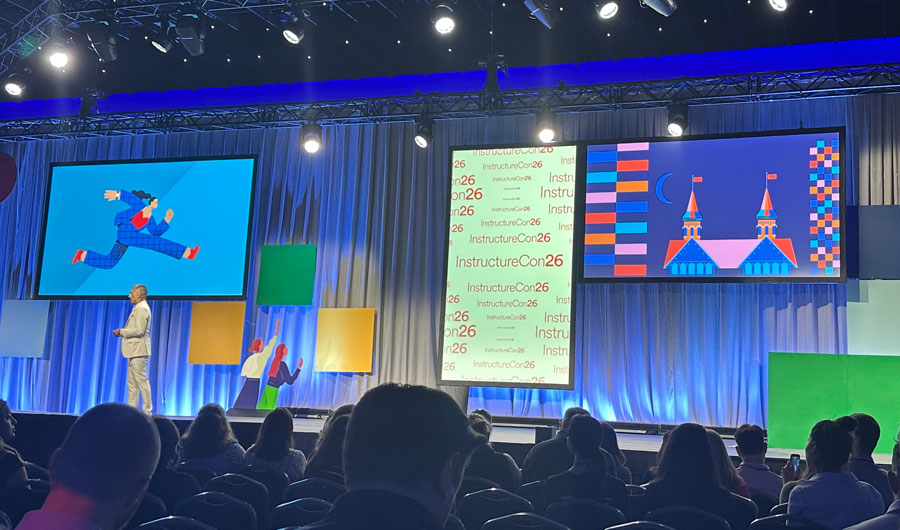
Daly shared what Instructure described as “a bold vision for how education and technology can move forward together in a time of rapid change,” framing the company’s evolution “from a learning management system provider to a comprehensive, future-ready learning ecosystem.” He emphasized that the rate of technological and workforce change will continue to accelerate and positioned Instructure as the partner to help institutions navigate it.
In the opening of the conference, guest speaker Michael Horn, co-founder of the Clayton Christensen Institute for Disruptive Innovation and one of education’s most recognized voices, challenged the audience to rethink AI’s role in education, not merely as an efficiency tool, but as a force that can “restore what education was always supposed to be: connection, curiosity, and purpose.”
He argued that AI should liberate educators from administrative burden, freeing them to spend more time genuinely engaging with students.
The biggest talking point of Day 1 was Instructure’s new research on the state of AI in education. Covering 1,125 respondents across educators, higher education students, and K-12 parents and guardians, the survey revealed a stark adoption gap:
- 90% of higher education students use AI in the classroom at least occasionally
- 61% of college instructors and 68% of K-12 educators also use AI in class
- Yet 41% of higher ed instructors and 45% of K-12 educators have received zero formal AI training
- Only 11% of college instructors reported comprehensive AI preparation; only 8% of K-12 educators
- 65% of all respondents worry that AI “presents incorrect information confidently”
Chief Learning Officer Melissa Loble framed these findings as validation for its IgniteAI strategy—embedding AI tools directly into existing Canvas workflows so educators can benefit from AI without needing to become AI specialists themselves.
On the second day of the conference, Instructure announced the launch of Instructure Foundry, a standalone venture studio within Instructure dedicated to innovation by developing “AI-native” educational products outside the traditional Canvas roadmap.
Designed to move faster than the core product team and experiment with ideas that don’t fit neatly into a learning management system, Foundry represents Instructure’s bet that the future of edtech requires startup-speed innovation backed by institutional-scale infrastructure.
Foundry’s inaugural project is Project Athena, an AI-powered study coach that delivers in-context learning through Canvas. Unlike generic AI tutoring tools, which operate without awareness of a student’s specific academic context, Athena pulls from a student’s actual Canvas environment — syllabi, course materials, assignments, and upcoming assessments — to generate:
- Personalized quizzes tailored to what the student is currently studying.
- Custom study guides aligned with real deadlines and assessment schedules.
- Coaching prompts that push toward mastery and deep understanding, not surface-level answers.
Chief Product Officer Shiren Vijiasingam emphasized that Athena addresses a “context gap” that plagues existing AI tutoring tools. “Most AI tutoring tools have a critical gap: they generate explanations without the context of what students are actually learning and require students to find, organize, and upload course materials themselves,” he said.
On the sensitive topic of data privacy — particularly acute given the breach — Instructure was explicit: student conversations with Athena will not be used to train external AI models, access to Canvas data will be read-only and governed by existing user authorizations, and students retain full ownership of their data.
During the event, the Canvas LMS Product Roadmap was announced
Vijiasingam said, “Educational technology, powered by AI, can strengthen the connection between educator and student, amplify the voice and impact of the educator, and provide a personalized learning experience that improves student success.”
He added that AI-driven efficiency should translate into “time savings that allow educators to use their time in higher quality and more meaningful ways, spending it where it matters most.”
Instructure announced plans to update more than 20 key Canvas workflows throughout 2026, including:
- Course dashboards — customizable views for learners and educators, with mobile improvements to help students quickly identify priorities.
- Content creation — elevated tools with embedded accessibility checks and AI-assisted support directly within course design workflows.
- Course navigation — simplified flows and modernized interfaces.
- Grading processes — performance and usability upgrades for SpeedGrader, including improvements for large-enrollment courses.
- Media experiences — interactive transcripts, improved video navigation, and richer Canvas Studio integration. Institutions will have control over enabling changes at their own pace.
- Canvas Career, which reached general availability on January 29, 2026, was highlighted as Instructure’s purpose-built platform for workforce-aligned, skills-first education.
- Canvas Studio, Instructure’s video learning platform, received several enhancements:
— Distraction-free YouTube integration with enhanced data privacy.
— Video annotation capabilities for both instructors and students.
— Vimeo upload support and automatic Zoom recording storage.
— Account-level and course-level analytics with CSV export options.
— Planned improvements for interactive transcripts and enhanced video navigation.
The Canvas platform owner concluded that the LMS — already the place where courses, grades, and student data live — is the natural home for AI in education.
By embedding AI directly into Canvas rather than building standalone products, Instructure is arguing that AI works best when it has context, and no tool has more educational context than the learning management system.