IBL News | New York
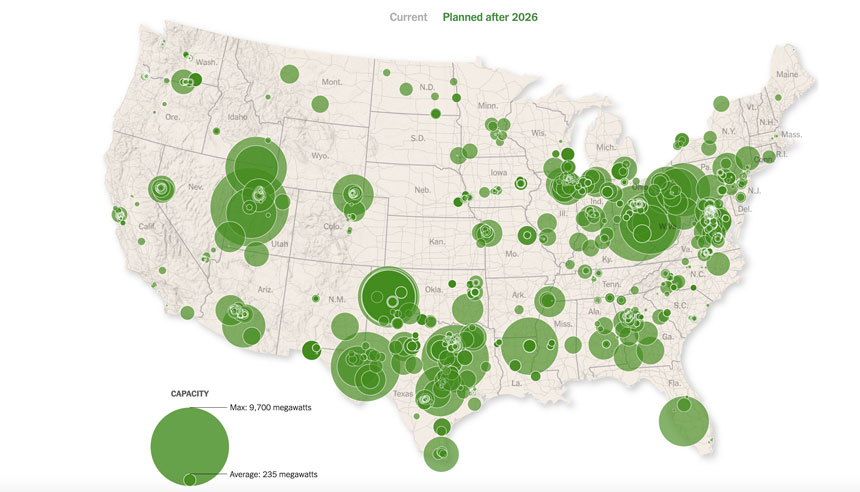
Hundreds of major data centers are now under construction. As a result, the existing computing power — needed to develop and run AI today — is expected to double every nine months, according to the research firm Epoch AI, as reported by The New York Times. [See image above].
By the end of 2028, the world will have about 200 million chips, 10 times the current number.
By 2029, AI infrastructure investment is forecast to top $1 trillion globally, up from $318 billion last year, according to IDC, the market research firm.
Currently, the United States hosts about 5,500 data centers, about 10 times as many as the next closest country, China.
American companies like Amazon, Google, Microsoft, and Meta control about 80 percent of the global computing power that drives AI. Google alone is believed to have four times as many AI chips as all of China’s companies.
In numbers, today, 75 percent of the compute is in the U.S., 12 to 15 percent in China, and 5 percent in the E.U. In the Persian Gulf, Saudi Arabia and the United Arab Emirates have pledged billions to build data centers.
Technologists say we are witnessing the largest-scale infrastructure build-out in human history. In size and ambition, this moment compares to the building of the railroads in the 1800s, President Franklin D. Roosevelt’s New Deal in the 1930s, and the Manhattan Project to create an atomic weapon in the 1940s.
The extended belief is that those with greater computing power will create the most advanced AI systems, capturing the largest share of profits and value, especially in drug discovery and robotics.
AI’s growing capabilities are linked to the expansion of data centers. To create a cutting-edge model, huge amounts of computing power are needed to analyze data and identify patterns.
That process costs hundreds of millions of dollars, as models work best when chips trade data over lightning-fast connections. To meet the demand, semiconductor production is also skyrocketing.
Massive amounts of electricity will also be needed to support new data centers.
At the most advanced AI data centers, every gigawatt of power costs roughly $40 billion to $60 billion, including servers, land, connectivity, and utility hookups, according to industry estimates.
This massive build-out has also provoked a backlash. There is a national movement pushing back against the tech industry and its billionaires, with protests in many communities over concerns that data centers could harm the environment, raise electricity prices, and strain water resources.
Some economists and investors have raised concerns that tech firms are spending faster than they can profit from AI, generating a bubble that is about to burst. They have noted that infrastructure booms have been followed by downturns. The railroad boom in the 1800s, electrification in the 1920s, and the dot-com bubble in the late 1990s were punctuated by economic recessions and a stock market crash as companies that overspent went out of business.
“AI is like the fourth industrial revolution, and it has this aspect to it that generates a bubble,” said Philippe Aghion, who won the Nobel in economic science in 2025 for research on innovation-driven economic growth.
Amazon, Google, Microsoft, Meta, and Oracle are projected to spend about $750 billion this year on data centers, chips, and other AI infrastructure, up from roughly $400 billion last year, according to Goldman Sachs.
China has made A.I. infrastructure a national priority, releasing a five-year economic strategy to create “next-generation supercomputing.”
China’s top tech companies are building new AI chips and data centers. This year, Huawei, ByteDance, and Alibaba are expected to spend $111 billion on data centers and other AI investments, according to Bernstein Research.
Even with these challenges, Chinese start-ups like Moonshot AI and DeepSeek have built powerful AI models, often given away as “open source” software.