IBL News | New York
Perplexity announced a version of its agentic “Computer platform”, named Portable Computer, that runs on hardware owned by clients, such as NVIDIA’s DGX Spark and Linux-powered systems with RTX GPUs.
The launch, developed in close partnership with Nvidia, reflects a new trend of AI agent workloads moving off the cloud and onto local devices with no billing credit consumption.
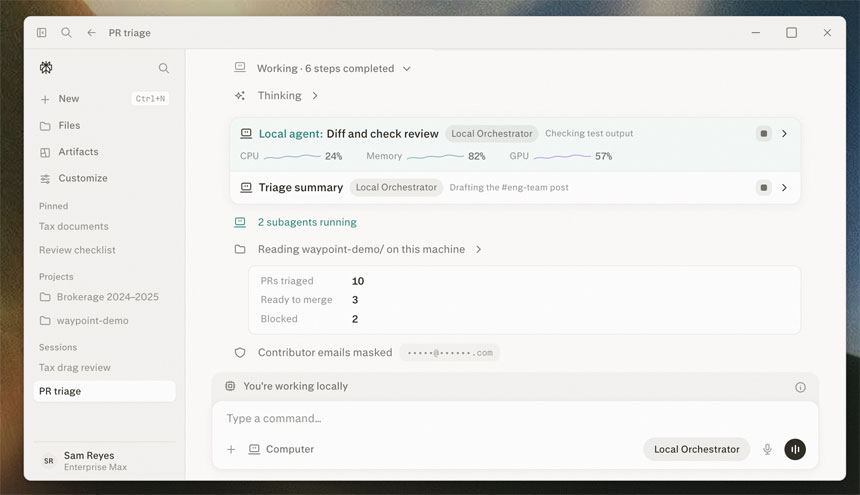
This local app has the same UI as Perplexity’s cloud version.
Portable Computer will be offered for Pro, Max, Enterprise Pro, and Enterprise Max subscribers on Linux, with Windows support following in September. Any RTX GPU with at least 24GB of VRAM — roughly a GeForce RTX 3090 or newer — clears the bar.
While Perplexity Computer orchestrates AI models, files, tools, and web access to complete multi-step tasks — reviewing folders of documents, analyzing data, producing reports, and pushing results into business systems. Portable Computer replicates that experience locally: the local models, agent harness, inference engine, tools, app connectors, and a security sandbox come packaged together in a single system.
Typically, today, with local AI stacks users must assemble and operate those pieces separately — downloading model weights, standing up an inference server, wiring together tools, and tuning performance.
Venture Beat did a demo running a 27-billion-parameter Qwen model at full GPU utilization on a DGX Spark, the agent reviewed each document and flagged cases where the hypothetical investor was paying unnecessary fees.
Alongside the launch, Perplexity published a research paper arguing that effective local agents require the model and the agent harness — the scaffolding of prompts, tools, and orchestration logic around the model — to be designed together. The core insight: general-purpose harnesses assume a frontier model that can absorb enormous contexts, navigate sprawling tool surfaces, and plan over long horizons. Small local models buckle under those demands.
Perplexity found empirically that although models like Qwen 3.8 27B advertise 260,000-token context windows, they begin to struggle beyond 100,000 tokens. So the company built a deliberately minimal harness: a succinct system prompt, a small set of core tools, and capabilities that load and unload as on-demand “skills” rather than sitting permanently in context.