This project, “Scenario Based Language Assessment,” uses an AI character to support students as they navigate an assessment involving real-world scenarios.
Source: Youtube
This project, “Scenario Based Language Assessment,” uses an AI character to support students as they navigate an assessment involving real-world scenarios.
Source: Youtube
In this fascinating talk, Stephen Fry shares his vision of how artificial intelligence could transform education — not by replacing human creativity, but by unlocking it.
Source: Youtube

A new article from The Wall Street Journal details how young, educated Americans struggling to break into the workforce are some of the earliest victims of artificial intelligence.
Source: Youtube

Investors are worried AI is going to eat software, says Jefferies Brent Thill.
Source: Youtube

IBL News | New York
Microsoft is preparing the launch of a new Copilot virtual character that will interact in real-time with the user.
It will be a highly personalized AI assistant that will have an identity, expressions, voice, and conversational memory, according to Microsoft’s AI CEO, Mustafa Suleyman.
The virtual character responds to queries, smiles, nods, and even acts surprised depending on the conversation.
The company provided a glimpse of the Copilot’s identity, as shown below.
Mustafa Suleyman already worked at Inflection AI on a personalized chatbot called Pi. Most of the Inflection AI team joined Microsoft.


IBL News | New York
Colleges and universities face an existential crisis due to converging pressures from lower enrollments, including restrictions on international enrollment, federal cuts, the emergence of AI, and changing societal expectations, stated a report from Boston Consulting Group (BCG), titled “US Higher Education’s Make-or-Break Moment.”
To build a future-ready and more resilient organization, these institutions must accelerate investment in digital infrastructure, workforce-relevant programming, deeper industry partnerships, and scalable revenue streams, advises the consultancy group.
Moody’s predicts that American schools will see a $750 billion to $950 billion rise in capital needs in the next ten years, while the Federal Reserve Bank of Philadelphia estimates that up to 80 universities may close by 2030.
Reinvention is an ambitious but achievable goal as strengths and disruptive opportunities converge. The BCG points out these:
AI has the potential to reshape every operational function. According to a 2024 global survey by the Digital Education Council, 86% of students are already using AI in their studies. In this context, administrations need to modernize outdated processes, including acquiring new skills and capabilities.
In terms of the federal pressure and funding cuts, BCG estimates that the potential impact of the combined economic and policy changes on an illustrative university (with a $1.5 billion operating budget, 10,000 to 15,000 students, and a $400 million to $500 million research portfolio) can range from $125 million to $250 million annually.
“What is required is a strategic reinvention of the business model, shifting from high-fixed-cost structures that are dependent on enrollment and federal research funding to more agile, modular, and mission-aligned platforms,” says the report.
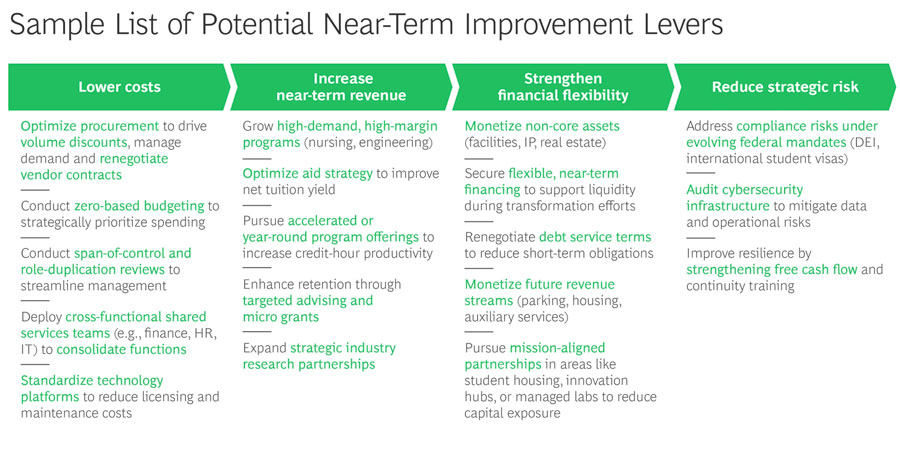
A change agenda can include:
A new approach to Artificial Intelligence is coming to schools in southwest Michigan this year. For some, this includes new technology and guidelines.
Source: Youtube

Some experts say false narratives generated by artificial intelligence can pose a threat to global politics.
Source: Youtube
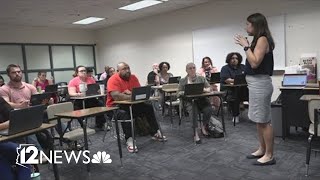
Peoria school district leaders said they’re preparing teachers so that they can lead artificial intelligence usage conversations responsibly.
Source: Youtube