Is the pursuit of human-like AI unlocking scientific breakthroughs—or diverting attention from the technology’s real-world risks?
Source: Youtube

Is the pursuit of human-like AI unlocking scientific breakthroughs—or diverting attention from the technology’s real-world risks?
Source: Youtube

IBL News | New York
OpenAI released the image generation feature of ChatGPT to its API on Wednesday, allowing developers to integrate it into their apps and services.
Launched in late March, this feature went viral for its ability to create realistic Ghibli Studio-style photos and AI action figures. Over 130 million ChatGPT users created more than 700 million images in just the first week of the tool’s availability, according to the company.
OpenAI’s natively multimodal model, gpt-image-1, can create images across different styles, follow custom guidelines, leverage world knowledge, and render text.
Developers can generate multiple images at a time using gpt-image-1 and control the generation quality, thereby adjusting the speed.
All images created are watermarked with C2PA metadata, allowing them to be identified as AI-generated by supported platforms and apps.
According to OpenAI, gpt-image-1 employs the same safety guardrails as image generation in ChatGPT.
Pricing is $5 per million input tokens for text and $10 per million input tokens for images, and $40 per million output tokens for images. That translates to around 2 cents, 7 cents, and 19 cents per generated image for low, medium, and high-quality square images, respectively.
OpenAI said that companies like Adobe, Airtable, Wix, Instacart, GoDaddy, Canva, and Figma are already using or experimenting with gpt-image-1. Figma’s Figma Design platform, for example, now allows users to generate and edit images via gpt-image-1, while Instacart is testing the model for images related to recipes and shopping lists.
imagegen is launched in the openai api!
build cool stuff plz
— Sam Altman (@sama) April 23, 2025

There’s no denying data centers play a critical role in society, with every text, web search and medical scan flowing through these giant buildings. Now AI has turbocharged their demand, along with the electricity that powers them.
Source: Youtube

At just 14 years old, Musab Shafiq, once barely able to use his wrists due to a neurological condition, is now controlling a robot and even dunking a basketball, thanks to specialized technology developed for him at his Broward County school.
Source: Youtube

Artificial intelligence is transforming the way we live and work, but we’ve seen plenty of cases where AI shows bias, often from the male perspective.
Source: Youtube
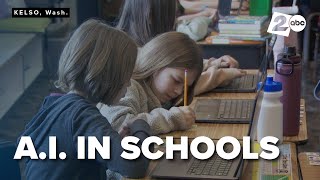
Artificial Intelligence is rapidly changing our world, including how your child learns at school.
Source: Youtube

The transformative potential of agentic AI.
Source: Youtube

Google DeepMind CEO worries about a “worst-case” AI future, but is staying optimistic.
Source: Youtube
IBL News | New York
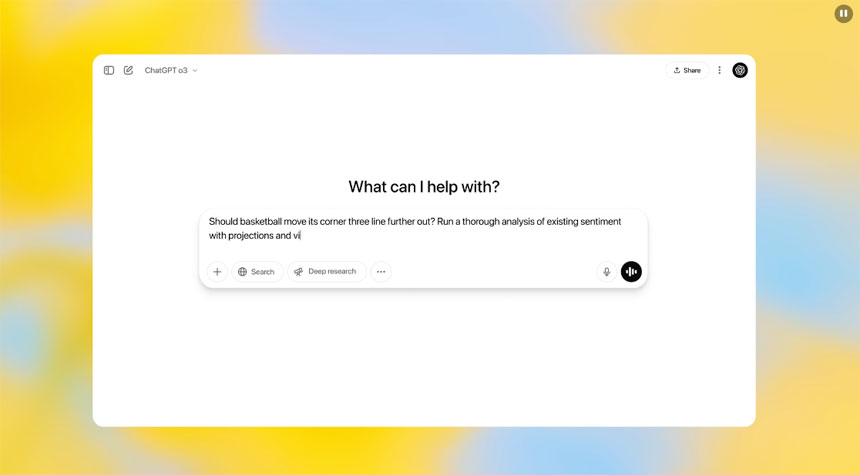
OpenAI released this month o3 and o4-mini, the smartest models trained to think for longer before responding, typically in under a minute.
These agentic models can search the web for public utility data, write Python code to build a forecast, generate a graph or image, and explain the key factors behind the prediction, chaining together multiple tool calls.
They tackle multi-faceted questions and produce detailed and thoughtful answers to solve more complex problems.
OpenAI o3 is our most powerful reasoning model that pushes the frontier across coding, math, science, visual perception, and more,” said OpenAI.
“It performs especially strongly at visual tasks like analyzing images, charts, and graphics. In evaluations by external experts, o3 makes 20 percent fewer major errors than OpenAI o1 on difficult, real-world tasks—especially excelling in areas like programming, business/consulting, and creative ideation.”
OpenAI o4-mini is a smaller model optimized for fast, cost-efficient reasoning—it achieves remarkable performance in math, coding, and visual tasks.

IBL News | New York
SchoolAI raised $25 million in Series A funding in a round led by Insight Partners. Existing investors include NextView Ventures, The General Partnership, and Peterson Ventures. SchoolAI’s total funding is $32 million to date.
SchoolAI’s Classroom Experience platform combines AI assistants for teachers that help with classroom preparation and administrative work. At the same time, SchoolAI’s Spaces uses personalized AI tutors, games, and lessons that can adapt to each student’s unique learning style and interests.
These tools give teachers actionable insights into student performance and allow them to deliver targeted support when it matters most.
According to the company, SchoolAI is used in over a million classrooms across all 50 U.S. States and over 80 countries worldwide. The platform is embedded in more than 400 school districts through strategic partnerships that train teachers and students on how to use AI safely and in a managed way.
Launched for classrooms in August of 2023, SchoolAI noted how teachers, instructional coaches, and school leaders are using their tools: