Author: IBL News

  • edX Announced Two AI Learning Assistants Built on ChatGPT

    edX Announced Two AI Learning Assistants Built on ChatGPT

    IBL News | New York

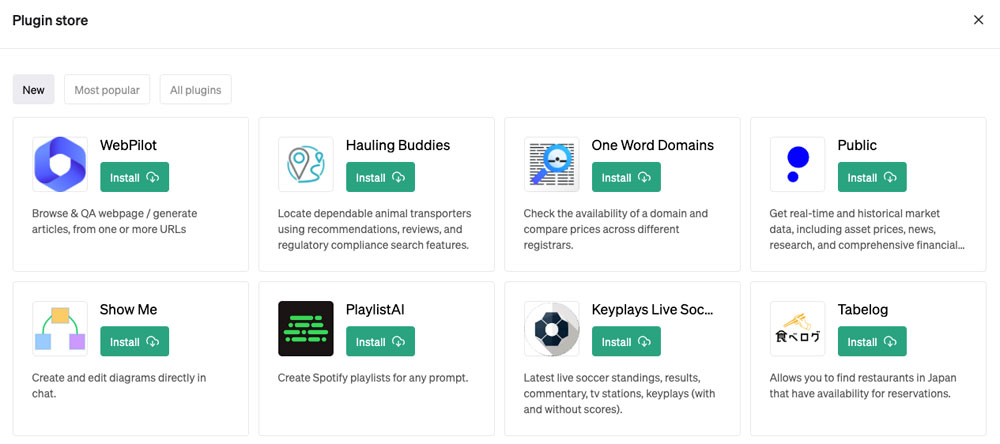
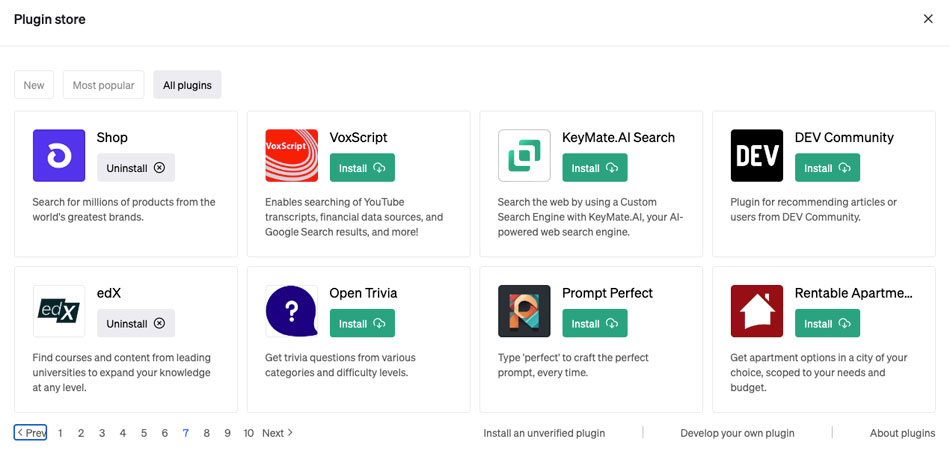
    2U’s edX.org platform announced the launch of a new edX plugin for ChatGPT Plus’ store that enables users to discover courses and programs across a library of 4,200 classes and resources — beginning with Circuits and Electronics.

    The plugin provides course recommendations, content, videos, quizzes, and links to courses.

    In addition, edX.org issued an AI-powered learning assistant called Xpert, currently in pilot. It will provide learners with real-time, personalized academic, friendly and intelligent conversational support for student success.

    “Working alongside edX’s career coaches, student success managers, tutors, and 24/7 live technical support specialists, Xpert will provide learners with an added layer of real-time, interactive guidance to support great student outcomes,” said 2U in a press release.

    New features of Xpert will be released in stages, including:

    • Academic Assistance: Learners will receive personalized assistance with coursework and assignments. They will ask the AI assistant to break down complex concepts from course material, recommend additional modules, and answer follow up questions and quizzes.
    • Course Content Summaries: Xpert will be able to generate brief summaries of video lectures and text materials, helping to maximize the time spent learning. Currently, this feature is available in MITx’s Circuits and Electronics, edX’s first MOOC.
    • Customer Service functionality: Xpert will provide clear advice and step-by-step solutions to help eliminate any technical barriers on the platform.
    • Course Discovery: As a guide and partner, Xpert will help connect learners with the best-fit program to learn the needed skills, factoring their career goals, prior experience, knowledge, and educational background.

    “By leveraging the intelligence and adaptability of OpenAI’s ChatGPT, we are creating more personalized and engaging experiences that further enable learners to achieve great academic and career outcomes,” said 2U Co-Founder and CEO Christopher “Chip” Paucek.

    “Our announcements today are just the first of many innovations edX is developing to harness the power and potential of generative AI,” he added.

     

  • OpenAI Releases a New ChatGPT Plus that Allows Web Browsing and the Use of 70+ Plugins

    OpenAI Releases a New ChatGPT Plus that Allows Web Browsing and the Use of 70+ Plugins

    IBL News | New York

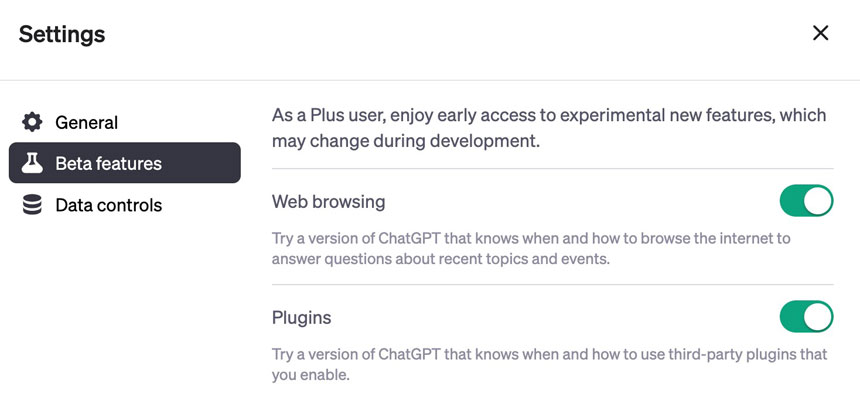
    OpenAI has released a new beta version of ChatGPT that allows Plus users to access the Internet and use over 70 third-party plugins. These features can be accessed through settings in the user panel.

    The addition of web browsing and plugins enhances users’ chat interface, enabling them to engage in various activities such as shopping, job searches, and checking the weather forecast.

    With the new web browsing capability, users can obtain answers related to recent topics and events.

  • Jupyter Incorporates Generative AI Into Notebooks

    Jupyter Incorporates Generative AI Into Notebooks

    IBL News | New York

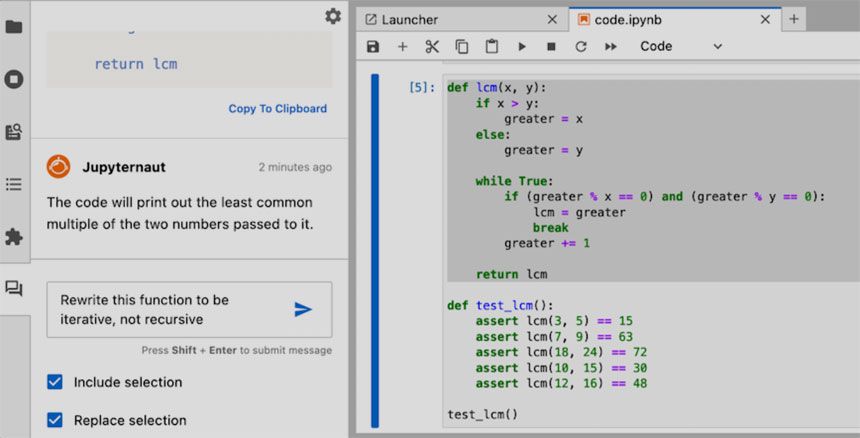
    The Project Jupyter introduced its generative AI model in notebooks during the 2023 JupyterCon conference last week, in Paris, France.

    Jupyter AI provides a user-friendly way to incorporate generative models, improving productivity in JupyterLab, Jupyter Notebook, Google Colab, VSCode, and any environment where the IPython kernel runs.

    Jupyter AI also includes a conversational assistant for developers.

    In addition, it offers support for a wide range of providers and models of generative models, including AI21, Anthropic, Cohere, Hugging Face, OpenAI, SageMaker, and more.

  • Google’s Bard Unavailable in the European Union and Canada

    Google’s Bard Unavailable in the European Union and Canada

    IBL News | New York

    Google made its Bard chatbot available in 180 countries this week but noticeably not in any country of the European Union.

    At Google I/O 2023 conference, the search giant announced a massive global expansion but it avoided mentioning the EU.

    Experts speculated that it was related to the restrictive European GDPR law.

    Last month, Italy briefly banned ChatGPT over concerns that the AI couldn’t comply with the regulations.

    Google only hinted that further Bard expansions will be made “consistent with local regulations.”

    Another notable omission is Canada, which is not listed as supported at this time.

    For users in a supported region, Google Bard is now available in English with no waitlist.

  • Four Solutions to Integrate ChatGPT Bots on Websites

    Four Solutions to Integrate ChatGPT Bots on Websites

    IBL News | New York

    A WordPress free plugin, AI Engine, allows for the creation of ChatGPT-like chatbots on websites by adding a shortcode.

    An English developer living in Japan, Jordy Meow, launched this tool through its website.

    Users would need to host a WordPress-based website and an account with OpenAI.

    The Chatbot builder allows the user to provide the AI assistant with a name and a starting message.

    It also allows fine-tuning the robot as the plugin comes with a Dataset Builder used to generate a large number of questions and answers based on the website content. Data is gathered in a Google Sheet with two columns, with a minimum of 500 rows. (According to the OpenAI documentation, numbers of 3,000 and 5,000 rows are recommended. But it ultimately depends on what you’re trying to achieve.)

    Once you have your dataset, you can import it into AI Engine using the “Import File” button. You can export a CSV file from Google Sheets and use it here, but it also supports JSON and JSONL formats if you prefer. Alternatively, you can type the data manually.

    The developer has added a paid Pro version, starting at $49 per site. This functionality allows the chat to read the WordPress page that’s hosted. This way, customers can ask questions about the webpage.

    This plugin is free, although getting access to OpenAI’s server has a cost for heavily trafficked sites.

    Another approach is offered by Chatbase.co. This start-up offers an API to create chatbots trained on your data.

    In terms of productivity, Chatbot UI offers an open-source clone of OpenAI’s ChatGPT user interface. Developers can plug in their API key to use this UI with their API.


    Chatshape.com allows the implementation of an AI customer support agent from the user’s website content and adds it as a chat bubble.


    Finally, the website espanol.love uses GPT-4 to accurately translate anything into Spanish with an accent.

    .

  • Google Introduced Its Newest LLM ‘PaLM 2’. It Includes Bard, ChatGPT’s Strongest Competitor Yet [Video]

    Google Introduced Its Newest LLM ‘PaLM 2’. It Includes Bard, ChatGPT’s Strongest Competitor Yet [Video]

    IBL News | New York

    Google went all-in on AI during its I/O 2023 developer annual conference on Wednesday.

    The search giant publicly unveiled its newest large language model (LLM), PaLM 2, which, according to the company, is better at reasoning, writing, math, and logic, and performs better than OpenAI’s GPT-4 in coding and debugging.

    The Mountain View, California-based company also introduced a new multimodal LLM called Gemini, which is currently under training.

    PaLM 2 comes in different sizes, which are weirdly named after animal constellations: Gecko, Otter, Bison, and Unicorn.

    Google’s new code completion and code generation tool, named Codey is the company’s answer to GitHub’s Copilot.

    Codey is specifically trained to handle coding-related prompts and is also trained to handle queries related to Google Cloud in general.

    Google also made its chatbot Bard, the equivalent of ChatGPT, officially available for everyone, removing any waitlist.

    Built on PaLM2, Bard allows export to Google Docs, Sheets, Replit, and Gmail, among others.

    Bard’s users will be able to generate images via Adobe Firefly and then modify them using Express.

    In its search business, Google introduced the AI snapshot feature, which takes content from top links and allows for follow-up questions.

    Sponsored ads will appear above while traditional links will be placed below.

    Google’s productivity suite Workspace was improved with an AI sidekick called Duet, designed to provide better prompts.

    It has automatic prompt suggestions and can do a ton of things, such as converting text to tables in Sheets, finding information in Gmail threads, and creating images in Slides.

    “The Sidekick panel will live in a side panel in Google Docs and is constantly engaged in reading and processing your entire document as you write, providing contextual suggestions that refer specifically to what you’ve written,” said Google.

    Another feature of Google Workplace, particularly in Gmail and Docs, is the ‘help me write’ feature, which allows users to write anything at different lengths.

    The new AI features for Slides and Meet include the ability to type in what kind of visualization the user is looking for, and the AI creates that image. Specifically for Google Meet, that means custom backgrounds.

    Google introduced the Magic Editor in Google Photos.

    Google also announced new AI models heading to Vertex AI, its fully managed AI enterprise service, including a text-to-image model called Imagen.

    Another interesting project introduced by the search giant is Project Tailwind, an AI-powered notebook tool that takes a user’s free-form notes and automatically organizes and summarizes them.

    Essentially, users pick files from Google Drive, then Project Tailwind creates a private AI model with expertise in that information, along with a personalized interface designed to help sift through the notes and docs.

    The tool is available through Labs, Google’s refreshed hub for experimental products.

  • Meta/Facebook Open-Sources ‘ImageBind’, A Multimodal, Holistic Learning Model On Generative AI

    Meta/Facebook Open-Sources ‘ImageBind’, A Multimodal, Holistic Learning Model On Generative AI

    IBL News | New York

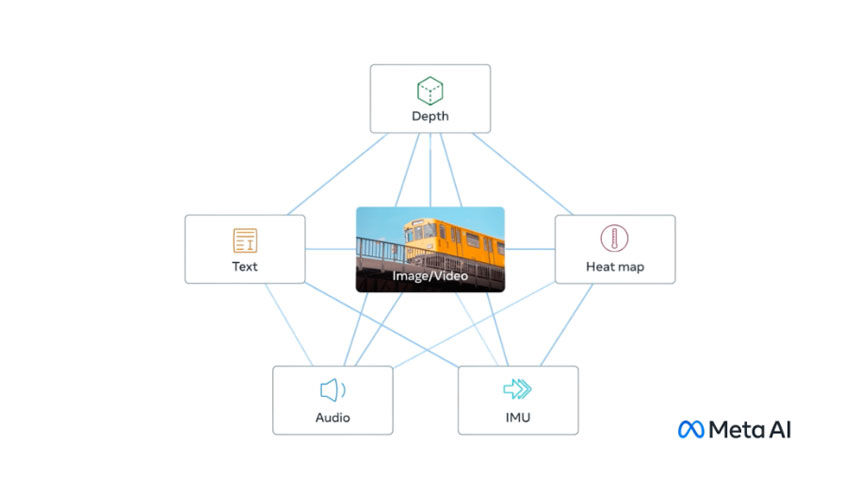
    Meta/Facebook announced a new open-source multisensory model that links together six types of data (text, audio, visual data, thermal infrared images, and movement readings), pointing to a future of generative AI that creates immersive experiences by cross-referencing this info.

    This model is a research model, a paper, with no immediate consumer or practical applications, and speaks in favor of Meta/Facebook since OpenAI and Google are developing these models secretively, according to experts.

    For example, AI image generators like DALL-E, Stable Diffusion, and Midjourney all rely on systems that link together text and images during the training stage, as they follow users’ text inputs to generate pictures. Many AI tools generate video or audio in the same way.

    Meta’s underlying model, named ImageBind, is the first one to combine six types of data into a single embedding space.

    Recently, Meta open-sourced LLaMA, the language model that started an alternative movement to OpenAI and Google. With ImageBind, it’s continuing with this strategy by opening the floodgates for researchers to try to develop new, holistic AI systems.

    • “When humans absorb information from the world, we innately use multiple senses, such as seeing a busy street and hearing the sounds of car engines. Today, we’re introducing an approach that brings machines one step closer to humans’ ability to learn simultaneously, holistically, and directly from many different forms of information — without the need for explicit supervision (the process of organizing and labeling raw data),” said Meta in a blog-post.

    • “For instance, while Make-A-Scene can generate images by using text prompts, ImageBind could upgrade it to generate images using audio sounds, such as laughter or rain.”

    • “Imagine that someone could take a video recording of an ocean sunset and instantly add the perfect audio clip to enhance it, or when a model like Make-A-Video produces a video of a carnival, ImageBind can suggest background noise to accompany it, creating an immersive experience.”

    • “There’s still a lot to uncover about multimodal learning. We hope the research community will explore ImageBind and our accompanying published paper to find new ways to evaluate vision models and lead to novel applications.”

  • IBM Launches Its Enterprise Service ‘WatsonX.ai’ as an Alternative to SageMaker Studio, Vertex AI, and Azure AI

    IBM Launches Its Enterprise Service ‘WatsonX.ai’ as an Alternative to SageMaker Studio, Vertex AI, and Azure AI

    IBL News | New York

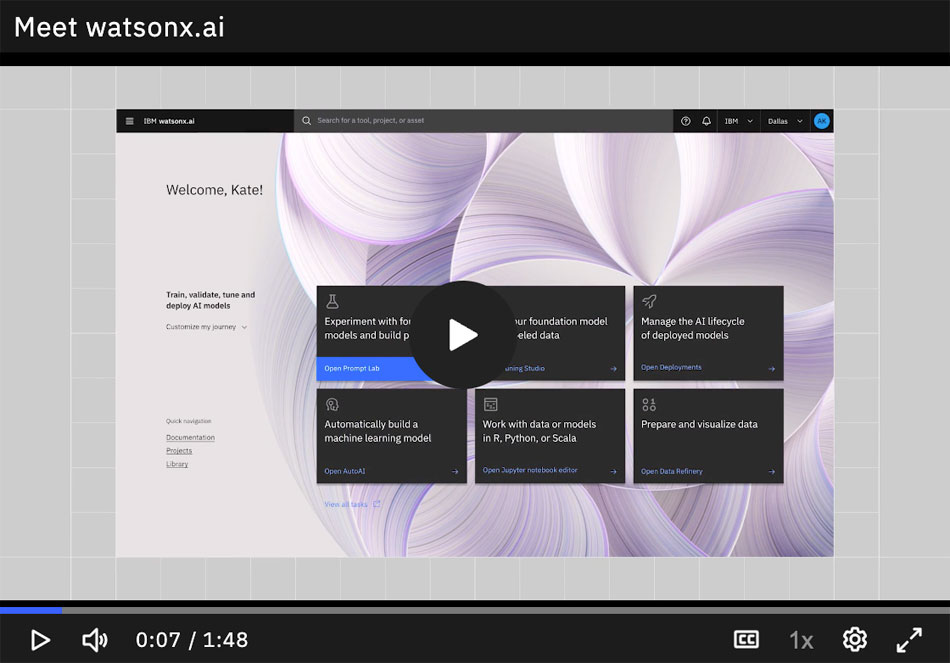
    IBM announced yesterday, at its annual Think conference, Watsonx, a new platform that gives customers access to the toolset, infrastructure, and consulting services to build their own AI models or fine-tune and adapt pre-trained models on their data for generating computer code, and text.

    According to IBM, WatsonX is an “enterprise studio for AI builders,” motivated by the challenges businesses experience in deploying AI within the workplace. In the same category, Amazon provides SageMaker Studio; Google, Vertex AI; and Microsoft, Azure AI. Along with tech giants, startups like Cohere and Anthropic appear as competitors.

    IBM is offering seven pre-trained models to businesses using Watsonx.ai, a few of which are open source. It’s also partnering with Hugging Face, the AI startup, to include thousands of Hugging Face–developed models, datasets, and libraries.

    (For its part, IBM is pledging to contribute open-source AI dev software to Hugging Face and make several of its in-house models accessible from Hugging Face’s AI development platform.)

    The three that the company is contributing are fm.model.code, which generates code; fm.model.NLP, a collection of large language models; and fm.model.geospatial, a model built on climate and remote sensing data from NASA.

    Similar to code-generating models like GitHub’s Copilot, fm.model.code lets a user give a command in natural language and then builds the corresponding coding workflow. Fm.model.NLP comprises text-generating models for specific and industry-relevant domains, like organic chemistry. And fm.model.geospatial makes predictions to help plan for changes in natural disaster patterns, biodiversity, and land use, in addition to other geophysical processes.

    IBM claims that the models are differentiated by a training dataset containing “multiple types of business data, including code, time-series data, tabular data and geospatial data and IT events data,” Arvind Krishna, the CEO of IBM, said in the roundtable.

    IBM is using the models itself, it says, across its suite of software products and services. For example, fm.model.code powers Watson Code Assistant, IBM’s answer to Copilot, which allows developers to generate code using plain English prompts across programs including Red Hat’s Ansible.

    As for fm.model.NLP, those models have been integrated with AIOps Insights, Watson Assistant, and Watson Orchestrate — IBM’s AIOps toolkit, smart assistant, and workflow automation tech, respectively — to provide greater visibility into performance across IT environments, resolve IT incidents in a more expedient way and improve customer service experiences — or so IBM promises.

    FM.model.geospatial, meanwhile, underpins IBM’s EIS Builder Edition, a product that lets organizations create solutions addressing environmental risks.

    Alongside Watsonx.ai, under the same Watsonx brand umbrella, IBM unveiled Watsonx.data, a “fit-for-purpose” data store designed for both governed data and AI workloads. Watsonx.data allows users to access data through a single point of entry while applying query engines, IBM says, plus governance, automation, and integrations with an organization’s existing databases and tools.

    Complementing Watsonx.ai and Watsonx.data is Watsonx.governance, a toolkit that provides mechanisms to protect customer privacy, detect model bias and drift, and help organizations meet ethics standards.

    In an announcement related to Watsonx, IBM showcased a new GPU offering in the IBM cloud optimized for compute-intensive workloads — specifically training and serving AI models.

    The company also showed off the IBM Cloud Carbon Calculator, an “AI-informed” dashboard that enables customers to measure, track, manage, and help report carbon emissions generated through their cloud usage.

    Around 30% of business leaders responding to an IBM survey cite trust and transparency issues as barriers holding them back from adopting AI, while 42% cited privacy concerns around generative AI.

    IBM expects AI will add $16 trillion to the global economy by 2030 and that 30% of back-office tasks will be automated within the next five years.


  • Atlassian Unveils an AI Assistant to Its Jira and Confluence Platforms

    Atlassian Unveils an AI Assistant to Its Jira and Confluence Platforms

    IBL News | New York

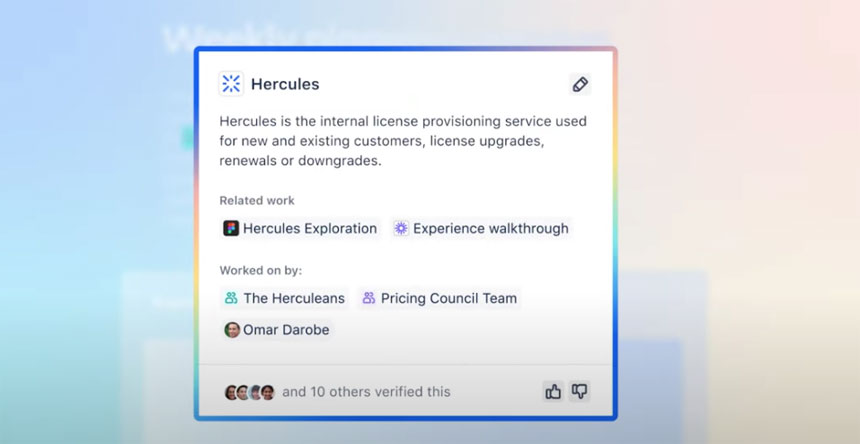
    Atlassian announced an OpenAI-based ‘virtual teammate’ for its collaboration platform Confluence and Jira this week during its annual conference for software vendors, Team ’23 in Las Vegas.

    Atlassian Intelligence chatbot will be tiered release starting in July 2023. Now, it is available in early access through a waitlist. Some of the features will become paid features over time.

    In Confluence, Atlassian Intelligence can summarize meetings with action items and decision overviews. It can also create Tweets and blog posts using documents in Confluence as reference material.

    In addition, this new tool can translate natural language queries into Atlassian’s SQL-like Jira Query Language.

    In the collaboration software market, Confluence is competing with Notion, which has its own suite of AI tools, Guru and Zoho.

    Adding ChatGPT-enabled features to their services is becoming an increased practice in the corporate world.
    .


  • StarCoder, a New Free Code-Generating Model Alternative to GitHub’s Copilot

    StarCoder, a New Free Code-Generating Model Alternative to GitHub’s Copilot

    IBL News | New York

    Hugging Face and ServiceNow released StarCoder, a free AI code-generating system alternative to GitHub’s Copilot (powered by OpenAI’s Codex), DeepMind’s AlphaCode, and Amazon’s CodeWhisperer.

    StarCoder — which is licensed to allow for royalty-free use by anyone, including corporations — was trained in over 80 programming languages as well as text from GitHub repositories, including documentation and Jupyter programming notebooks.

    It also integrates with Microsoft’s Visual Studio Code code editor and, like OpenAI’s ChatGPT, can follow basic instructions (e.g., “create an app UI”) and answer questions about code.

    ServiceNow supplied an in-house compute cluster of 512 Nvidia V100 GPUs to train the StarCoder model.

    Hugging Face and a co-lead on StarCoder, Leandro von Werra claimed that StarCoder matches or outperforms the AI model from OpenAI that was used to power initial versions of Copilot.

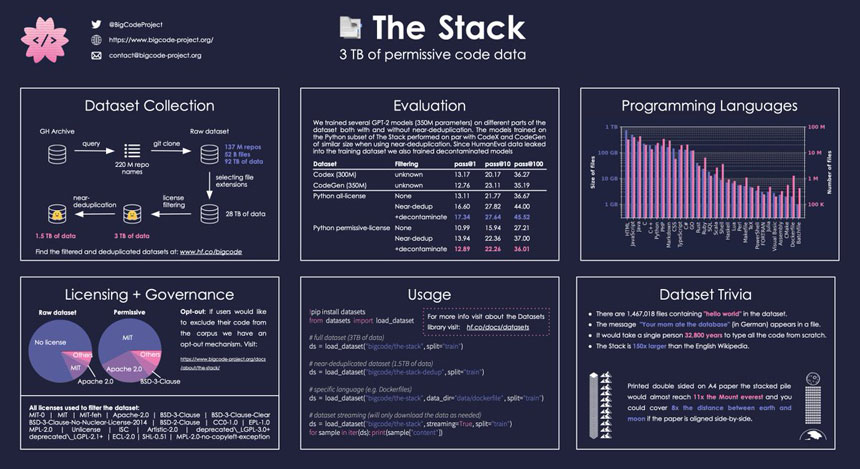
    Unlike Copilot, the 15-billion-parameter StarCoder was trained over the course of several days on an open-source dataset called The Stack, which has over 19 million curated, permissively licensed repositories and more than six terabytes of code in over 350 programming languages.

    Because it’s permissively licensed, code from The Stack can be copied, modified, and redistributed.

    StarCoder isn’t open source in the strictest sense. Rather, it’s being released under a licensing scheme, OpenRAIL-M, that includes “legally enforceable” use case restrictions

    The StarCoder code repositories, model training framework, dataset-filtering methods, code evaluation suite, and research analysis notebooks are available on GitHub as of this week.

    “At launch, StarCoder will not ship as many features as GitHub Copilot, but with its open-source nature, the community can help improve it along the way as well as integrate custom models,”  Leandro von Werra said in TechCrunch.

    The nonprofit Software Freedom Conservancy among others criticized GitHub and OpenAI for using public source code, not all of which is under a permissive license, to train and monetize Codex.

    AI-powered coding tools can cut development costs substantially while allowing coders to focus on more creative tasks. A study from the University of Cambridge found that at least half of developers’ efforts are spent debugging and not actively programming, which costs the software industry an estimated $312 billion per year.