Author: IBL News

  • SAP Litmos Training Platform Sold to a Private Equity Firm

    SAP Litmos Training Platform Sold to a Private Equity Firm

    IBL News | New York

    Private equity firm Franciso Partners (FP) announced this month that it reached an agreement to buy the corporate training platform SAP Litmos (Litmos) from enterprise software provider SAP America, a subsidiary of SAP SE (NYSE: SAP), for an undisclosed amount. The transaction is expected to close by the end of the year.

    The German giant SAP, which offers SuccessFactors in the corporate learning space, determined that this platform overlapped with SAP Litmos.

    “Francisco Partners will be able to provide Litmos the necessary investment, focus and experience to continue to realize its ongoing growth,” said Meg Bear, President and Chief Product Officer, SAP SuccessFactors.

    The new owner ensured that it would keep the existing leadership team. “As an independent company partnering with FP, Litmos will have more flexibility to focus all of its investments and operations on customer success and increase its customer happiness by augmenting platform capabilities, proprietary content library, and third-party integrations,” said Jason Brein and Christine Wang, Partners at Francisco Partners.

    Headquartered in San Ramon, California, and launched in 2007, Litmos was acquired by CallidusCloud in 2011, and later in 2018 by SAP. The training and course library platform claims to host over 30 million users worldwide.

    With approximately $45 billion in capital raised to date, and 20 years of experience, Francisco Partners executed divisional carve-outs of IBM’s Watson Health business (now Merative) and Discovery Inc.’s Discovery Education business.

  • The U.S. Government Cancels $3.9 Billion in Loans for Deceived ITT Students

    The U.S. Government Cancels $3.9 Billion in Loans for Deceived ITT Students

    IBL News | New York

    The U.S. Department of Education announced last week that it will discharge all federal student loans that students borrowed to attend ITT Technical Institute (ITT) from January 1, 2005, through its closure in September 2016. The decision will result in 208,000 borrowers who received $3.9 billion in loans will be discharged.

    This is the second-largest targeted debt relief action the Biden Administration has taken for defrauded borrowers. The first was the $5.8 billion loan cancellation for 560,000 former attendees of Corinthian Colleges.

    The total amount of loan relief approved by the Biden Administration nears $32 billion for 1.6 million borrowers. This includes $13 billion related to institutions that took advantage of borrowers.

    “It is time for student borrowers to stop shouldering the burden from ITT’s years of lies and false promises,” said U.S. Secretary of Education Miguel Cardona. “The evidence shows that for years, ITT’s leaders intentionally misled students about the quality of their programs in order to profit off federal student loan programs, with no regard for the hardship this would cause.”

    The Department also announced that it formally notified DeVry University (DeVry) that it is required to pay millions of dollars for approved borrower defense applications.

    Finally, the Department also announced the approval of discharges for just under 100 borrowers who enrolled in the Medical Assistant or Medical Billing & Coding Program at Kaplan Career Institute’s Kenmore Square location in Massachusetts from July 1, 2011, to February 16, 2012, when the institution stopped enrolling new students.

    The Department of Education announced that it is also “working on new regulations that will permanently improve a variety of the existing student loan forgiveness programs, significantly reduce monthly payments, and provide greater protections for students and taxpayers against unaffordable debts.”


  • OpenStax Will Make Available for Free the Bestselling Organic Chemistry Textbook

    OpenStax Will Make Available for Free the Bestselling Organic Chemistry Textbook

    IBL News | New York

    Cornell Professor John McMurry’s bestselling textbook Organic Chemistry will be published as a free online download by Rice University’s OpenStax open educational program (OER) in Fall 2023.

    This textbook, now in its 10th edition, usually priced over $100, was first printed in 1984. Since then, it has helped over a million students.

    Organic Chemistry has been widely recognized for its scholarship, precise explanations, innovative illustration, and applications for pre-med, allied health, biology, chemistry, and related majors.

    The industry giant Cengage has sold the rights to OpenStax. This will be the 16th textbook Cengage has published among OpenStax’s library of 57 free, openly licensed titles. Cengage will continue to produce some of the auxiliary digital material it has developed for the book over the years, such as interactive study guides, and will sell them at a lower price point than its usual products after an arrangement the company has made with OpenStax.

    “The inclusion of the McMurry text in the OpenStax platform represents a high-quality option that will significantly benefit our organic chemistry students,” said David Powers, Associate Professor of Chemistry at Texas A&M University. “Textbook prices represent a significant cost barrier to student participation in STEM education,” he added.

    “My textbook is the best-selling organic textbook in the world and has been for some time, but it’s expensive. All textbooks are expensive,” Professor McMurry said. “I liked the notion of making my work free for anyone.”

    OpenStax will pay McMurry a licensing fee for the rights, but he will donate it directly to the Cystic Fibrosis Foundation, a nonprofit research center seeking a cure to the life-threatening genetic disorder, in memory of his son Peter, who passed away in 2019 after a decades-long battle with the disease.

    According to a detailed report of Inside Higher Ed, OpenStax, the foremost publisher of OER materials, saw its user base grow by 183 percent from March 2020 to December of the same year, serving over 1 million more students in the 2020-2021 academic year than during the previous year.


  • New York State Government Alerts of Scam Practices in Higher Ed

    New York State Government Alerts of Scam Practices in Higher Ed

    IBL News | New York

    The New York State Division of Consumer Protection issued a scam warning to all post-secondary students as they head back to campus and have to make many decisions and deal with new situations. New York State is home to 300 higher Ed institutions.

    “Whether living away from home for the first time, navigating financial aid, or building credit, students have ample opportunities to get scammed,” stated the NYS Division of Consumer Protection (DCP).

    In this regard, the Secretary of State, Robert J. Rodriguez, said that “the best way for college students to avoid textbook, scholarship or rental scams is to be informed.”

    These are the main tips to prevent scams, according to the authorities:

    • Fake Scholarships, Grants, or Loans. Don’t believe anyone who offers guarantees or pre-approvals for loans or grants. The required paperwork to apply for financial aid is the FAFSA form and it’s free.
    • Unpaid Tuition Scam. Ignore calls claiming that you’ll be dropped from all classes unless you pay tuition immediately over the phone. Always call the school bursar’s office directly to verify your account status. Schools generally send an invoice to alert students of account status.
    • Fake Employment or Internship Offers. Never pay an upfront fee to move forward in an interview process or provide too much personal information, such as your SSN, during the application or interview process.
    • Buying Books Online. Scam artists set up fake websites and offer great deals on expensive textbooks only to never deliver the textbooks leaving the student out of cash and with no textbook. Learn how to identify fake website listings for textbooks and supplies. Before you buy, do your research, and confirm it’s a reputable source. Pay attention to contact information and return policies. Legitimate sites provide a physical address and working phone number in the contact section.
    • Roommate/Rental Scam. Scammers pose as an individual selling or renting a property or as someone on behalf of a property owner. Potential renters are then solicited for money in exchange for promises that the homes will be shown to them or rented to them upon completion of payment. The scam is realized when there is no home for sale, or the property is already occupied.
    • Credit Cards. If applying for a credit card for the first time, do your own research. Students are often targeted with misleading credit card offers that could be a veiled attempt at identity theft or may charge exorbitant annual fees and interest rates.
    • Understand the consequences of identity theft. Higher education students are at great risk of identity theft, but you can minimize these risks by protecting yourself and keeping your information private. It’s important that you understand the consequences of identity theft. Criminals can use your personal information to build a fake identity and open new accounts or loans under your name. Restoring credit and correcting false information can be a costly and lengthy process so it’s best to prevent it before it happens.
    • Keep all personal identifiable information private. Whether it’s in a dorm room, online, or in any social situation, keep all information and documents containing personal information private and securely guarded. Personally identifiable information is information that, when used alone or with other relevant data, can identify a person.
      • Remember to always keep a close hold on your social security number (SSN) and ask why it’s needed before deciding to share it. Oftentimes organizations include the SSN request as a formality, and it may not be mandatory. Ask if you can use a different kind of identifier.
      • Personal documents, checkbooks, credit card statements and other personal papers should be always locked securely.
      • When searching for and applying for student loans or other applications for financial aid, never share personal information via the phone or internet unless you have initiated contact.
      • Shred pre-approved credit card offers and bills before disposing of them.
    • Practice Online Safety
      • Social media is a great place to connect with friends or catch up with the latest viral trend but remember to save some secrets for yourself. Social media posts often reveal sensitive information unintentionally. Cybercriminals look for content that can reveal answers to security questions used to reset passwords, making accounts vulnerable to identity theft.
      • Avoid downloading free music, games, or apps. Free downloads come with a price – identity theft. Often the free apps, music, and games are tainted with keystroke logging malware.
      • Avoid using public WIFI/computer to shop online or pay bills.
      • Monitor privacy settings on all online accounts.
      • Before you get rid of your old laptop or smartphone, protect your data so it doesn’t end up in the hands of an identity thief. For tips on how to protect your data before getting rid of your devices, please see information from this Federal Trade Commission article.

  • Varsity Tutors Acquires Codeverse, a Platform that Teaches Kids to Code

    Varsity Tutors Acquires Codeverse, a Platform that Teaches Kids to Code

    IBL News | New York

    Nerdy Inc. (NYSE: NRDY), the owner of live online tutoring and classes platform Varsity Tutors, announced yesterday the acquisition of Codeverse, a platform that teaches kids to build apps and games with real code, for a non-disclosed amount.

    “Coding is one of the fastest-growing segments in education, yet the tools and resources for students have not kept up with the increasing demand,” said Chuck Cohn, Founder, and CEO of Nerdy.

    Varsity Tutors will integrate Codeverse’s tools as part of its membership offering.

    Codeverse was founded by husband and wife duo Craig Ulliott and Katy Lynch with a mission to “teach a billion kids to code.”

    Nerdy’s flagship business, Varsity Tutors provides 3,000+ subjects and multiple formats through its platform, including one-on-one instruction, small group classes, large format group classes, and adaptive self-study.

    In the second quarter of 2022, Nerdy reported revenue of $42.2 million, up 29% compared to the second quarter of 2021. Gross profit of $28.8 million in the second quarter increased 35.2% year-over-year. The company claims to hold no debt and $121.0 million in cash on the balance sheet.

    Among its investors, Nerdy has Learn Capital, Chan Zuckerberg Initiative, and TCV. To date, the company has raised over $107 million.

    https://youtu.be/uUo9weedgi0

  • AWS Introduces Paid Subscriptions for Learners Looking to Bolster Cloud Skills

    AWS Introduces Paid Subscriptions for Learners Looking to Bolster Cloud Skills

    IBL News | New York

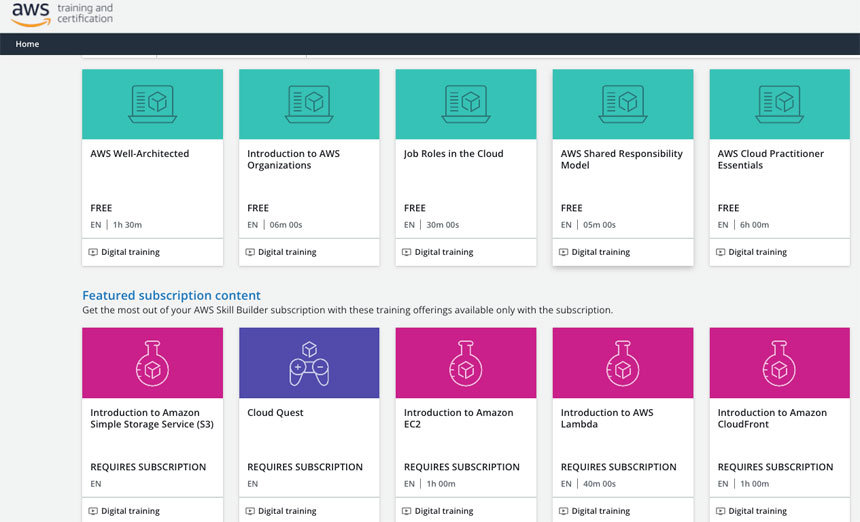
    Amazon introduced AWS Skill Builder and Team subscriptions this month. These are courses about cloud technologies that include hands-on training.

    The foundation courses are available online for free; there are over 500 free courses. The announced subscriptions offer more exclusive content to advance learners’ cloud skills and prepare them for AWS Certification exams.

    The AWS Builder Labs will provide hands-on guided, practical exercises to develop skills for common cloud scenarios. Learners will receive a sandbox AWS account for the duration of the lab.

    The Individual subscription is offered monthly at the price of $29 per month or annually at the price of $299 per year. The subscription can be stopped at any time.

    Team subscriptions cost $449 per learner each year, though high-volume discounts are available. This plan includes enterprise-focused features such as the ability to assign training exercises, progress reports, and integration with a company’s single sign-on (SSO) provider.

    Last November, Amazon launched a bunch of free cloud skills products, such as AWS Skill Builder. Now, the e-commerce giant intends to monetize the offering through monthly subscriptions.

    In the last years, the “big three” cloud companies have introduced training courses to sway developers and companies over to their ecosystems.

    Last year Google introduced Google Cloud Skills Boost with the goal of training 40 million people. Similar to Amazon’s new effort, it charges $29 or $299 on a monthly or annual subscription.

    Despite the global economic climate and a $2 billion loss, Amazon last week reported continued strong cloud growth, with AWS revenues jumping 33% year on year to $19.74 billion in Q2.

  • Skillsoft Will Now Include on Its Platform the Coursera Enterprise Content

    Skillsoft Will Now Include on Its Platform the Coursera Enterprise Content

    IBL News | New York

    Skillsoft (NYSE: SKIL) announced this week an integration partnership with Coursera (NYSE: COUR).

    This means that Skillsoft’s customers, using the company’s Percipio platform, will access Coursera for Business content, that is, over 5,000 courses, 300 SkillSets, and 10,000 bite-size clips.

    “This integration will bring even more choices of high-quality content to learners and deliver increased value as employers seek to reskill and upskill talent to overcome critical skills and talent shortages,” said Apratim Purakayastha, Chief Product and Technology Officer at Skillsoft.

    Recent research conducted by Skillsoft and IDG found that 83% of decision-makers identified training and development as a critical priority within their organization.

  • Docebo Reported an Increase of Sales and Profits in the Second Quarter

    Docebo Reported an Increase of Sales and Profits in the Second Quarter

    IBL News | New York

    Docebo Inc. (NASDAQ: DCBO; TSX:DCBO) reported an increase of 36%, to $34.9 million, on its revenue during the second quarter of 2022 compared to the period in the prior year. A total of 91% is subscription revenue.

    The company showed net income of $2.1 million, or $0.06 per share, compared to net loss of $7.2 million, or $0.22 per share in the same period.

    “With our long-term secular growth drivers intact, we believe our investments will continue to drive the success of our balanced growth strategy,” said Claudio Erba, CEO and Founder of Docebo.

    Docebo disclosed that it had 3,106 customers, an increase from 2,485 customers at the end of June 30, 2021.

    In this reported period, Docebo added Cliplote, Bupa, Eurofins Scientific, Seven Hills Foundation, LeadingRE, and Genuine Parts Company as signature customers.


  • College Endowments Lost 10% In the Last Year

    College Endowments Lost 10% In the Last Year

    IBL News | New York

    College endowment returns in the U.S. are down, largely in part due to double-digit losses in the equity markets and market volatility. In 2021, colleges had the strongest endowment returns in 35 years, with returns of around 27%.

    Colleges typically need annual gains of at least 7% to keep pace with annual spending and inflation. Spending isn’t determined by a single year of performance, but rather by formulas based on three or five-year averages.

    According to data by Wilshire Trust Universe Comparison Service, endowments lost a median 10.2% for the 12 months through June 2022.

    It was the biggest loss since 2009 when returns fell by 17.6%.

    The S&P 500 declined by 12% for the period.

    However, funds with assets of more than $500 million performed substantially better, with a slight gain of 0.9%.

    These larger funds invested more in alternatives such as private equity funds and bonds, while smaller ones rely more on U.S. stocks.

    That’s especially true for larger institutions with more diverse investment strategies.

    “Other than investing in cash, which obviously is not the answer, the second quarter was literally one of the worst quarters for investing,” Mike Rush, a senior vice president at Wilshire, said. “Endowments have this prudent diversifier into alternatives that helped out at least the relative returns during the second quarter.”

    That left smaller endowments in particular with nowhere to hide, although commodities and private equity offered some relief, said Mike Rush, a senior vice president at Wilshire.

    As mentioned, these returns contrasted sharply with the previous year’s results, when endowments returned a median of 27%, their best results since 1986.

    According to Bloomberg, the largest funds posted a median gain of 34% last year, driven by private equity and venture capital, with some colleges faring even better. Washington University in St. Louis notched returns of 65%, and several schools gained more than 50%, including the Massachusetts Institute of Technology, Bowdoin College, and Vanderbilt and Duke universities.

    “All plan types were able to outperform a traditional 60/40 portfolio, particularly larger plans with higher allocations to alternative investments,” said Jason Schwarz, President of Wilshire, in a company press release.

    Bloomberg: Ivy League Endowments Brace for Losses With PE Values Tumbling

  • Learning Platform Kahoot! Issues an Add-On for Google Classroom

    Learning Platform Kahoot! Issues an Add-On for Google Classroom

    IBL News | New York

    The Oslo, Norway-based learning gamification platform Kahoot! announced the launch of the Kahoot! add-on for Google Classroom.

    The company announced that this enhancement will allow “educators and learners to discover, assign, and host interactive sessions without leaving Google Classroom.”

    Kahoot! is one of the first digital learning platforms available as a Google Classroom add-on.

    This summer, Google Classroom announced that it had available fifteen add-ons, including Pear Deck, IXL, and Nearpod.

    These plug-ins allow students to access the tools without remembering and navigating to external websites.

    Admins can set up each add-on from the Google Workspace Marketplace for their district in a few clicks, simplifying the digital classroom experience.