Author: IBL News

  • An AI Model Named BLOOM, Larger than OpenAI’s GPT-3 and MetaAI’s OPT, Will Be Open Sourced

    An AI Model Named BLOOM, Larger than OpenAI’s GPT-3 and MetaAI’s OPT, Will Be Open Sourced

    IBL News | New York

    A large language model (LLM) named BLOOM will be available for free as open source software. These models are used to write essays, generate code, and translate languages.

    Its openness can democratize access to AI technologies, making a deep impact on society, according to experts talking at TheNextWeb.com.

    It’d free AI from big tech labs that have spent millions of dollars developing systems such as LaMDA (Google) and GPT-3 (OpenAI). Training GPT-3, for instance, was estimated to cost up to $27.6 million.

    BLOOM was an initiative bootstrapped and led by AI startup Hugging Face, with strong support from GENCI, the IDRIS team at the CNRS, the Megatron team at NVIDIA, and the Deepspeed team at Microsoft as well as the more than 250 entities (universities, startups, and enterprises) supporting the various participants of BigScience including EleutherAI and the Allen Institute for AI.

    A research project called BigScience created BOOM in 2021.

    The BigScience collaboration that created BLOOM was bootstrapped and led by Hugging Face

    A team of 100,000 researchers from 60 countries and 250 institutions developed BLOOM. The model was trained on the Jean Zay supercomputer in Paris, France.

    At 176 billion parameters, BLOOM is larger than OpenAI’s GPT-3 and MetaAI’s OPT.

    The model can generate text in 46 natural languages and dialects and 13 programming languages.

    BigScience says researchers can use BLOOM for less than $40/hr on a cloud provider. That makes it very affordable.

    It’s available for free to any individual or institution who agrees to the system’s Responsible AI License.

    “Large ML models have changed the world of AI research over the last two years but the huge compute cost necessary to train them resulted in very few teams actually having the ability to train and research them,” explained Thomas Wolf, the BigScience co-lead and Hugging Face co-founder.

    “BLOOM is a demonstration that the most powerful AI models can be trained and released by the broader research community with accountability and in an actual open way, in contrast to the typical secrecy of industrial AI research labs,” said Teven Le Scao, co-lead of BLOOM’s training, in a statement.


  • Skill-Based Premium Pay: An Effective Way to Attract IT Talent, Says Gartner

    Skill-Based Premium Pay: An Effective Way to Attract IT Talent, Says Gartner

    IBL News | New York

    Skill-based pay is one of the most effective ways to hire and retain IT talent, a survey from Gartner stated.

    Around 10% to 12.5% of base salary would convert into premium pay. Individuals should continue to perform well to receive it.

    Gartner says that an advantage of this premium pay is that it be flexed and adapted as businesses and markets evolve.

    Beyond skills, the main way to attract and retain IT talent in 2022 and beyond is through compensation.

    The Gartner Global Labor Market Survey shows that compensation is the No. 1 reason for IT talent attraction and retention today.

    “CIOs must decide how to address skills shortages and whether to offer higher compensation, perks and incentives, training and reskilling to increase retention,” says the research.

    The three effective strategies are:

    • Prioritize raising pay and competitive compensation.
    • Use variable pay components that can be adjusted or removed as talent needs and market conditions evolve. Common variable pay programs include skill-based premium pay, a signing bonus, and retention bonuses.
    • Set effective pay conversations responding with empathy and explaining the value of the rewards, bonuses, benefits, and well-being programs.
  • A Singapore Firm Buys a Private U.S. University and Will Create a Version in the Metaverse

    A Singapore Firm Buys a Private U.S. University and Will Create a Version in the Metaverse

    IBL News | New York

    The Singapore-based Genius Group, listed on the NYSE as GNS, announced yesterday the acquisition of the for-profit Lancaster, California-based University of Antelope Valley (UAV) for an undisclosed amount.

    The closing was completed on July 7th, and it took place three months after Genius Group’s IPO. The group allocated $50 million for purchases since the IPO. An undisclosed portion went to UAV.

    The Asian company said that it plans to build a Metaversity, that is, a digital twin of UAV in the Metaverse, “to deliver education globally in an immersive and engaging way.”

    In addition, it will own an American institution with accredited courses and a central campus with in-person learning.

    Genius Grop claims to host 2.9 million students in 200 countries, ranging from primary and secondary school students to startup founders and entrepreneurs.

    Founders of UAV, Marco and Sandra Johnson, commented: “Roger — Roger James Hamilton is Founder & CEO of Genius Group — has a futuristic vision for UAV and we can’t wait to see where he takes the community and campus with his plans.”

  • 2U/edX Offers Scholarships for Cybersecurity and Data Analytics Boot Camps in Tulsa

    2U/edX Offers Scholarships for Cybersecurity and Data Analytics Boot Camps in Tulsa

    IBL News | New York

    2U Inc’s edX announced a partnership with Tulsa Community College (TCC) and Tulsa Innovation Labs (TIL) to fund a scholarship initiative called the Cyber Skills Center, intended to increase the technical talent pipeline in the area.

    This scholarship will give eighty Tulsa adult learners access to free, fully online boot camp tech training programs in cybersecurity and data analytics.

    The first boot camp cohorts — applications are now open — will begin in October 2022.

    Boot camp graduates will enjoy career opportunities along with credits.

    The scholarship is funded with support from TIL’s partner, the George Kaiser Family Foundation.

    This initiative is part of edX’s Access Partnerships, a public-private partnerships program that connects colleges and universities with local workforce agencies and funding partners to offer adult learners affordable tech skills pathways. Programs currently active include Kansas University, University of Central Florida, University of Oregon, University of Utah, University of Denver, University of California-Davis, University of Minnesota, the University of Texas at Austin, the University of Texas at San Antonio, University of North Carolina-Chapel Hill, University of Wisconsin Extension, and the University of Birmingham.

    Since 2016, over 55,000 learners have graduated from boot camps offered at over 50 colleges and universities that are 2U partners.


  • Harvard University Starts the Search for Its Next President

    Harvard University Starts the Search for Its Next President

    IBL News | New York

    The Harvard Corporation has begun the search for the University’s 30th president. For that, the institution has started to hear diverse views and thoughts from across the Harvard community.

    The presidential search follows Larry Bacow’s announcement that he will step down from the presidency in June 2023, at the end of the 2022-2023 academic year.

    Penny Pritzker, Senior Fellow of the Harvard Corporation and Chair of the presidential search committee, invited the Harvard community to submit advice and nominations of individuals for the role. Advisory committees of faculty, students, and staff will structure community input.

    “We seek a person of high intellectual distinction, with proven qualities of leadership, a devotion to excellence in education and research, a capacity to guide a complex institution through times of change, a talent for advancing progress and collaboration across a wide span of domains, a commitment to embracing diversity along many dimensions as a source of strength, and a dedication to the ideals and values central to our community of learning,” Pritzker wrote in a message to the community.

    She continued: “We aim to identify a president who, like past Harvard leaders, will bring not only a deep devotion to Harvard’s excellence but also a passion for how Harvard — through its myriad programs and extraordinary people — can be a force for good in the world.”

    The members of the presidential search committee are:

    • Timothy R. Barakett, A.B. ’87, M.B.A. ’93, chair, TRB Advisors;
    • Kenneth I. Chenault, J.D. ’76, chair and managing director, General Catalyst Partners, and former chair and CEO, American Express;
    • Paul Choi, A.B. ’86, J.D. ’89, partner, Sidley Austin LLP;
    • Mariano-Florentino (Tino) Cuéllar, president, Carnegie Endowment for International Peace, and former justice, Supreme Court of California;
    • Paul J. Finnegan, A.B. ’75, M.B.A. ’82, co-CEO, Madison Dearborn Partners;
    • Carla A. Harris, A.B. ’84, M.B.A. ’87, senior client adviser, Morgan Stanley, and former chair, National Women’s Business Council;
    • Tyler Jacks, A.B. ’83, Koch Professor of Biology, Massachusetts Institute of Technology, and president, Break Through Cancer;
    • Carolyn (Biddy) Martin, president, Amherst College;
    • Karen Gordon Mills, A.B. ’75, M.B.A. ’77, former administrator, U.S. Small Business Administration, senior fellow, Harvard Business School, and president, MMP Group;
    • Diana L. Nelson, A.B. ’84, co-chair, Carlson Holdings, and former chair, Carlson;
    • Tracy Pun Palandjian, A.B. ’93, M.B.A. ’97, CEO and co-founder, Social Finance;
    • Penny Pritzker (chair), A.B. ’81, founder and chair, PSP Partners, and former U.S. Secretary of Commerce;
    • David M. Rubenstein, co-founder and non-executive co-chair, The Carlyle Group;
    • Shirley M. Tilghman, LL.D. ’04 (hon.), president emerita and professor of molecular biology and public affairs, Princeton University;
    • Theodore V. Wells Jr., J.D. ’76, M.B.A. ’76, partner, Paul, Weiss, Rifkind, Wharton & Garrison LLP.

    Penny Pritzker, a former U.S. secretary of commerce, civic and business leader, nonprofit trustee, and philanthropist, has served on the Corporation since 2018.

  • META Engineers Build a Universal Translator of 200 Languages in Open Source Software

    META Engineers Build a Universal Translator of 200 Languages in Open Source Software

    IBL News | New York

    META, the social media conglomerate META, will open source a newly engineered AI model that can translate into 200 different languages.

    This tool, called No Language Left Behind, is part of Meta’s R&D project to create a universal speech translator, which would help the growth of Facebook, Instagram, virtual reality destinations, and other of its social media properties. The open source approach — with the code available on GitHub — is taken to attract more technicians to the development work.

    In an abstract, Meta explains that this universal translator is “driven by the goal of eradicating language barriers on a global scale” with the help of machine learning technologies.

    From a technical perspective, “it’s a conditional compute model based on Sparsely Gated Mixture of Experts that is trained on data obtained with novel and effective data mining techniques tailored for low-resource languages.”

    The model, that lays the groundwork for a universal translation system, achieves an improvement of 44% BLEU (which stands for Bilingual Evaluation Understudy).

    Technical Description of the Project (PDF)

  • About 222 Million School-Aged Children Around the World Need Education Support

    About 222 Million School-Aged Children Around the World Need Education Support

    IBL News | New York

    Conflicts, wars, refugee displacement, and the COVID pandemic are taking a huge toll on children’s education. Millions of vulnerable children are holding on to the hope that education will allow them to fulfill their dreams.

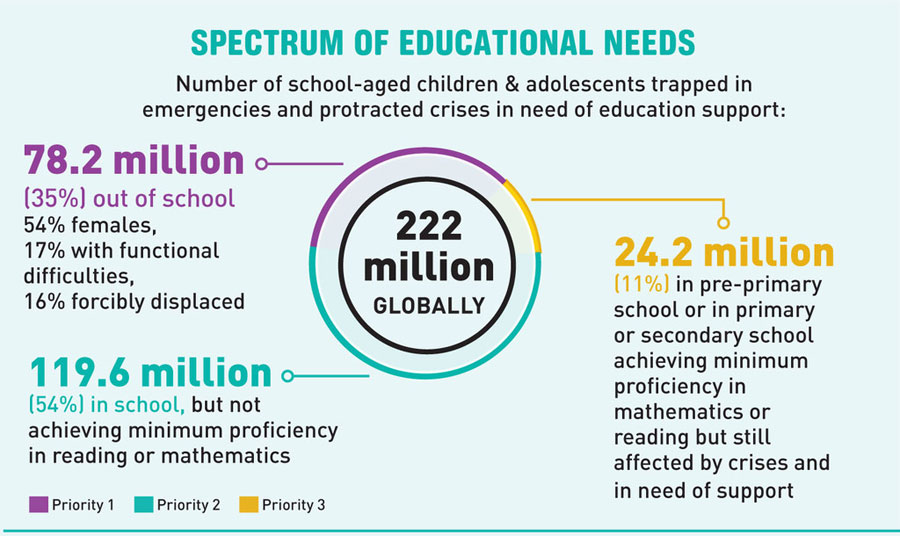
    Specifically, the number of crisis-impacted school-aged children requiring educational support has grown from an estimated 75 million in 2016 to 222 million today, according to a report released by the United Nations.

    This research outlines that of those 222 million girls and boys, as many as 78.2 million are out of school. Close to 120 million in attendance are not achieving minimum proficiency in math or reading.

    In fact, just one in ten crisis-impacted children attending primary or secondary education are actually meeting proficiency standards.

    The most impacted countries are Afghanistan, Democratic Republic of the Congo, Ethiopia, Mali, Nigeria, Pakistan, Somalia, South Sudan, Sudan, and Yemen.

    “We need governments, businesses, foundations, and individuals to support the vital work of Education Cannot Wait (ECW), the UN global fund for education in emergencies and protracted crises,” said the UN Secretary, General António Guterres.

    In September, in New York, during the 77th UN General Assembly, the UN will celebrate a summit titled Transforming Education to deal with this problem. “The Summit seeks to mobilize political ambition, action, solutions, and solidarity to transform education: to take stock of efforts to recover pandemic-related learning losses; to reimagine education systems for the world of today and tomorrow; to revitalize national and global efforts to achieve SDG-4,” states the UN.

    Gordon Brown, UN Special Envoy for Global Education and Chair of ECW’s High-Level Steering Group, called for more financial resources “to ensure that every child and young person can receive a quality education exist in the world”. He added: “Governments, private sector, and foundations can and must unlock these resources”.


  • The tCRIL Organization Releases Nutmeg, the 14th Version of the Open edX Platform

    The tCRIL Organization Releases Nutmeg, the 14th Version of the Open edX Platform

    IBL News | New York

    The Center for Reimagining Learning (tCRIL) — the MIT’s and Harvard University’s non-profit organization that manages the Open edX software and its community — released the 14th version of the platform, called Nutmeg.

    This release spans changes in the code of the edX platform — used at edx.org — from October 15, 2021, to April 11, 2022. The code was cut on April 12, 2022.

    To date, Open edX releases have been Maple, Lilac, Koa, Juniper, Ironwood, Hawthorn, Ginkgo, Ficus, Eucalyptus, Dogwood, Cypress, Birch, and Aspen.

    The next one will be Olive. It will be released on December 9th, 2022. The open-release/olive.master branches will be created two months earlier, on October 10th.

    In a blog post this month, Sarina Canelake, an Open edX engineer, detailed some of the new features, deprecations, removals, and security updates to the code, including overhauls on Tutor.

    The release notes feature additional breaking changes.

  • FINRA Will Invest $90M Coming from Fines to Robinhood to Educate Newer Investors

    FINRA Will Invest $90M Coming from Fines to Robinhood to Educate Newer Investors

    IBL News | New York

    FINRA, the not-for-profit dedicated to protecting investors, approved a $90.1 million initiative to reach and educate new and self-directed investors in June. The funding will come from fines paid by Robinhood Financial LLC in 2021.

    A part of this initiative will be based on promoting compliance by FINRA member firms through education, compliance resources, or ensuring that FINRA’s employees are highly trained in the market, products, and businesses it regulates.

    Also, in June, the SEC (Securities and Exchange Commission) launched a public-service campaign titled “Investomania” to help investors make informed investment decisions and avoid fraud.

    Earlier this month, the Securities and Exchange Commission launched “Investomania,” a public-service campaign aimed at young investors with similar goals.

    This educational campaign reminds investors to do their due diligence when making investment decisions.

    The campaign also reminds investors to take advantage of the free financial planning tools and information on Investor.gov, the SEC’s resource for investor education.

    “With the growing access to markets, it’s as important as ever for investors to take time to educate themselves. I encourage investors to go to Investor.gov for accurate and unbiased investment information,” said SEC Chair Gary Gensler.

    More than 40 million users have accessed Investor.gov since it launched in October 2009, and thousands of investors are testing their investing knowledge by taking a new quiz published each month on Investor.gov/quiz.

    These are some of the videos of the campaign:

    https://youtu.be/av3k_lcGm9g

    https://youtu.be/L3TwZOMm6Wc

    https://youtu.be/6uVGEG5W16Q

    https://www.youtube.com/watch?v=yB7KJ1nlKsM


  • Meta Delivers Five New Certificate Programs in Coursera.org in Software Engineering

    Meta Delivers Five New Certificate Programs in Coursera.org in Software Engineering

    IBL News | New York

    Meta (Facebook) announced five new Professional Certificates on Coursera.org on Software Engineering, a field projected to grow 22% by 2030.

    The programs, designed by experts at Meta, are self-paced, completely online, and cost $49 per month.

    They target professionals that don’t have relevant experience or background in software engineering. The skill areas taught revolve around HTML, CSS, Java Programming, Python, and MySQL.

    Meta said that earning the certificate will grant access to its company Career Program Job Board, a job search platform with 200+ potential employers and career support resources.