Stars perform at Obama Presidential Center opening ceremony
Source: Youtube

Stars perform at Obama Presidential Center opening ceremony
Source: Youtube

Anthropic Gets A Warning, SpaceX Shares Fall on Fourth Day | Bloomberg Tech 6/17/2026
Source: Youtube

Tropical Storm Arthur could bring life-threatening flooding as it hits Gulf Coast
Source: Youtube
IBL News | New York
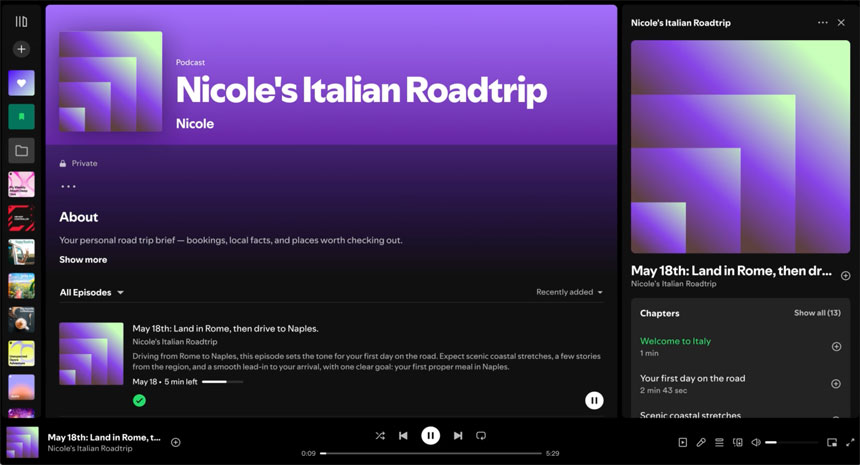
Spotify will introduce, in the coming weeks, as a research preview, a Google NotebookLM – style stand-alone desktop app, named “Studio by Spotify Labs,” designed to explore a topic and, by following personal context, create a podcast about it.
Announced during its 2026 Investor Day, this podcast-generation tool has an agent that can browse the web and fetch personal information to create a personal and private podcast.
The tool can create a daily briefing or a podcast based on the user’s email, calendar, and documents.
All these AI-generated podcasts are saved in the user’s Spotify Library for personal consumption and are not available publicly.
Since Google’s NotebookLM was released, the format for creating podcasts to explore a topic or get daily briefings has been adopted by companies like Adobe and ElevenLabs, as well as apps like Hero and Huxe.
Also, Claude Code or Codex has debuted a command-line tool for users of coding tools to create personal podcasts and save them to their Spotify library.
The company said, “Studio by Spotify Labs understands your Spotify taste across music, podcasts, and audiobooks, while also drawing on world knowledge to help you find the audio you want faster. With your permission, it can take action on your behalf: researching topics, using a web browser, organizing information, and helping complete tasks. It can also connect to the tools you use every day, like your calendar, inbox, and notes.”

Google Made Its Pixel Watch 4 Repairable. Can I Actually Fix It?
Source: Youtube

Stay Tuned NOW Streaming Behind The Scenes! – Jun 17
Source: Youtube

‘Disclosure Day’ Review: Spielberg Gets Paranoid
Source: Youtube

Erin unpacks Iran's edge in agreement with US
Source: Youtube

IBL News | New York
When search has turned on generative AI, the SEO practice is still relevant?
Experts express a resounding yes. Creating valuable, non-commodity content and maintaining a clear technical structure continues to be critical in the goal of converting a user into a subscriber, requesting commercial info, or making a purchase.
Techniques such as AEO (answer engine optimization) and GEO (generative engine optimization) are now part of any SEO setup to improve a website’s visibility in both generative AI search experiences and Google Search.
In this regard, Google has posted a best-practices guide for reframing SEO and optimizing any website for succeeding in AI Overviews and AI Mode searches. This means more opportunities for any website to appear beyond web page links.
According to the company, these AI features are still rooted in Google’s core Search and Qualify systems, which rely on Retrieval-augmented generation (RAG) and Query fan-out — a set of concurrent, related queries generated by the model to request more information and fetch additional relevant search results to address the user’s query.
Creating unique, valuable, good content requires, according to Google:
Some topics circulating on the internet around generative AI and Google Search are unnecessary, Google says, such as LLMS.txt files and other “special” machine-readable markup files; breaking up content into tiny pieces for AI to better understand it; rewriting content just for AI systems; adding inauthentic “mentions”; and overfocusing on structured data.
Overall, prioritizing effective SEO strategies over “AEO/GEO hacks” is a mistake.

SpaceX Soars On Third Trading Day, Seals Cursor Takeover | Bloomberg Tech 6/16/2026
Source: Youtube