Author: IBL News

  • A Survey Shows that Many College Students Struggle to Maintain Focus and Discipline in Distance Learning

    A Survey Shows that Many College Students Struggle to Maintain Focus and Discipline in Distance Learning

    IBL News | New York

    Most U.S. college students whose schools have recently made the switch to online learning, remain anxious about the new remote instructional environment. Many students are worried about their ability to adjust to learning completely outside of the classroom setting.

    This is the main conclusion from a survey conducted by Barnes & Noble Education the week of March 23, 2020, among 432 college students across the U.S.

    More than half (64%) of students expressed concern over maintaining focus and discipline, unsure if they would be able to motivate themselves over the long term to do work remotely. They noted “my house is not the proper environment in which to do work” and that they “easily get distracted while on the computer.”

    However, the survey found that 60% of students say they are technically prepared for the switch to online classes, while the rest are less certain, saying that they need time to adjust to the transition.

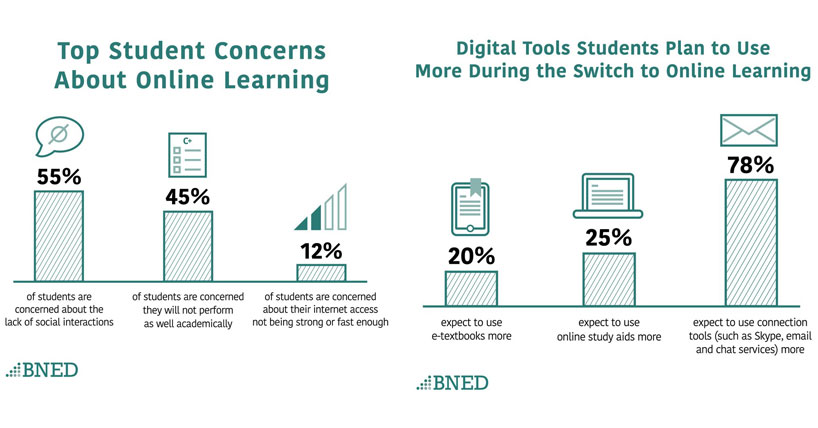
    Over half (55%) of students said they were concerned about the lack of social interactions, saying they learn better when they are with their fellow students, and 45% of students are concerned they will not perform as well academically under these circumstances. A smaller percentage of students have technological worries, with 12% citing concerns about their internet access not being strong or fast enough.

    “This abrupt change in lifestyle has also had social and emotional impacts on students, and many are grappling with how to succeed academically in the midst of this disruption,” said Lisa Malat, President, Barnes & Noble College.

    In addition to using digital learning platforms to view lectures, surveyed students are planning to use a suite of digital tools to continue their education online.

    While the majority of students agreed that schools and instructors are prepared for the switch to online learning, 24% expressed doubts about their college or university’s preparedness, and 33% expressed doubts about their instructors’ preparedness.

    Communication is key in times of uncertainty. Frequent check-ins between professors and students can play a crucial role in maximizing online learning,” said Malat. “Whether it’s through video conferences or a simple phone call, holding regular ‘office hours’ can help keep students feel engaged and provide them with the additional support they need to navigate this transition.”


     

  • At-Home Testing Solutions Unveiled for AP Programs, TOEFL and GRE Amid the Covid-19 Pandemic

    At-Home Testing Solutions Unveiled for AP Programs, TOEFL and GRE Amid the Covid-19 Pandemic

    IBL News | New York

    The College Board will offer an at-home exam for the AP programs from May 11th through May 22nd. [See exam dates here].

    In late April, the College Board plans to provide AP students and educators with information on how to access the testing system on test day, the institution announced in a blog post.

    Students worldwide will take each subject’s exam at the same time and will have 45 minutes to complete them.

    “We want to give every student the chance to earn the college credit they’ve worked toward throughout the year,” Trevor Packer, Senior Vice President of AP and Instruction for the College Board, said.

    On the other hand, ETS (Educational Testing Service) introduced another at-home solution for the TOEFL and GRE general test amid coronavirus pandemic. Testing through the remote proctoring service, by ProctorU, has been active since last week.

  • O’Reilly Eliminates Its Face-to-Face Conference Business, Laying Off Nearly 100 People

    O’Reilly Eliminates Its Face-to-Face Conference Business, Laying Off Nearly 100 People

    IBL News | New York

    O’Reilly Media –a company known for its software conferences and how-to manuals for computer programming– completely shut down its in-person event division, laying off nearly 100 people, including most of its conference team.

    Laura Baldwin, President of O’Reilly Media, attributed the decision to the Coronavirus’ rough business environment, citing “the toll COVID-19 has taken on families, livelihoods, and the economy.”

    “Without understanding when this global health emergency may come to an end, we can’t plan for or execute on a business that will be forever changed as a result of this crisis,” she added.

    O’Reilly had already postponed its March Strata Data & AI Conferences in London and San Jose and combined it with an online Strata Data & AI event scheduled for September.

    The plans of the company created by visionary entrepreneur Tim O’Reilly are uncertain. “We’ll continue to invest in and grow O’Reilly online learning, supporting the 5,000 companies and 2.5 million people who count on our experts to help them stay ahead in all facets of business and technology,” the organization stated on its event page.

    On Monday 6th, O’Reilly, in an attempt to create good PR, issued a press release mentioning that “it was opening up access to its learning platform for all government agencies, in the light of the health crisis. Some of the content includes:


  • An edX and Harvard Course to Train Clinicians on Mechanical Ventilators for Covid-19

    An edX and Harvard Course to Train Clinicians on Mechanical Ventilators for Covid-19

    IBL News | New York

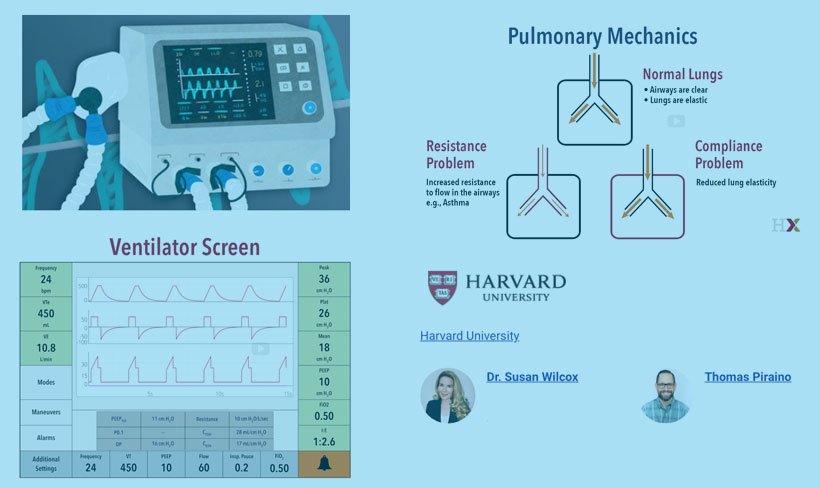
    Harvard University and edX launched on Monday a free online course that addresses an urgent need for healthcare clinicians: understanding mechanical ventilation so they can assist in the operation and professionally treat Coronavirus patients.

    The 2 to 5 hours open course “Mechanical Ventilation for COVID 19” will help prepare licensed non-ICU hospital professionals to assist in this subject during the COVID-19 pandemic.

    As the number of patients requiring critical care continues to grow, medical professionals who do not normally work in an ICU setting are being reassigned to the ICU.

    The course was developed in collaboration with the American Association for Respiratory Care, Dr. Susan Wilcox and Thomas Piraino.

    Wilcox is the Division Chief, Critical Care at Massachusetts General Hospital (MGH) in Boston leading the team addressing the influx of COVID-19 patients, and Piraino is the Clinical Specialist for Mechanical Ventilation for the Centre of Excellence in Mechanical Ventilation at St. Michael’s Hospital in Toronto.

    Wilcox and Piraino wanted to create a resource that would help not only their teams but teams across the globe who are experiencing the same urgent challenge.

    While the global shortage of ventilators remains a major issue, proper training is another challenge that hospitals will face, and this edX.org course aims to address that need.

    “Bringing together Wilcox and Piraino’s experience with edX and Harvard’s expertise in delivering high-quality online courses that deliver practical knowledge that can be applied immediately, this course was rapidly developed and made available for medical professionals anywhere,” explained edX on a press-release.


    Update: Licensed medical professionals who complete the course and pass a quiz can claim up to three continuing education credit hours for no fee. 


  • LabXchange, Harvard’s Science Platform, Provides a Free Tool to Create Online Classes and Pathways

    LabXchange, Harvard’s Science Platform, Provides a Free Tool to Create Online Classes and Pathways

    IBL News | New York

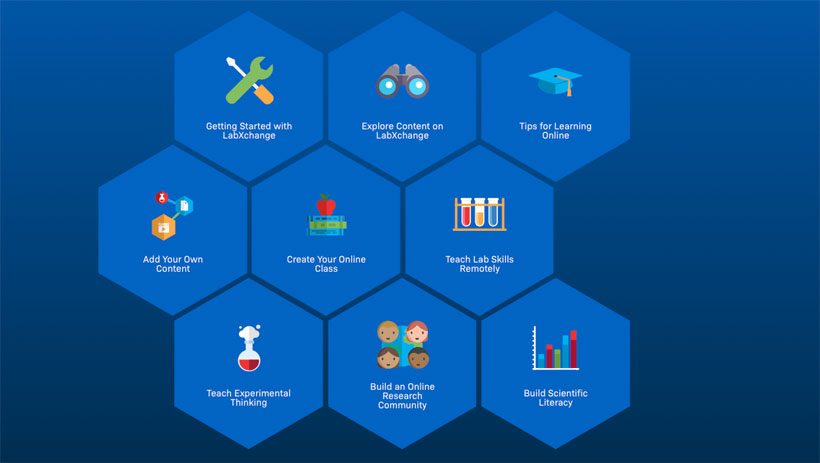
    LabXchange.org, the Open edX-based platform created by Harvard University and Amgen Foundation, is providing a free tool for educators to create online and hybrid classes and pathways with science content.

    The platform lets instructors select vetted content from Harvard, OpenStax, Khan Academy and other sources, remix it with private materials, build collaboration and share ideas with a small group of learners –with a maximum of 100 users.

    “Due to economic and geographic limitations, millions of students worldwide lack opportunities to engage meaningfully in the scientific process, which has led to significant gaps in scientific literacy and in diversity across scientific fields,” explained Robert Lue, Director at the platform.

    LabXchange is essentially designed to support educators in creating customized learning experiences. The content-type offered on the LabXchange library includes video, text, image, simulation, assignment, pathway, narrative, assessment, and cluster. Some animations allow learners to learn by doing in the digital space.

    Subject areas include Biological Sciences, Chemistry, Science & Society, Physics, Health Science, Global Health, Prepare For Careers, Prepare For College, Scientific Process, Online Learning, Professional Development, and Prepare for Graduate School.

    An interesting pathway content available at the LabXchange platform is “Coronavirus: From Bats to Humans to Pandemic”.

    Soon, teachers will be able to track students’ progress and individually contact learners.

    This video below explains the main features:


    These two tutorials recently posted, shows how to create a class and a pathway at LabXchange.


    More stories about LabXchange at IBL News

  • Zoom Continues Its Marketing Effort Despite Reports Questioning Its Security

    Zoom Continues Its Marketing Effort Despite Reports Questioning Its Security

    IBL News | New York

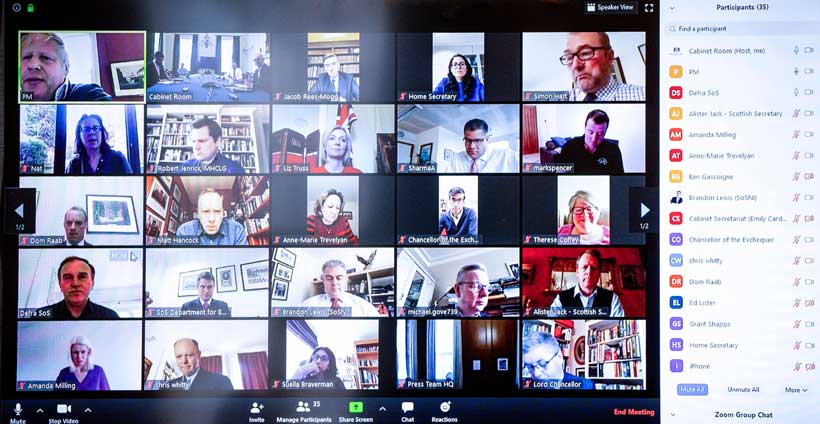
    Zoom.com, the increasingly popular video conferencing service, announced yesterday additional security measures to combat the hacking phenomenon of “Zoombombing”.

    As a result, Zoom announced on Friday that it will enable passwords and turn on waiting rooms by default starting on April 5.

    “We’re always striving to continue to deliver you a secure virtual meeting environment,” the company said in a statement.

    Meanwhile, Skype released a new feature yesterday in an attempt to compete with Zoom, which has dominated the video calling conversation ever since the pandemic started. Skype users can now start a video meeting and invite people to it without using the app or even having an account; this process is done completely on the web.

    Skype, owned by Microsoft, is hoping to bring people over its service, especially in the midst of Zoom’s security and privacy issues.

    In fact, researchers at the University of Toronto found that meetings on Zoom are encrypted using an algorithm with well-known weaknesses, and sometimes using keys issued by servers in China, despite when meeting participants are al being in North America.

    According to The Intercept.com, these researchers found that Zoom protects video and audio content using a home-grown encryption scheme, that there is a vulnerability in Zoom’s “waiting room” feature.

    They concluded in a report for the university’s Citizen Lab — widely followed in information security circles — that Zoom’s service is “not suited for secrets” and that it may be legally obligated to disclose encryption keys to Chinese authorities and “responsive to pressure” from them.

    The New York Times: Zoombombing’ Becomes a Dangerous Organized Effort

  • Smithsonian Open Access: Millions of 2D and 3D Digital Items Without Copyright Restriction

    Smithsonian Open Access: Millions of 2D and 3D Digital Items Without Copyright Restriction

    IBL News | New York

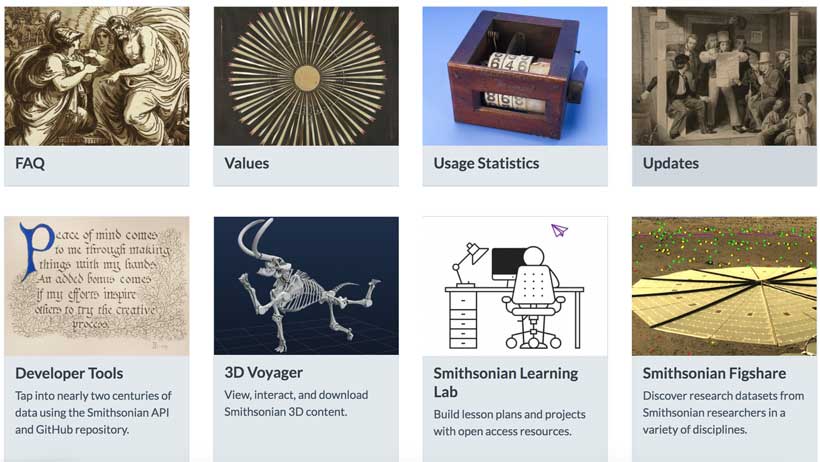
    The Smithsonian launched an open-access website that removes any copyright restriction from 2.8 million images on its digital collection, labeling them with the Creative Commons “Zero” designation.

    Smithsonian Open Access allows users to download, share, and reuse millions of 2D and 3D digital items, including images and data from 19 museums, 9 research centers, libraries, archives, and the National Zoo.

    The Smithsonian Institution plans to continue to add another 200,000 images by late 2020.

    “Through this initiative, we are empowering people across the globe to reimagine and repurpose our collections in creative new ways,” Smithsonian Secretary, Lonnie G. Bunch III said.

    Since the opening of the initiative, five weeks ago, nearly a quarter-million assets have been downloaded by users, and almost 15 million assets have been viewed.


  • Zoom Comes Under Scrutiny Because of the “Zoombombing” Attacks Amid the Pandemic Outbreak

    Zoom Comes Under Scrutiny Because of the “Zoombombing” Attacks Amid the Pandemic Outbreak

    IBL News | New York

    The interruption Zoom video meetings with inappropriate content, known as “Zoombombing”, has become a widespread practice, amid the coronavirus outbreak.

    A simple search on Twitter of #zoombombing provides an idea of how annoyed is the educational community with this kind of attack. Complains about lack of action of the Zoom corporation, along with demands to the uprising startup to create an urgent solution, are everywhere.

    The magnitude of the problem is reflected in this testimonial that arrived at the IBL News desk.

    Yesterday we had the first online workshop (using Zoom, not using the Webinar mode). We plan ahead, we had a system set up to answer questions, mentors answering those questions, etc, etc. After 30 minutes of the event, we got attacked by trolls that rush into the channel and started to curse, insult the host and participants, writing racist/misogynistic/homophobic things on the chat, etc, etc, etc. It was a really shitty situation, but everyone managed to go forward by locking the meeting and start removing trolls one by one. This seems to be a problem that many people are suffering, and I know some solutions like providing a password, but still, once one malicious person gets the password, the whole event can go to the trash if not properly handled. Besides choosing a platform to go online, we need to have an action plan in case of this kind of attacks, Maybe having an admin on each “online room” with some procedure in case of emergency will be enough, but still, I guess we should try to find a solution to the problem before having the event.

    In the last weeks, during the pandemic, Zoom’s popularity has skyrocketed as millions of homebound people have settled into new remote work and learning routines. The platform has been used for everything from business meetings and yoga classes to virtual happy hours. But the increased use of Zoom, along with the free versions of Zoom, has brought more opportunities to hack into it, spewing hate speech and showing porn.

    Unlike other types of cyberattacks, hacking into a Zoom meeting can be relatively easy if certain security settings aren’t turned on, experts say. Zoom invites often are posted on social media to increase attendance, which can make them more vulnerable. Some argue Zoom’s default settings could be more secure.

    On Monday, New York State Attorney General, Letitia James, questioned the videoconferencing tool Zoom about its privacy and security policies. She sent a letter to Zoom asking what security measures it has put in place to deal with the increased traffic. The New York Times, which obtained a copy of the letter.

    Zoom has come under scrutiny because of “Zoombombing.” Professionals, teachers and faculty members have reported people who have accessed their Zoom conferences and yelled profanities, showed pornography or displayed racist or anti-Semitic images.

    On Sunday, Zoom said in a blog post that it has implemented safeguards to protect our users’ privacy, “which includes robust and validated controls to prevent unauthorized access to any content that users share during meetings.” However, these policy changes have not stopped the attacks, according to the experts.

    Last week, the FBI release the following recommendations for how to handle “Zoombombing.”

    • Don’t make meetings public. Zoom lets users make meetings private by requiring a meeting password or using a waiting room feature to control who’s admitted.
    • Don’t share a link to the meeting on a public social media post. Send the link to people directly.
    • Change the screen-sharing option in Zoom to “host only.”
    • Ask people to use the latest updated version of Zoom.
    • Ensure your organization’s telework policy addresses requirements for information security.

    On the other hand, two psychology instructors at the University of California, Riverside (URC), shared 35 how-to Zoom tutorials for teaching colleagues with this tool.

    CNN: Zoom faces questions over privacy

  • edX & Platforms | April 2020: Remote Access Program, Coursera, Nvidia, Udacity, Blackboard…

    edX & Platforms | April 2020: Remote Access Program, Coursera, Nvidia, Udacity, Blackboard…

    Newsletter format  |  Click here to subscribe ]

    APRIL 2020 – NEWSLETTER #26  |  Breaking news at IBL News  |  Noticias en Español


    Coursera | edX 

    • Coursera and edX Launch Initiatives to Support Universities Impacted by the Outbreak

    • IBM, Microsoft, Harvard, MIT, and 40 Universities Join the edX ‘Remote Access’ Program

    • Harvard University’s President, Lawrence Bacow, Tests Positive for Coronavirus


    Open edX

    • NVIDIA Issues a Free Certificate Course About AI Video Analytics on Its ‘Deep Learning Institute’ Platform

    • The Open edX Annual Conference Suspended Amid the Virus Concerns


    Learning at Scale

    • Udacity.com Offers One Free Month Access to Nanodegree Programs

    • MiriadaX, with 4M Spanish-Language Learners, Continues to Look for a Buyer


    Other Platforms

    • Blackboard Shifts Away From the Open Source Business By Selling Its Moodle Based Business

    • Facebook Unveils a Virtual Community to Fight Rumors About Covid-19


    2020 Upcoming Events   [All of the conferences are canceled or moved online due to the Coronavirus – CDC Recommendations]

    • Education Calendar  –  APRIL  |  MAY  |  JUNE  |  JULY – DEC  |  Conferences in Latin America & Spain


    This newsletter is created in collaboration with IBL Education, a New York City-based company specialized in open-source learning platforms. Read the latest IBL Newsletter   |  Archive of Open edX Newsletters

  • Learning At Scale | March – April 2020: Covid-19 Pandemic, Scammers, Free Resources, Initiatives, Johns Hopkins…

    Learning At Scale | March – April 2020: Covid-19 Pandemic, Scammers, Free Resources, Initiatives, Johns Hopkins…

    Newsletter format  |  Click here to subscribe ]


    MARCH – APRIL 2020  –  NEWSLETTER #32 |  Breaking news at IBL News  |  Noticias en Español


    Covid-19 Pandemic

    • How to Protect Yourself From Coronavirus’ Scammers Who Try to Steal Money or Personal Information

    • Johns Hopkins University Updates the Coronavirus Map by Adding Local Data

    • Historic $2.2 Trillion Coronavirus Relief Bill Provides Funding for Higher Ed and Help for Students with Loans


    Free Resources

    • Don’t Let Education Fall in the Curve of Covid: An Extensive Resource Website with Tools and Services

    • Free Educational Resources in Times for Adjusting to the New Complicated Environment


    Instructure / Canvas LMS

    • Thoma Bravo Completes the Acquisition of Instructure and Appoints an Interim, CEO J. Charles Goodman

    • Adobe Creative Cloud and Spark Will Be Integrated Inside the Canvas LMS

    • Canvas LMS Creates a Toolkit for Contingency Planning Amidst the COVID-19 Outbreak


    Conferences

    • GW Plans a Workshop for STEM Faculty Who Teach Engineering through Computing

    • NVIDIA’s Grand Virtual Conference After Closing Its In-Person Annual Reunion

    • The ASU-GSV Summit Postponed to September 29th. AAC&U Conference Canceled

    • The City of Austin Cancels SXSW March Festival and Plans a Virtual Conference


    2020 Upcoming Events   [All of the conferences are canceled or moved online due to the Coronavirus – CDC Recommendations]

    • Education Calendar  –  APRIL  |  MAY  |  JUNE  |  JULY – DEC  |  Conferences in Latin America & Spain


    This newsletter is created in collaboration with IBL Education, a New York City-based company specialized in open-source learning platforms. Read the latest IBL Newsletter   |  Archive of Open edX Newsletters