Author: IBL News

  • IBM Launches a Blockchain Credentials Network – A Community College At The Forefront

    IBM Launches a Blockchain Credentials Network – A Community College At The Forefront

    IBL News | New York

    Central New Mexico Community College will soon have the ability to store students’ academic records on the blockchain in a way that is nearly impossible to counterfeit. This way students will have the ability to send their transcripts to employers without having to involve the college registrar.

    Once the system is completed (a user interface and public website are still in development), students will then need to authorize the college to release their academic transcripts, and select how much details they would want to reveal.

    This project is part of IBM’s initiative called the “Learning Credential Network”, intended to streamline hiring processes with verifiable certificates from training programs and skill boot camps, along with conventional degrees.

    A recent IBM study found that over 120 million workers in large economies may have to retrain within three years due to AI automation. Big Blue, along with an education consortium of US-based institutions, hopes to solve this by supporting a diverse range of learning credentials on a blockchain platform.

    The consortium consists of the National Student Clearinghouse, which verifies academic qualifications for over 3,700 institutions. Ethos Veterinary Health’s VetBloom, a learning ecosystem for veterinarians, and Central New Mexico Community College, are innovators in blockchain with over 23,500 students.

    Blockchain technology enables immutably stored, verifiable credentials to be shared at the owner’s discretion.

    This helps both job seekers, navigating an often complex web of opportunities, and employers, who are looking for specific and authentic qualifications. With the inclusion of organizations like the Clearinghouse, trusted certificates can be provided, reducing the risk of fraud.

    IBM has participated in another credentials project, Job-Creds, with blockchain identity leader Sovrin and Workday. Last month, Workday released its own blockchain qualifications platform, also for job applicants.

    A more similar project to today’s is PwC’s ‘Smart Credentials’, tackling resumé fraud while offering self-sovereign identity. Deloitte, Korea’s Shinhan Bank, and US Homeland Security have also explored credentialing.

    Another interesting initiative points out to UK’s ed-tech startup, Education Index. It recently launched Libereka, an international student recruitment platform that allows students to manage university application materials via a blockchain account.


    UK’s Libereka Launches an Innovative Platform

    Libereka stores students’ academic credentials, transcripts, and letters of recommendation on the blockchain.

    Users can apply to multiple universities and for scholarships with one application form and one set of documents. A personalized dashboard recommends degrees and programs based on the student’s profile and goals.

    “Libereka makes recruiting students simpler, cheaper and more efficient, freeing up time for universities to focus on what really matters: securing the best and brightest students,” said Soumik Ganguly, CEO of Education Index, in a statement. “Millions of prospective students around the world currently rely on a patchwork system of application support. This model is inefficient and we are streamlining that process for universities as well as applicants.”

    The platform is free for students, while universities pay an access fee.

  • Black Friday and Cyber Monday: edX, Pluralsight, Udemy and Skillshare Join the Marketing Season

    Black Friday and Cyber Monday: edX, Pluralsight, Udemy and Skillshare Join the Marketing Season

    IBL News | New York

    This year, online education was not immune to the marketing craziness of Black Friday and Cyber Monday.

    Even edX.org, the nonprofit organization founded by Harvard and MIT, and focused on higher education at scale, fell into the guerrilla promotional techniques after the Thanksgiving day.

    Competitors, Coursera and Udacity, the two Silicon Valley largely founded unicorns, contradicted their commercially aggressive reputation and stayed calm. Also, Microsoft’s LinkedIn Learning and 2U’s GetSmarter short courses unit remained quiet.

    On Thursday, edX announced that something big was coming: “Mark your calendars and head over to edx.org tomorrow for the reveal.”

    That big event was no other than a 20% discount on the purchases of courses and programs, as stated on their website, Facebook, Twitter, and LinkedIn:

    edX’s offer highlighted a selection of 24 programs and courses about Data Science, Business, and Computer Science, although the code could be applied to other courses, as MITx reminded on its Twitter account.

    Another large company, Pluralsight (NASDAQ: PS), with a whopping market cap of $2.3 billion, offered a discount of 40% on an annual subscription: prices on regular subscriptions dropped from $299 to $179, and from $449 to $269 on premium. (Connected or not to the deal, Pluralsight’s stock grew 2.23% yesterday.)

    Black Friday savings were also heavily promoted on Udemy.com, with one of the largest catalogs of courses (over 100,000 titles).

    Udemy launched thousands of courses starting at $10 when those classes normally cost $100.

    Skillshare didn’t miss the shopping opportunity and went with a “super sale”.

    Finally, Teachable.com, the course creation platform, launched its first-ever discount (10% to 20%) on basic and professional membership plans. Its main competitor, Thinkific, joined the marketing season, too.

  • Today, MOOCS Are Focused on Online Degrees and Corporate Training, Says Dhawal Shah

    Today, MOOCS Are Focused on Online Degrees and Corporate Training, Says Dhawal Shah

    IBL News | New York

    “In the last few years, MOOCs have been generally focused on micro-credentials and certifications; now, it is more about online degrees and corporate training,” Dhawal Shah, Founder and CEO at Class Central, explained in a video interview with IBL News. [Watch it below]

    The four main MOOC platforms – Coursera, edX, Udacity, and Future Learn – are certainly pursuing revenue-generating opportunities. However, “it seems a sense of balance has been restored since now not everything is behind a paywall,” he adds.

    In terms of the players, Coursera and Udacity, led by some Silicon Valley’s top VC fund, are behaving aggressively, by making fast changes and spending more. Although they are not profitable yet. Coursera made $140 million in revenue last year, and Udacity, $90 million. Meanwhile, edX was in the range of $60 million, according to the creator of Class Central.

    The case of Udacity is more colorful. “It is always a roller coaster with Udacity. Hard to predict. They are more suitable to get acquired; they have their own content and one of the most popular credentials in technology, the Nanodegree.”

    Finally, Dhawal Shah spoke about his own company – “profitable, with a remote-based team, and a clear goal of making online education to work for everyone”.


  • Duke University Introduces an Open Source Tool as an Alternative to a Monolithic LMS

    Duke University Introduces an Open Source Tool as an Alternative to a Monolithic LMS

    IBL News | New York

    Duke University announced Kits, an open-source, next-generation digital learning environment (NGDLE).

    “Relying on any single solution, including the LMS, is s a short-sighted technology strategy,” Jolie Tingen, Product Manager at Duke, explained in an article at Educause Review. “No monolithic system can provide all learning communities with a completely optimal experience. Learning is maximized when appropriate technologies are used in conjunction with evidence-based pedagogies.”

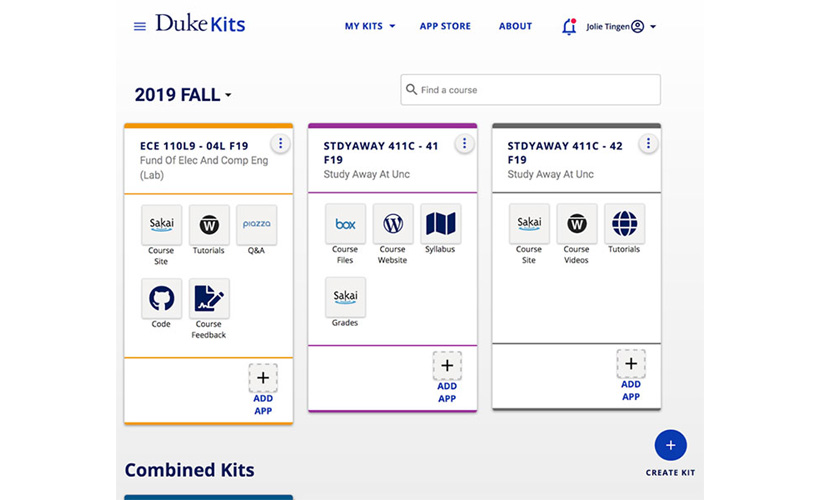
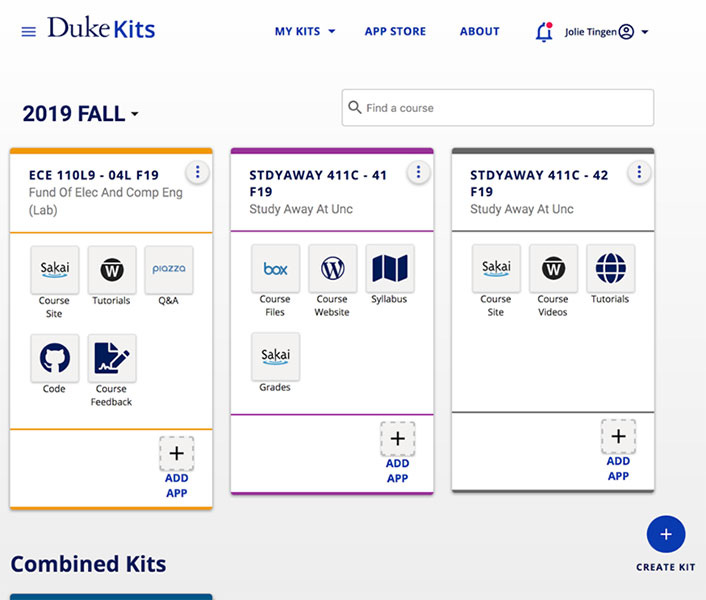
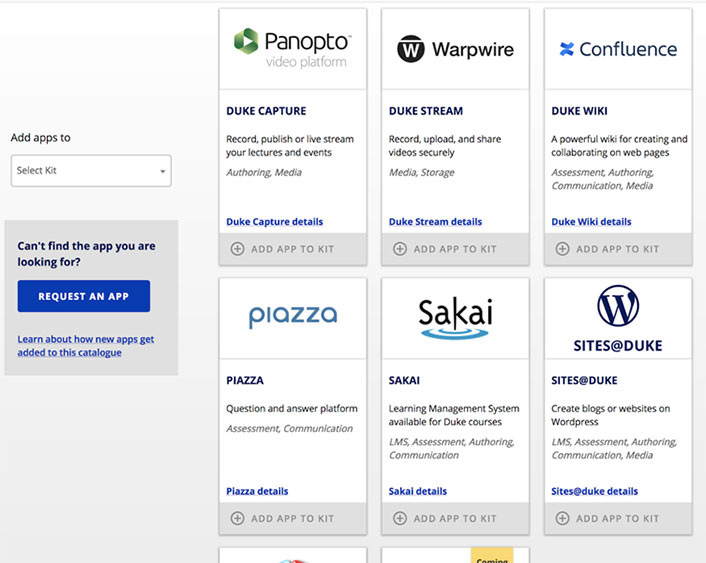
    Kits features a card (a “kit”) for every course. Instructors can add apps to their kits, and those apps are automatically shared with everyone in their courses.  (See images below).

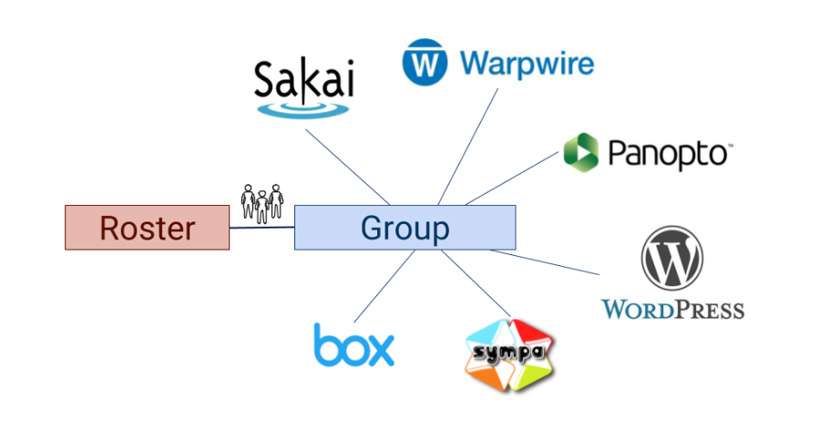
    Developed by Duke’s Learning Innovation and the Office of Information Technology,  Kits – now released as an alpha version – evolved from a home-grown group management solution and it was developed outside the LMS. “It brings together the centralized student access points of the LMS with the flexibility and power of an app-based system.”

    Currently, eight applications are included on Kits, and three more are expected to arrive this year. Learning analytics are in the roadmap, too. The integration was done via LTI standard or API. In addition, Kits comes with a “custom link” option that allows both instructors and students to add any share-by-link application.

    Kits is built with Ruby on Rails (Backend Framework), React (Frontend Framework), Grouper (Group Management), Shibboleth (SSO) and LTI.

    All of the work is open at learnwithkits.com, Duke’s public GitHub repository.


  • edX’s View for 2020: MicroBachelors Programs and Stackable Modular Credentials for Full Degrees

    edX’s View for 2020: MicroBachelors Programs and Stackable Modular Credentials for Full Degrees

    IBL News | New York

    In 2020, edX will launch its “MicroBachelors programs, a series of career-relevant, credit-backed undergraduate online courses”, the organization announced yesterday on its 2020 Impact Report“MicroBachelors programs will be transformative for learners unable to attend or afford traditional bachelor’s degree programs.” 

    In the report, edX highlights its belief that higher education will be “modular and stackable”. “Our vision for the future of education is built on the stacking of modular credentials, sometimes from different institutions, into new types of degrees and programs that fit the needs of learners where they are, no matter their background.”

    Anant Agarwal, CEO at edX, expressed this view at a recent interview and conference.

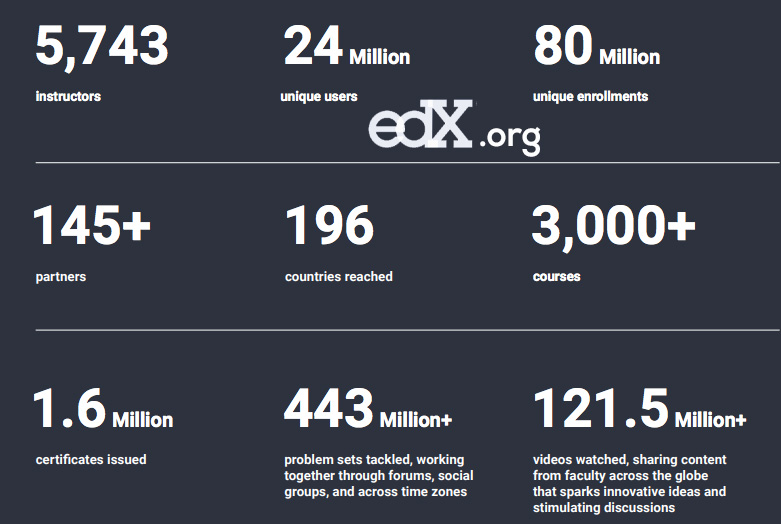
    edX’s 2020 Impact Report is the result of a discussion started earlier this year by the organization itself. Essentially, it’s a 9-page document that explores the milestones accomplished by edX since its foundation in 2012.

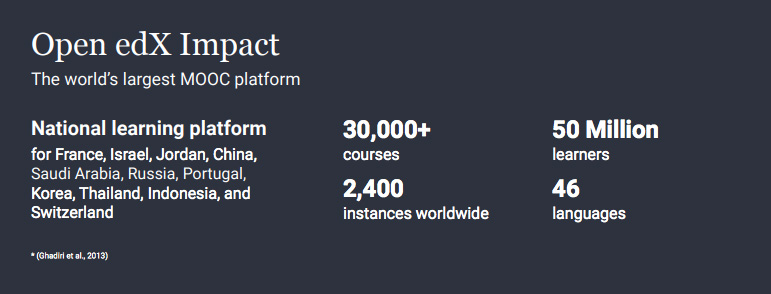
    Its impact is especially notorious regarding the Open edX open-source tool, which has become the learning-at-scale national platform in France, Israel, Jordan, China, Saudi Arabia, Russia, Portugal, Korea, Thailand, Indonesia, and Switzerland, as well as the preferred choice of 2,400 instances. Overall, there are over 30,000 courses built on Open edX, and 50 million learners taking classes in 46 languages.

    The edX.org educational portal is featured as “the Classroom to the World.” “By opening the classroom through MOOCs, edX brings the best courses from the best schools to millions of learners around the world.”

    edX 2020 Impact Report in PDF

  • Novartis Will Grant Employees Free Tuition to Earn Two Master’s Degrees on Coursera

    Novartis Will Grant Employees Free Tuition to Earn Two Master’s Degrees on Coursera

    IBL News | New York

    Novartis will grant eligible employees free tuition to earn two Coursera’s MastersMaster of Computer Science in Data Science from the University of Illinois or the Master of Applied Data Science from the University of Michigan.

    This way, Novartis, a leading pharmaceutical multinational with 108,000 employees, expands its initial agreement with Coursera, which was based on accessing of 3,600 courses.

    “Novartis is the first Coursera for Business customer to offer master’s degrees through our enterprise platform, setting a model for creating diverse and flexible pathways within an institutional learning context,” Leah Belsky, SVP of Enterprise at Coursera, stated in a blog post announcing the agreement.

    “These efforts enable Novartis to boost employee engagement and attract and retain talent in the long-run,” she added.

  • WordPress: Jetpack Vulnerability and Recurring Payments Button with Stripe

    WordPress: Jetpack Vulnerability and Recurring Payments Button with Stripe

    IBL News | New York

    Over five million admins and owners of WordPress websites with the Jetpack plugin installed are urged to apply a critical security update.

    The Jetpack 7.9.1 release will prevent potential attacks that could abuse a vulnerability that has existed since Jetpack 5.1 (July 2017), advised Automattic, the company behind WordPress.

    The vulnerability was found in the way Jetpack processed embed code.

    The security issue damaged the reputation of Jetpack, given that this plugin is widely used since it provides security, performance, and site management features, including site backups, secure logins, malware scanning, and brute-force attack protection.

    [ Update to the 7.9.1 version through the WordPress dashboard, or manually download the Jetpack 7.9.1 release. ]


    Recurring Payments Feature with Stripe

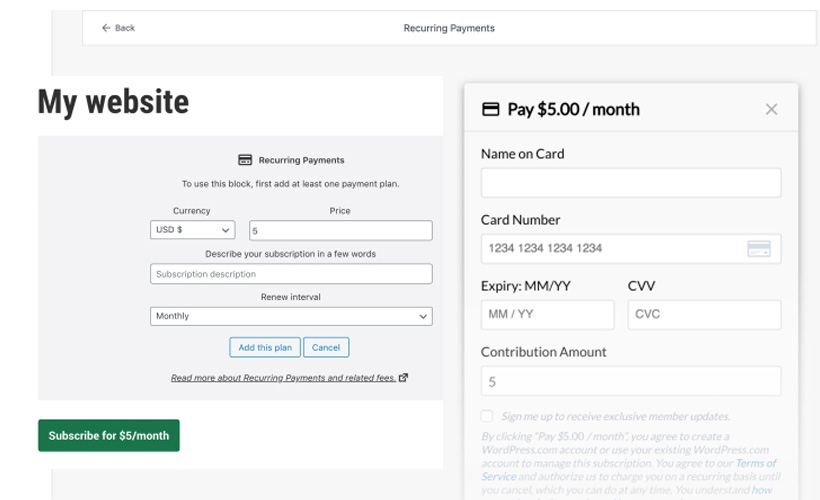
    On the other hand, Automattic announced that it partnered with Stripe, who will offer a recurring or tiered payment button on WordPress websites without the need to install an entire e-commerce package.

    Automattic said that it wants to lend a hand to millions of bloggers who might not be able to sustain their creative work on ad revenue from Google AdSense, Media.net or others.

    With this regularly-scheduled payments feature, it should be easier to charge for newsletters and memberships, sell subscriptions and access to exclusive instructional content, and accept monthly donations.

    Stripe and WordPress will collect around a 3% fee on the payments.

    [ Installation: Go to the “Earn” page on WordPress.com once a Stripe account is set up. More ]


  • Pearson’s AI Enabled Calculus App Provides Real-Time Feedback and Suggests Pathways

    Pearson’s AI Enabled Calculus App Provides Real-Time Feedback and Suggests Pathways

    IBL News | New York

    Nearly one-third of STEM students fail or drop Calculus on their first semester of college.

    Experts explain that students understand the concepts of Calculus but don’t have the assumed knowledge of algebra, trigonometry, and exponential functions.

    “Calculus is an unseen barrier to STEM careers. It’s a leak in the pipeline,” Milena Marinova, Vice President of Artificial Intelligence Products and Solutions at Pearson, said.

    In an attempt to tackle the students’ struggle, London-based Pearson introduced an AI-powered calculus tutor this month.

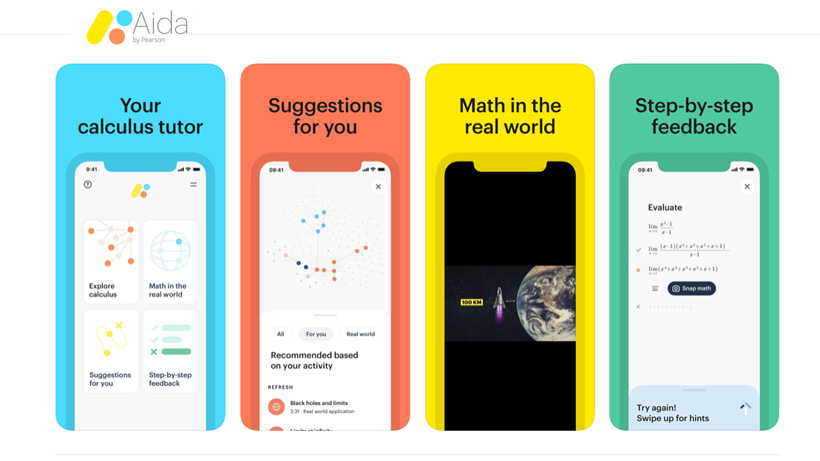
    It’s an iOS mobile app called Aida that offers real-time, specific feedback and personalized recommendations on students’ work on Calculus 1. It tracks learner progress and provides suggestions for what to learn next.

    Learners can type formulas directly on the app’s keyboard or take a photo of their handwritten homework. Aida will then analyze their calculations line by line, telling the student if they got each step right and prompting them to review instructional resources.

    The app also features videos of calculus in the real world, step-by-step demonstrations, and practice questions.

    Using numerous AI techniques, such as deep learning and reinforcement learning, Aida can understand handwriting, analyze a student’s reasoning, and determine whether or not it is correct.

    Logically, it needs a lot of data to auto-improve: the more students engage with these materials, the more specific the app’s recommendations for future study will become.

    The app is available for free until the end of the year.  Next year, Pearson plans to introduce a subscription at $2.99 a month.

    Aida is not the first tool for solving mathematical equations (PhotoMath is another popular free online tool), although it is ones of the most sophisticated using AI.

    https://youtu.be/6Q5JLF46SDI

    https://youtu.be/n0XEKiL0d9Y

  • Learning At Scale | November 2019: AI Jobs, Guild Education, ISTE EdSurge, Instructure Canvas LMS, 2U…

    Learning At Scale | November 2019: AI Jobs, Guild Education, ISTE EdSurge, Instructure Canvas LMS, 2U…

    Newsletter format  |  Click here to subscribe ]

    NOVEMBER 2019  –  NEWSLETTER #28  |  More breaking news at IBL News  |  Noticias en Español


    Learning At Scale

    • Coursera’s Blockbuster Classes of 2019: Preeminence of AI, with 2M Enrollments

    • Two Professors from Dartmouth and IMT of France Awarded After their ‘C Programming with Linux’ Course


    Higher Ed

    • Mid-Wage Jobs Will Be Squeezed by AI Unless They Adapt by Honing Skills

    • Virginia Will Invest $1 Billion to Graduate 31,000 Computer Scientists Over the Next 20 Years

    • Another Letter from President Reif to the MIT Community

    • A Spanish University Builds a Futuristic Eco-Campus with Outside Classrooms


    Initiatives

    • With a Unique Business Model, Guild Hits $1 Billion Valuation After Raising $157 M

    • An Amazon Marketplace for K-12 Educators Who Want to Sell Their Teaching Materials


    Conferences

    • The Open Education Conference Falls Apart, Leaving a Community of Passionate OER Supporters

    • ISTE Conference Organizer Absorbs EdSurge Media – Investors Won’t Be Rewarded


    Wall Street: Instructure, 2U

    • Instructure Announces It Is Exploring to Sell the Company – Estimated to be Worth $2.5B

    • Sachem Head Becomes One of the Top Shareholders of 2U and Advocates for a Sale

    • An Influential Hedge Fund Pushes Instructure’s Canvas LMS to Sell Its Business

    • 2U Exceeds Wall Street Expectations With Its Third-Quarter Results


    2019 Upcoming Events

    • Education Calendar  –  NOVEMBER  | DECEMBER | JAN – JUNE 2020


    This newsletter is created in collaboration with IBL Education, a New York City-based company that has built the IBL Platform. Read the latest IBL Newsletter   |  Archive of Open edX Newsletters

  • Coursera’s Blockbuster Classes of 2019: Preeminence of AI, with 2M Enrollments

    Coursera’s Blockbuster Classes of 2019: Preeminence of AI, with 2M Enrollments

    IBL News | New York

    Coursera’s AI-centric courses and Specializations will soon reach the milestone of two million enrollments in 2019, according to the company’s data. In this area, one of the most requested courses was AI For Everyone, taught by Coursera’s co-founder Andrew Ng.

    Other blockbuster courses and specializations were Learning How to Learn, from McMaster University and UC San Diego;  The Science of Well-Being, from Yale, IBM Data Science Professional Certificate (with 135,000 enrolled) and Google IT Support Professional Certificate (50,000 enrolled).

    “Demand for industry certificates is on the rise, as are innovative models for stackable credentials,” Dil Sidhu, Chief Content Officer at Coursera, wrote in a blog-post yesterday. “This marks a new era of higher education that recognizes the need for stackable content before entering a degree program.”

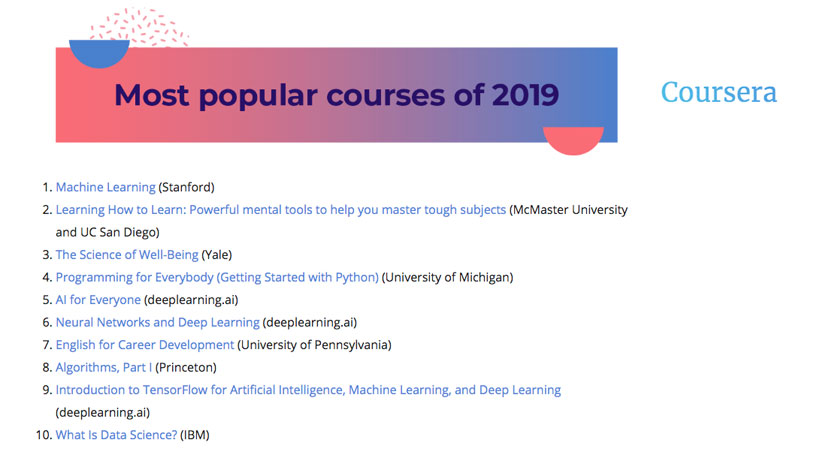
    The ranking of the most popular courses of 2019 features seven universities and three corporations:

    1. Machine Learning (Stanford)
    2. Learning How to Learn: Powerful mental tools to help you master tough subjects (McMaster University and UC San Diego)
    3. The Science of Well-Being (Yale)
    4. Programming for Everybody (Getting Started with Python) (University of Michigan)
    5. AI for Everyone (deeplearning.ai)
    6. Neural Networks and Deep Learning (deeplearning.ai)
    7. English for Career Development (University of Pennsylvania)
    8. Algorithms, Part I (Princeton)
    9. Introduction to TensorFlow for Artificial Intelligence, Machine Learning, and Deep Learning (deeplearning.ai)
    10. What Is Data Science? (IBM)

    Regarding the most popular Specializations and Professional Certificates of 2019, this is the list:

    1. Python for Everybody (University of Michigan)
    2. Deep Learning (deeplearning.ai)
    3. IBM Data Science (IBM)
    4. Google IT Support (Google)
    5. Architecting with Google Compute Engine (Google Cloud)
    6. Applied Data Science with Python (University of Michigan)
    7. Data Science (John Hopkins University)
    8. Excel Skills for Business (Macquarie University)
    9. Data Engineering, Big Data, and Machine Learning on GCP (Google Cloud)
    10. Improve Your English Communication Skills (Georgia Institute of Technology)

    With a catalog of over 3,800 courses, 400 Specializations, 16 degrees, 13 Professional Certificates, and six MasterTrack Certificates, Coursera reported annual growth of eight million users on a learner base of 45 million, with an age average of 32 years-old and the US, India, China, Mexico, Brazil, the UK, and Russia being their largest markets.

    • Coursera’s Top Courses of 2018  |  Top Courses of 2017