Author: IBL News

  • Schoology Acquired by PowerSchool – A New Giant with 65 Million Users

    Schoology Acquired by PowerSchool – A New Giant with 65 Million Users

    IBL News | New York

    PowerSchool, an ed-tech provider on K-12, announced yesterday an agreement to acquire Schoology, a leading learning management system used by 60.000 schools and 20 million students, with a 17% percent market share. The financial terms of the deal were not disclosed.

    This acquisition, if approved, will result in a dominant company among K-12 schools and districts, which will leave behind competitors such as Google Classroom, Canvas, and Moodle.

    PowerSchool, roughly used by 45 million learners, has acquired eight companies since 2015. Schoology would be PowerSchool’s second purchase of a learning management system (LMS) after it acquired Haiku Learning in 2016.

     “Teachers have shared that they need more time and tools to provide individual learning paths for every student,” said Hardeep Gulati, CEO of PowerSchool.

    “With the scale and investment we will get being part of PowerSchool, we can further advance what is possible in education, and take Schoology to a whole new level,” said Schoology CEO and Co-Founder, Jeremy Friedman.
     

  • EdX Cancels Its Annual Partners Conference Scheduled in Hong Kong Due to Safety Concerns

    EdX Cancels Its Annual Partners Conference Scheduled in Hong Kong Due to Safety Concerns

    IBL News | New York

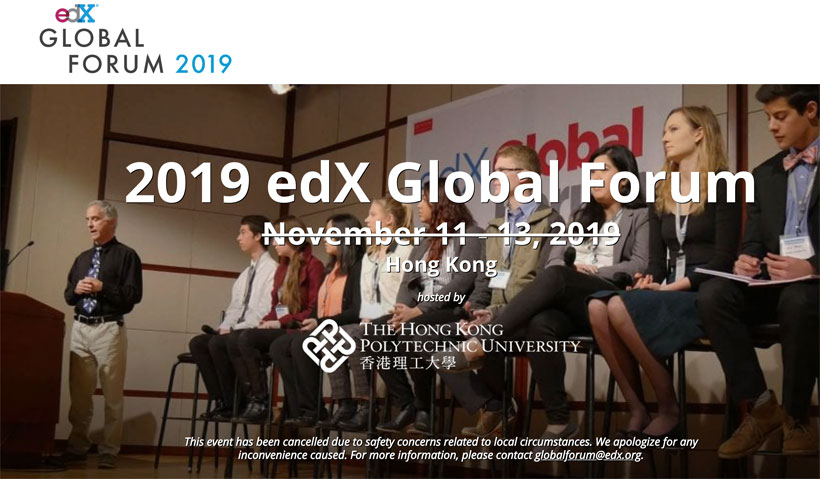
    The annual edX Global Forum partners conference, that scheduled this year in Hong Kong for November 11-13, was canceled due to “safety concerns related to local circumstances”, organizers say.

    The anti-government protests that have rocked Hong Kong for months show no sign of dying down and given this situation edX prioritized the safety of attendants. “We want to keep people safe,” an edX representative said to IBL News.

    The edX organization and The Hong Kong Polytechnic University (PolyU), who was the host of the event, mutually made the decision.

    The 2019 Global Forum won’t take place in any other place. Instead, the MOOC platform is planning to celebrate a Town Hall-style event with its CEO, Anant Agarwal, along with other virtual events.

    Finally, the edX organization announced that the 2020 Global Forum will take place in the Fall at Columbia University in New York City.

  • Over 3,000 Starbucks Employees Have Earned their Bachelor’s Degree through ASU Online

    Over 3,000 Starbucks Employees Have Earned their Bachelor’s Degree through ASU Online

    IBL News | New York

    The combination of flexible online classes with the discipline of real-work experience has proven to be successful for many learners.

    Over 3,000 Starbucks employees have earned their bachelor’s degree at Arizona State University (ASU) while working, the institution announced on the fifth anniversary of its partnership with the coffee giant.

    These graduates enrolled in the Starbucks College Achievement Plan, that offers more than 80 undergraduate programs through ASU Online. Employees, called “partners” at Starbucks, are reimbursed for tuition every semester.

    The first classes began in mid-October 2014, and today, more than 13,000 Starbucks partners are in this plan.

    “Our partnership with Starbucks is the exemplar of how corporations and universities may come together to create real impact at the individual, community and macroeconomic level,” said Philip Regier, University Dean for Educational Initiatives and CEO of EdPlus at ASU.

    In addition to Starbucks, ASU has partnered with Uber and Adidas to provide tuition assistance to their employees.

  • MIT’s Provost Will Impulse the Open Sharing of Data, Software, and Educational Materials

    MIT’s Provost Will Impulse the Open Sharing of Data, Software, and Educational Materials

    IBL News | New York

    An MIT report, published on October 17, urged its community of researchers to increase the open sharing of publications, data, software, and educational materials.

    The MIT Open Access task force, convened by Provost Martin Schmidt on July 2017, was charged with exploring how the institute should update and revise current policies. Now, the final recommendations research concludes that openly sharing research and educational materials is key to the MIT mission of advancing knowledge.

    The task force also calls for heads of departments, labs, and centers to develop discipline-specific plans to encourage and support open sharing.

    “Scholarship serves humanity best when it is available to everyone,” Libraries Director Chris Bourg, co-chair of the task force with Hal Abelson, Professor of Electrical Engineering and Computer Science said on MIT News.

    In an email to the MIT community, Provost Martin Schmidt announced that he would appoint an implementation team this fall to prioritize and enact the task force’s recommendations. He has asked Chris Bourg to convene and lead this team.

    The MIT libraries have already begun working with the departments of Linguistics and Philosophy and Brain and Cognitive Sciences to develop sample plans.

  • Docebo Learning Platform’s Stock Dropped 28% after Raising C$75 Million on its IPO

    Docebo Learning Platform’s Stock Dropped 28% after Raising C$75 Million on its IPO

    IBL News | New York

    The cloud-based LMS company Docebo didn’t show promising performance on its first trading days on the Toronto Stock Exchange.

    The stock, listed under the ticker symbol “DCBO”, started trading at C$16.00 (Canadian Dollars) on October 8 and closed at C$11.50 on Friday 18, losing over 28% of its value. [Update: on Monday 21, the stock gained 13% until C$ 13.04].

    An imperfect balance sheet with weak fundamentals discouraged investors, according to some analysts.

    Toronto-headquartered Docebo had raised high hopes after it successfully closed its IPO at a price of C$16, obtaining C$75 million.

    A total of 4,687,500 common shares were sold, with Canaccord Genuity Corp. and TD Securities as the lead underwriters. Docebo’s pre-IPO backers included Intercap Equity, and Canadian enterprise software equity firm Klass Capital.

    “Completing this IPO is a significant milestone for Docebo and a testament to the talent and dedication of our team and support from our global base of customers,” said during the offering, CEO Claudio Erba, an Italian computer consultant who founded the company on March 2005 in Florence, Italy. “With the proceeds raised, we will continue to strengthen our market position and look to continue our track record of innovation in the enterprise learning industry.”

    Written in PHP, Docebo (Latin for “I will teach”) is focused on providing a SaaS learning platform to train workforces, partners, and customers worldwide. It claims to have a customer base of more than 1,600 companies in 68 countries.


    Claudio Erba, CEO, Docebo at Learning Technologies 2019 from Learning News.

  • Udacity Issues Three Programs to Prepare Developers in C+++, Blockchain and Data Streaming Technologies

    Udacity Issues Three Programs to Prepare Developers in C+++, Blockchain and Data Streaming Technologies

    IBL News | New York

    Udacity is starting this Monday two Nanodegree Programs for developers: Blockchain Developer and C++.

    These programs cost $999 each and take four months to complete, at 10 hours/week.

    “Being fully decentralized and free from censorship, Blockchain has become an adaptable business tool across industries,”
    said Neha Garg, product manager at Google.

    “We have seen massive growth in public knowledge of crypto-currency and business in the last few years, and because of that, there has been an explosion in career options in the blockchain field,” she added.

    In addition to developers, some of the most demanded jobs related to Blockchain are quality engineers, technical project managers, and community managers.

    Regarding the new version of the C++ Nanodegree Program, the creators of the course highlight that this programming language is used to code self-driving cars, robots, servers, media platforms, video games, and other artificial intelligence software systems. It is one of the top five most important computer languages and one for which employers pay a yearly average salary of $95,000.

    The program teaches real-world tools and best practices, including Bjarne Stroustrup’s C++ Core Guidelines, the Microsoft Visual Studio Code development environment, and several testing frameworks.

    Throughout the course, students will build a portfolio of projects that they will be able to showcase to hiring managers and recruiters, including a Chatbot.


    UPDATE
    : On October 22nd, Udacity introduced the newest addition to its School of Data Science: the Data Streaming Nanodegree program.

    This program, starting on November 12, prepares learners to develop systems and applications capable of interpreting data immediately by using tools like Apache Spark, Kafka, Apache Streaming, and Kafka Streaming.

    The Data Streaming Nanodegree takes two months to complete and costs $718.


  • MIT to Examine Engagement Practices with Gifts and Grants After Epstein’s Donations

    MIT to Examine Engagement Practices with Gifts and Grants After Epstein’s Donations

    IBL News | New York

    MIT’s Chair of Faculty, Rick Danheiser, and Provost, Martin Schmidt, announced this week, the creation of two committees to examine any of the institute’s external engagements with gifts, grants, and collaborations.

    The committees will also set new guidelines for the relationship with funding sources, MIT News reported.

    Their work continues a process begun last month with the launch of outside fact-finding, by Boston-based law firm Goodwin Procter, on MIT’s engagements with sex trafficker Jeffrey Epstein.

    The first of the two new committees, to be chaired by Tavneet Suri, an associate professor of applied economics at the MIT Sloan School of Management, will include faculty members, such as:

    • Daron Acemoglu: Institute Professor, Department of Economics
    • W. Craig Carter: POSCO Professor of Materials Science and Engineering
    • Arup Chakraborty: Robert T. Haslam Professor of Chemical Engineering, Physics, Chemistry, and Biological Engineering
    • Fotini Christia: Professor of Political Science
    • Robert Desimone: Doris and Don Berkey Professor of Neuroscience, Department of Brain and Cognitive Sciences; Director, McGovern Institute for Brain Research
    • Amy Glasmeier: Professor of Economic Geography and Regional Planning, Department of Urban Studies and Planning
    • Paula Hammond: David H. Koch Professor; Head, Department of Chemical Engineering
    • Daniel Hastings: Cecil and Ida Green Professor; Head, Department of Aeronautics and Astronautics
    • Diana Henderson: Professor of Literature
    • J. Chappell Lawson: Associate Professor of Political Science
    • Jacqueline Lees: Virginia and D.K. Ludwig Professor; Associate Head, Department of Biology; Associate Director, Koch Institute for Integrative Cancer Research
    • Tamar Schapiro: Associate Professor of Philosophy
    • Susan Silbey: Leon and Anne Goldberg Professor of Humanities, Sociology, and Anthropology; Professor of Behavioral and Policy Sciences, MIT Sloan School
    • Yogesh Surendranath: Paul M. Cook Associate Professor of Chemistry
    • Bruce Tidor: Professor of Biological Engineering and Computer Science
    • Robert van der Hilst: Schlumberger Professor; Head, Department of Earth, Atmospheric, and Planetary Sciences
    • Bilge Yildiz: Professor of Nuclear Science and Engineering and Materials Science and Engineering

    The second new committee will be chaired by Peter Fisher, professor of physics and head of the Department of Physics, and will include members from across MIT.

    Regarding the Epstein’s donations cover-up, MIT President L. Rafael Reif completed last week his forum participation with faculty, alumni, alumni and staff. The last of these public discussions was with postdocs and research from MIT Lincoln Laboratory.

    [In the picture, Peter Fisher, left, and Tavneet Suri, right. Image: Mimi Phan and Donna Coveney, MIT News]

  • Canvas Integrates into Its LMS a Tool to Show Evidence of Students’ Achievements

    Canvas Integrates into Its LMS a Tool to Show Evidence of Students’ Achievements

    IBL News | Chicago

    Canvas LMS, the flagship product of Instructure (NYSE: INST), announced this week, during the 2019 Educause conference, Portfolium’s integration into its learning platform.

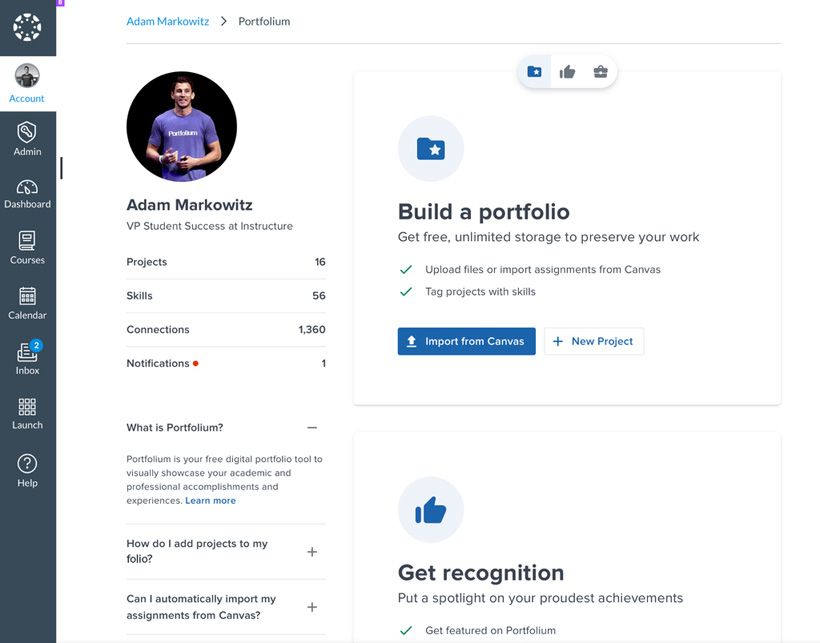
    The Portfolio tool, acquired earlier in the year by Instructure, allows students to showcase their badges, achievements, projects, competencies and skills, serving as an expanded resume.

    Canvas LMS’ clients will access Portfolium at no extra cost, as the company’s staff told IBL News.

    “Too often, students do not recognize or even fully appreciate the skills and competencies they’re acquiring along their academic paths,” Adam Markowitz, General Manager of Instructure Portfolium, explained to IBL News. “This skills awareness gap is being solved by our integration.”

    In addition to Portfolium’, Ryan Lufkin, Senior Director of Global Education Product Marketing, highlighted Instructure’s partnership with Badgr to automatically issue digital credentials at set milestones.

    Canvas LMS is used by 30 million people, according to the company. Last year, it surpassed Blackboard as a leading organization in the paid learning management system market.

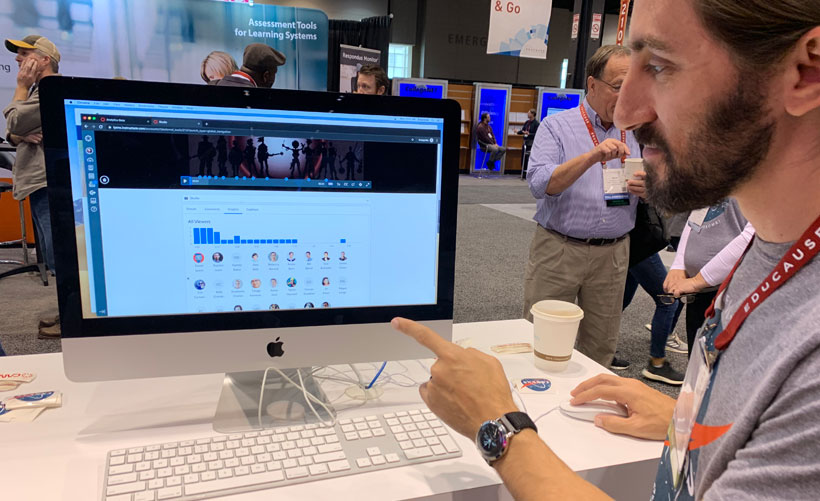
    [A Portfolium snapshot below. David Lyons, Sr. Solutions Engineer at Instructure, at Educause, in the picture above] 

  • What’s Ahead? Unbundled Degrees, Micro-Bachelors, and Stackable, Employer-Endorsed Credentials

    What’s Ahead? Unbundled Degrees, Micro-Bachelors, and Stackable, Employer-Endorsed Credentials

    IBL News | New York

    Where online learning will be in three to five years? How it will be scaled?

    In an article at Evollution.com, Holly Zanville, Strategy Director for the Future of Learning and Work at the Lumina Foundation, provided a glimpse of how edX.org is building the structure of tomorrow’s learning system.

    Nina Huntemann, edX’s Senior Director of Academics and Research at edX, offered her thoughts on upward trends. This is a summary:

    • Students will move among programs and learning blocks within an institution and among universities.
    • Degrees will be broken into smaller components of competencies and skills. This will better meet industry needs and will result in smaller and more affordable credentials.
    • More hybrid paths –those that couple in-person, classroom learning with online instruction– will emerge. The challenge to move noncredit courses and micro-credentials into credit pathways.
    • A new class of instructors —learning engineers— will emerge. They will use the latest technologies, develop new instructional paths, help faculty members teach in new ways, and work closely with employers.
    • It will be a more performance-based admission system.
    • Institutions will continue to be unable to serve the growing number of applicants to programs in specialty areas such as data, programming and health.

    Recently, the Indianapolis-based Lumina Foundation gave a grant of $900,000 to nonprofit edX Inc to create a new credentialing system. Among those credentials, edX is developing a series of micro-bachelors programs for undergraduate college education.


  • The 10 IT Issues Higher Ed Leaders Are Focusing on, According to Educause

    The 10 IT Issues Higher Ed Leaders Are Focusing on, According to Educause

    Mikel Amigot, IBL News (Chicago)


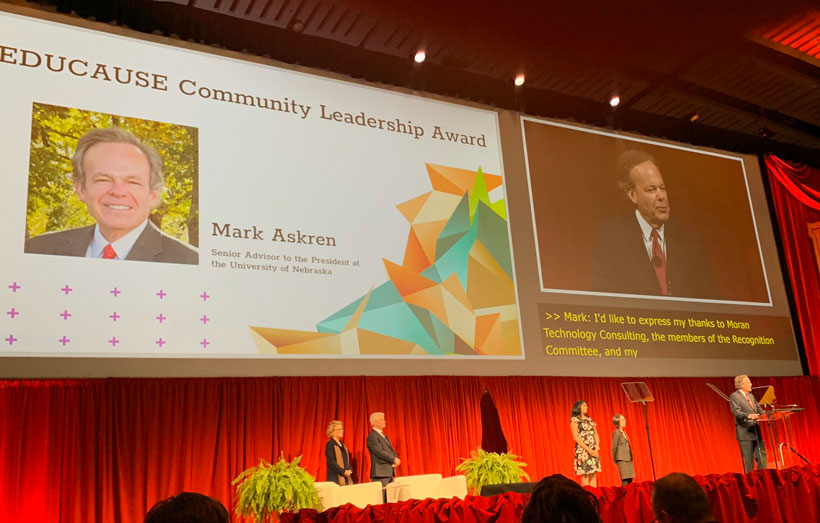
    The 2019 Educause Annual Conference yesterday recognized four prominent educators, highlighting their achievement during the opening talk in Chicago’s convention center.

    • Leadership Award: Linda Jorn, Assoc Vice Provost for Learning Technologies, University of Wisconsin-Madison
    • Community Leadership Award: Mark Askren, Senior Advisor to the President, University of Nebraska
    • DEI Leadership Award: Melissa Woo, President for Information Technology and Enterprise Chief Information Officer, Stony Brook University
    • Rising Star: Tina Pappas, Associate Director, Innovation and Technology, Rutgers, The State University of New Jersey


    In addition, the Educause staff announced the 2020 Top 10 IT Issues index,  stressing what’s important and where to focus on in terms of higher education:

    1. Information Security Strategy
    2. Privacy
    3. Sustainable Funding
    4. Digital Integrations
    5. Student Retention and Completion
    6. Student-Centric Higher Education
    7. Improved Enrollment
    8. Higher Education Affordability
    9. Administrative Simplification
    10. The Integrative CIO

    “The 2020 IT Issues reveal where the integrative CIO must simplify, sustain, and innovate as higher education drives to digital transformation,” said Susan Grajek, Vice President, Communities and Research at Educause.

    “Institutions know they need to innovate to achieve a competitive advantage in today’s complex marketplace, and almost none of today’s innovation can happen without data and technology,” she added.

    On this edition, the gathering attracted over 8,000 attendees. “This year’s attendance has been a record-setting,” John O’Brien, CEO at Educause, said without providing further data. “Every year there is something new in the air that captures imagination,” he said. “We know innovation is everywhere.”


    [Promotional Video]