Author: IBL News

  • A MOOC to Deal with a Post-Truth World Developed by SUNY

    A MOOC to Deal with a Post-Truth World Developed by SUNY

    We live in a post-truth world where factual information has been displaced by subjective and biased viewpoints.

    SUNY Albany and Empire State College have created a MOOC to help learners recognize their own biases and identify preconceptions in today’s social information environment.

    “Empowering Yourself in a Post-Truth World” is a six-week open, free course, taught by eight top instructors from SUNY, starting on March 18.

    This MOOC is hosted at University at Buffalo’s platform and runs on an independent Open edX-based ecosystem, empowered by IBL Education.


  • Ten 5-Min Talks of Open edX Vendors to Attend

    Ten 5-Min Talks of Open edX Vendors to Attend

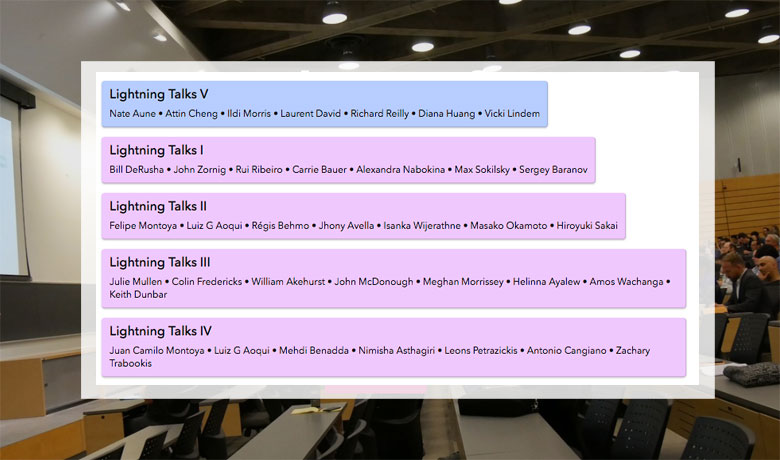
    Thirty-six speakers will perform on five rounds of Lighting Talks that will take place in the 2019 Open edX Conference, hosted by UC San Diego, March 26 – 29.

    The edX organization has chosen, following its own criteria, twenty-eight 5-minute duration talks, which will be spread into five different rooms from 2 pm to 3 pm on Thursday 28. Most of the speakers belong to vendor companies that specialize in the Open edX software.

    Here is the complete list of talks.

    This is a selection of the ten must-attended talks, according to IBL News’ editorial staff:


  • The OPM Market Will Grow Until $7.7B by 2025

    The OPM Market Will Grow Until $7.7B by 2025

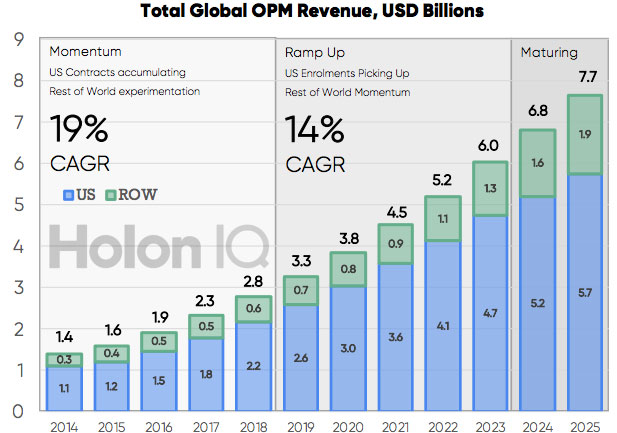
    The Online Program Manager (OPM) business, with 60+ providers in a $3B+ market growing at 17%, will reach $7.7B by 2025, according to research by HolonIQ. Increased interest from learners, more offerings from colleges, and wider acceptance from employers will boost this growth.

    OPM operators –which are dedicated to helping universities build, recruit for and deliver digital programs– have realized that online degrees are one of the fastest growing areas of higher education.

    Revenue sharing is the dominant model in this industry but a fee for service, unbundled and hybrid relationships are growing fast.

    Over six million students worldwide pursue higher education online, representing a $30B market today. In the US, online students make up only 15% of all higher education enrollments, while in China it is 10%.

    The top 10 OPM players make up over half of global revenue. The US is the largest market by far, and VCs are very active. As recent transactions, we’ve recently seen how 2U invested in Keypath, Wiley acquired Learning House, Seek acquired OES, Grand Canyon spun out and acquired Orbis, Emeritus raised $40 million.

    One of the main uncertainties is whether universities will embrace the OPM model and continue to outsource capabilities, or whether they will seek to build them in-house.

    The Anatomy of an OPM – PDF by Holon IQ

  • An Open Book to Empower Using Jupyter for Teaching

    An Open Book to Empower Using Jupyter for Teaching

    A well-elaborated handbook for teaching and learning with Jupyter saw the light this month. It is a first draft that aims to provide an entry point and a broad overview of Jupyter in education.

    Coordinated by Prof. Lorena A. Barba, from The George Washington University, this handbook is intended for any educator teaching a topic that includes data analysis or computation.

    “It is not just for educators teaching courses in engineering or science, but also data journalism, business, and quantitative economics, data-based decision sciences and policy, quantitative health sciences, and digital humanities,” say the authors of this open book.

    Jupyter Notebook has exploded in popularity in the last four years as the favorite environment for data science. It has also grown as a platform to use in the classroom, to develop teaching materials, to share lessons and tutorials, and to create computational stories. Prof. Lorena A. Barba has been the main driver in the Jupyter for Education movement. Her courses at The George Washington University Engineering MOOC Open edX platform are a good example of Jupyter use.

    Notebooks are documents containing text narratives with images and math, combined with executable code (many languages are supported) and the output of that code. This marriage of content and code makes for a powerful new form of data-based communication.


  • EdCast Acquires Leapest, a European B2B Training Specialist

    EdCast Acquires Leapest, a European B2B Training Specialist

    EdCast, whose corporate LMS is powered by Open edX, announced this month the acquisition of Leapest, a 2017-created, Netherlands-based learning marketplace that offers courses, certifications, and training programs to 1,600 business customers. The amount of the transaction has not been disclosed.

    The CEO and Founder of Leapest, Sukhbir Jasuja, will be joining EdCast as its Executive Vice President and Managing Director of EdCast’s Blended Learning Marketplace.

    “This acquisition will accelerate EdCast’s rapid growth in Europe and expand the company’s blended learning capabilities. With this step, EdCast also builds upon its success with ContentExchange, the global learning content marketplace focused on workforce upskilling,” said Karl Mehta, CEO, and founder of EdCast.

    “This acquisition demonstrates how the LXP market is growing up. By acquiring Leapest, EdCast becomes both an LXP and a true content network, adding LMS features as well. This changes the game and has the potential to add tremendous new value for corporate training buyers,” Global industry analyst Josh Bersin stated.


  • The OMSCS Degree Will Graduate 1,500 Students Per Year in 2021

    The OMSCS Degree Will Graduate 1,500 Students Per Year in 2021

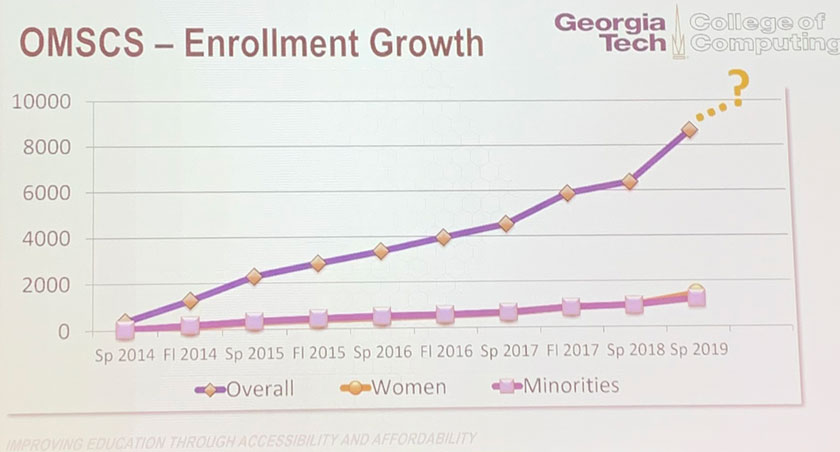
    Georgia Tech’s iconic Online Master of Science in Computer Science (OMSCS) will result in 1,500 graduates per year in two-to-three years, as predicted on Friday at a conference in Princeton University by Zvi Galil, Dean of the Georgia Institute of Technology College of Computing. This growth (see the graphic below) reflects the success of this program.

    Around 1,000 students will be graduating in 2019 with the OMSCS, the world’s first accredited MOOCs, now on their fifth year.

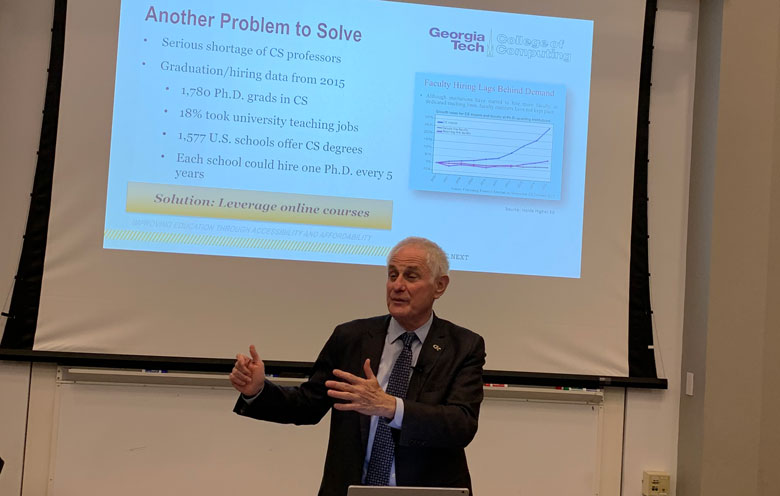
    Zvi Galil’s OMSCS lecture at Princeton–its 62nd talk–attracted dozens of students, including six enrollees in that Master’s as well as Mark Braunstein, who teaches Health Informatics. [In the picture above].

    Here is the talk recorded by Princeton University, and exclusively posted at IBL News.

    The OMSCS, hosted on Udacity, inspired Georgia Tech to launch another two Master’s: the OMS Analytics and the OMS Cybersecurity, both on edX.org.

    • Georgia TechFive Years a Cyber Pioneer
    • IBL News: 45 MOOC-Based Master’s Degrees Worldwide

  • MIT Issues 2,000 Blockchain-Based Certificates

    MIT Issues 2,000 Blockchain-Based Certificates

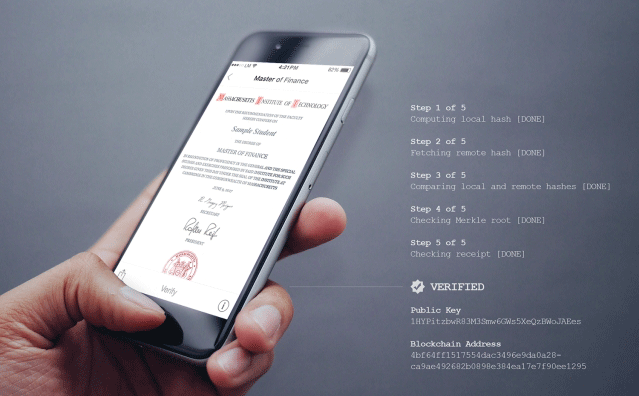
    MIT has issued over 2,000 blockchain-based credentials so far, becoming the first top U.S. university to extensively use this type of virtual credentials, IBL News learned

    With the blockchain technology, students have ownership of their records and are able to share them in a secure manner.

    “Ed credentialing on blockchain allows students to share their diplomas with employees easily and instantly,” explained Mary Callahan, Registrar and Senior Associate Dean at MIT, at the Learn Launch conference last week in Boston. “It is a valid way to authenticate their diplomas,” she added.

    At a global scale, there is an issue with massive circulation of fake degrees. This affects prestigious universities and corporations. For example, IBM has detected that 20% of certificates with their name are fake. David Leaser, Senior Executive at IBM, mentioned this data during a talk at the same conference.

    MIT’s initiative with blockchain certificates started in the summer of 2017, as part of a pilot program promoted by its Registrar’s Office and Learning Machine.

    A cohort of 111 graduates became the first to have the option to receive their diplomas on their smartphones via an app, in addition to the traditional format.

    The institute developed Blockcerts, an open-source standard for creating, issuing, viewing, and verifying blockchain-based certificates. The code is available in GitHub.

    • IBL News (Oct 2017): MIT Successfully Starts to Use Blockchain Technology to Issue Digital Certificates

  • View: Master’s Degrees At Scale Must Follow a Stackable Approach

    View: Master’s Degrees At Scale Must Follow a Stackable Approach

    Mikel Amigot

    The new MOOC-based professional master’s degrees usually include fewer or no synchronous sessions, limited contact with leading instructors and more auto-graded assignments.

    But more important than those features is stackability, as we are experiencing on Coursera’s MasterTrack or edX’s MicroMasters. This means that learners earn a credential and then apply for an on-campus or an online master’s degree program.

    However, the crucial innovation is stackability.

    Stackability is also a learning strategy, as James DeVaney (University at Michigan) and Matthew Rascoff (Duke University) innovation experts rightly explain on Inside Higher Ed. “Educational providers meet learners where they are, and provide the right level and amount of learning, and an appropriate credential, for their needs.”

    At the same time, a stackable strategy can reduce the cost of the program without compromising quality, and can be the basis for admissions instead of the existing flawed tests.


  • MITx Granted 1,277 Credentials on its Supply Chain MicroMasters

    MITx Granted 1,277 Credentials on its Supply Chain MicroMasters

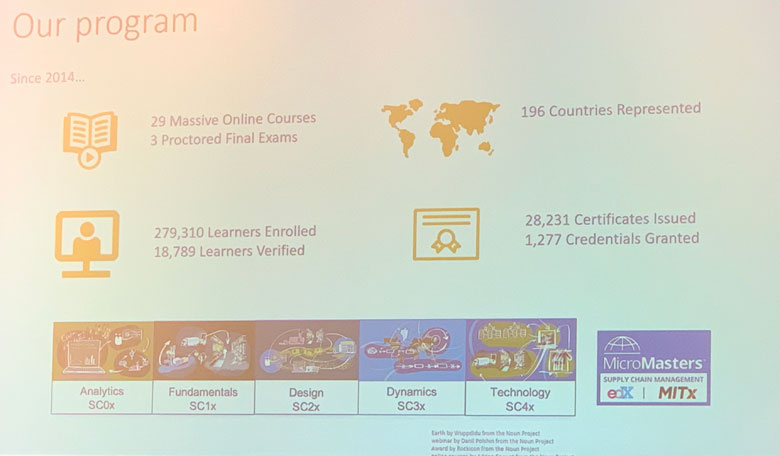
    The flagship MIT’s Supply Chain Management MicroMasters on edX.org released new numbers:

    • 279,310 learners enrolled
    • 18,789 learners verified
    • 28,231 certificates issued
    • 1,277 credentials granted

    This program, priced at $1,080, includes five online courses and a final comprehensive exam: Analytics, Fundamentals, Design, Dynamics, and Technology and Systems. These courses offer the same rigor and relevance as the material taught on the MIT campus. It represents the equivalent of one semester of coursework at MIT, from January through June.

    The data above, disclosed during a talk at the Learn Launch conference last week in Boston, and exclusively reported by IBL News, reflects the success of this blended initiative.

    The first class on the Supply Chain Management five-course MicroMaster program on edX.org was finalized by 1,900 students in 2018, according to data released in July 2018. A total of 622 students successfully completed the final exam, and 42 started the residential semester at MIT’s Cambridge campus in January 2018 to earn a full master’s degree.

    This year another 40 students have been accepted to complete the full MIT Master’s degree on-campus.

  • Edraak Launches its School Learning for K-12 Children in the Arab World

    Edraak Launches its School Learning for K-12 Children in the Arab World

    Edraak.org, the leading Arabic MOOC platform for adult learners, has expanded into K-12 by launching School Learning. This new vertical portal offers educational resources for school-aged children across the Arab world. These materials can be used in and out of the classroom, reinforcing the role teachers play.

    Developed by Queen Rania Foundation and headquartered in Jordan, Edraak, a well-designed open education platform built on Open edX, has reached over 1.5 million learners across the Arab world since its launch in 2014, according to its CEO Shireen Yacoub.

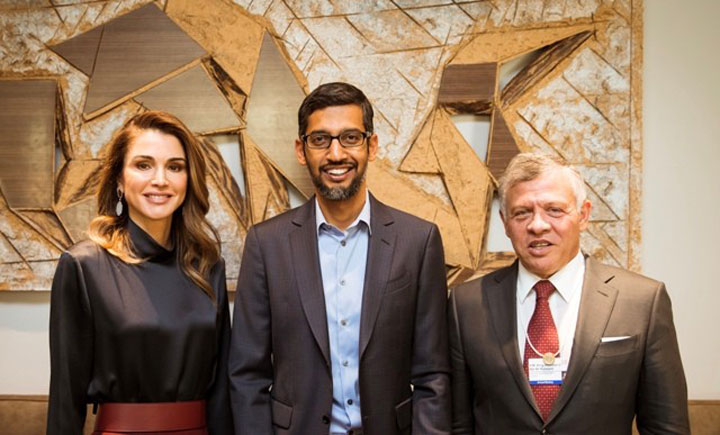
    Queen Rania Al Abdullah officially announced School Learning on January 24 during an event hosted by Google in Davos, Switzerland. King Abdullah II and Google CEO, Sundar Pichai, were also present. [Above in the picture]

    The project was developed with the support of a $3 million grant from Google.org, and complemented with engagement from Google employees who provide product design expertise. School Learning was launched with Mathematics materials for grades 7 and 9, including more than 1,200 educational minutes of bite-sized video lectures. 

    The e-curricula and learning resources for the rest of the grades will be released over two phases by the end of this year, and other major subjects will be gradually introduced by 2020. The platform will also offer tools and resources for parents and educators, empowering them to guide children’s learning journeys.

    The new platform offers sequential learning material as well as student-centred inquiry-based learning, making it possible for students to search for specific concepts without having to enroll in a predefined learning sequence. Given the growing need to support remedial education due to conflict and unrest that have disrupted formal education in the region, the platform adopts a competency-based approach to learning, while also providing material that can be used in a blended learning setting.

    “A child denied an education isn’t just a tragedy for that child; it leaves the rest of us vulnerable, Queen Rania Al Abdullah said.” “Education is a solution capable of bringing hope and opportunity to the Middle East.”


    • IBL News (Feb 2018): Edraak.org Expands its Open edX Platform into K-12 with a Grant from Google
    • IBL News (May 2014): Edraak.org, an Open edX platform aimed at Arab-speaking people