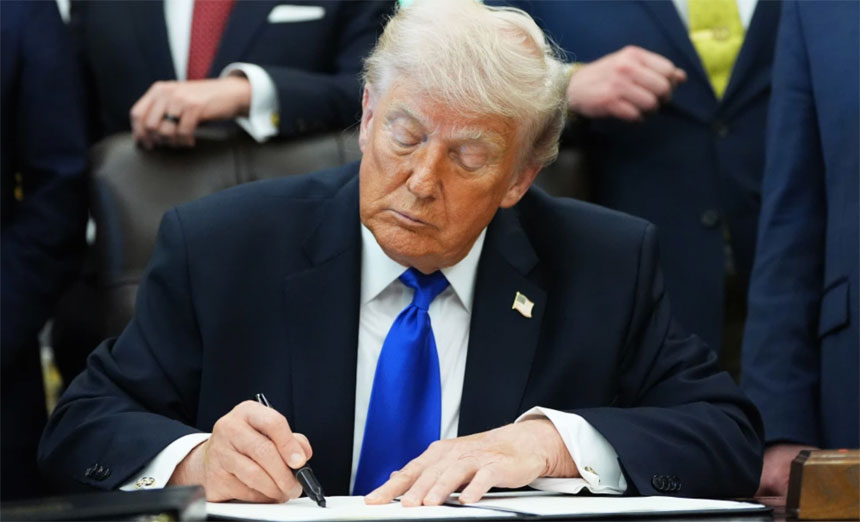
President Donald Trump signed a landmark executive order on Tuesday that lays the foundation for federal testing of the most powerful AI systems.
It asks technology companies to voluntarily give the government oversight of new models up to 30 days before releasing them to the public.
The order, a shift for an administration that had promoted a hands-off approach to AI, follows months of debate in the Trump administration over how to handle AI and its effects on cybersecurity and national security. It is the Trump administration’s biggest step toward regulating artificial intelligence.
The order, signed in private, directs federal agencies — including the Pentagon, Treasury, and the Cybersecurity and Infrastructure Security Agency — to shore up the nation’s cybersecurity defenses for critical infrastructure, and charts out a mechanism for the federal government to test and vet the most powerful AI systems for safety issues before they are deployed.
The testing would rely on voluntary collaboration from America’s leading AI companies, like Anthropic, OpenAI, and Google.
The order explicitly bars the government from imposing a mandatory licensing or pre-clearance requirement for new AI models, making the government’s move a request rather than a rule.
The order also directs the Attorney General to prioritize the prosecution of crimes involving AI, with a particular focus on cyber crimes. It also asks prosecutors to focus on individuals using AI agents, or autonomous AI systems, to “unlawfully access data or information that is subsequently used for a criminal or unlawful purpose.”
Brad Smith, Microsoft’s president; Chris Lehane, OpenAI’s chief global affairs officer; Kent Walker, Google’s president of global affairs, and other executives separately praised the order as “an important step” that would balance A.I. safety and innovation.
The executive order has been in development for months. In April, AI company Anthropic’s new Mythos Preview model sent shockwaves through Washington with its superhuman ability to find critical and severe vulnerabilities in the world’s most widely used operating systems. In a March Quinnipiac University poll of American adults, 55 percent said they viewed AI as a force for harm rather than good.
In May, MAGA allies, including Stephen K. Bannon, Amy Kremer, and three dozen pastors, signed a letter urging the president to adopt a mandatory vetting process for AI models. They warned that the systems could harm cybersecurity, and that tech companies could not be trusted “to police themselves.”
Anthropic confidentially submitted yesterday a draft registration statement on Form S-1 to the U.S. SEC for a proposed (IPO) initial public offering, which is expected to be among the biggest ever.
This move gave the AI start-up the option to go public after the SEC completes its review. The timing of the proposed initial public offering will depend on market conditions, but experts predict it could happen as soon as this fall. The company didn’t provide details on the size, number of shares to be offered, or the IPO price.
With its IPO filing, Anthropic is expected to be among three high-profile companies preparing to go public this year, along with Elon Musk’s SpaceX (expected this month) and OpenAI (preparing to file in the coming weeks).
In a statement, Anthropic said the filing “gives us the option to go public” after a review of its paperwork by the Securities and Exchange Commission (SEC).
Anthropic has surpassed OpenAI as the world’s most valuable AI start-up after raising $65 billion, achieving a valuation of $900 billion, as the two San Francisco-based companies duel for supremacy in this technology. OpenAI, which kicked off the AI boom with the launch of ChatGPT in 2022, announced it had raised $122 villion in a funding round that put its value at $730 billion.
Both companies are planning to file for an initial public offering this year.
The new investment in Anthropic, led by Greenoaks Capital, Sequoia Capital, Altimeter Capital, and Dragoneer Investment Group, boosted Anthropic’s value two and a half times its previous valuation of $380 billion, about three months ago.
Anthropic has now raised more than $130 billion since its establishment. Its roster of investors includes Capital Group, Menlo Ventures, Iconiq Capital, and Lightspeed Venture Partners, as well as tech giants like Amazon and Google.
On the rise over the past few months, Anthropic is the creator of Claude, a chatbot (with Claude Opus 4.8 as its new flagship model), and Claude Code, code-writing software on which the company has built a robust business.
Recently, it released an AI security model, Mythos, capable of finding and exploiting hidden flaws in software. It also advised Pope Leo XIV on his encyclical warning about AI’s most disruptive effect.
By releasing new frontier models in April at higher API prices, Anthropic and OpenAI have found product-market fit by selling massive amounts of tokens across industries, according to an analyst. Coding agents burn a large number of tokens, and by charging $10-$20/month, the two start-ups won’t generate enough revenue to cover $1 trillion in infrastructure costs.
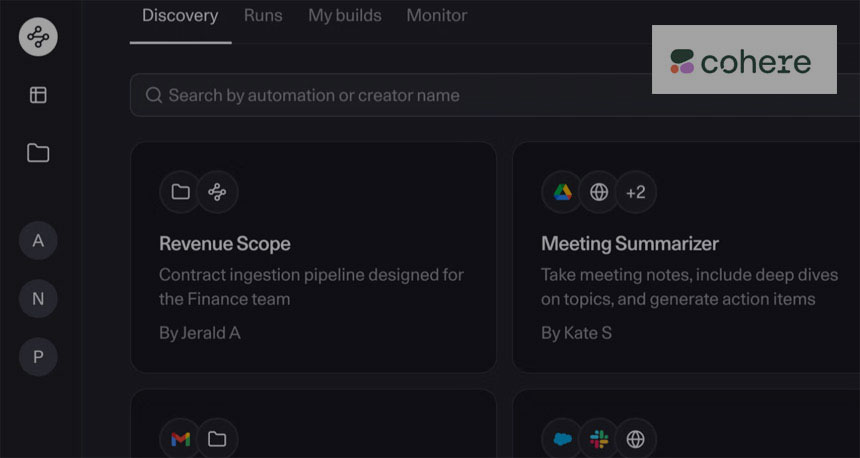
Canadian AI platform Cohere released an open-source LLM, called Command A+, for enterprise data-sensitive and sovereign environments. Born out of Cohere’s North platform, Command A+ works on two H100S or a single B200 GPU in private deployments.
The software, to be deployed in a VPC, on-premises, or fully air-gapped, is a 200+B parameter model with advanced reasoning and multimodal capabilities. It seeks to ensure data sovereignty for governments and regulated industries worldwide while upholding the highest security standards.
Nick Frosst, Co‑founder of Cohere, stated, “When only a few big companies control the technology, people have little ability to shape how their AI systems work or evolve. That’s why it’s so important to prioritize sovereignty now and make sure organizations can own their intelligence layer instead of renting it.”
“Command A+ delivers a sovereign, open‑source model built for critical infrastructure that gives people, enterprises, and governments the trust, performance, and efficiency they need to run real‑world systems at scale.”
As a multilingual, it supports 48 languages, including all official EU languages, as reflected in the EU AI Act.
Released with fully open weights under the Apache 2.0 license, Command A+ gives organizations full transparency into model behavior and complete control over deployment.
According to Cohere, key sovereignty features include:
Zero hidden backdoors: Full visibility into model architecture and behavior
Total data sovereignty: On-premises and private cloud deployment with no external data transmission
Regulatory alignment: Control and deployment model designed to enable alignment with evolving global compliance and AI governance requirements
No vendor lock-in: Predictable costs with no licensing restrictions or forced ecosystem dependencies
Cohere North is one of the many platforms — ibl.ai, the parent company of this news service, is another leading one — responding to the accelerated demand for sovereign AI in large‑scale production environments, as enterprises and public‑sector agencies are prioritizing deployments that give them complete ownership of their data, infrastructure, and model behavior.
Founded in 2019 and headquartered in Toronto, Canada, Cohere is a security-first AI enterprise that raised ~$1.6BUSD from strategic tech investors (Nvidia, AMD Ventures, Salesforce Ventures, Oracle, Cisco), institutional investors (Radical Ventures, Inovia Capital, PSP Investments, HOOPP, BDC, Nexxus), and AI pioneers, including Geoffrey Hinton, Fei-Fei Li, Pieter Abbeel, and Raquel Urtasun.
OpenAI is preparing to file an IPO (Initial Public Offering) in the coming weeks, The New York Timesreported.
The IPO could take place as soon as September.
The maker of the ChatGPT chatbot is working with Goldman Sachs and Morgan Stanley to prepare the paperwork.
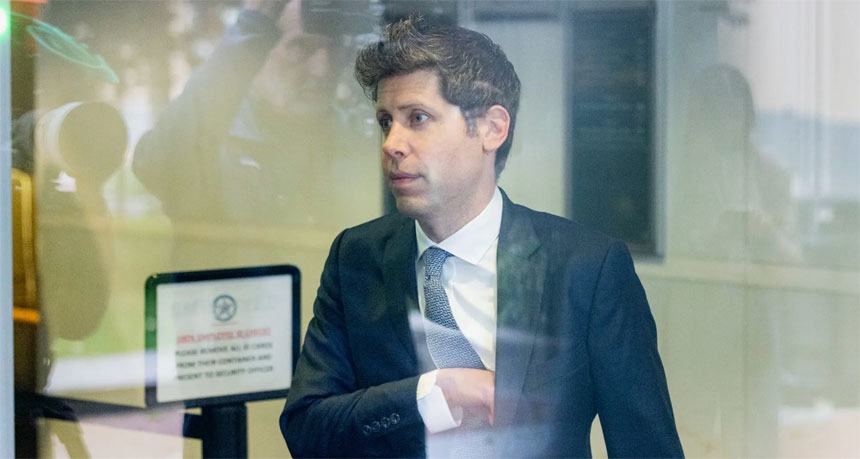
San Francisco-based OpenAI has been valued at $730 billion in the private market after a funding round this year. [Its CEO is in the picture above.
Its public offering can set a lucrative string of tech company offerings in a major year of IPOs for Silicon Valley.
Rival Anthropic, which is raising money at a $900 billion valuation, has also taken steps to go public.
And Elon Musk’s SpaceX, which has valued itself at more than $1 trillion, is on track to go public next month.
“An IPO boom would probably unleash a flood of generational wealth, creating the world’s first trillionaires and cementing the riches of a set of Silicon Valley tech executives who are already billionaires. It would also bring a bonanza to A.I. company employees, as well as to Wall Street banks and others,” wrote The New York Times.
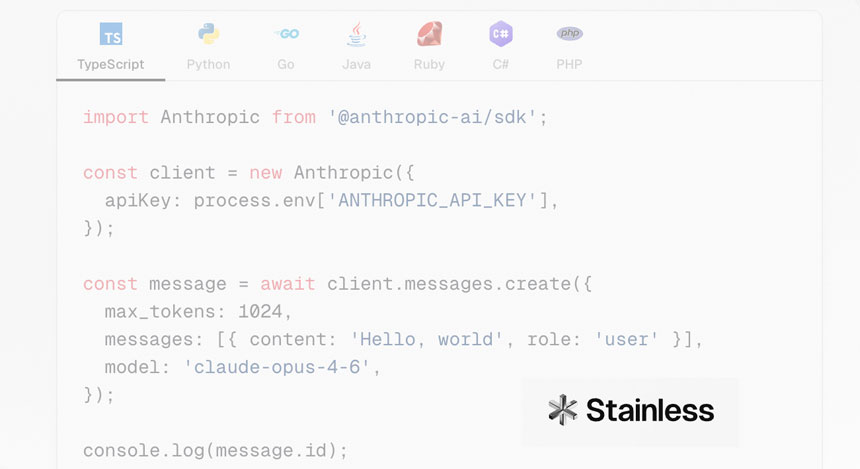
Anthropic acquired Stainless this month, a leading firm specialized in SDKs and MCP server tooling, a transaction that takes place in a context where AI models are shifting from models that answer to agents that act.
Analysts estimated that Anthropic paid over $300 million for this company, which is backed by Sequoia Capital and Andreessen Horowitz, although the official terms of the deal were not disclosed.
Founded in 2022 and based in New York, Stainless has powered Anthropic’s SDK since the earliest days of its API.
Many companies rely on Stainless to generate SDKs, CLIs, and MCP servers—the libraries, command-line tools, and connectors developers use to interact with APIs.
Stainless turns an API spec into SDKs across TypeScript, Python, Go, Java, and more. Stainless’s software is also widely used by rivals OpenAI and Google, as well as others such as Replicate, Runway, and Cloudflare.
Going forward, the Stainless tools will only be available to Anthropic, not its competitors.
Therefore, the acquisition will take a key infrastructure supplier out of the hands of Anthropic’s competitors.
“Agents are only as useful as what they can connect to. We’re excited to bring the Stainless team into Anthropic to advance Claude’s ability to connect to data and tools,” said Katelyn Lesse, Head of Platform Engineering at Anthropic — a company that created MCP to make agent connectivity possible.
Pope Leo XIV has sparked a global conversation on how to handle AI from a moral perspective.
The Pontifex tried to inject Catholic moral values into a secular American industry that is transforming the world at lightning speed.
“Crucial questions impose themselves on our conscience and can no longer be avoided: Where are we going? Toward what goal do we wish to orient ourselves? What direction should we choose as a people and as a human community?” Leo wrote.
After being a major critic of immigration crackdowns and war, challenging, without intending to, the political leadership of his home country, Pope Leo XIV has added AI to that list, taking on Silicon Valley.
Leo, the first pope from the United States, called on Monday for A.I. to be “disarmed,” similar to the church’s support for nuclear disarmament, meaning “freed from logics that turn it into an instrument of domination, exclusion and death,”he explained in a speech at the Vatican.
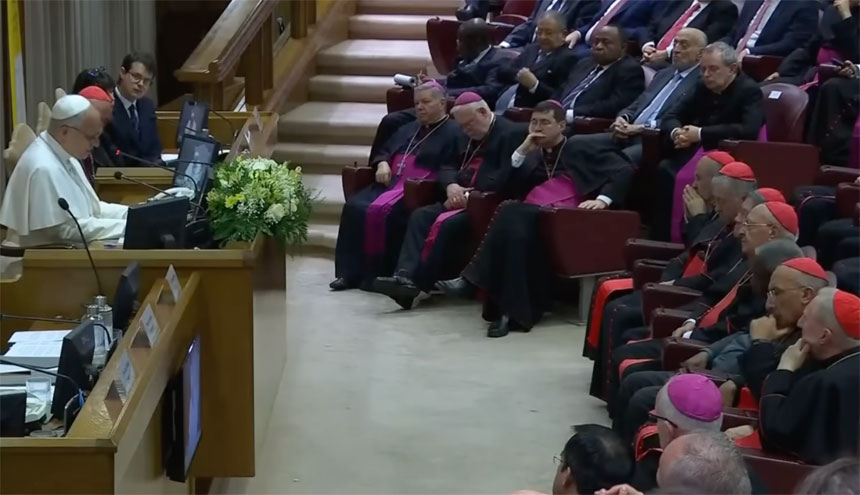
The launch event for the encyclical document was attended by high-powered AI pioneer Christopher Olah [in the picture above], a co-founder of Anthropic, which is pursuing a trillion-dollar valuation.
For the Pope, the way forward must involve collaboration, said Cardinal Blase Cupich of Chicago.
Leo opened his remarks with a special thank you to Mr. Olah, almost as if he were a head of state. “In turn, in the name of the church, I accept your invitation to walk together to listen and to speak and together to find the way for humanity in this time of artificial intelligence,” Leo said.
Church leaders under Pope Francis regularly held meetings called the “Minerva Dialogues” with technology leaders to discuss AI developments. Pope Francis met with the Group of 7 leaders in 2024 and urged regulation and called for a ban on lethal autonomous weapons.
Leo’s document, called an encyclical, is in many ways a culmination of that effort.
“At key moments in history, the Church is called to decipher the ‘new things’ in the light of the Gospel and the dignity of the human being,” Leo said. “Today we find ourselves facing a transformation of similar magnitude, with perhaps even greater consequences.”
Catholic universities in the U.S., including Georgetown and Santa Clara, have taken significant steps to advance the conversation about AI and Catholic moral values in academic and public circles.
The University of Notre Dame received a $50 million grant from the Lilly Endowment in December to develop faith-based ethical frameworks for AI through its Institute for Ethics and the Common Good.
In a stark warning and global alarm, Pope Leo XIV called for action during an explosive speech at the Vatican yesterday.
Marking a rare break from papal tradition, the Pontifex unveiled his first encyclical, Magnifica Humanitas, at the Vatican, warning that artificial intelligence “needs to be disarmed to prevent domination, exclusion, and threats to humanity.”
Speaking at the Aula Nuova del Sinodo, the pope urged global cooperation to ensure AI serves peace, justice, and the common good. The landmark address compared the AI revolution to the industrial transformations the Church faced over a century ago.
The encyclical Magnifica Humanitas (or “Magnificent Humanity”), on the protection of the human person in the age of artificial intelligence, was signed by the Holy Father on May 15, 2026, the 135th anniversary of Pope Leo XIII’s encyclical Rerum Novarum (known in English as “Rights and Duties of Capital and Labor.”)
Here are some of Leo’s themes in the encyclical:
• AI is fundamentally not human.
We must avoid the misconception of equating this type of “intelligence” with that of human beings. These systems merely imitate certain functions of human intelligence. In doing so, they often surpass human intelligence in speed and computational capacity, offering tangible benefits across many fields. Yet this power remains entirely tied to data processing. So-called artificial intelligences do not undergo experiences, do not possess a body, do not feel joy or pain, do not mature through relationships, and do not know from within what love, work, friendship, or responsibility mean.
Leo describes the field of artificial intelligence as swiftly evolving, and with real promise as a “valuable tool.” But he emphasizes throughout the text that, on a profound level, artificial intelligence is not human, however closely it approximates the human mind and even its soul.
This view clearly differentiates between machines and humans. It directly counters a view of some A.I. researchers and thinkers, including some in the room who have recently raised questions about whether A.I. systems may actually feel or express human emotion.
• Humane labor practices and just wages remain essential.
The various kinds of job insecurity, fragmented career paths, and automation must not be evaluated solely in terms of efficiency, but in relation to the dignity of the worker, the right to sufficient remuneration, and the genuine possibility of participating in society.
AI has already displaced many entry-level jobs, and while the full scope of its impact is far from clear, the mass automation of both white-collar and blue-collar work is likely to significantly reshape most sectors of the labor market.
Echoing many of his predecessors, including Pope John Paul II, Leo acknowledges that economic and technological systems may undergo radical upheavals over the course of history, but insists that the essential dignity of the worker — which includes fair wages — must remain at the center of any new order.
In another section, he condemns “new forms of slavery” connected to the digital economy, including the young people who work for minimal pay in jobs like data labeling and content moderation, and the even younger ones who labor under dangerous conditions extracting the rare earth materials the industry requires: “The bodies of these people are scarred, injured and worn down so that computational flow may continue uninterruptedly.”
• No technology can take away the dignity of ordinary human beings.
We are living through a rapid phase of transition, a “change of era,” in which — while some are vying for the future of new technologies and others dedicate themselves to reflecting on the matter — most people are watching and waiting, observing from afar and merely hoping for the best.
The Vatican invited people from Silicon Valley to the formal introduction of the encyclical on Monday, including, notably, Christopher Olah, a co-founder of Anthropic, who participated in the presentation.
But the encyclical itself reminds readers that the aspiring history-makers in the room are not the only ones who have worth. Most of the world’s population will simply have to live with the fallout of how those leaders steward this technological revolution. “Magnifica Humanitas” insists that each of those people “observing from afar” matters.
“The value of persons, however, does not depend on what they achieve or produce,” Leo writes elsewhere in the text. “There are rights that apply to everyone simply by virtue of being human.” The document uses the word “dignity” 100 times.
• Beware the temptation of erecting a new Tower of Babel.
With the heart of a shepherd and a father, I ask everyone to abandon the construction of yet another Tower of Babel and to join forces in building up the common good, so that humanity will never lose its beauty, and the world once again will come to recognize the human heart as the place where God desires to dwell.
The biblical story of the Tower of Babel recurs as a touchstone. The account appears in the Book of Genesis and describes a world in which a unified human population that speaks only one language decides to build a tower “whose top reaches to the heavens” to exert its own power and domination.
In response, God scatters the people across the earth, in what serves as an origin story for the existence of different languages and cultures.
Leo uses the Tower of Babel as an illustration of the pitfalls of pursuing uniformity and standardization, and the limits of ambitious undertakings that appear able to compete with the claims of religion. As many aspects of global culture homogenize, and technology becomes a kind of universal language, Leo’s call for humility and diversity stands in contrast. It’s also a reminder that many of the seemingly new ethical and social challenges posed by A.I. have ancient roots.
• The pope cites research and makes concrete recommendations.
In recent years, psychological and psychiatric literature has documented with growing insistence how early and unsupervised exposure to digital devices and social media can negatively impact sleep, attention span, control of emotions and relationships, especially during the most vulnerable stages of life, at times with tragic consequences.
For all its sweeping moral force, “Magnifica Humanitas” is also a practical document, showing how Leo is focused on pastoral care for the church’s hundreds of millions of families. It surveys research on the impact of technology on child development, including how early and unsupervised access to cellphones leaves children vulnerable to addiction, bullying, and sexual exploitation. Other topics include the regulation of data ownership and the use of A.I.-related weapons in war.
• Human life is beautiful.
For this reason, humanity — in all its grandeur and woundedness — must never be replaced or surpassed. We can embrace technological progress that alleviates suffering and unlocks new possibilities, provided we do not abandon the very essence of our humanity, namely, the capacity for relationship and love.
The title of “Magnifica Humanitas” says it all: In the end, Leo is less interested in technology than in humanity. Humans are flawed, vulnerable, and finite, the pope writes. We are increasingly inferior to the technology we have created if we measure only in cold terms of performance. But the pope writes with great affection for humans. The text ends with a wish “that we may bear witness to the grandeur of humanity, in which God has made his dwelling.”
Humanity, created by God in all its grandeur, is today facing a pivotal choice: either to construct a new Tower of Babel or to build the city in which God and humanity dwell together. In Jesus Christ, this humanity in its grandeur becomes the Way, the Truth and the Life, opening…
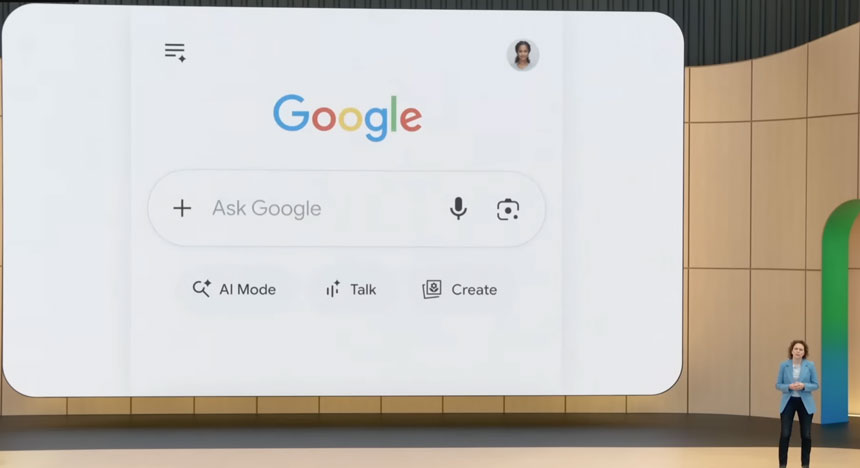
Using the Gemini 3.5 Flash model, Google is increasing its search box size and making it more interactive so that people can ask even longer questions, upload photographs and videos into queries, and ask follow-up questions.
It’s the first overhaul of its iconic search bar in 25 years, since 2001, prompted by the rise of AI.
In addition to adding a chatbot on the main search page, Google will also offer digital assistants, or agents, to automate searches.
For example, someone apartment hunting can be notified of a new listing without opening the real estate website Zillow.com.
Google’s CEO, Sundar Pichai, said at the company’s annual developer conference in Mountain View, Calif., this month, “When people use our AI in search, they use search more.”
This move shows that Google has solidified its position as an AI heavyweight.
In addition to its Gemini models, it is producing AI chips and pouring hundreds of billions of dollars into data centers for its cloud computing business.
Its Gemini app, which can do coding and research, now has 900 million active users — about the same number as ChatGPT.
Analysts say that these changes are helping Google make more money from advertising. Last year, Google’s ad clicks rose 6 percent, and it charged 7 percent more for each click. The company’s annual profit has more than doubled since 2022 to $132 billion.
On searches that deliver AI Overviews, people can ask follow-up questions in AI Mode, which Mr. Pichai called “a revelation.”
Google is also bringing one of AI’s biggest breakthroughs — software coding — to search.
Google said it was introducing an alternative to the agents powered by Anthropic’s Claude Code and OpenAI’s Codex.
Called Gemini Spark, the service is embedded in Gmail, Docs, and other Google products, where it can turn meeting notes spread across emails and chats into a single document. It can also read and draft emails.
Google’s AI-driven shopping cart will also recommend discounts when products go on sale and warn people when they select items that could be incompatible.
Koray Kavukcuoglu, the chief technology officer at Google DeepMind, the company’s AI lab, said that “plugging Gemini into Google’s products will help the company stay ahead of competitors by providing information about users’ needs.”
OpenClaw users will once again be able to enjoy their Claude AI subscription to power the open-source, autonomous, AI-agentic harness.
Anthropic announced via its official developer communications account on X, @ClaudeDevs, a new subcategory of “Agent SDK” credits for all paid subscribers, which they can now allocate specifically for “programmatic” uses, including external third-party agents such as OpenClaw.
Starting June 15, paid Claude plans can claim a dedicated monthly credit for programmatic usage.
The credit covers usage of:
– Claude Agent SDK
– claude -p
– Claude Code GitHub Actions
– Third-party apps built on the Agent SDK
The move is a major reversal of Anthropic’s policy introduced in early April 2026, which expressly prohibited its AI subscriptions from powering these kinds of non-Anthropic agents.
The problem was that some Claude subscribers were paying $20 to $200 per month for Anthropic’s Claude Pro and Max subscriptions, but consuming hundreds, even thousands, of dollars’ worth of tokens at prices above those through their OpenClaw and similar autonomous agents.
This was unsustainable for Anthropic’s finances and its limited compute infrastructure.
Rather, Anthropic redirected users to pay through the company’s application programming interface (API), which is billed by usage (priced per million tokens, rather than a flat monthly rate as the subscriptions offer), or to pay for extra usage credits on top of their subscriptions.
Now, Anthropic is giving Claude subscribers another way to use their subscription bill to pay for third-party agents.
However, if the user doesn’t use these new Agent SDK credits, they simply expire at the end of the month.