Category: Top News

  • International Enrollments Drop 43% in the U.S. Due to the Global Pandemic

    International Enrollments Drop 43% in the U.S. Due to the Global Pandemic

    IBL News | New York

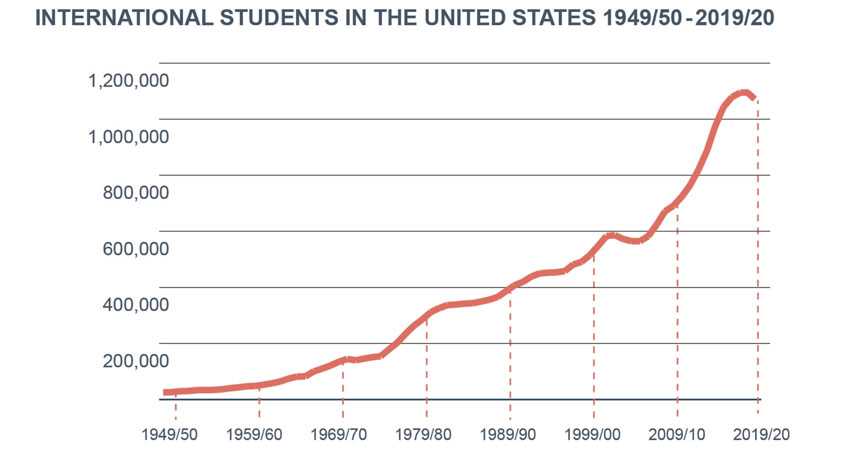
    COVID-19 pandemic’s impact on international students has resulted in a drop of 43% in international enrollments in the U.S. At least 40,000 students have deferred enrollment to a future term.

    These findings come from a survey conducted by IIE (Institute of International Education) and nine partner associations in 700 colleges.

    • The majority of responding institutions report increasing virtual recruitment through online events and asynchronous or synchronous virtual campus visits.
    • Over half is leveraging current international students, online recruitment, social media, EducationUSA, and international partnerships for outreach and recruitment.
    • Fifty-six percent of institutions are recruiting international students at U.S. high schools. Approximately half are prioritizing overseas recruitment in China, Vietnam, and India.

    The IIE is convinced that when international travel resumes, there will be a surge of students that have deferred or set their plans aside.

    International students contributed $38.7 billion to the U.S. economy in 2019-20.

  • Unizin’s Consortium Partners with Blackboard to Offer Ally to its 14 Member Institutions

    Unizin’s Consortium Partners with Blackboard to Offer Ally to its 14 Member Institutions

    IBL News | New York

    The Unizin university consortium announced last month a partnership with Blackboard to offer Ally (Blackboard Ally) to its 14 member institutions [in the graphic above].

    “Blackboard will also implement learning data interoperability standards in Ally to integrate learning data to the Unizin Data Platform (UDP), enabling institutions to build effective data-driven practices at scale,” explained the learning company in a press release.

    “Now more than ever with digital learning tools usage at an all-time high, it is critical that all students have equitable access to course resources,” said Cathy O’Bryan, Chief Executive Officer of Unizin.

    Ally integrates LMSs, automatically checking digital course content for accessibility issues, and generating alternative formats of instructor content “using advanced Machine Learning algorithms.”

    Unizin started its trajectory as a consortium with a partnership with Canvas LMS, later on exploring other educational technologies. Its alliance with Blackboard is a win for the learning company amid the loss of business in favor of Canvas LMS.

  • About Half of the US Says that More Training Doesn’t Result in a Better Job

    About Half of the US Says that More Training Doesn’t Result in a Better Job

    IBL News | New York

    Half of Americans (52%) don’t believe a good job is within their reach, a 46% say that the hiring and advancement system isn’t fair. Similar shares of Americans cited a lack of employer support for training.

    These are the main findings of a national survey of 21,000 people conducted by Strada Education Network and Public Viewpoint about the impact of the pandemic in the U.S.

    Another relevant conclusion points to the fact that a quarter of Americans without a college degree said more education and training would make no difference in their ability to get a good job or advance in their career.

    “Americans’ skepticism about their ability to advance professionally is deeply concerning,” said Dr. Dave Clayton, Senior Vice President at Strada’s Center for Education Consumer Insights. “People need a clearer understanding of how education can lead to a good job for them.”

    Among Americans considering an education in the next six months, 44% prefer work-based learning, nontraditional online training programs, or employer training over college programs.


  • Educause Analyzes How Higher Education Institutions Will Emerge from the Pandemic

    Educause Analyzes How Higher Education Institutions Will Emerge from the Pandemic

    IBL News | New York

    Educause released its report 2021 Top IT Issues: Emerging from the Pandemic, intended to guide higher education leaders use technology.

    This year, the institution offers three lists, examining the top 5 issues within three scenarios of restore, evolve, and transform.

    “For some institutions, the pandemic will indeed be an extinction event. Others will strive to evolve, and our data suggest that many of those will incorporate some transformational elements and will also try to restore their previous financial health or cultures. But the pandemic will lead other institutions to reinvent themselves and, in doing that, contribute to higher education’s epigenetic change.”

    “2021 will require that the higher education industry and its leaders answer the difficult questions and start moving forward to emerge from this pandemic—by restoring, evolving, and/or transforming.”

    Educause identified several potential Top IT Issues for 2021.

    Scenario 1: Restore. Figuring out what to do to get back to where we were before the pandemic.

    #1: Cost Management
    Reducing institutional costs and increasing workforce efficiency through process redesign and automation, data and analytics, and other technology solutions

    #2: Online Learning
    Strengthening online and hybrid education by providing on-demand support for course development and delivery and advocating for processes, policies, and support structures to increase student and institutional readiness

    #3: Financial Health

    Revising budget models and IT governance to preserve critical IT operations and capacities in the face of institutional financial challenges

    #4: Affordability and Digital Equity

    Providing increased support for students’ technology needs and enabling technology availability from anywhere, particularly off campus

    #5: Information Security

    Providing information security leadership that supports faculty, students, and staff returning to campus, while being budget-conscious and ensuring a safe and secure recovery

    Scenario 2: Evolve. Focusing on adapting to the new normal.

    #1: Student Success
    Advancing student support services to help students attain their academic and career goals by integrating data systems, user interfaces, policies, and guided pathways

    #2: Equitable Access to Education
    Providing technologies, support, and policies for diverse users and equitable access to bridge the digital divide and reduce equity gaps

    #3: Online Learning
    Progressing from emergency remote teaching and learning to online learning by advancing best practices in technology-enabled teaching and learning

    #4: Information Security
    Developing a cybersecurity operations strategy that effectively detects, responds to, and mitigates security threats regardless of where students, faculty, and staff are located

    #5: Financial Health
    Partnering with advancement, research, and other institutional areas to develop new funding sources and partnerships

    Scenario 3: Transform. Focusing on redefining our institution and taking an active role in creating the innovative future of higher education.

    #1: Institutional Culture
    Contributing to a culture of transformation by modeling agility and future thinking when designing IT programs and services

    #2: Technology Alignment
    Identifying and applying sustainable digital strategies and innovations that are driven by the institution’s ambitions and transformational goals

    #3: Technology Strategy
    Developing an enterprise architecture to enable business outcomes, manage data to enable decision-making and future opportunities, streamline business processes, and enable digital resources to keep pace with strategic change

    #4: Enrollment and Recruitment

    Exploring and implementing creative holistic solutions for recruitment, including analytics-based marketing around student career outcomes, technology-enabled transfer agreements and partnerships, and use of social media to build student communities

    #5: Cost Management

    Focusing digital transformation efforts and IT service delivery on helping the institution maximize value and reduce overhead.
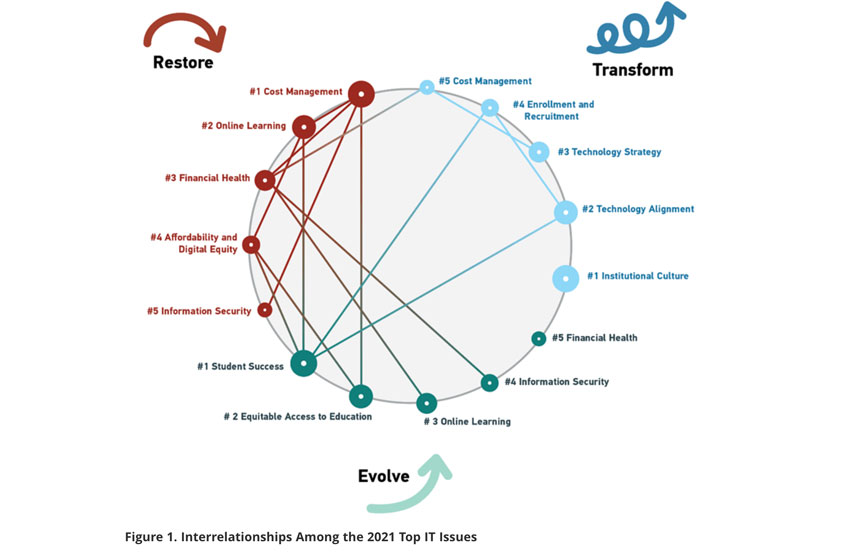


    Infographic Download

     

  • Thomas Edison State University Backs with College Credit Two MicroBachelors Programs on edX.org

    Thomas Edison State University Backs with College Credit Two MicroBachelors Programs on edX.org

    IBL News | New York

    Thomas Edison State University (TESU) announced that it will now offer college credit for Western Governors University‘s MicroBachelors program “Introduction to Information Technology” and for Doane University’s “Marketing Essentials,” through edX.org.

    “By recognizing MicroBachelors programs for credit, we are creating yet another diverse and alternative method to gain access to a relevant and affordable undergraduate education,” said Dr. Merodie A. Hancock, president, Thomas Edison State University.

    edX’s MicroBachelors programs are designed to assist nontraditional students like adults without college degrees who need additional education to advance in their careers. These online programs provide a pathway to a full bachelor’s degree and are offered at a price between $500 and $1,500 (roughly $166 per credit).

    “TESU joins us in providing credit and pathways to full TESU bachelor’s degrees and in signaling to employers that the MicroBachelors programs are rigorous enough to be credit grade and equip learners with applicable knowledge,” said Anant Agarwal, CEO at edX. “As an institution providing credit for MicroBachelors programs on edX, the first credit-backed stackable credential, Thomas Edison State University plays an integral role in the launch of these innovative programs.”

    In addition to credit on MicroBachelors, TESU said that it plans to offer a few of its own courses through the edX platform.


  • Udacity Raises $75M in Debt and Announces It’s Now Profitable

    Udacity Raises $75M in Debt and Announces It’s Now Profitable

    IBL News | New York

    Udacity.com announced this month that it secured $75 million in the form of a debt facility, with Hercules Capital (NYSE: HTGC) serving as the underwriter.

    In addition, the Mountain View, California–based learning company said it has reached profitability. “Q3 enterprise and government bookings rose by 120% year-over-year, total bookings increased 80% year-over-year, and ARR increased 260% in H1 2020.”

    “Our clients clearly understand that investing in current talent, versus hiring from the outside, has proven to be a far more effective way to accelerate their digital transformation strategy,” said Gabe Dalporto, CEO of Udacity. “This new financing will help us continue to scale and provide global workers with the skills they need to future-proof their careers.”

    On the other hand, Udacity forecasted how the online education landscape will look like in 2025 with the changes brought by COVID-19:

    • There will be increased educational program options and accessibility. This will solve one of the biggest challenges faced in higher education: accessibility — both financially and physically.
    • There will be alternatives to traditional degrees. Employers are placing more emphasis on skills, not degrees.
    • Greater incorporation of next-generation technologies such as augmented reality, artificial intelligence (AI), and virtual reality. Much of online education has relied on a model more focused on solo study. However, there will be a more hands-on learning experience, group socialization and social platforms, user-generated content, and video conferencing.


  • SUNY Announces Remote Instruction Until February, Along with Mandatory Tests and Masks-Wearing

    SUNY Announces Remote Instruction Until February, Along with Mandatory Tests and Masks-Wearing

    IBL News | New York

    The State University of New York system (SUNY) announced Sunday that it is canceling its spring break and also requiring all students to be tested for COVID-19 if they return to campus for in-person learning on February 1st. In addition, masks-wearing will be mandatory at all times, even amid social-distancing.

    SUNY–which includes 64 colleges in the State of New York–said in a public statement that its “aggressive strategy gives the institution the best chance to return students to classrooms in early 2021.

    Jim Malatras, Chancellor at SUNY, explained that its “comprehensive plan” was intended “to keep this virus at bay throughout the flu season and through the spring semester.”

    Several schools at SUNY suffered COVID-19 outbreaks, especially after infections at large parties.

    The institution ensured that it conducted over 370,000 coronavirus tests since August, with a positive rate of .48 percent.

    In addition to testing before returning to campus, all students will be forced to quarantine for seven days prior to their arrival. Students will be given mid-week breaks from instruction in place of the week-long spring break that is usually taken.


  • View: A New Learning Platform During Pandemic Times? The Must-Have List of Features

    View: A New Learning Platform During Pandemic Times? The Must-Have List of Features

    IBL News | New York

    Traditionally, the U.S. educational system has been slow to evolve, and the COVID-19 pandemic has exposed that weakness.

    At pre-pandemic educational shows and conferences, keynote speakers often joked that if Benjamin Franklin were to have visited our country today, the only place he would recognize would be the school classroom.

    But the classroom has changed overnight, and LMS platforms haven’t been incapable to evolve for the new teaching environment.

    Instructors must radically rethink how to efficiently engage students. The shift from face-to-face to remote teaching requires a non-legacy, new generation, pedagogically–robust Learning Management Systems (LMS). It is not about managing the classroom but coping with the new demands of education.

    Your new learning platform or ecosystem should be the foundational rock that supports the new learning environment.

    These are seven key chapters to consider when choosing the right learning platform to deliver an effective, rock-solid experience in this new challenging time.

    1. Simplified, user-friendly, and scalable access for students, enhanced with Single Sign-On (SSO) authentication. Interactive and easily accessible, downloadable, offline-viewable content.
    2. Easy to use CMS for instructors, not needing to be tech-savvy, and avoiding any dependence on the IT department. Admin dashboard.
    3. Mobile friendly, elegant, and visually distinctive UI-UX enhanced platform.
    4. Course catalog website, learner portal, landing pages, along with integration with other LMS and applications within the university or business organization.
    5. Social-learning powered platform, enriched with digital, blockchain-based, and career-advancement ready credentials.
    6. Data-driven and AI analytics dashboard, plug-and-play interoperability with other systems, and Student Information Systems (SIS).
    7. Backed by a reliable, experienced–check its portfolio of customers–and forward-thinking LMS supplier and partner, who provides robust post-implementation technical support and is able to optimize the platform with the latest pedagogical innovations. Consulting service review and recommendations.


  • Google Introduces New Analytics with Machine Learning and Predictive Models

    Google Introduces New Analytics with Machine Learning and Predictive Models

    IBL News | New York

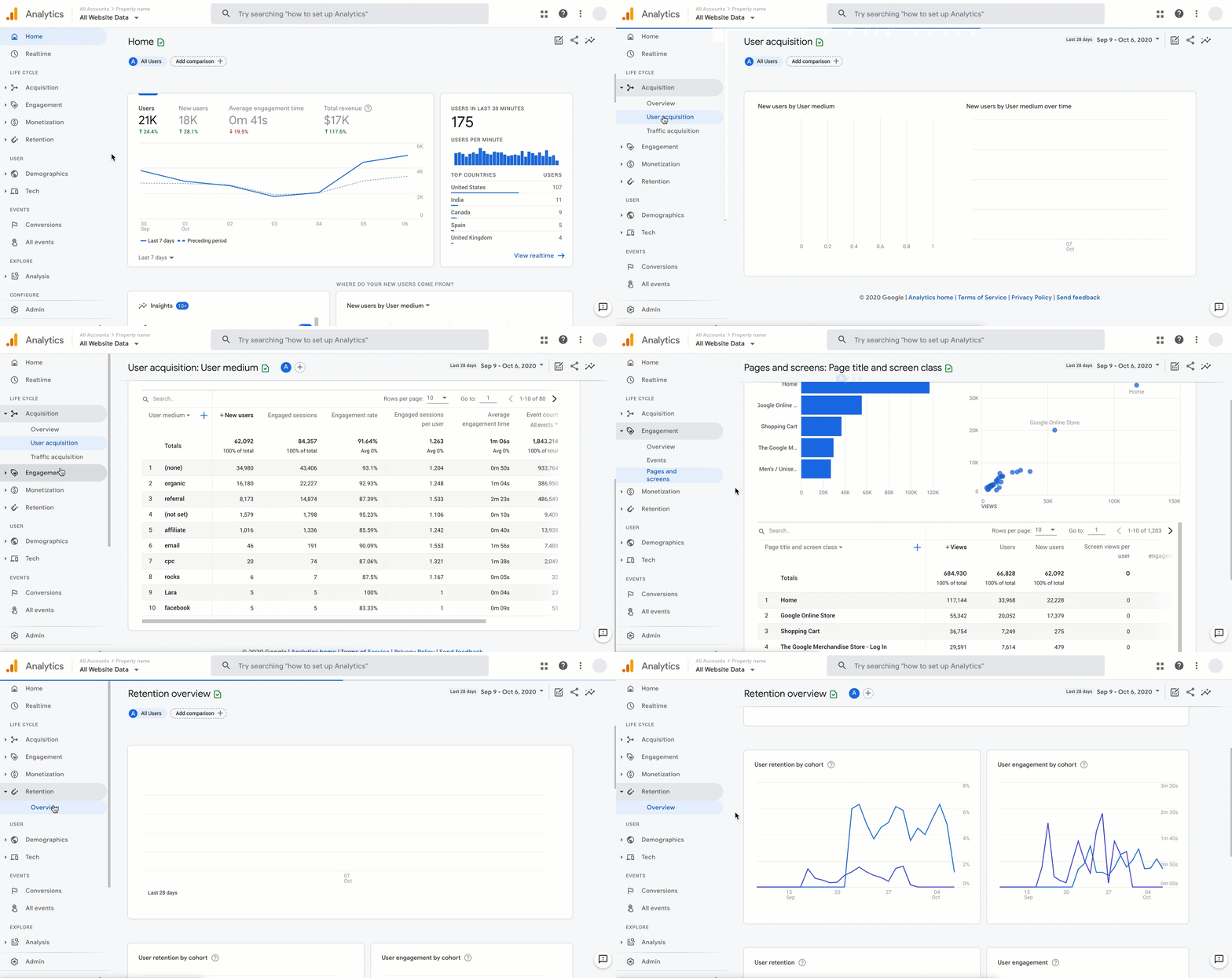
    Google announced the introduction of its new Google Analytics with machine learning at its core, which is privacy-centric by design. They are built on the foundation of the App + Web property presented last year.

    The goal of the giant searching company is “to help users to get better ROI and improve their marketing decisions.” It follows what a survey from Forrester Consulting points out that improving the use of analytics is a top priority for marketers.

    The machine learning models include will allow the ability to alert on trends in data, like products seeing rising demand, and help to anticipate future actions from customers. “For example, it calculates churn probability so you can more efficiently invest in retaining customers at a time when marketing budgets are under pressure,says in a blog-post Vidhya Srinivasan, Vice President, Measurement, Analytics, and Buying Platforms at Google.

    It also adds new predictive metrics indicating the potential revenue that can be earned from a particular group of customers. “This allows you to create audiences to reach higher-value customers and run analyses to better understand why some customers are likely to spend more than others, so you can take action to improve your results,” wrote Vidhya Srinivasan.

    The new Google Analytics provides customer-centric measurement, including conversion from YouTube video views, Google and non-Google paid channels, search, social, and email. The setup works with or without cookies or identifiers.

    They come by default for new web properties. In order to replace the existing setup, Google encourages to create a new Google Analytics 4 property (previously called an App + Web property). Enterprise marketers are currently using a beta version with an Analytics 360 version with SLAs and advanced integrations with tools like BigQuery.


    Resource:
    • Introduction to Google Analytics 4 for Higher Education Institutions

  • EdX Introduces Its New ‘For Business Subscription’ Initiative

    EdX Introduces Its New ‘For Business Subscription’ Initiative

    IBL News | New York

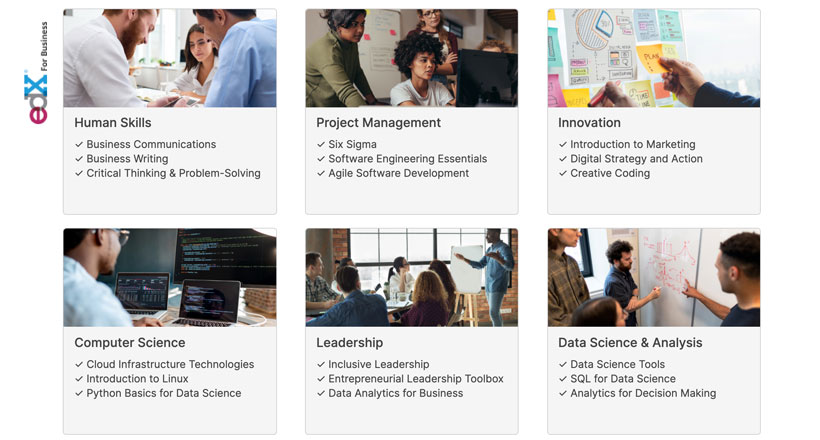
    EdX introduced in October its new edX For Business Subscription initiative. It offers unlimited access to hundreds of self-paced, and on-demand courses and professional certificates for a flat yearly rate ($349 per user).

    The service is aligned with competitors such as Coursera for Business, Udemy for Business, or Pluralsight, among others.

    EdX For Business facilitates the creation of skills pathways and integrates with native platforms, along with Degreed, EdCast, SuccessFactors, and Cornerstone.

    The MIT and Harvard-backed nonprofit highlights that their courses are backed by the science of learning: “EdX courses are backed by science of the McGovern Brain Institute and are carefully designed to motivate and engage learners, and maximize long-term learning benefits.”