Category: Top News

  • OpenAI Valued at $300 Billion after Closing $40 Billion In Funding

    OpenAI Valued at $300 Billion after Closing $40 Billion In Funding

    IBL News | New York

    OpenAI announced on Monday that it closed a $40 billion funding round, the largest private amount raised by a private tech company.

    The $40 billion financing valued the ChatGPT owner at $300 billion. This valuation puts OpenAI only behind SpaceX at $350 billion and TikTok.

    The financing round included $30 billion from SoftBank and $10 billion from a syndicate of investors, including core investor Microsoft and Coatue, Altimeter, and Thrive.

    According to a blog post, OpenAI plans to use the fresh capital to “push the frontiers of AI research even further” and scale its compute infrastructure.

    About $18 billion of the funding is expected to be used for OpenAI’s commitment to Stargate, the joint venture between SoftBank, OpenAI, and Oracle, which President Trump announced in January.

    The initial funding will be $10 billion, followed by the remaining $30 billion by the end of 2025. However, in an updated disclosure on Monday, SoftBank said that its total investment could be slashed to as low as $20 billion if OpenAI doesn’t restructure into a for-profit entity by Dec. 31.

    The pulling into a for-profit conversion will need the approval of Microsoft and the California Attorney General. Elon Musk, who was one of the co-founders of OpenAI in 2015, when it was started as a non-profit research lab, challenged in court this effort of OpenAI.

    On the other hand, OpenAI CEO Sam Altman announced yesterday that the company is planning to release its first open-weight language model with reasoning capabilities since GPT-2 in the coming months.

    The generative AI market is poised to top $1 trillion in revenue within a decade. Companies from Google and Amazon to Anthropic and Perplexity are racing to announce new products and features, especially as the race to build “AI agents” intensifies.

  • Columbia University Replaced Its President as the White House Threatened Funding

    Columbia University Replaced Its President as the White House Threatened Funding

    IBL News | New York

    Dr. Katrina Armstrong, president of Columbia University, left her post this Friday after her leadership threatened $400 million in federal funding. She was Columbia’s third leader since August 2024, when the university became a hub of a campus protest movement against the war in Gaza and the Israelis.

    Claire Shipman, a journalist with two degrees from Columbia and co-chair of the university’s board of trustees, was named the acting president and replaced Dr. Katrina Armstrong.

    One week before this abrupt replacement, Columbia University bowed to a series of White House demands, and no resignations seemed involved.

    However, a leaked revelation pointed to comments from Dr. Armstrong at a faculty meeting last weekend saying privately that the school would not stick to some of its agreements with the Trump administration.

    Following this punitive approach at Columbia, the Trump Administration is now threatening to end the funding of billions of dollars to several universities across the country. Many colleges are facing inquiries from agencies that range from the Justice Department to the Department of Health and Human Services.

    DEI Scrutiny

    • Two days before Columbia announced its decision, the government said it would withhold about $175 million in funding to the University of Pennsylvania because the school allowed a transgender woman to be a member of its women’s swim team in 2022.

    • Last week, the University of Michigan announced it will close its diversity, equity, and inclusion (DEI) office due to recent executive orders from President Trump and funding uncertainty. The institution had spent $250 million on DEI efforts through last fall and had 163 DEI personnel.

    This DEI closure announcement comes as federal funding for schools has been under scrutiny by Trump.

    Antisemitic Scrutiny

    Another focus from the Trump Administration is what is considered antisemitic activity on campus following the October 7, 2023, Hamas attacks on Israel. On March 10, the White House warned 60 institutions that they risk losing federal government funding.

    Moreover, nineteen of those academic institutions are under investigation for antisemitism by the Trump administration, according to Reuters.

    “Universities are experiencing distress because they don’t even know the nature and extent of the allegations against them,” said Lynn Pasquerella, president of the advocacy group American Association of Colleges and Universities (AACU).

    Secretary of Education Linda McMahon said Jewish students at “elite U.S. campuses” are in fear for their safety. “American colleges and universities benefit from enormous public investments funded by U.S. taxpayers. That support is a privilege contingent on scrupulous adherence to federal antidiscrimination laws.”

  • OpenAI’s Studio Ghibli Style Generated Images Flood Social Media with Memes

    OpenAI’s Studio Ghibli Style Generated Images Flood Social Media with Memes

    IBL News | New York

    AI-generated memes in the style of Studio Ghibli—the cult-favorite Japanese animation studio behind films such as “My Neighbor Totoro” and “Spirited Away”—are flooding social media, forcing OpenAI to put a rate limit on image generation requests, according to CEO Sam Altman.

    “It’s super fun seeing people love images in ChatGPT, but our GPUs are melting,” he posted on X today.

    The newly improved image generation of GPT-4o, released this week, is resulting in creations that are more realistic than before, and even users can take them in any number of directions.

    Usually, users upload existing images and pictures into ChatGPT and ask the chatbot to recreate them in new styles. OpenAI’s and Google’s latest tools make it easier than ever to re-create the styles of copyrighted works — simply by typing a text prompt.

  • Mistral Releases an Open Source Model that Outperforms Gemma 3 and GPT-4o Mini

    Mistral Releases an Open Source Model that Outperforms Gemma 3 and GPT-4o Mini

    IBL News | New York

    Paris–based Mistral AI unveiled Mistral Small 3.1, a new multimodal open-source model. According to the company, it is “the best model in its weight class ” and “outperforms comparable models like Gemma 3 and GPT-4o Mini.

    Released under an Apache 2.0 license, Mistral Small 3.1 has an expanded context window of up to 128k tokens and a delivery inference speed of 150 tokens per second.

    Experts say that Mistral Small 3 is competitive with larger models such as Llama 3.3 70B or Qwen 32B and replaces opaque proprietary models like GPT4o-mini.

    Mistral Small 3 can be fine-tuned to specialize in specific domains, creating highly accurate experts. This is particularly useful in fields like legal advice, medical diagnostics, and technical support, where domain-specific knowledge is essential.

    This model sets the stage for increased competition in a market dominated by U.S. tech giants. Mistral’s open-source approach highlights a growing divide in the AI industry between closed, proprietary systems and open, accessible alternatives.

    After raising $1.04 billion, founded in 2023 by former researchers from Google DeepMind and Meta, Mistral AI has rapidly established itself as Europe’s leading AI startup, with a valuation of approximately $6 billion. While impressive for a European startup, this valuation remains a fraction of OpenAI’s reported $80 billion.

    Mistral Small 3 Human Evals

    Mistral Small 3.1 joins the company’s rapidly expanding suite of AI products.

    Earlier this month, the company introduced Mistral OCR, an optical character recognition API that converts PDF documents into AI-ready Markdown files. This addresses a critical need for enterprises seeking to make document repositories accessible to AI systems.

    These specialized tools complement Mistral’s broader portfolio, which includes Mistral Large 2 (their flagship large language model), Pixtral (for multimodal applications), Codestral (for code generation), and “Les Ministraux,” a family of models optimized for edge devices.

  • OpenAI Integrates New Image Generation Capabililty Into ChatGPT

    OpenAI Integrates New Image Generation Capabililty Into ChatGPT

    IBL News | New York

    OpenAI released an advanced image generator for GPT‑4o this week.

    The San Francisco-based research lab announced that this improvement in image generation is now native to GPT-4o, allowing users to refine images through natural conversation.

    “GPT‑4o can build upon images and text in chat context, ensuring consistency throughout. For example, if you’re designing a video game character, the character’s appearance remains coherent across multiple iterations as you refine and experiment,” explained the company.

    This initial release is available across ChatGPT Plus, Pro, Team, and Free subscription tiers. The free tier’s usage limit is the same as three images per day with DALL-E.

    This model is considered a step change from previous models as it uses GPT-4o unimodal, a foundation that can generate data, including text, images, audio, and video.

  • Google Gemini’s Latest Feature: Canvas, an Interactive Space for Refining Documents and Code

    Google Gemini’s Latest Feature: Canvas, an Interactive Space for Refining Documents and Code

    IBL News | New York

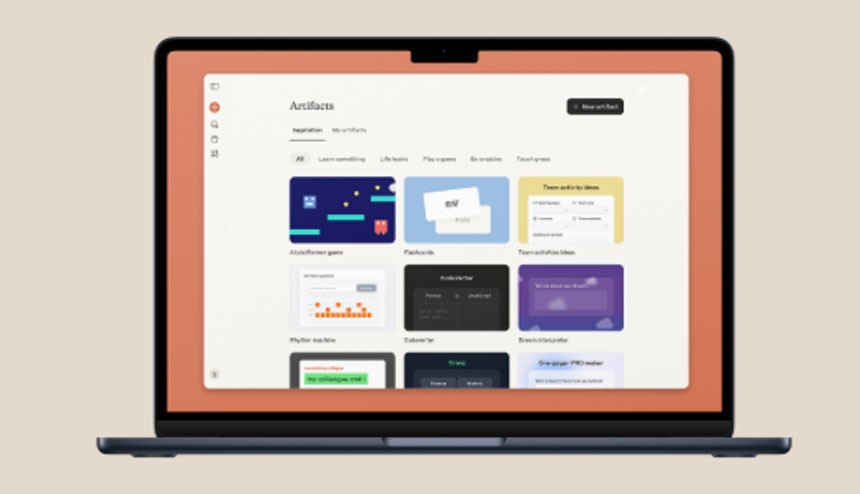
    Google added this week a dedicated workspace to its Gemini chatbot called Canvas, an identical name used by OpenAI for the same feature – and similar to Anthropic’s Artifacts.

    It’s an interactive space where users can refine documents, create and debug code, and share writing and coding projects while using Gemini’s feedback to suggest edits and adjust the tone, length, or formatting.

    Canvas also streamlines the process of transforming coding ideas into working prototypes for web apps, Python scripts, games, simulations, and other interactive apps.

    It can also generate and preview HTML/React code and other web app prototypes to visualize the design, such as a website’s email subscription form.

    This feature works by selecting Canvas in the prompt bar and start creating. Google created a dedicated website.

    Gemini’s Canvas includes the Audio Overview of NotebookLM, which went viral last year. It transforms users’ files into realistic-sounding podcast-style discussions between two AI hosts, with audio summaries of documents, web pages, and other sources.

    Uploading a document via the prompt bar triggers the Audio Overview shortcut. Once a summary is generated, it can be downloaded or shared via the Gemini app on the web or mobile.

    Gemini Canvas

  • DeepSeek Releases a New Iteration of Its Model, MIT-Licensed

    DeepSeek Releases a New Iteration of Its Model, MIT-Licensed

    IBL News | New York

    The Chinese AI lab DeepSeek released the latest version of the flagship chat: DeepSeek V3, a 685-parameter model.

    This iteration, named DeepSeek-V3-0324, came with an MIT open-source license, while the previous one had a custom license.

    The release added up to a total of 641 GB of files,

    The new model was also listed on OpenRouter.

    The chat can be tried at openrouter.ai/chat?models=deepseek/deepseek-chat-v3-0324:free.

  • Microsoft Announces Two Sales AI Agents In Competition with Salesforce

    Microsoft Announces Two Sales AI Agents In Competition with Salesforce

    IBL News | New York

    Microsoft will launch Sales Agent and Sales Chat in May, two AI sales agents accessible in Microsoft 365 Copilot and designed to work with Microsoft Dynamics 365 and Salesforce.

    The software giant also introduced a new program intended, in part, to help businesses “migrate off legacy CRM vendors,” without citing Salesforce by name in that case.

    Microsoft wants to “empower every employee with a Copilot and transform every business process with agents” and “apply this ambition to sales, the revenue engine for every business.”

    • Sales Agents can work autonomously by researching and identifying potential customers, setting up meetings, and contacting and following up on leads. It can complete some basic sales independently. The agents gather information from customer databases and CRM and company data like pricing sheets, the web, and Microsoft 365—such as emails and meetings—to personalize every response.
    • Sales Chat gives sales reps summaries, actionable takeaways, and insights from CRM data, pitch decks, meeting notes, emails, and the web. It works with simple prompts like “Give me a list of deals that are at risk of falling through,” “What should I know going into tomorrow’s meeting with this customer?” or “Help me create a plan to close this deal.”

    Meanwhile, Salesforce announced its updates to Agentforce on Wednesday morning, dubbed “2dx”.

    Its CEO, Marc Benioff, has criticized Microsoft’s AI initiatives while rolling out Salesforce’s competing Agentforce platform.

    Benioff has called Microsoft a “reseller of OpenAI.” He also criticized Microsoft’s Copilot, comparing it to the infamous “Clippy” assistant and suggesting it exposes user data to security risks.

    Oracle, IBM, and ServiceNow are among the other major companies developing and offering agentic AI technology for sales and business applications.

  • Columbia University Conceded to Trump Administration Demands

    Columbia University Conceded to Trump Administration Demands

    IBL News | New York

    Columbia University agreed yesterday to the Trump administration’s list of demands to start negotiations on restoring $400 million in federal funding for medical and scientific research projects.

    On March 7, the U.S. Government canceled the university’s federal grants, accusing the New York-based institution of “inaction in the face of persistent harassment of Jewish students.”

    The Trump administration had ordered the school to implement a mask ban at protests, discipline protesters, and reform admissions, among other demands.

    Columbia University was seen as the epicenter of student-led pro-Palestinian demonstrations that overtook life at college campuses nationwide.

    Yesterday, the institution agreed to ban students from wearing masks at protests, hire 36 new campus security officers who will be able to arrest students and appoint a new senior vice provost to oversee the Department of Middle East, South Asian, and African Studies.

    Columbia also committed to “greater institutional neutrality” and “working with a faculty committee to establish an institution-wide policy implementing this stance.” The university added that it will review its admissions procedures to “ensure unbiased admission processes,” as the Trump administration requested.

    On Thursday, 41 of the roughly 100 members of the university’s history department warned the university against allowing the administration to interfere in its policy. They compared the administration’s actions to attempts by “authoritarian regimes” to seek control over independent academic institutions.

    Amid the negotiations over the grants, federal immigration officials apprehended at least two Columbia students who participated in the student-led protest, including 30-year-old Mahmoud Khalil. A doctoral student from India, Ranjani Srinivasan, also fled to Canada after her student visa was revoked.

  • Trump Signed Order Aimed at Shutting Down the U.S. Department of Education

    Trump Signed Order Aimed at Shutting Down the U.S. Department of Education

    IBL News | New York

    President Trump signed a long-awaited executive order on Thursday that begins the process of dismantling the U.S. Department of Education, fulfilling a longstanding campaign promise to conservatives.

    The order is designed to leave school policy almost entirely in the hands of states and local boards, a prospect that alarms liberal education advocates.

    Surrounded by schoolchildren seated at desks in the East Room of the White House, President Trump cited poor test scores as a key justification for the move.

    He instructed Education Secretary Linda McMahon to begin shutting down her agency. According to Article I of the Constitution, this task cannot be completed without congressional approval.

    However, Trump also said Thursday that the department would continue to provide critical functions required by law, such as administering federal student aid, including loans and grants, funding special education and districts with high levels of student poverty, and continuing civil rights enforcement.

    Since taking office, Trump has slashed the department’s workforce by more than half and eliminated $600 million in grants.

    “This is political theater, not serious public policy,” said Ted Mitchell, the president of the American Council on Education, an association that includes many colleges and universities in its membership. “To dismantle any cabinet-level federal agency requires congressional approval, and we urge lawmakers to reject misleading rhetoric in favor of what is in the best interests of students and their families.”

    Lawyers for supporters of the Education Department anticipated they would challenge Mr. Trump’s order by arguing that the administration had violated the Constitution’s separation of powers clause and the clause requiring the president to take care that federal laws are faithfully executed.

    Senator Bill Cassidy, a Louisiana Republican who chairs the chamber’s Health, Education, Labor and Pensions Committee, said he would submit legislation to eliminate the Education Department.

    “I agree with President Trump that the Department of Education has failed its mission,” Cassidy said.

    “Since the department can only be shut down with congressional approval, I will support the president’s goals by submitting legislation to accomplish this as soon as possible.”

    Under the Biden administration, the department was criticized as being deferential to teachers’ unions and overreaching on specific issues, such as student loan forgiveness and its interpretations of civil rights laws on behalf of transgender students.